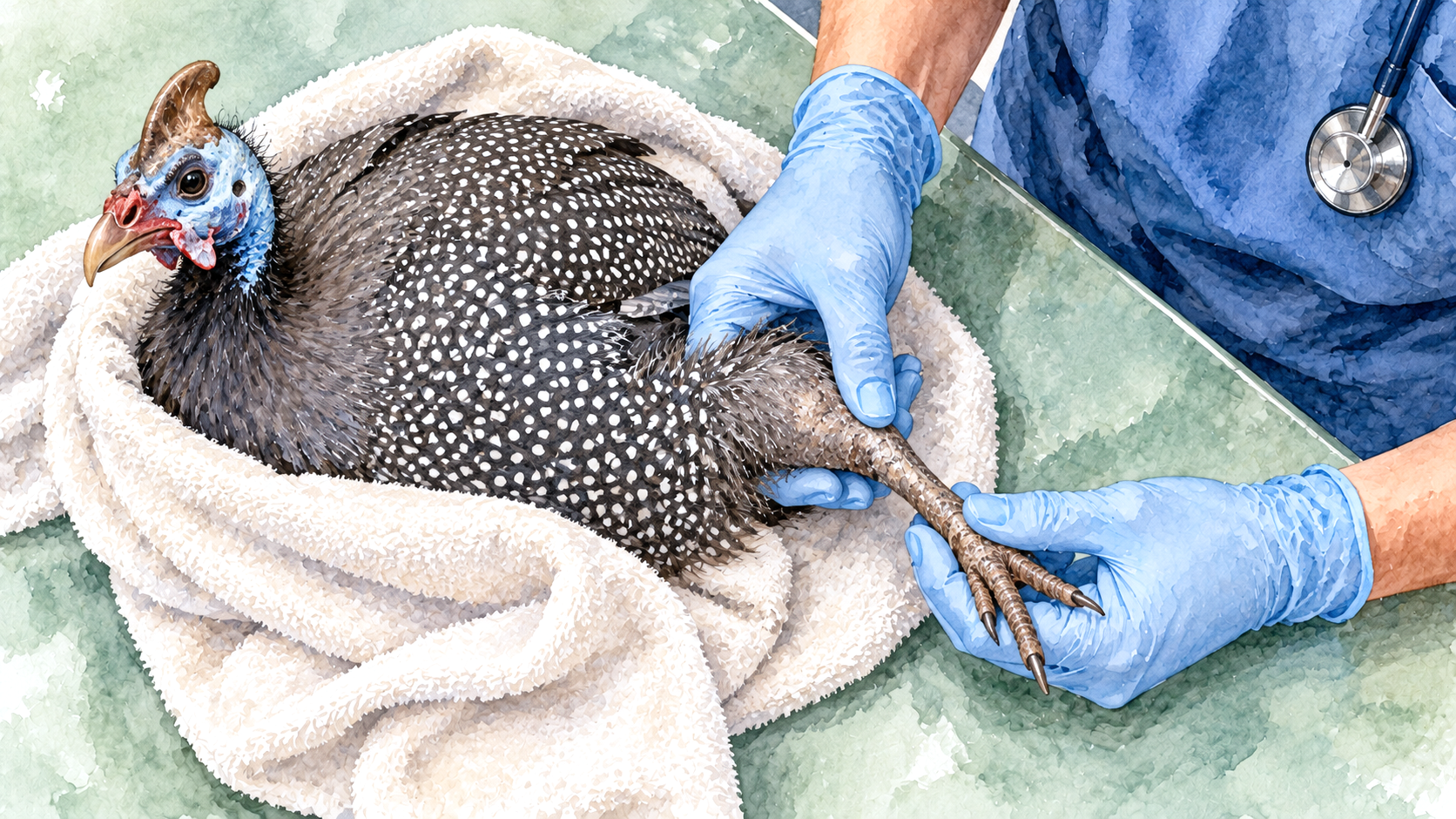
A guinea fowl that suddenly holds up one leg, cannot stand or has a leg positioned at an unusual angle may have a fracture. These birds can panic and struggle when approached, so trying to make one walk or repeatedly picking it up can turn a potentially manageable injury into a more serious one.
If you suspect your guinea fowl has broken a leg, restrict its movement immediately, protect it from other birds and contact a poultry-experienced veterinarian for prompt examination. Do not try to straighten the limb or make a homemade splint. An apparent break could also be a dislocation or another injury, and the correct treatment depends on the precise location and extent of damage.
How Can You Tell if a Guinea Fowl Has Broken Its Leg?
A fracture may follow a fall, collision, entanglement, predator encounter or other accident. Some birds make a sudden distress call and stop putting weight on a leg, while others hide or sit silently. An obvious change in the limb’s shape is especially concerning, but not every break causes visible deformity.
| Possible sign | What it means for your next step |
|---|---|
| Refuses to bear weight on one leg | Restrict movement and seek veterinary assessment |
| Leg bent or hanging at an unusual angle | Suspect serious injury; do not reposition it |
| Swelling, bruising or marked pain | Avoid manipulation; arrange examination |
| Visible bone or wound over the suspected break | Emergency veterinary care |
| Unable to stand, collapsed or breathing abnormally | Emergency stabilization and transport |
These signs cannot establish a fracture without examination. A veterinary assessment of backyard poultry considers breathing, alertness and general stability as well as the affected limb. Other explanations for a guinea fowl unable to walk also need consideration when the cause is unclear.
What Should You Do Immediately?
First, prevent further chasing, jumping or struggling. If the bird is being pecked or crowded, move flockmates away or secure a temporary barrier. Prepare a small, quiet enclosure or carrier before attempting to move the bird, so it will not need to be carried around while arrangements are made.
Approach calmly and support the body rather than pulling on the injured limb. The principles of safely handling guinea fowl are especially important during an injury: keep the wings controlled without compressing the chest, which must expand for breathing. If the bird is trapped in equipment, avoid twisting its leg to free it. Seek veterinary guidance if removal could worsen the injury.
Place the bird on dry, non-slip bedding with no elevated perch. Make sure it has enough room to rest in a natural position but not enough space to build speed, launch into flight or repeatedly strike the enclosure. Do not attempt to test whether the injured leg still works by encouraging walking.
Should You Splint a Broken Guinea Fowl Leg at Home?
Do not apply a homemade splint without veterinary direction. Poultry legs contain several joints and bones close together, and a bandage positioned incorrectly can force the limb into a harmful alignment, restrict blood flow, create pressure sores or prevent normal movement of other joints.
The complexities of fractures in birds include fragile bones and injury patterns that require careful stabilization. Some fractures can be supported externally, whereas others need pins, specialized fixation or different approaches. A splint that looks secure from outside may still fail to immobilize the damaged bone.
Never pull a crooked leg straight, massage an apparently broken area or bind both legs together. If a veterinarian advises temporary support before transport, follow those exact instructions rather than adapting a technique intended for chickens or pet parrots.
What if the Bone Is Visible or the Skin Is Broken?
A wound over a suspected fracture raises concern about an open fracture, which requires emergency veterinary care because contamination and deeper tissue damage may be present. Avoid touching exposed bone, pushing it back under the skin or cleaning deep tissue with disinfectant.
If there is active bleeding and you can do so without manipulating the fracture, apply gentle direct pressure to an accessible bleeding area with clean gauze or cloth. Do not press directly onto exposed bone or attempt to remove embedded objects. The emergency principles for bleeding and traumatic injuries in birds emphasize stabilization and prompt professional evaluation.
Keep the affected limb protected from dirt and additional contact while arranging immediate transport. Do not use glue, tape directly on a wound or household peroxide to seal or clean a suspected open fracture.
How to Keep the Bird Safe While Awaiting the Veterinarian
Quiet confinement reduces repeated loading of the injured leg. Keep the bird away from dominant guinea fowl, pets and predators, and avoid slick flooring that forces it to scramble. A towel or suitable clean bedding on the bottom of a carrier can improve grip without creating loose loops that catch toes.
Provide appropriate shelter and ventilation. An injured bird may become chilled, but excessive heat is also dangerous; maintain comfortable conditions and watch for panting or labored breathing. The stabilization priorities for birds with traumatic injuries place overall survival and respiratory stability ahead of detailed manipulation of damaged tissue.
If the guinea fowl is alert and swallowing normally, place food and water within reach without requiring it to stand. Do not force water or food into a weak or unresponsive bird. The general care of injured guinea fowl also involves monitoring for shock or problems beyond the damaged leg, but suspected fractures require particular restraint of movement.
How Will a Veterinarian Confirm a Broken Leg?
The veterinarian will first check the bird’s overall condition, including breathing, circulation, pain and other injuries. Once it is stable enough to be examined, the clinician may assess the limb and use radiographs to locate a break, identify dislocation and determine whether more than one bone or a joint is involved.
The diagnostic approach to avian trauma notes that radiographs help distinguish fractures from joint dislocations. A bird that is unstable or extremely stressed may need initial stabilization before imaging or other procedures. That is one reason to avoid repeatedly examining the leg at home.
Not every break is obvious on inspection, and a leg that looks straight can still be fractured. Timely professional assessment improves the opportunity to choose an appropriate treatment before swelling, pressure injury or further displacement complicates recovery.
What Veterinary Treatment Might Be Needed?
Treatment depends on fracture location, whether skin is broken, the bird’s overall health and the stability of the injury. Some fractures can be managed with professionally fitted external support and restricted activity. More complicated breaks may require specialized fixation, surgery or other interventions. The options for stabilizing fractured avian bones cannot be selected reliably without examination.
A veterinarian may also prescribe appropriate pain relief and decide whether antibiotics are indicated for an open or contaminated injury. Human painkillers, livestock products and leftover poultry medications should not be given on your own. Guinea fowl may supply meat or eggs, and U.S. rules for extra-label animal drugs include veterinary oversight and applicable food-residue precautions.
Discuss the expected follow-up, how long confinement should continue, what signs of a tight or displaced dressing require a call, and whether the bird will be able to perch or move normally after healing.
How to Transport a Guinea Fowl With a Suspected Fracture
Use a secure, ventilated carrier with a low ceiling and stable, non-slip floor. The bird should be able to rest without being thrown against the sides but should not have space to flap forcefully or jump. Remove perches and unsecured objects.
Lift only as much as necessary to transfer the bird, supporting its body and avoiding pressure on the damaged leg. Keep the carrier level, secure it during the drive and avoid loud noise or abrupt movement. The transport advice for injured birds emphasizes reducing stress and preventing further injury.
Call before leaving so the veterinary clinic knows the bird may have a fracture and can advise on urgent precautions. Note when the injury was first observed and whether there was a fall, predator encounter or equipment entrapment. Photographs may be helpful if they can be taken without handling or delaying transport.
What Can Make a Suspected Fracture Worse?
Repeated attempts to make the guinea fowl stand or exercise can shift damaged bone and injure surrounding tissue. High roosts, slippery surfaces and flockmates that peck or chase an injured bird create additional risks. The effect of roost placement on guinea fowl safety matters when deciding which elevated equipment to remove during confinement.
An overly tight wrap can interfere with circulation, while an improvised rigid splint may place pressure against a vulnerable joint. Do not let a bird with a suspected fracture roam free in the belief that exercise will help it heal. Follow veterinary instructions for activity restriction and any later return to normal movement.
When Is a Broken Leg an Emergency?
A suspected fracture deserves prompt veterinary evaluation, and an open wound with exposed bone, significant bleeding, collapse, difficulty breathing, severe distress or inability to remain upright calls for emergency care. A bird attacked by a predator may have crushing injuries and infection risks beyond the leg.
If other guinea fowl are also suddenly collapsing or unable to walk, do not assume each has an isolated fracture. The signs that suggest serious illness in guinea fowl may indicate a shared environmental or infectious problem requiring a different response.
Questions About a Broken Guinea Fowl Leg
Can a guinea fowl survive a broken leg? Yes, some fractures can heal with timely veterinary care. Recovery depends on location, severity, tissue damage and overall health.
Can a guinea fowl still stand with a fracture? Sometimes. Being able to bear some weight does not rule out a broken bone.
How do I know whether the leg is broken or dislocated? Appearance alone may not distinguish them. A veterinarian may need radiographs.
Should I make a splint from sticks or cardboard? No. An incorrectly positioned splint can cause further injury or compromise circulation. Seek veterinary direction.
Can the bird stay with its flock? Keep it protected from jumping, chasing and pecking while the injury is evaluated. A separate secure enclosure is usually safer.
How long does a broken guinea fowl leg take to heal? Healing varies with the bone, fracture type, treatment and bird’s condition. Your veterinarian should establish the follow-up schedule.
Can I give a guinea fowl ibuprofen or acetaminophen? Do not administer human pain medicine without explicit veterinary instructions; safety and legal restrictions must be considered.