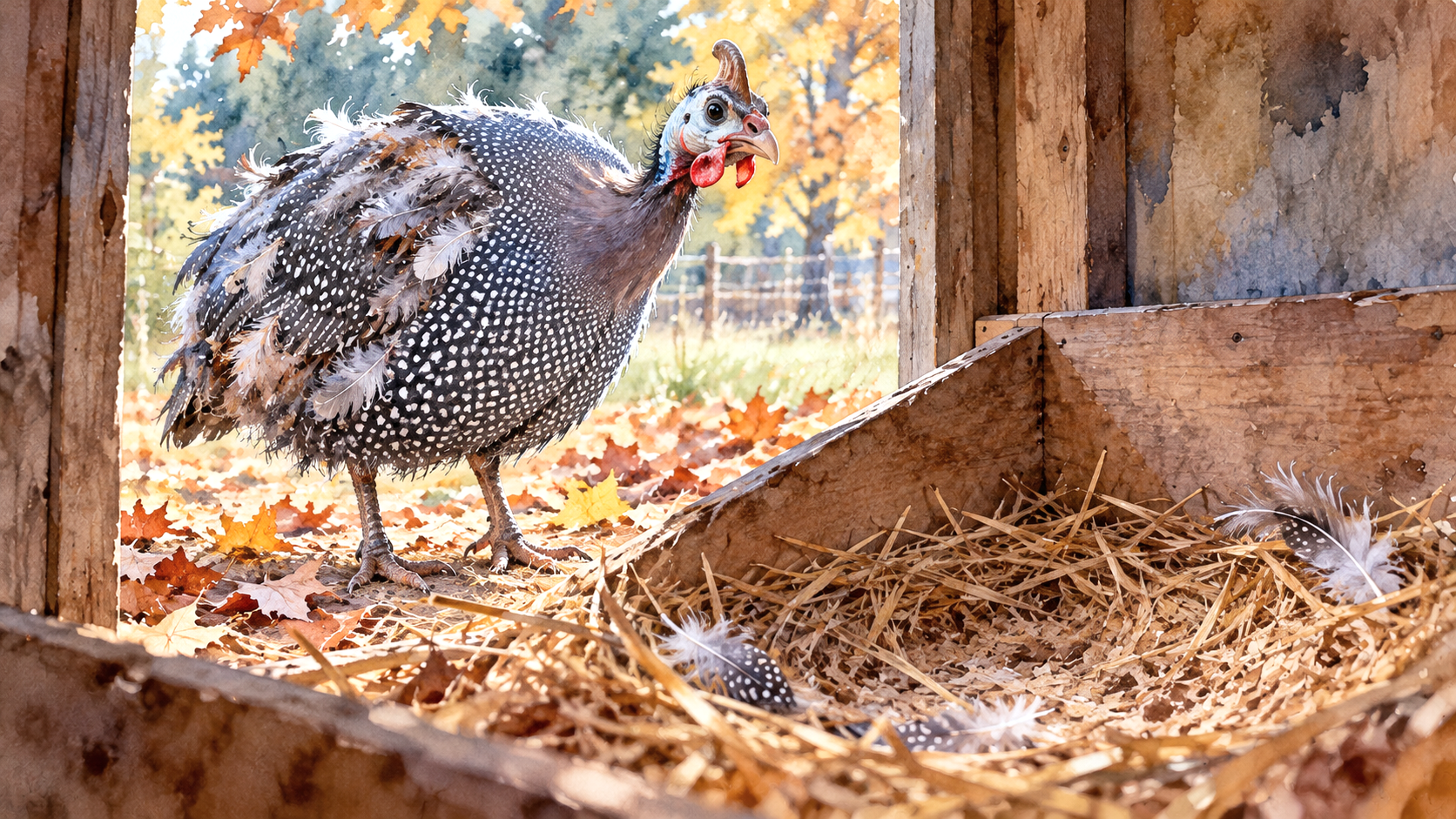
An empty guinea fowl nest does not necessarily mean the hens have stopped producing eggs. A flock that provided eggs throughout early summer may be responding to shorter days, while a hen that suddenly disappears for several hours may have chosen a different nesting location. Changes in feed, flock activity, health or broodiness can also interrupt production.
Guinea fowl most commonly appear to stop laying because their breeding season is ending, they have become broody, or their eggs are being laid somewhere else. If production drops unexpectedly during the active season, investigate feed and water access, recent stress, environmental conditions and possible illness before assuming the change is normal.
The timing and circumstances matter more than the number of eggs missing on any single day.
Start by Checking Whether the Hens Have Actually Stopped
The first question is whether egg production has declined or simply become harder to observe. Guinea hens frequently select concealed ground nests, particularly when they have access to vegetation and secluded areas.
Several hens may share a nesting location, creating the impression that all have stopped when the group begins laying elsewhere. Eggs may also disappear because of predators, damage or collection by someone else.
The nesting habits of free-ranging guinea fowl make collected egg totals an imperfect measure of production. Finding no eggs in the coop is therefore not proof that the reproductive cycle has stopped.
Look for changes in where the hens spend their time, especially repeated visits to sheltered ground. Avoid chasing birds through vegetation or repeatedly disturbing suspected nests. The practical techniques for finding hidden guinea fowl eggs are distinct from diagnosing a genuine interruption.
If eggs are still being produced, improving access to safe, familiar nesting places may solve the collection problem without attempting to change the birds’ reproductive activity.
Shorter Daylight Hours Can End the Laying Season
Guinea fowl are naturally seasonal layers. In much of the United States, breeding and egg production are most active during spring and summer, when days are longer.
As daylight decreases through late summer and autumn, reproductive activity commonly declines. An Extension response specifically addressing guinea hens that stopped laying identifies shorter days as a likely explanation and notes that hens often return to production when daylight increases.
The typical natural laying season for guinea fowl may extend from March or April into October, although local climate and management affect the dates.
If several otherwise healthy hens gradually stop producing as autumn approaches, seasonal change is a stronger explanation than a sudden flock-wide nutritional problem. This is especially likely when the birds have outdoor access and no supplemental lighting.
Artificial lighting can alter reproductive activity, but recommendations developed for laying chickens should not be copied automatically for guinea fowl. A carefully designed lighting program must preserve appropriate rest periods and should be discussed with a poultry specialist rather than used to force production from an exhausted or unhealthy flock.
A Broody Guinea Hen May Stop Producing Eggs
A guinea hen becomes broody when she shifts from laying eggs to incubating a clutch. She may remain on a nest for extended periods, leave only briefly to eat or drink and become defensive when approached.
Broodiness is a normal reproductive state, not necessarily a sign of illness. In small farm flocks, guinea hens may accumulate approximately 30 eggs before beginning incubation, although individual nesting behavior varies.
A broody hen will generally stop laying while she is committed to incubation. The timing of her return to production depends on her reproductive condition, the stage of the season and whether she subsequently cares for young.
Removing eggs does not guarantee an immediate return to laying. Some hens may abandon a nest and establish another location; unnecessary disturbance can also create stress.
If the bird is nesting safely, determine whether allowing natural incubation fits the farm’s management goals. A hen sitting in an exposed location may require special attention to predator risk, but moving or handling her should not be improvised without considering her welfare.
Sudden Stress Can Interrupt Egg Production
Stress can affect normal reproductive activity even when a hen appears physically healthy. Potential triggers include relocation, unfamiliar birds, predator disturbances, repeated chasing, crowding, extreme weather and abrupt changes to daily routines.
The effects of environmental stress on poultry egg production include reduced laying following disruptive conditions. Much of this research concerns chickens, so the precise duration and severity of a guinea hen’s response cannot be assumed identical. Nevertheless, stress is a plausible factor when egg collection declines immediately after a significant management change.
For example, introducing new birds may disrupt established relationships and interfere with feeding or resting. Persistent chasing and fighting among guinea fowl can create more than a temporary disturbance if particular hens cannot avoid aggressive flock members.
Look for the timing of the change. If egg numbers dropped shortly after a predator entered the run or the flock moved to new accommodation, address the source of disturbance before making unnecessary changes to feed or lighting.
Inadequate Feed or Water Can Reduce Laying
Egg production requires consistent access to energy, protein, calcium, other minerals and clean drinking water. A hen may reduce production if her diet is unsuitable or she cannot consume enough to meet her needs.
The nutritional causes of reduced poultry egg production include inadequate feed intake, nutrient deficiencies and interruption of water access. These principles are relevant to guinea fowl, although feed formulation must reflect their own species and reproductive needs.
Check whether the birds are receiving an appropriate complete ration rather than relying primarily on scratch grains, kitchen scraps or unpredictable forage. The nutritional requirements of adult guinea fowl also change with reproductive condition.
Inspect waterers for contamination, leaks, frozen water and inadequate capacity. In hot weather, birds may drink more and eat less; during winter, frozen equipment may restrict access even when the waterer appears full.
Do not attempt to restart laying by providing excessive calcium, vitamins or high-protein supplements without identifying a genuine deficiency. Correcting the underlying diet and water problem is more useful than adding several products at once.
Molting Can Redirect Energy Away From Eggs
Molting is the natural replacement of feathers. During a substantial molt, a bird must allocate nutrients and energy to producing new plumage, potentially reducing or stopping egg formation.
Seasonal changes and molting can overlap, making them difficult to separate. Normal feather replacement and reduced laying are closely associated in domestic poultry. Although the precise timing differs among species and individual birds, a healthy guinea hen replacing feathers may also show reduced reproductive activity.
Look for symmetrical feather replacement, emerging new feathers and otherwise normal behavior. Molting should not automatically explain bald patches, bleeding skin, persistent scratching or severe feather damage, which can indicate parasites, aggression or another problem.
A balanced diet and low-stress environment support feather replacement. Forced molting, food withdrawal or deliberate water restriction are inappropriate responses to a backyard guinea flock’s reduced egg output.
Illness and Parasites May Be Responsible
When production declines during favorable laying conditions, especially alongside changes in appetite, body condition or activity, illness becomes a more important possibility.
Internal parasites, external parasites, infections and reproductive disorders can affect poultry performance. The relationship between poultry health problems and reduced laying is well established, but egg loss alone cannot identify a particular disease.
Examine the flock’s overall condition without subjecting birds to repeated unnecessary restraint. Watch for lethargy, weight loss, abnormal droppings, breathing difficulty, lameness and changes in the appearance of the abdomen.
A guinea hen that is straining, weak, standing abnormally, breathing with difficulty or showing a swollen abdomen requires prompt veterinary assessment. Egg binding and other reproductive disorders can be serious. Do not squeeze the abdomen, insert objects into the vent or attempt home procedures to remove an egg.
If several birds become ill or deaths occur unexpectedly, contact a veterinarian and follow relevant state animal-health reporting requirements. A full evaluation of common guinea fowl diseases and health problems involves more than checking their laying records.
Can Age Explain a Sudden Drop?
Age can influence reproductive performance, but it is rarely the most useful explanation for an abrupt interruption affecting several hens at once.
Breeders may remain productive for several seasons, although their output and reproductive consistency can change over time. The breeding life of domestic guinea fowl may extend beyond their most productive years.
An older hen whose production has gradually declined over successive seasons presents a different situation from a previously productive young flock that stops laying within several days. The latter warrants investigation of season, nesting, nutrition, stress and health.
Record the ages of confirmed hens when comparing performance. The pattern of normal laying frequency during active production should not be confused with a persistent loss of eggs.
A Practical Troubleshooting Checklist
Use the timing and accompanying signs to narrow the possibilities rather than treating every empty nest as the same problem.
| What you notice | First explanation to consider |
|---|---|
| Egg numbers decline gradually as autumn days shorten | Seasonal reproductive slowdown |
| A hen spends long periods sitting in one place | Broodiness |
| Eggs disappear after birds begin using new outdoor areas | Hidden or changed nesting location |
| Production drops after a predator incident or flock relocation | Stress |
| Feed consumption, body condition or water access has changed | Nutrition or water problem |
| Birds are replacing substantial amounts of plumage | Molting |
| Reduced laying occurs with weakness, abnormal droppings or other illness signs | Disease or reproductive problem |
| One older hen has produced progressively fewer eggs over several seasons | Age-related reproductive change |
Start by confirming the number of actual females, the time of year and whether any eggs have been found outside the usual collection areas. Then review recent changes in feeding, housing, flock behavior and health.
Sex identification in adult guinea fowl can help establish how many laying birds should be present. A keeper who overestimates the number of hens may incorrectly conclude that production has dropped.
Avoid changing several management variables simultaneously. If food, housing and lighting are all changed at once, it becomes difficult to determine what caused the interruption or whether conditions have actually improved.
Questions About Guinea Hens That Stop Laying
Why did my guinea hens stop laying in September?
Shortening daylight and the approach of the end of the breeding season are common explanations. Hidden nests, broodiness, stress and illness remain possible, particularly when the change is abrupt.
Can guinea hens stop laying because they are scared?
Yes. A significant disturbance or repeated stress may reduce production. Removing the cause of stress and restoring stable conditions are more useful than attempting to force the birds to lay.
Will a broody guinea hen start laying again?
Often, but the timing varies. Her return to production depends partly on her reproductive state and the remaining season.
Do guinea fowl stop laying when they molt?
They may reduce or suspend laying during substantial feather replacement, especially when molting overlaps with seasonal reproductive changes.
Can poor feed cause guinea fowl to stop laying?
Yes. Insufficient feed intake or an unbalanced ration may compromise egg production. Water shortages can also cause substantial problems.
Should I add a male if my hens stop laying?
No. A male is needed to fertilize eggs, not to make hens produce them. Adding a male will not correct seasonal decline, poor nutrition, broodiness or disease.
How long can guinea hens go without laying?
Healthy hens may have an extended nonlaying period outside their reproductive season. A sudden interruption accompanied by illness or distress needs investigation regardless of how long it has lasted.