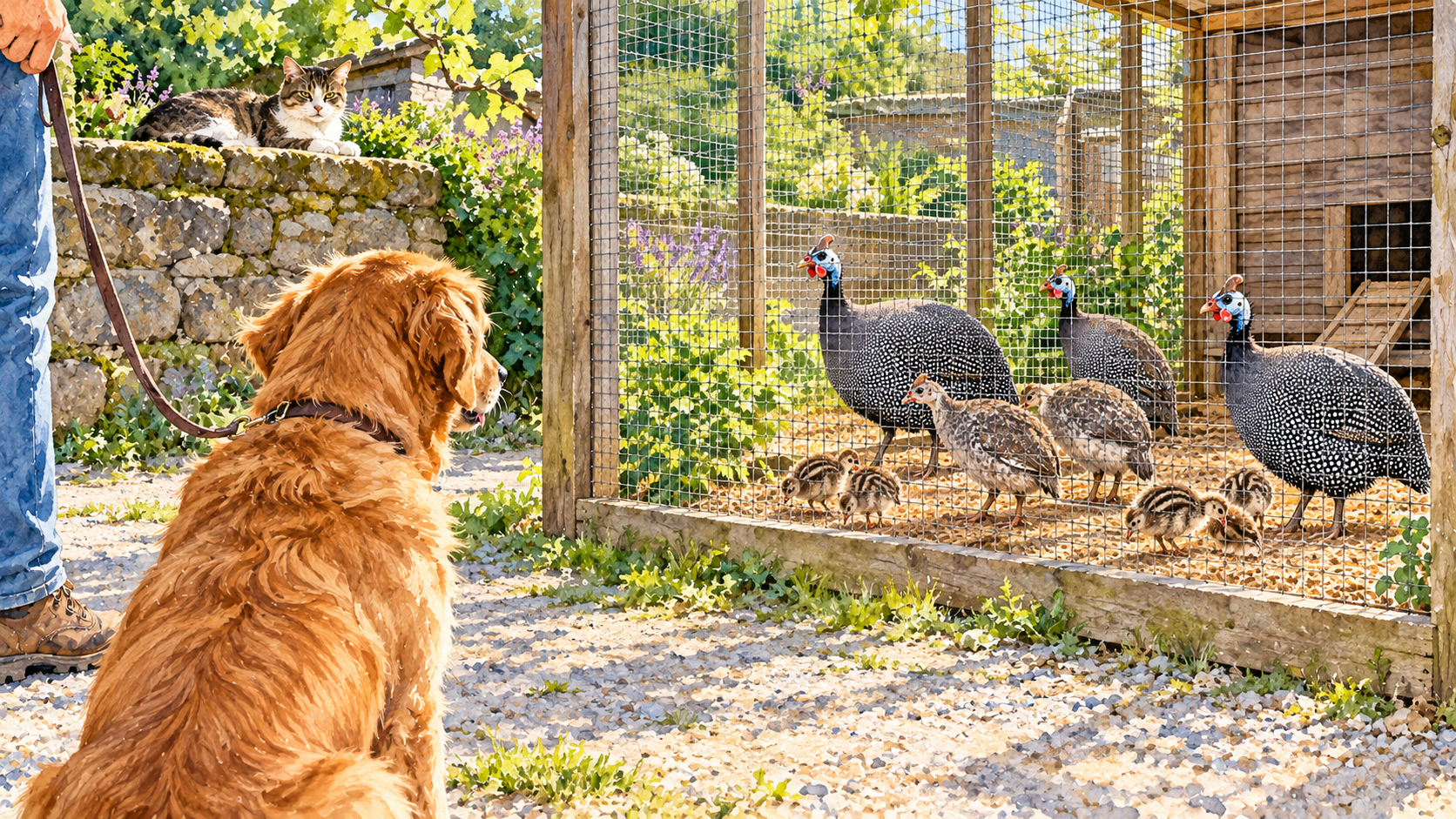
Guinea fowl can live on the same property as dogs and cats, but they should not automatically share an enclosure or be left together unattended. Some dogs learn to ignore poultry, while others chase or seize moving birds. Cats may stalk keets and can threaten smaller or vulnerable birds. Safe coexistence depends on the individual animal’s behavior and reliable physical separation, not simply how long the animals have known one another.
How Guinea Fowl Typically Respond to Dogs and Cats
Guinea fowl are alert, quick-moving birds that may call loudly, run or fly when alarmed. Their alarm calls can alert a keeper to disturbances, but they are not a substitute for protection. A bird that becomes frightened may trigger a chase even from a dog that previously seemed uninterested.
The extension guidance on poultry predator behavior identifies free-roaming domestic dogs as a significant risk and explains that breed tendencies, other dogs and previous experience can influence attacks. Cats are a separate concern, particularly where young birds are accessible.
Can Dogs Be Trusted Around Guinea Fowl?
A calm dog that responds reliably to cues may be manageable near a securely enclosed guinea fowl flock. That does not establish that the dog is safe loose among the birds. Staring, freezing, crouching, stalking, lunging, circling the enclosure or becoming difficult to redirect are warning signs that the distance is too small.
Excitement can escalate quickly when guinea fowl run or fly. Their ability to take sudden flight may provoke pursuit, and even a dog apparently trying to play can injure a bird through grabbing or collision. An extension response about free-ranging poultry with household dogs recommends separation when pets are not reliably well behaved.
A trained livestock guardian dog is not automatically poultry-safe either. Its individual history, handling, response to birds and the farm’s layout matter more than a breed label. Dogs that have previously chased or grabbed poultry should not be allowed direct access simply because they obey commands in quieter settings.
Are Cats Dangerous to Adult Guinea Fowl or Keets?
Healthy adult guinea fowl are larger and more mobile than newly hatched keets, so the risks differ by life stage. Cats may be discouraged by a noisy adult flock, but a cat that stalks, swats or ambushes birds is still a threat. Keets are especially vulnerable and should be kept inside a secure brooder with a properly fitted cover that prevents a cat from reaching through or entering.
Outdoor cats should not be allowed access to the birds’ feeding and sleeping spaces. The CDC’s advice on bird flu in pets recommends preventing pets from interacting with backyard poultry and potentially infected birds. Cats can develop serious illness following exposure to certain avian influenza viruses, so the separation also protects the cat.
A Safer Way to Introduce the Animals
An introduction is useful for learning how a dog or cat responds at a distance, not for proving that unsupervised contact will be safe. Keep the guinea fowl behind a secure barrier throughout, and stop before either animal becomes highly distressed.
- Prepare a poultry enclosure with secure doors, roof or appropriate cover, and no gaps that permit paws or muzzles to reach the birds. Small-scale poultry housing guidance emphasizes that secure, covered runs provide strong predator protection.
- Bring a dog past the enclosure at a comfortable distance on a leash with an adult handler. Reward calm disengagement and leaving the birds alone. Do not force the birds to approach.
- Keep sessions short and end them if the dog fixates, lunges or cannot be redirected. Increase distance instead of correcting the situation through a closer encounter.
- For cats, observe from the far side of a secure barrier. Do not permit stalking at the brooder or repeated swatting at wire.
- Retain separate access arrangements even after many calm observations. Never test compatibility by releasing guinea fowl into the same area as an unrestrained pet.
General RSPCA animal-introduction guidance emphasizes gradual exposure, individual differences and supervision, principles that also support a conservative approach around poultry. A qualified reward-based dog trainer experienced with livestock may help assess a persistent chasing problem, but training cannot replace secure housing.
When Separation Is the Only Sensible Arrangement
Physical separation should be permanent when a dog has chased, grabbed or killed poultry, a cat persistently stalks keets, or either pet can enter the coop despite barriers. Children should not be responsible for holding a strong or excited dog near the birds. The security of guinea fowl housing matters even when the only known threat is a household pet.
The USDA’s biosecurity recommendations also advise keeping animal species and their equipment apart where practical. Do not share feeding bowls or allow pets to eat dead birds or poultry waste. A sudden illness in poultry or a pet with recent bird exposure requires prompt veterinary advice; avian influenza in cats can be severe.
What If a Dog or Cat Attacks a Guinea Fowl?
Immediately separate the animals without placing your hands between an attacking dog’s jaws and the bird. Confine the pet safely, move the injured guinea fowl to a quiet, ventilated container, and contact a veterinarian promptly. Punctures and internal injury may be difficult to see beneath feathers, even when the bird remains standing. Do not assume a minor-looking wound is harmless or apply medications without veterinary direction.
The immediate care of an injured guinea fowl should prioritize minimizing handling, avoiding further injury and arranging veterinary assessment. A bird that struggles to breathe, collapses, bleeds heavily or cannot stand needs urgent care.
Common Questions About Guinea Fowl, Dogs, and Cats
Can guinea fowl become accustomed to a family dog? They may become less reactive to a familiar dog, but familiarity does not prevent chasing or an unexpected attack. Maintain barriers and supervision.
Will guinea fowl scare away cats? Some adult birds may alarm-call or move away from a cat. Do not depend on those reactions to protect the flock, particularly young keets.
Is it safe for a dog to guard a guinea fowl coop? A suitable, individually assessed dog may deter outside threats while remaining separated from the birds. A guarding label alone does not make direct contact safe.
Can guinea keets be raised in a home with cats or dogs? Yes, provided pets cannot enter or reach into the brooder and the keets have suitable heat, ventilation and care. Direct introductions are unnecessary.