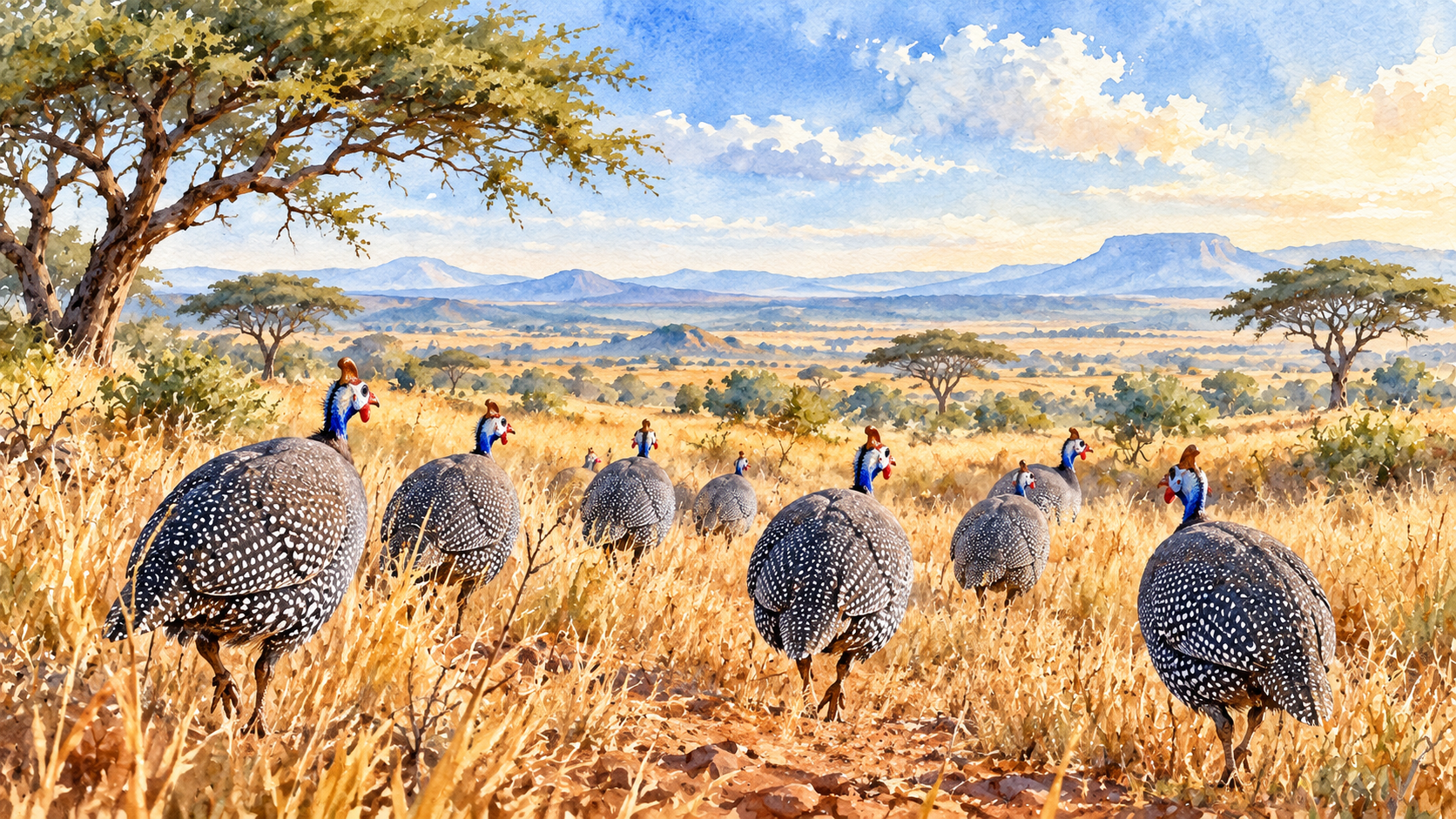
Guinea fowl originated in Africa, where their wild ancestors lived long before people began raising them as domestic poultry. The familiar farm guinea fowl descends from the helmeted guinea fowl (Numida meleagris), a species native to sub-Saharan Africa. Genetic research identifies West Africa as the principal center of domestication, with evidence suggesting that people began domesticating these birds approximately 1,300 to 5,500 years ago.
From Africa, guinea fowl spread into the Mediterranean world, including ancient Greece and Rome, before being reintroduced to Europe through African trade routes during the 15th and 16th centuries. They subsequently reached the Americas and other parts of the world through European exploration, colonization, and agricultural trade. The birds now found on American farms are descendants of these African domestic populations rather than a poultry species native to North America.
The African Homeland of Guinea Fowl
Africa is the natural home of the guinea fowl family, Numididae. Its members evolved in different African environments, including open grasslands, wooded savannas, dense forests, and scrubland. These habitats supported the development of several distinct species, but the helmeted guinea fowl became the principal ancestor of modern domestic populations.
The helmeted species has a particularly broad natural distribution across sub-Saharan Africa. Wild populations occur in parts of western, eastern, central, and southern Africa, with geographical differences in their appearance and habitat preferences. Their original distribution extended across landscapes where grassland and woodland vegetation provided food, cover, and suitable nesting conditions. The different species of guinea fowl reflect this wider African diversity, although domestication centered primarily on one species rather than the entire family.
West Africa holds particular importance in the history of domestic guinea fowl. The Food and Agriculture Organization’s account of poultry origins identifies the region as the source of domesticated guinea fowl, which later spread into agricultural systems elsewhere. The region includes countries where guinea fowl remain an important component of traditional village poultry production, especially in rural communities that maintain locally adapted birds.
Wild helmeted guinea fowl and domestic populations share a common evolutionary background, but their histories have diverged through human management and selective breeding. The modern appearance of domestic guinea fowl still preserves recognizable characteristics of their wild ancestors, including the distinctive head structures and spotted plumage familiar in traditional farm birds.
When Were Guinea Fowl First Domesticated?
The precise date of guinea fowl domestication remains uncertain because archaeological records are incomplete and ancient bird remains can be difficult to identify. Genetic research nevertheless provides a useful estimate of when domestic populations began separating from their wild ancestors.
A 2021 genome-wide investigation of helmeted guinea fowl domestication examined 129 birds representing domestic populations, wild ancestors, and closely related species. The researchers identified West Africa as the principal domestication region and estimated that domestication occurred approximately 1,300 to 5,500 years ago. The findings also identified genetic changes associated with characteristics such as movement, behavior, and reproduction.
Archaeological evidence provides another perspective. Guinea fowl appear in ancient African artistic representations, including Egyptian imagery traditionally dated to around 2400 BC. However, depictions of the birds do not necessarily prove that the animals were domesticated at the time. They could represent wild birds, captive individuals, or animals maintained under some form of human management.
A 2024 archaeological review of human relationships with birds discusses the difficulty of distinguishing domestication from captivity, hunting, and other interactions. Evidence of guinea fowl in ancient settlements establishes human familiarity with the species, but determining when systematic breeding and long-term domestication began requires additional archaeological and genetic information.
The available evidence therefore supports an ancient African domestication history without establishing a single universally accepted starting date or settlement where the process began.
How Guinea Fowl Became Part of African Agriculture
Guinea fowl became incorporated into African farming systems as people began maintaining birds for meat, eggs, and other household purposes. Their use was particularly significant in communities where poultry could be kept alongside crop production and other agricultural activities without requiring the same resources as larger livestock.
Domestication likely involved gradual changes in the relationship between people and birds rather than one isolated event. Wild guinea fowl could be captured, kept near settlements, and eventually bred within managed populations. Over generations, human selection and local breeding conditions influenced characteristics such as body size, coloration, behavior, and reproductive performance.
The history of indigenous guinea fowl production in West Africa documents their longstanding agricultural importance and the persistence of traditional production systems. Local populations often retained considerable behavioral independence, with birds moving around village surroundings while remaining associated with human settlements.
African guinea fowl husbandry also developed differently across regions. Some communities maintained birds within established domestic flocks, while others continued obtaining animals from wild populations. The FAO’s examination of indigenous African animal domestication describes guinea fowl as an example of an indigenous bird whose relationship with humans has included varying degrees of domestication and interaction with wild populations.
This history explains why domesticated guinea fowl may retain strong tendencies to roam, forage, and react to disturbances. Such behavior is part of their biological inheritance, although individual birds and breeding populations can differ considerably.
Guinea Fowl in Ancient Greece and Rome
Guinea fowl reached the Mediterranean world long before modern European exploration of Africa. Evidence places them in ancient Greece by approximately the fifth century BC, indicating that people transported African birds across established trading networks.
Their arrival demonstrates the movement of animals and agricultural resources between Africa and Mediterranean societies. Guinea fowl became known to Greek and Roman communities, where they were maintained as unusual poultry and associated with particular culinary and cultural traditions. Their presence did not necessarily mean that extensive domestic breeding populations had become established throughout Europe.
A zooarchaeological investigation of domestic chickens and African guinea fowl identifies guinea fowl movement into Europe during the fifth century BC or earlier as evidence of ancient cultural contact. Distinguishing their bones from those of other birds remains important because mistaken identification can produce inaccurate interpretations of early poultry distribution.
Guinea fowl were also known in Roman antiquity, although their popularity and distribution appear to have declined following the collapse of the Western Roman Empire. The historical spread of domestic guinea fowl suggests that the birds became uncommon in Europe before being introduced again through later commercial contacts with Africa.
Their ancient Mediterranean presence was therefore part of an earlier period of movement rather than an uninterrupted history of widespread European guinea fowl farming.
How Guinea Fowl Returned to Europe
Guinea fowl became more familiar in Europe during the 15th and 16th centuries as Portuguese maritime activity expanded commercial connections with West Africa. Birds obtained through African trade were transported to European ports and incorporated into local poultry keeping.
Portugal played an important role in this renewed introduction, followed by wider distribution through European trade and agricultural networks. By the 16th century, guinea fowl were appearing in European natural-history descriptions and poultry collections. Their distinctive appearance and African origins attracted interest beyond their immediate value as food-producing birds.
The genetic history of European domestic guinea fowl populations supports a strong connection with African ancestral stock. Genetic comparisons indicate that domestic populations share substantial ancestry, while subsequent selection produced differences in plumage and other characteristics.
Over time, some European producers developed more specialized guinea fowl farming systems. France and Italy became particularly associated with commercial production, especially for meat. The FAO’s account of modern guinea fowl production identifies these countries among those maintaining guinea fowl in larger agricultural operations.
European breeding also contributed to the development and distribution of domestic plumage variations. The familiar guinea fowl color varieties represent differences within domestic populations rather than evidence of separate geographic origins for each color.
When Did Guinea Fowl Arrive in the Americas?
Guinea fowl were introduced to the Americas during the period of European overseas expansion, with historical accounts placing their arrival in the 16th century. Portuguese involvement in Atlantic trade contributed to the movement of African domestic birds into European colonies, particularly in regions connected to Portuguese commercial networks.
The birds reached parts of the Caribbean and South America before becoming established more widely across the Americas. Their spread was associated with colonial agriculture, the movement of domestic livestock, and transatlantic trading systems that connected African, European, and American ports.
A historical review of guinea fowl production and distribution describes their 16th-century introduction to the Americas from West Africa through Portuguese activity. The available evidence establishes the broad historical period, although it does not provide a single definitive arrival date for every American territory.
Guinea fowl subsequently became part of poultry keeping in North America, where they were maintained on farms for food and other agricultural purposes. Unlike the wild turkey, which is native to North America, guinea fowl have no indigenous North American population from which modern domestic flocks originated.
The distinction between these birds also reflects their separate domestication histories. Although guinea fowl are related to chickens, turkeys, and peafowl, their evolutionary origins and the routes by which they entered American agriculture were different.
How Guinea Fowl Spread Beyond Africa and Europe
Human transportation eventually carried domestic guinea fowl into parts of Asia, Australia, and other regions where the birds had not originally evolved. Their distribution expanded through trade, agricultural experimentation, and the movement of poultry between countries.
Guinea fowl became established in several Asian farming systems, including parts of India, where they have been maintained for meat, eggs, and other agricultural purposes. The FAO’s small-scale poultry production assessment records guinea fowl keeping in several Indian states and describes their presence in different production systems.
The worldwide spread of guinea fowl did not produce identical farming traditions everywhere. African village populations, European commercial strains, and smaller flocks maintained in other regions developed under different management conditions. Agricultural selection also influenced the characteristics of some domestic lines, particularly where producers emphasized meat production.
Modern domestic guinea fowl consequently share a common African ancestry while reflecting generations of breeding and adaptation within different human agricultural environments.
What Does Their African Origin Mean for Guinea Fowl Kept Today?
The origin of domestic guinea fowl helps explain why they differ from poultry species with longer histories of intensive production selection. Guinea fowl retain many behaviors characteristic of their wild ancestors, including strong flock associations, extensive ground foraging, flight capability, and responsiveness to unfamiliar activity. Their ancestral background does not mean every domestic bird behaves identically, but it helps place these characteristics within a longer evolutionary and agricultural history.
Domestic populations have also undergone genetic changes since their early domestication. Research on selection within guinea fowl populations identifies changes associated with domestication and later breeding, demonstrating that modern farm birds are not genetically identical to wild African populations.
For American farms, historical origin should not be confused with an automatic preference for hot weather or an inability to live in other climates. Suitable conditions depend on the birds’ age, health, breeding background, and management environment. Their successful introduction to different parts of the world reflects both human care and the adaptability of domestic populations, not an absence of environmental requirements.
The modern role of guinea fowl on farms is the result of this long history of movement and domestication. An African bird originally associated with regional farming traditions eventually became part of poultry production across several continents, while its wild relatives continued to inhabit their native African environments.
One thought on “Where Do Guinea Fowl Come From?”