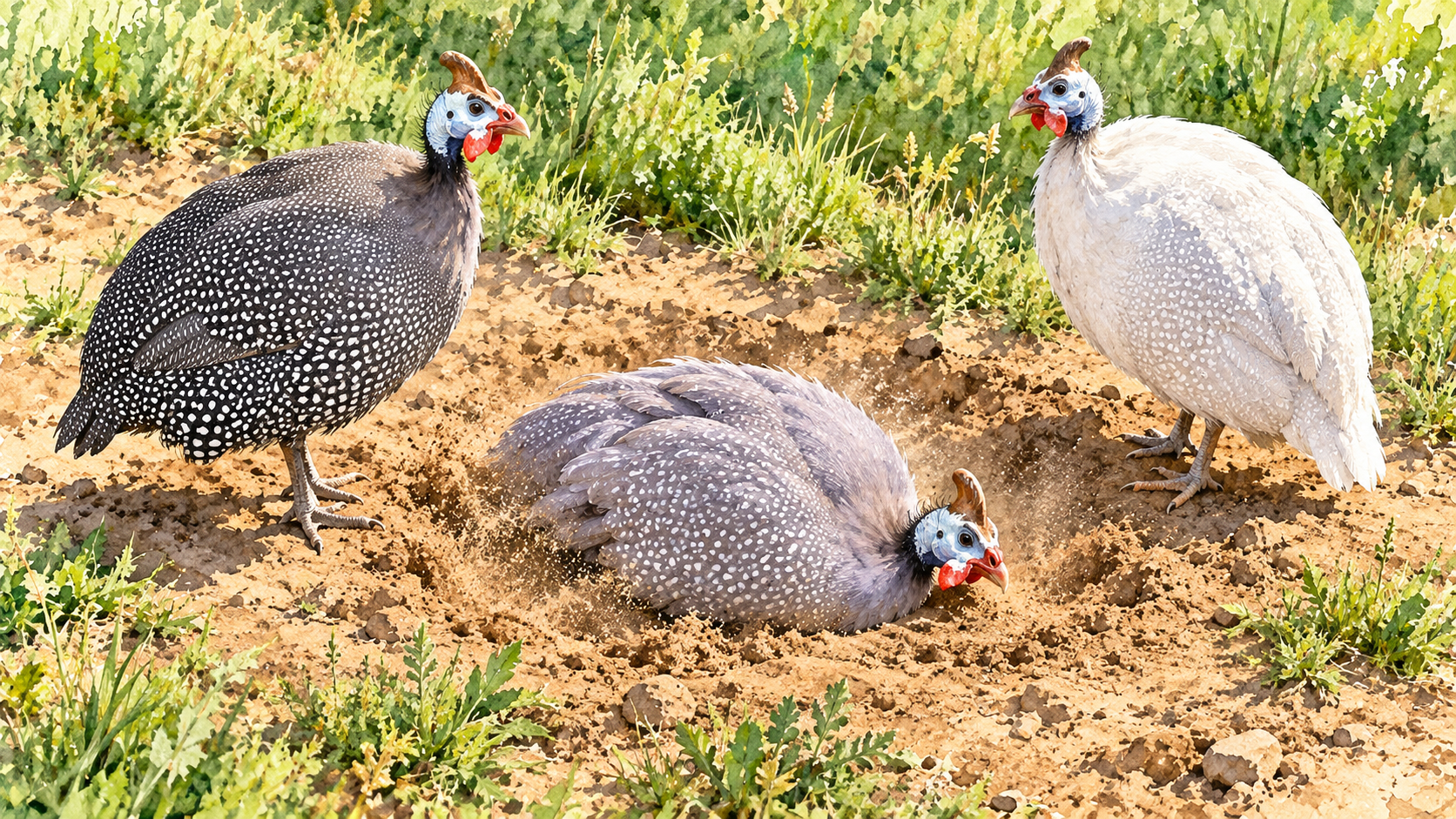
Domestic guinea fowl come in numerous color varieties, including Pearl Gray, Lavender, White, Royal Purple, Violet, Coral Blue, Slate, Chocolate, Buff, and Porcelain. These names are frequently advertised as different breeds, but they generally describe inherited plumage variations of the domestic helmeted guinea fowl (Numida meleagris), rather than separate breeds with distinct body types or production purposes.
The American Poultry Association recognizes three exhibition varieties: Pearl, Lavender, and White. Additional colors are maintained by breeders and hatcheries, with some distinguished by their underlying feather color and others by the amount and distribution of white spotting. Identifying a variety therefore requires examining more than whether its feathers look gray, brown, blue, or purple.
Are Guinea Fowl Colors Different Breeds?
Unlike chickens, which have numerous established breeds selected for different appearances and agricultural purposes, domestic helmeted guinea fowl are commonly classified by color variety. A Lavender guinea fowl and a Pearl Gray guinea fowl belong to the same species and share the principal anatomical characteristics of domesticated helmeted birds. Their different feather colors do not make them separate biological species.
The American Poultry Association’s accepted breed and variety classifications list Helmeted Guinea in Pearl, Lavender, and White. These are formal exhibition classifications rather than an exhaustive catalogue of inherited colors. Royal Purple, Coral Blue, Buff, and other varieties may be legitimate products of selective breeding without appearing in the association’s accepted exhibition list.
Some breeder terminology is also more descriptive than standardized. Names such as Blue, Purple, or Pied may refer to particular colors, combinations of color and spotting, or broader groups of related appearances. The different guinea fowl species are biological classifications, whereas the varieties discussed here are domestic forms within the helmeted species.
The Three American Poultry Association Varieties
Pearl, Lavender, and White provide the most standardized reference points for domestic guinea fowl identification. Their distinguishing characteristics involve the underlying feather color and whether the plumage carries the familiar pale spots known as pearling.
Pearl Gray Guinea Fowl
Pearl Gray is the traditional dark, spotted variety most people associate with domestic guinea fowl. Its feathers have a dark slate-gray background covered with small white spots distributed across much of the body and wings. The closely spaced markings create a speckled appearance that remains recognizable even when the bird is viewed from a distance.
Pearl Gray is also called Pearl in exhibition terminology. The Guinea Fowl International color classification identifies it as the original dark-gray, fully pearled color. Its distinctive spotting differs from irregular white patches, which are associated with pied plumage rather than ordinary pearling.
The variety remains a useful reference when comparing other domestic colors. Several varieties retain similar white spots while displaying a lighter gray, blue, tan, or brown background.
Lavender Guinea Fowl
Lavender guinea fowl have lighter gray-blue feathers covered with white pearling. Their plumage may appear silvery, lavender-gray, or slightly bluish depending on lighting and feather condition, but the underlying color is noticeably paler than Pearl Gray.
The two varieties share a fully pearled spotting pattern. A Lavender bird should therefore not be identified simply because its feathers contain white markings. The difference lies primarily in the lighter background color rather than in the presence of spots.
Lavender is one of the three accepted American exhibition varieties. It is also an established domestic color that can be distinguished from similarly pale varieties such as Coral Blue and Porcelain by examining both the feather background and the distribution of pearling.
White Guinea Fowl
White guinea fowl have white plumage without the visible pearling characteristic of Pearl and Lavender birds. Their appearance is striking because the white feathers contrast with the exposed skin and other head structures typical of helmeted guinea fowl.
White plumage does not automatically establish albinism. A bird may have white feathers while retaining pigment in its eyes and other tissues. True albinism involves a particular disruption of pigmentation, and identifying it requires more evidence than feather color alone.
The White variety is recognized for exhibition, but its coloration should not be interpreted as proof of different temperament, productivity, or nutritional requirements. Those characteristics depend on genetics beyond visible plumage and on the bird’s environment and management.
Other Domestic Guinea Fowl Color Varieties
Breeders maintain many colors beyond the three accepted exhibition varieties. Some differ mainly in their base pigmentation, while others combine a particular color with reduced spotting. The following descriptions use established breeder terminology, although not every hatchery applies all names identically.
| Color variety | Typical adult plumage | Spotting pattern |
|---|---|---|
| Royal Purple | Very dark plumage with a purple sheen in sunlight | Semi-pearled |
| Violet | Dark, nearly black feathers with violet highlights | Solid |
| Bronze | Dark feathers with bronze-colored highlights | Semi-pearled |
| Copper | Dark plumage with a coppery sheen | Solid |
| Slate | Steel-gray feathers with lighter shoulder and back areas | Faintly pearled |
| Pewter | Muted gray plumage, sometimes with uneven shading | Faintly pearled |
| Brown | Brown and tan tones with conspicuous pale spots | Fully pearled |
| Chocolate | Dark brown plumage with reduced spotting | Partially pearled |
| Cinnamon | Warm, pale-brown plumage | Fully pearled |
| Blonde | Soft brown feathers, lighter than Chocolate | Semi-pearled |
| Buff Dundotte | Soft tan plumage with white spots throughout | Fully pearled |
| Buff | Light tan to cream-colored feathers | Semi-pearled |
| Coral Blue | Soft blue feathers with darker shading toward their edges | Semi-pearled |
| Powder Blue | Light blue plumage | Faintly pearled |
| Sky Blue | Soft blue-gray coloration | Solid |
| Porcelain | Very pale pastel-blue feathers with white spotting | Fully pearled |
| Opaline | Nearly white feathers with a faint icy-blue tint | Very reduced pearling |
These descriptions follow the general categories maintained by specialist breeders. They are useful for identifying visible differences, but subtle colors may not be distinguishable reliably from photographs alone. Feather wear, sunlight, camera settings, and the bird’s developmental stage can alter the apparent shade.
Royal Purple vs. Violet
Royal Purple and Violet can appear nearly identical when viewed in poor lighting because both have extremely dark plumage. Under direct sunlight, their feathers may develop a visible purple sheen, making the difference easier to recognize.
Royal Purple typically has white pearling concentrated on the lower wings and flanks. Violet lacks visible pearling and appears more uniformly dark. The presence or absence of those markings is generally more reliable than judging how purple the bird looks.
Coral Blue, Powder Blue, and Sky Blue
Several domestic varieties belong to a loosely described blue-gray color group. Coral Blue has a soft blue background with darker shading along feather edges and limited pearling. Powder Blue is also pale blue but has faint spotting, while Sky Blue lacks visible pearling.
These varieties can be difficult to distinguish when photographed in shaded environments. The recorded diversity of domestic guinea fowl plumage includes both spotted and reduced-spotting forms, reflecting how different pigmentation and marking characteristics can occur within the same domesticated species.
A bird sold under the general name Blue Guinea should not automatically be assumed to be Coral Blue. The more precise variety name and spotting description are useful when comparing breeding stock from different sellers.
Brown, Chocolate, Cinnamon, and Buff
Brown-based varieties span a range of darker chocolate tones through warm cinnamon and pale tan coloration. Brown guinea fowl have conspicuous pearling, while Chocolate birds generally show less extensive spotting. Cinnamon combines a lighter brown background with full pearling, and Buff Dundotte has a soft tan appearance with pale spots distributed across its feathers.
Buff has a similar background shade to Buff Dundotte but is generally semi-pearled. Blonde falls within the same broad color family and is commonly described as an intermediate brown shade with reduced spotting.
Some brown varieties can be challenging to distinguish without examining adult plumage closely. Their names reflect inherited color differences rather than separate feeding requirements or established production breeds. The genetic basis of some guinea fowl pigmentation has been studied experimentally, including research on dun and blue plumage inheritance, which identified a recessive gene responsible for dun coloration.
What Does Pearling Mean in Guinea Fowl?
Pearling is the pattern of pale spots appearing on guinea fowl feathers. Breeders commonly classify domestic varieties according to how extensively these markings appear, producing four useful categories.
| Pearling classification | Meaning | Example varieties |
|---|---|---|
| Fully pearled | Spots extend across most of the feathered body | Pearl Gray, Lavender, Buff Dundotte |
| Semi-pearled | Spots are mainly concentrated on selected areas, often wings and flanks | Royal Purple, Coral Blue, Buff |
| Faintly pearled | Spots are reduced and difficult to distinguish | Slate, Pewter, Powder Blue |
| Solid | No visible white pearling | Violet, Sky Blue, White |
The spotting pattern can identify varieties that share similar underlying colors. A Royal Purple bird may look much like a Violet bird until its wing feathers are examined, while Lavender and some lighter blue varieties can be distinguished partly by how completely their plumage is pearled.
Pearling should also be separated from the shape of the individual white markings. Ordinary guinea fowl spots are part of the feather’s pigmentation. They are not caused by holes, missing feathers, or patches of exposed skin.
Feather pigmentation and spot distribution are inherited characteristics, although the exact genetic combinations underlying every named breeder variety are not equally well documented. Research examining genetic relationships among Pearl, Lavender, and White guinea fowl found high genetic similarity among the populations studied. Their visible differences therefore should not be interpreted as evidence that they represent deeply separated domestic breeds.
What Are Pied and Pinto Guinea Fowl?
Pied guinea fowl have irregular areas of white plumage interrupting another underlying color. The white patches may occur on the chest, wings, sides, or other parts of the body, and their extent varies considerably between individual birds.
A Pearl Gray Pied bird, for example, can have the familiar dark spotted feathers across much of its body while displaying a broad white chest or partially white wings. Other underlying colors can also occur in pied form. The term identifies the distribution of white plumage rather than a single base color.
Pinto is another name encountered in guinea fowl breeding. Its use is less consistently defined, and some breeders apply it to particular combinations or distributions of white feathers. Because naming conventions vary, a photograph of the parents or an accurate description of the adult feather pattern is preferable to relying solely on the word Pinto.
Pied plumage occurs in documented domestic populations. A study of 394 guinea fowl in northern Ghana identified Pearl Gray Pied among the prevalent color forms, demonstrating that pied feathering is not limited to American ornamental breeding.
How to Identify Guinea Fowl Colors as They Mature
Newly hatched guinea keets can look considerably different from their adult counterparts. Their down may contain stripes, contrasting facial markings, or pale body areas that change as juvenile feathers develop. A dark adult Royal Purple bird, for example, may have brown and pale down when newly hatched, while a Pearl Gray keet commonly displays conspicuous brown-and-dark striping.
The pattern on the crown of a young keet can offer an early indication of its future pearling category. Fully pearled varieties commonly have a broad central stripe accompanied by smaller stripes, while semi-pearled keets often display less regular head markings. Some faintly pearled and solid varieties have comparatively uniform crown coloration.
These are identification clues rather than guarantees. Individual variation and the resemblance between related colors can make early classification uncertain, particularly when breeders have crossed different color lines. The appearance of young guinea keets also changes rapidly during feather development, so descriptions based exclusively on newly hatched down may become unreliable as the bird matures.
Adult identification should give greater weight to developed feather coloration and pearling. The growth and feathering stages of guinea keets affect when those distinguishing characteristics become visible, and some varieties are easier to identify after the bird has acquired more complete adult plumage.
For breeders selling young birds as a specific color, documented parentage is particularly useful. A hatchery’s breeding records can help establish the expected variety even before the keet develops its mature appearance.
Do Guinea Fowl Colors Affect Egg Production, Size, or Temperament?
A guinea fowl’s feather color does not, by itself, establish how many eggs it will lay, how large it will become, or how readily it will tolerate human handling. Those characteristics involve multiple genetic and environmental factors, including breeding history, nutrition, reproductive status, housing, and management.
Some locally maintained guinea fowl populations have shown associations between plumage and body measurements, but those observations cannot automatically be extended to every color variety sold by American breeders. The Ghanaian study of domestic guinea fowl characteristics found differences in certain body measurements among locally identified color groups. The findings describe those populations and do not demonstrate that purchasing a particular named color guarantees a predictable adult size or productivity.
Similarly, breeder claims that Royal Purple, Lavender, or White guinea fowl are inherently quieter, friendlier, or more intelligent than Pearl Gray birds require supporting evidence. Individual behavior and inherited family characteristics can vary, but color alone is an unreliable basis for predicting temperament.
Farmers primarily interested in meat production should evaluate the size and physical development of guinea fowl and the breeding stock’s documented characteristics. A color variety should not substitute for evidence about actual growth, health, and production performance.
Choosing a Guinea Fowl Color Variety
Appearance is a reasonable basis for selecting guinea fowl when the primary goal is ornamental keeping or exhibition. Anyone intending to show birds should first determine whether the desired variety is accepted under the applicable exhibition standard. Pearl, Lavender, and White provide recognized options in American Poultry Association competition, while other colors may be suitable for exhibitions operating under different rules.
For ordinary farm keeping, the health and quality of the birds deserve greater priority than unusual plumage. Breeding records, the condition of the parent flock, age, appropriate feeding, and responsible sourcing provide more useful information than a rare color designation alone. The selection of healthy guinea fowl before purchase should include observable condition and relevant health history regardless of whether the birds are Pearl Gray or a less familiar variety.
Buyers ordering assorted-color keets should also recognize that hatcheries may use different names for similar shades. A seller’s color chart, photographs of mature breeding birds, and explanation of pearling patterns can help prevent confusion. When purchasing breeding stock, accurate identification of both parents matters more than a promotional description of the offspring.
For a farm selecting between several attractive colors, the choice of keets, adults, or hatching eggs also affects how confidently the intended appearance can be evaluated. Adult birds offer the clearest opportunity to examine mature plumage directly, while young keets and hatching eggs require greater reliance on reliable breeding records.
2 thoughts on “Guinea Fowl Breeds and Color Varieties Explained”