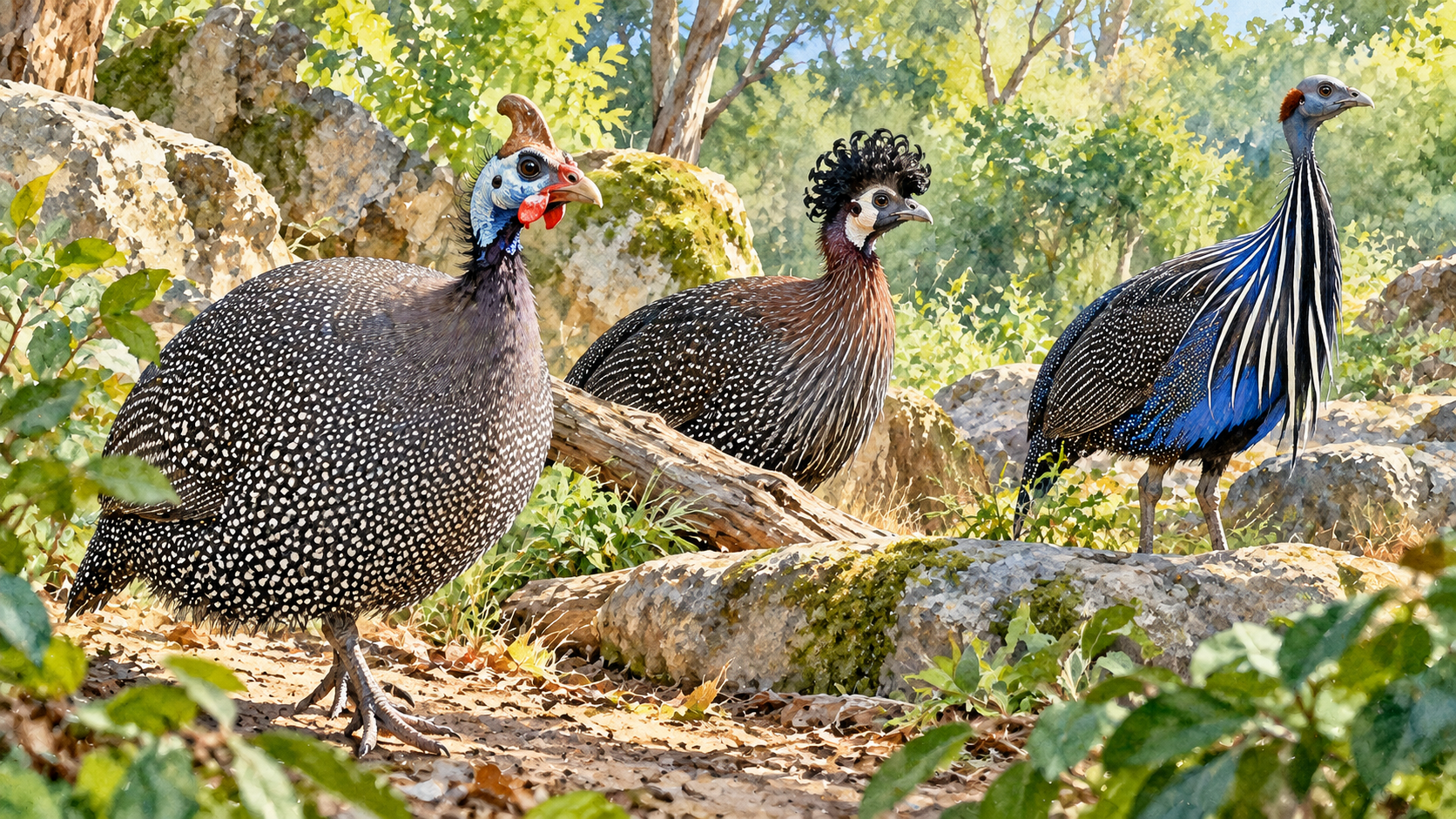
There are eight commonly recognized species of guinea fowl, belonging to four genera within the family Numididae. They include the helmeted, vulturine, plumed, black, white-breasted, eastern crested, western crested, and southern crested guinea fowl. All are native to Africa, but only the helmeted guinea fowl (Numida meleagris) has become a widespread domesticated farm bird.
These species differ in their head structures, plumage, geographic ranges, and preferred habitats. Some inhabit open savannas and grasslands, while others live primarily in tropical forests and dense woodland. Although they share the guinea fowl name, they are not interchangeable agricultural birds, and most remain predominantly wild species.
The Eight Guinea Fowl Species
The modern classification of the guinea fowl family recognizes eight species across four genera. Older references sometimes list only six species because they combine the eastern, western, and southern crested guinea fowl into a single species.
| Guinea fowl species | Scientific name | Distinguishing characteristic | Principal habitat |
|---|---|---|---|
| Helmeted guinea fowl | Numida meleagris | Bony helmet above the head | Savannas, grasslands, and open woodland |
| Vulturine guinea fowl | Acryllium vulturinum | Long neck and blue, black-and-white breast plumage | Dry savanna and thorn scrub |
| Plumed guinea fowl | Guttera plumifera | Tall, relatively straight feather crest | Central African tropical forests |
| Eastern crested guinea fowl | Guttera pucherani | Curled feather crest and spotted dark plumage | Eastern African forest and thickets |
| Western crested guinea fowl | Guttera verreauxi | Feathered crest and spotted plumage | Central and western African forest habitats |
| Southern crested guinea fowl | Guttera edouardi | Distinctive curled head crest | Southern African woodland and forest |
| White-breasted guinea fowl | Agelastes meleagrides | Dark upper body contrasting with a white breast | West African tropical forests |
| Black guinea fowl | Agelastes niger | Predominantly dark plumage with little conspicuous spotting | Central African lowland forests |
The scientific names identify separate species, not domestic breeds or color variations. Their shared family relationship does not mean they have identical ecological requirements or domestication histories.
Helmeted Guinea Fowl: The Familiar Domestic Species
The helmeted guinea fowl is the species most commonly raised for eggs, meat, ornamental purposes, and insect foraging. Its most recognizable feature is a hard, hornlike casque on top of the head, accompanied by exposed facial skin and fleshy wattles. Wild birds typically have dark gray plumage covered with small pale spots, although domesticated populations display additional feather colors.
Wild helmeted guinea fowl occupy a broad range of African savanna, grassland, and open woodland habitats. Their tendency to move in groups and forage extensively on the ground is documented in the helmeted guinea fowl species account. Domestic populations descend from this species and have been introduced to agricultural environments outside Africa.
Their agricultural importance distinguishes them from the other members of Numididae. Domestic helmeted guinea fowl are bred and maintained within established poultry systems, whereas most other species are encountered primarily in wild populations or specialized avicultural collections. Their African origins and domestication history explain how one member of a diverse bird family became familiar on farms around the world.
The helmeted guinea fowl also provides the reference point for identifying unfamiliar birds. Its characteristic head structures and body appearance distinguish it from species bearing prominent feather crests or unusually elongated neck plumage.
Vulturine Guinea Fowl: The Long-Necked Species
The vulturine guinea fowl (Acryllium vulturinum) is among the most visually distinctive members of the family. It has an elongated neck, a relatively small, mostly bare head, and striking blue breast plumage overlaid with long black-and-white feathers. Its appearance resembles that of a vulture in some respects, which accounts for its common name, although it is not a vulture or a scavenging bird of prey.
This species inhabits dry areas of northeastern Africa, particularly parts of Ethiopia, Somalia, Kenya, and northern Tanzania. It occupies thorn scrub and dry savanna, where groups search for food on the ground. Its distinctive anatomy and flock behavior make it relatively easy to distinguish from the helmeted guinea fowl in the field.
Unlike domestic helmeted guinea fowl, vulturine guinea fowl are not a conventional agricultural species in the United States. They may be maintained in specialized collections, but their habitat requirements and management considerations cannot be inferred directly from domestic guinea fowl husbandry.
Crested Guinea Fowl: Three Closely Related Species
Crested guinea fowl belong to the genus Guttera, which also includes the plumed guinea fowl. Their most recognizable characteristic is a feathered crest rather than the hard casque associated with helmeted guinea fowl. Their dark plumage is usually patterned with pale spots, giving them a recognizable family resemblance despite the different head structure.
Modern classifications distinguish three crested species:
- Eastern crested guinea fowl (Guttera pucherani): Found in parts of eastern Africa, including Kenya, Tanzania, and Somalia.
- Western crested guinea fowl (Guttera verreauxi): Associated with forest and woodland habitats across parts of central and western Africa.
- Southern crested guinea fowl (Guttera edouardi): Occurs farther south, particularly in woodland and forested environments of southern Africa.
These birds were formerly grouped together under Guttera pucherani. The 2022 eBird taxonomic revision separated the eastern, western, and southern forms into three species. Consequently, older field guides and wildlife references may still use crested guinea fowl for the combined group rather than identifying each species separately.
Their habitats include forests, thickets, and wooded landscapes, although the exact conditions vary geographically. The eastern crested guinea fowl’s recorded range includes both forest and dry savanna environments, demonstrating that not every crested population occupies dense rainforest.
Crested guinea fowl are wild African birds, not the same as domestic helmeted guinea fowl with unusual head feathers. The crest is a species characteristic and should not be confused with a domestic plumage mutation.
Plumed Guinea Fowl: The Forest Species With a Tall Crest
The plumed guinea fowl (Guttera plumifera) resembles crested guinea fowl but has a characteristic head ornament consisting of relatively long, upright feathers. Its dark, spotted body gives it some resemblance to other members of the genus, although the arrangement of its head feathers provides an important distinguishing feature.
Plumed guinea fowl occur mainly in tropical forest habitats in central Africa, including parts of the Congo Basin. They are associated with forest-floor environments rather than the extensive open grasslands commonly inhabited by helmeted guinea fowl. Their presence in countries such as Gabon is documented in regional bird occurrence records, alongside other wild members of Numididae.
Their forest association helps distinguish them from the familiar domestic species. An open pasture suitable for helmeted guinea fowl should not automatically be considered appropriate housing for a bird adapted to tropical forest conditions.
White-Breasted and Black Guinea Fowl
Two less familiar species belong to the genus Agelastes: the white-breasted guinea fowl (Agelastes meleagrides) and the black guinea fowl (Agelastes niger). Both are associated with African tropical forests, but their appearances and distributions differ.
The white-breasted guinea fowl has a conspicuously pale breast contrasting with its dark upper body. It inhabits the Upper Guinea forests of West Africa, including remaining forest areas in Sierra Leone, Liberia, Côte d’Ivoire, and Ghana. Its dependence on forest habitat makes it especially vulnerable to extensive clearance and degradation. The white-breasted guinea fowl’s conservation assessment classifies it as Vulnerable, with habitat loss and hunting among the pressures affecting its populations.
The black guinea fowl is predominantly dark, lacking the conspicuous white spotting characteristic of helmeted guinea fowl. Its range lies farther east within the central African forest region, including countries of the Congo Basin. It is a forest-dwelling wild bird rather than a commonly domesticated poultry species.
These two species illustrate how much ecological diversity exists within the guinea fowl family. Not all guinea fowl have spotted feathers, conspicuous wattles, or the open-country habits typically associated with birds kept on farms.
Wild Species and Domestic Guinea Fowl Are Not the Same Thing
The distinction between species and domesticated varieties is important when identifying guinea fowl or considering their suitability for agricultural use. The helmeted guinea fowl is both a wild species and the ancestor of widespread domestic populations. Selective breeding has produced birds with different plumage characteristics, but those color differences do not automatically create new species.
For example, pearl, lavender, white, and other domestic guinea fowl color varieties remain forms of the helmeted guinea fowl. They should not be counted alongside vulturine, plumed, or white-breasted guinea fowl when identifying the biological species within Numididae.
A wild species is also not automatically suitable for ordinary poultry keeping. Forest-dwelling guinea fowl may have environmental and behavioral requirements substantially different from those of domestic helmeted birds. Wild-bird acquisition can involve wildlife protection laws, import restrictions, documentation, disease controls, and animal welfare obligations. The conservation status and legal requirements must be established for the exact species and jurisdiction before any acquisition is considered.
In the United States, the USDA’s live poultry import requirements govern applicable animal-health conditions for imported poultry, while other wildlife regulations may apply depending on the species and transaction. Ordinary domestic poultry ownership rules do not establish permission to import or possess every wild guinea fowl species.
Which Guinea Fowl Species Is Commonly Kept on American Farms?
The helmeted guinea fowl is the established choice for ordinary American farm and homestead keeping. Its domesticated populations are available through poultry breeders and hatcheries, and management information is specifically available for this species. Domestic guinea fowl are raised for several purposes, although their active behavior and vocalizations require appropriate housing and flock management.
Prospective keepers should identify the species before purchasing birds, especially when encountering unfamiliar names or photographs. The choice between guinea keets, adult birds, and hatching eggs concerns different acquisition methods for domestic poultry, not a choice among all wild guinea fowl species.
Established small-flock guinea fowl husbandry primarily addresses the domestic helmeted species. That guidance provides a more appropriate starting point for farm planning than descriptions of wild vulturine or forest-dwelling guinea fowl. Farm suitability depends on obtaining healthy domestic birds from responsible sources and providing conditions appropriate to their species, rather than selecting an unfamiliar wild relative for its appearance.
One thought on “What Are the Different Types of Guinea Fowl?”