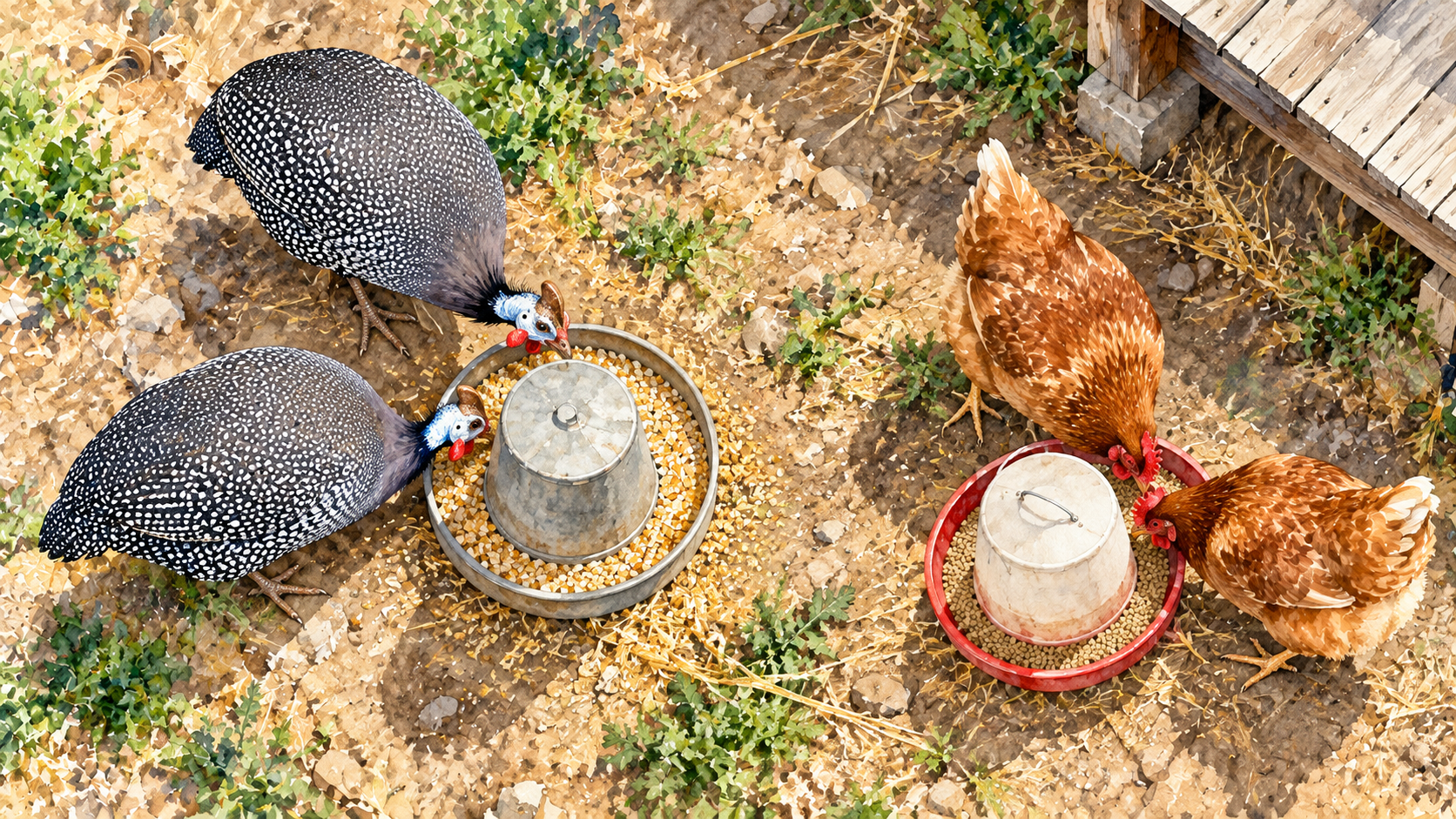
Chickens are generally the better choice for farms prioritizing dependable egg production, efficient meat production, manageable housing, and predictable daily routines. Guinea fowl are more suitable for properties that value active insect foraging, conspicuous alarm calls, and a free-ranging flock. Neither species is universally better, but chickens offer more specialized production options, while guinea fowl have distinctive behaviors that can be useful in certain farming environments.
The decision becomes particularly important when space, neighbors, labor, and containment are limited. Chickens can be kept successfully in many types of well-designed poultry housing, including enclosed runs. Guinea fowl can also live in confinement, but their strong roaming tendencies, flight ability, and frequent alarm vocalizations require different planning. Their small-flock management characteristics make them appealing on some rural properties and inconvenient on others.
Guinea Fowl vs. Chickens at a Glance
| Farm consideration | Guinea fowl | Chickens |
|---|---|---|
| Primary agricultural strengths | Insect foraging, alarm calling, specialty meat and seasonal eggs | Egg production, meat production and dual-purpose farming |
| Egg production | Generally seasonal, with considerable management variation | Commercial laying strains offer more consistent production |
| Meat production | Smaller specialty poultry carcasses | Specialized broiler strains offer substantially greater production efficiency |
| Temperament | Active, alert and often wary of handling | Highly breed-dependent, with many manageable domestic strains |
| Noise | Loud alarm calls that may occur repeatedly | Clucking, laying calls and rooster crowing |
| Free-ranging | Strong tendency to roam and travel beyond boundaries | Often easier to manage within established ranges, depending on breed |
| Containment | Flight and wandering complicate ordinary fencing | Many breeds can be managed with conventional secure poultry enclosures |
| Housing | Secure shelter, suitable roosts and adequate activity space | Secure housing, suitable roosts, nesting facilities and appropriate space |
| Feeding | Species- and life-stage-appropriate rations plus optional foraging | Widely available rations for chicks, layers and meat birds |
| Beginner suitability | Greater challenges with ranging, noise and handling | More straightforward for many first-time poultry keepers |
These comparisons concern typical domestic helmeted guinea fowl and commonly kept farm chickens. Chicken breeds vary substantially, and a flight-capable bantam or highly active heritage breed may present different management challenges from a heavy commercial meat bird.
Egg Production Favors Chickens
Chickens have a substantial advantage when the principal farming objective is producing eggs regularly. Commercial laying strains have been selectively bred for sustained output, while domestic guinea fowl generally exhibit more pronounced seasonal laying behavior. The selection of chickens for egg production allows farmers to choose birds according to productivity, climate tolerance, temperament, and other characteristics relevant to their operation.
Guinea hens can lay frequently during their breeding season, but their output is less evenly distributed throughout the year. They may also select concealed outdoor nests when allowed to roam, complicating collection and making it difficult to determine how many eggs the flock actually produces. Chickens can likewise hide eggs, particularly in free-range systems, but established laying breeds and appropriate nesting facilities generally make production easier to organize. The differences in guinea fowl and chicken egg production are especially significant for farms supplying households or customers on a regular schedule.
Guinea fowl eggs are edible and useful for household consumption, so lower or less predictable production does not make them unsuitable for every operation. A small homestead interested in seasonal eggs may find them satisfactory. Farms requiring consistent collection, larger volumes, and established laying-strain options will usually have more flexibility with chickens.
Chickens Offer More Options for Meat Production
Chicken production benefits from decades of specialized breeding for growth rate, carcass characteristics, and feed efficiency. Commercial broilers are designed for meat production, while dual-purpose breeds provide an alternative for smaller operations that want both meat and eggs. The selection of poultry for different production objectives illustrates how choosing an appropriate species and production type affects farm outcomes.
Guinea fowl produce smaller carcasses than typical commercial broiler chickens and are commonly marketed as specialty poultry. Their lean meat has culinary appeal, but a farm seeking maximum meat output from a conventional production system will generally find chickens better suited to that objective. Guinea fowl can be worthwhile when a particular market or household prefers their characteristics, provided the farmer accounts for the birds’ growth, available processing arrangements, and expected carcass yield.
The economic comparison depends on what is being produced. A specialty bird may command a different selling price from a standard chicken, but higher prices alone do not establish better returns. Processing expenses, labor, mortality, feed consumption, and actual demand all influence the outcome. Neither species should be assumed profitable without evaluating the intended operation.
Guinea Fowl Are More Independent, but Less Predictable
Farm management often reveals the greatest differences between these birds. Guinea fowl commonly remain alert to unfamiliar movement, travel together during foraging, and react quickly to disturbances. Chickens also display complex social behavior and substantial individual variation, but many domestic breeds have been selected for characteristics that make routine handling and controlled production more manageable.
Guinea fowl can be particularly difficult to approach or catch when they have had little human contact. Birds accustomed to a familiar keeper may become easier to manage, yet their reactions can remain markedly different from those of a calm, regularly handled chicken flock. Handling either species roughly can cause injury and unnecessary distress, so a bird’s reluctance to be restrained should be addressed through appropriate facilities and humane handling rather than force.
Their activity patterns also influence flock supervision. A chicken keeper may find it relatively straightforward to establish predictable feeding, nesting, and housing routines with a suitable breed. Guinea fowl can learn routines, but their tendency to wander and select elevated resting places makes consistency more dependent on early acclimation and suitable management. The ability of guinea fowl to roam considerable distances complicates supervision where birds have access to extensive open land.
For farmers who want birds primarily for observation, foraging, and outdoor activity, guinea fowl may be appealing. For people who expect frequent close handling or highly organized daily production, a suitable chicken breed often offers a more convenient arrangement.
Noise Can Determine Which Bird Fits the Property
Guinea fowl produce loud calls when alarmed, separated from flock members, or disturbed by unfamiliar activity. Several birds calling simultaneously can create substantial noise, especially on properties where people, vehicles, pets, and wildlife regularly pass nearby. Their reputation as alarm birds comes from this behavior, but the same vocalizations may become a nuisance where neighboring homes are close.
Chickens are not silent. Hens produce communication and laying calls, while roosters crow and may vocalize repeatedly throughout the day. The comparison therefore depends partly on flock composition. A flock of hens without roosters may be more suitable for noise-sensitive properties than guinea fowl, although individual chicken breeds and environments influence how much noise is produced.
Guinea fowl can serve as conspicuous farm alarm birds because they react to unfamiliar activity, but these calls cannot reliably distinguish harmless disturbances from predators. Chickens also produce alarm vocalizations, so guinea fowl should not be regarded as the only poultry capable of responding audibly to danger.
Before choosing either species, farmers should assess surrounding homes, permitted poultry types, and local noise restrictions. Guinea fowl are particularly unsuitable where frequent loud calling would create an ongoing conflict that housing and reasonable management cannot resolve.
Housing and Containment Are Usually Simpler With Chickens
Both species require secure housing that protects them from predators and unsuitable weather. The amount of usable space, ventilation, roosting accommodation, and outdoor access must reflect bird size, flock activity, climate, and the management system. The space allowances for small poultry flocks also depend on whether the birds can regularly use an outdoor area, rather than on a universal floor-space figure.
Chickens are often easier to manage within enclosed poultry runs, particularly when relatively heavy breeds are selected. Guinea fowl can fly over ordinary fencing and may travel beyond the areas where their owners intend them to remain. Their flight capability makes overhead containment important when a property requires reliable boundaries. Open-topped fencing that works for some chicken flocks may be inadequate for guinea fowl.
Nighttime housing presents another difference. Chickens generally respond well to appropriate roosting facilities and established coop routines. Guinea fowl may prefer elevated outdoor locations, including trees, if they are not accustomed to returning to secure housing. Free-ranging does not eliminate their vulnerability to predators, and the need for protected nighttime accommodation remains even when birds spend most daylight hours outdoors.
Guinea fowl can be raised in suitable enclosed systems, although permanent confinement requires adequate space and opportunities for natural activity. Chickens have more established housing options across commercial and small-flock production systems, making it easier to select facilities compatible with a specific breed and farming objective.
Which Bird Is Better for Insect Foraging?
Guinea fowl have a reputation for searching actively through pasture, grass, and cultivated areas for insects and other invertebrates. They consume a variety of available prey while moving across the property, and farmers sometimes maintain them partly for this behavior. Their use as insect-foraging poultry is particularly familiar on rural homesteads.
Chickens also eat insects, but their foraging behavior frequently involves vigorous scratching and disturbance of surface soil. Guinea fowl generally rely more heavily on walking and picking up food, which may make them more convenient around certain established plantings. Neither species can be assumed harmless to gardens, and both may damage vulnerable plants under some conditions.
A farmer should not choose guinea fowl solely because they are promoted as reliable tick-control animals. A 2024 peer-reviewed study of guinea fowl and lone star ticks found no evidence that guinea fowl effectively controlled the studied tick populations or their associated pathogens. Guinea fowl also served as hosts for immature lone star ticks during the investigation. Insect consumption therefore needs to be separated from demonstrated reductions in pest abundance or disease risk.
The broader pest-control suitability of guinea fowl depends on the insect species, habitat, flock management, and existing pest-management practices. Chickens and guinea fowl can contribute to insect consumption without replacing established methods for controlling harmful pests.
Feed, Labor, and Ownership Costs
Chickens usually offer a practical advantage in feed availability because commercial rations are widely formulated for specific production stages, including starter, grower, layer, and broiler diets. Guinea fowl also require nutritionally appropriate rations, but their requirements are not identical to those of chickens, particularly during early development. A feed suitable for an adult laying chicken should not automatically be treated as appropriate for a growing guinea keet.
Feed represents a continuing expense for both species. Although foraging provides supplemental food, neither flock should be expected to obtain a complete, balanced diet exclusively from whatever it finds outdoors. Suitable feeding arrangements must account for age, production purpose, seasonal food availability, and access to water. The nutritional management of laying chickens illustrates the importance of balanced rations even when birds have access to pasture or garden areas.
Labor costs depend heavily on management. Chickens may require more frequent egg collection when maintained for consistent production, while guinea fowl can create additional work through wandering, difficult retrieval, and the need to maintain dependable nighttime housing routines. Greater free-range access does not necessarily reduce labor when birds repeatedly leave the intended area.
A useful way to compare ownership expenses is to separate them into the following categories:
| Expense | Guinea fowl consideration | Chicken consideration |
|---|---|---|
| Purchasing birds | Availability of keets, adults and selected varieties | Broad range of breeds and production strains |
| Feed | Appropriate guinea rations and seasonal supplementation | Established commercial diets for different production stages |
| Housing | Secure roosting areas and possible overhead containment | Breed-appropriate coops, runs and nesting facilities |
| Labor | Flock supervision, retrieval and confinement routines | Feeding, cleaning, collection and production management |
| Veterinary and health costs | Disease prevention, diagnostics and treatment when necessary | Disease prevention, diagnostics and treatment when necessary |
| Replacement birds | Breeding availability and flock renewal | Established hatchery and replacement-pullet markets |
The actual cost of raising guinea fowl depends on local feed prices, flock size, housing infrastructure, climate, and management arrangements. A small chicken flock can be expensive to maintain if substantial new facilities are required, while a guinea fowl flock may incur relatively modest additional housing costs when suitable secure infrastructure already exists. Neither outcome should be assumed without a property-specific budget.
Animal Welfare and Disease Risks Affect Both Choices
Guinea fowl and chickens need suitable shelter, balanced nutrition, clean water, social contact, and opportunities to perform normal behaviors. Differences in temperament or foraging ability do not justify withholding feed, exposing birds to predators, or confining them in unsuitable conditions. Guinea fowl are social birds, and their need for compatible flock members deserves particular attention when planning a small group.
Both species can encounter infectious poultry diseases, including avian influenza. The USDA’s poultry biosecurity guidance identifies contaminated equipment, visitors, wild birds, feed, and water as possible routes through which pathogens enter a flock. Secure enclosures, clean equipment, protected feed supplies, and reduced contact with wild birds are relevant to both species. Extensive roaming may increase opportunities for environmental exposure, while confinement requires careful attention to ventilation, sanitation, stocking density, and behavioral needs.
Farmers should investigate abnormal breathing, weakness, reduced appetite, unexplained deaths, or other significant health changes promptly. Sudden deaths or signs of a serious infectious disease warrant veterinary guidance and, where appropriate, contact with the state animal-health authority. Choosing a species perceived as hardy does not remove the need for veterinary care or routine disease prevention.
Which Is Better for Different Types of Farms?
A farmer’s objectives provide a more useful basis for choosing poultry than general claims that one species is superior.
| Farm situation | Generally better choice | Reason |
|---|---|---|
| Consistent household egg supply | Chickens | More established laying strains and predictable collection systems |
| Conventional meat production | Chickens | Specialized broiler options and production infrastructure |
| Rural property seeking additional insect foragers | Guinea fowl may suit | Active ground foraging, provided expectations for pest reduction remain realistic |
| Small property near neighbors | Chickens, especially hens without roosters | Guinea alarm calls and roaming can create greater conflicts |
| Farm requiring strict boundary containment | Chickens often easier | Many breeds are easier to manage in conventional secure runs |
| Farm interested in conspicuous alarm calls | Guinea fowl | Strong vocal response to unfamiliar activity |
| First-time poultry keeper | Chickens generally | More established husbandry resources and manageable breed choices |
| Specialty poultry production | Depends on market | Product demand, production costs and processing access determine suitability |
For a beginner establishing a small flock, chickens generally provide a more flexible starting point. Farmers can select breeds appropriate for egg laying, meat production, climate, and handling preferences without accepting the same degree of roaming and alarm behavior associated with guinea fowl. The differences in poultry species and farming purposes make species selection an important early decision rather than a choice based exclusively on appearance.
Guinea fowl become more attractive when a farm has enough space for active birds, accepts substantial vocalization, and values their additional foraging or alarm behavior. Their usefulness is reduced when the property cannot safely accommodate those characteristics. A flock should not be purchased on the assumption that roaming birds will remain within boundaries, eliminate ticks, or meet their nutritional needs without appropriate feeding.
For farms focused on efficient and dependable poultry production, chickens are the stronger general-purpose choice. Guinea fowl are a more specialized option for rural operations prepared to accommodate their behavior in exchange for the particular benefits they offer.
One thought on “Guinea Fowl vs. Chickens: Which Is Better for a Farm?”