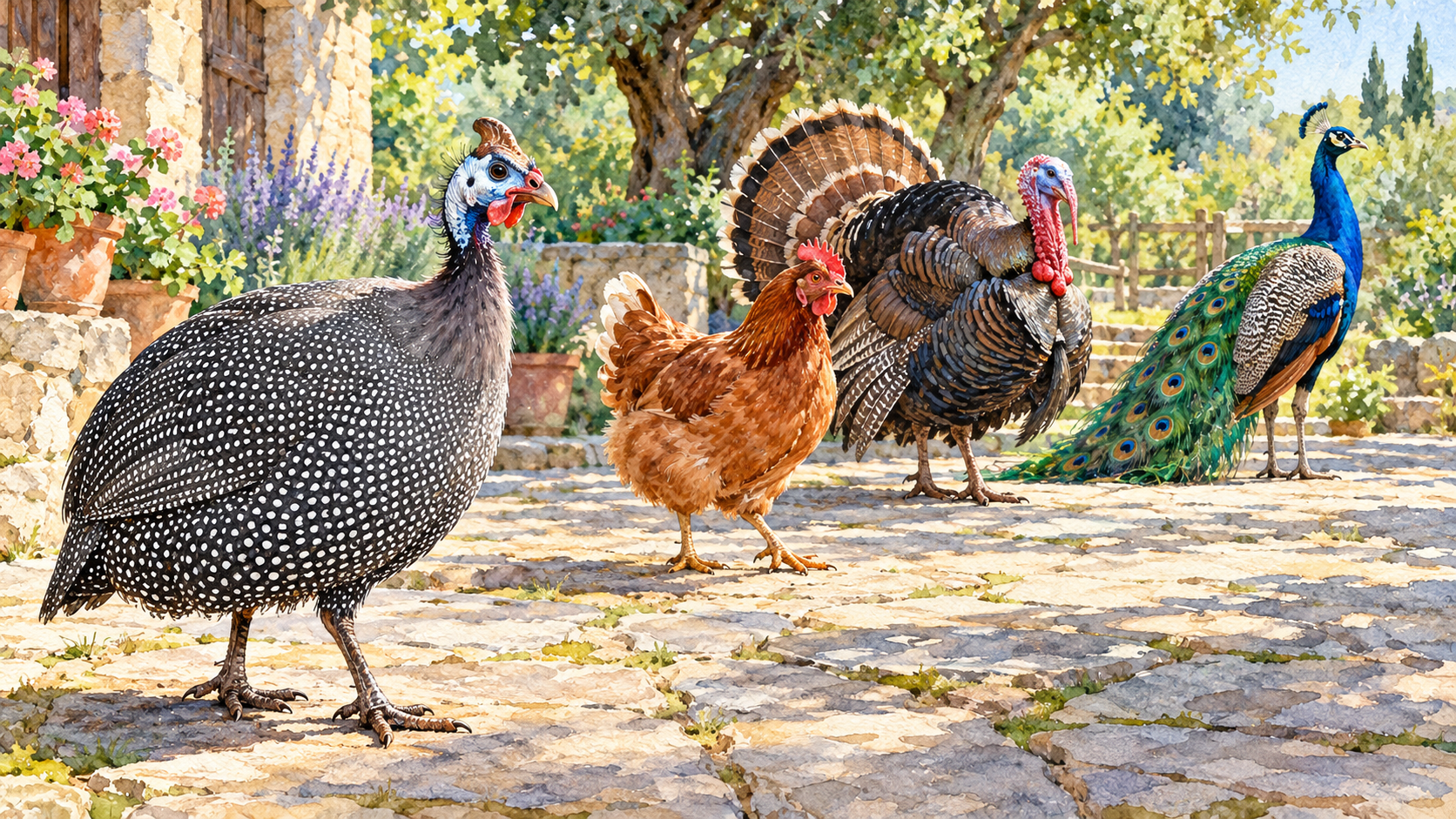
Guinea fowl are related to chickens, turkeys, and peafowl because all four belong to the bird order Galliformes. They share ancient evolutionary ancestors, but guinea fowl belong to a separate family, Numididae, while chickens, turkeys, and peafowl are members of Phasianidae. Their relationship is therefore broader than that of birds belonging to the same genus or family.
The familiar domestic guinea fowl (Numida meleagris) is not a type of chicken, turkey, or peafowl. Its similarities to those birds reflect shared ancestry and the evolution of comparable physical characteristics, including strong legs, ground-oriented feeding habits, and relatively compact wings. Genetic research places guinea fowl on a distinct branch of the galliform evolutionary tree, separate from the lineage containing the other three birds.
How Guinea Fowl Fit Into the Poultry Family Tree
Bird classification organizes species according to evolutionary relationships, placing closely related organisms into progressively broader groups. Guinea fowl, chickens, turkeys, and peafowl all belong to the class Aves and the order Galliformes, but their classification differs at the family level.
| Bird | Scientific name | Order | Family |
|---|---|---|---|
| Helmeted guinea fowl | Numida meleagris | Galliformes | Numididae |
| Domestic chicken | Gallus gallus domesticus | Galliformes | Phasianidae |
| Wild turkey | Meleagris gallopavo | Galliformes | Phasianidae |
| Indian peafowl | Pavo cristatus | Galliformes | Phasianidae |
The International Ornithologists’ Union family classification recognizes Numididae and Phasianidae as separate families within Galliformes. Numididae contains guinea fowl, while Phasianidae encompasses a much larger collection of birds, including pheasants, partridges, junglefowl, peafowl, turkeys, and grouse.
The domestic chicken is descended from the red junglefowl, whereas domesticated guinea fowl descend from the helmeted guinea fowl. Turkeys and peafowl have their own evolutionary histories within Phasianidae. The different species of guinea fowl are more closely related to one another than they are to chickens or turkeys because they belong to the same biological family.
Are Guinea Fowl More Closely Related to Chickens or Turkeys?
Guinea fowl are not considered significantly closer to domestic chickens than to turkeys under the commonly accepted family-level evolutionary tree. Chickens and turkeys belong to Phasianidae, along with peafowl, whereas guinea fowl diverged from the ancestral lineage leading to that family much earlier.
A multigene phylogenetic study of 88 galliform species supported five major families within Galliformes: Megapodiidae, Cracidae, Numididae, Odontophoridae, and Phasianidae. The analysis placed guinea fowl outside the more recently shared ancestry of the principal phasianid lineages.
This evolutionary arrangement explains why a chicken and a turkey share a more recent common ancestor with each other than either shares with a guinea fowl. Both belong to the same family, even though their appearances and sizes differ considerably.
The overall farming differences between guinea fowl and chickens arise from domestication, selective breeding, and species-specific biology rather than their taxonomic positions alone. Evolutionary closeness does not necessarily produce identical behavior or agricultural characteristics.
What Do Guinea Fowl Share With Peafowl?
Peafowl and guinea fowl have similarities in their general body organization and terrestrial habits. Both are galliform birds with strong legs, ground-oriented foraging behavior, and the ability to fly despite spending substantial time walking. Their shared characteristics reflect broad features of the order rather than membership in the same family.
Indian peafowl (Pavo cristatus) belong to Phasianidae. Males are recognizable by their elaborate trains of elongated upper-tail covert feathers, which are displayed during courtship. Guinea fowl lack this specialized display structure and have a different evolutionary history of plumage and head ornamentation. The Indian peafowl classification places the species within the same family as junglefowl and turkeys, not Numididae.
The similarity between their names can also cause confusion. A male peafowl is a peacock, a female is a peahen, and the collective name is peafowl. Guinea fowl are not peafowl, even though some domestic bird enthusiasts keep both as ornamental poultry.
Their geographic origins are different as well. The familiar Indian peafowl originated in the Indian subcontinent, while guinea fowl are African birds. The African origins of domestic guinea fowl and the Asian ancestry of Indian peafowl reflect separate geographic histories within an ancient group of birds.
Why Do These Birds Look and Behave Similarly?
Their resemblance begins with a shared galliform body plan. Many members of the order are relatively heavy-bodied birds that search for food on the ground, possess strong legs, and have short, rounded wings suited to bursts of flight. These traits are widespread among galliform lineages, although the degree to which individual species rely on running, scratching, or flying varies.
The veterinary description of galliform anatomy and disease identifies the order as a diverse group of predominantly ground-feeding birds that includes guinea fowl, pheasants, chickens, turkeys, and peafowl. These common characteristics help explain their superficial resemblance without implying that they should be classified together at the family level.
Shared ancestry also accounts for similarities in reproduction. All four birds lay hard-shelled eggs, develop within eggs outside the mother’s body, and produce young that are relatively mobile soon after hatching. Such chicks are described as precocial. They are not entirely self-sufficient, but their early mobility differs from that of helpless nestlings found in many other bird groups.
Social communication, courtship, and responses to predators also occur throughout Galliformes. However, the specific vocalizations, mating displays, and social interactions differ between species. Similar behaviors should not be interpreted as evidence that guinea fowl and chickens have identical social requirements.
What Genetic Research Reveals About Their Ancestry
Modern genetic studies have substantially changed how scientists classify galliform birds. Earlier systems sometimes placed turkeys and grouse in separate families, whereas molecular evidence supports including them within Phasianidae.
A study using complete mitochondrial genomes supported the monophyly of Phasianidae and identified turkeys as part of that family. Monophyly means that a group includes a common ancestor and all the descendants assigned to that evolutionary branch.
The position of guinea fowl is especially informative because Numididae represents an early-diverging lineage among the major families of Galliformes. A combined molecular and morphological investigation of galliform relationships recovered Numididae as a distinct family and examined how the different galliform lineages separated over evolutionary time.
Some details of the branching order among galliform families have produced different results across studies, particularly involving New World quail and other early-diverging groups. Those disagreements do not overturn the well-supported separation between Numididae and Phasianidae.
Modern genomic research therefore establishes shared ancestry without suggesting that today’s guinea fowl descended directly from modern chickens, turkeys, or peafowl. Each living species represents its own evolutionary lineage.
Does Their Relationship Mean They Can Be Managed the Same Way?
Belonging to the same bird order does not establish identical nutritional requirements, behavior, disease susceptibility, or housing needs. The biological relationship between guinea fowl and turkeys is useful for understanding their evolutionary history, but it does not provide a reliable basis for transferring husbandry instructions between the two species.
Even birds within the same family can differ in their physiological needs and responses to their surroundings. A suitable chicken diet, for example, cannot automatically be assumed appropriate for a growing guinea keet. Feeding decisions must account for the particular species, age, and production stage rather than relying on family membership.
Similarly, the practical differences between guinea fowl and turkeys cannot be determined from ancestry alone. Size, reproductive biology, social behavior, and agricultural breeding have all contributed to differences between modern domestic populations.
Keeping related poultry species near one another can also present health considerations. Birds that share susceptibility to certain infectious agents do not necessarily develop identical symptoms or respond to diseases in the same way. The USDA’s poultry biosecurity recommendations emphasize reducing exposure to potential sources of infection, including contaminated equipment, wild birds, and other animal contacts.
The compatibility of guinea fowl and chickens therefore requires separate evaluation of their social interactions, housing conditions, nutrition, and health risks. Evolutionary relatedness alone cannot establish whether different poultry species will live together successfully.
More Questions About Guinea Fowl Ancestry and Classification
Are guinea fowl related to ducks and geese?
Yes, but more distantly than they are related to chickens or turkeys. Guinea fowl belong to Galliformes, while ducks and geese belong to Anseriformes. These orders are sister lineages within the broader evolutionary group Galloanserae, meaning they share an ancient common ancestor.
Are guinea fowl related to pheasants?
Yes. Pheasants belong to Phasianidae, so they share galliform ancestry with guinea fowl without belonging to the same family. Their relationship is comparable at the family level to that between guinea fowl and peafowl. The differences between guinea fowl and pheasants include both their evolutionary classification and their observable physical characteristics.
Are guinea fowl closely related to quail?
The answer depends on which quail are being discussed. Old World quail, including the Japanese quail (Coturnix japonica), belong to Phasianidae. New World quail, including the northern bobwhite (Colinus virginianus), belong to Odontophoridae. Both groups are members of Galliformes, but neither belongs to the guinea fowl family. Their different evolutionary lineages explain why the common name quail does not describe one exclusive family of closely related birds.
Are guinea fowl descended from modern chickens?
No. Guinea fowl and chickens evolved from ancient common ancestors, but neither living bird descended from the other. Domestic helmeted guinea fowl and domestic chickens also have separate domestication histories. Their current similarities are the result of inherited features and subsequent evolution along different branches of the galliform family tree.