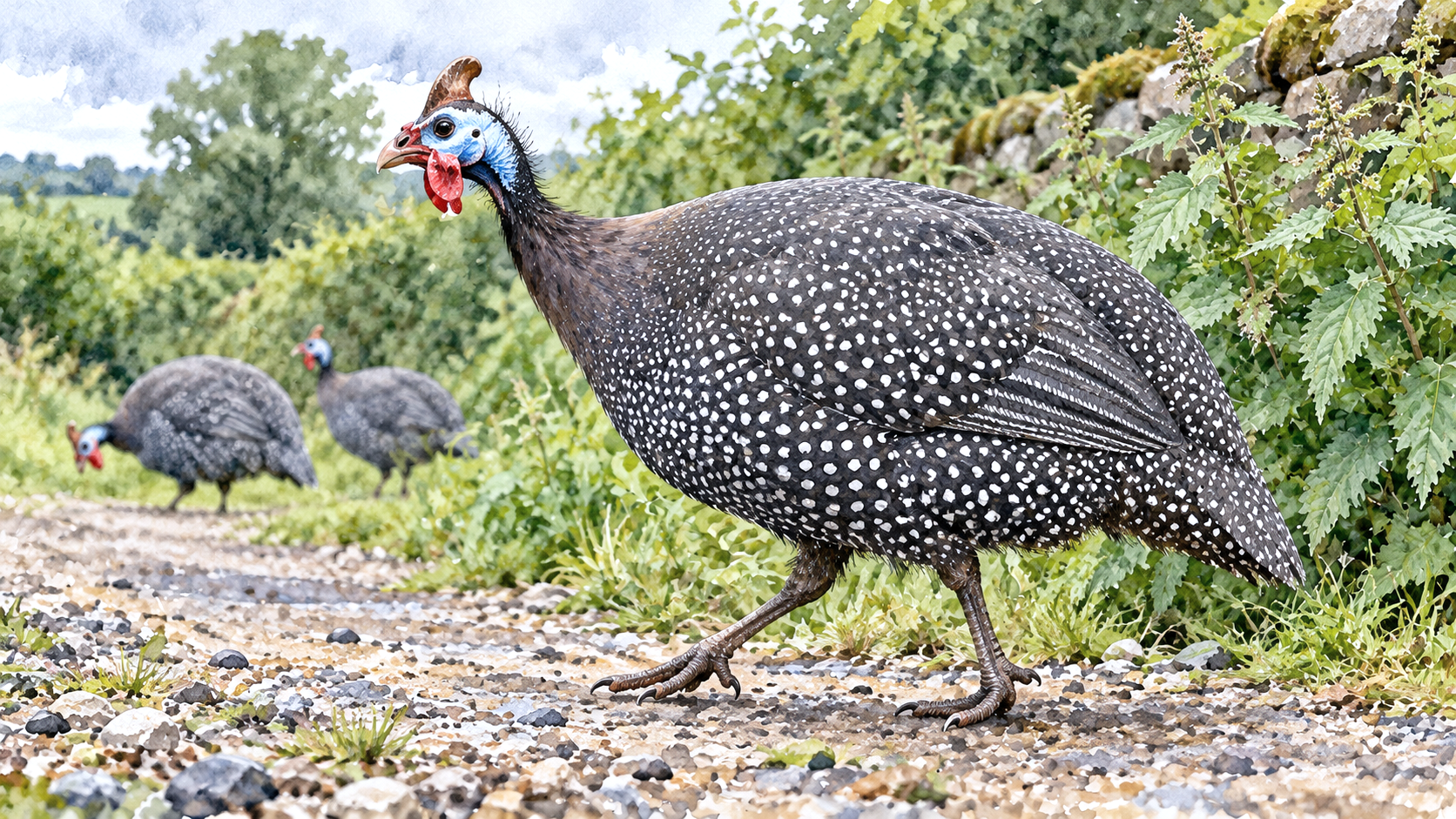
A guinea fowl is a ground-dwelling bird belonging to the family Numididae, commonly kept on farms for meat, eggs, insect foraging, and its distinctive alarm calls. The domestic guinea fowl most familiar to American farmers is the helmeted guinea fowl (Numida meleagris), an African bird with a rounded body, relatively small head, and a prominent bony projection above its face. Although guinea fowl are raised alongside chickens and other poultry, they have their own behavioral characteristics, social habits, and farming uses.
Guinea fowl are active birds that spend much of their day walking through grass, pasture, and open ground in search of food. They usually travel in groups, communicate through conspicuous calls, and respond quickly to unfamiliar activity. Their ability to forage independently and alert a farmyard to disturbances makes them useful in certain agricultural settings, although they still require suitable housing, nutrition, and protection from predators.
What Kind of Bird Is a Guinea Fowl?
Guinea fowl belong to the order Galliformes, a group of primarily ground-dwelling birds that also includes chickens, turkeys, pheasants, and quail. Within that order, guinea fowl form the family Numididae. Their scientific classification places the familiar helmeted guinea fowl in the genus Numida, distinguishing it from domestic chickens (Gallus gallus domesticus) and other poultry despite their shared evolutionary ancestry.
The term guinea fowl can describe several related African bird species, but the domesticated helmeted guinea fowl is the one most commonly encountered on American farms. Its wild relatives inhabit grasslands, savannas, and other environments across Africa, while domesticated populations have spread to agricultural settings elsewhere in the world. The different types of guinea fowl share recognizable biological characteristics, although their appearances, habitats, and relationships with humans differ.
Domestic helmeted guinea fowl have a compact body, relatively short tail, strong legs, and a small head with a casque, commonly called a helmet. Fleshy wattles extend from the sides of the face, and the neck is largely bare of feathers. The familiar pearl variety has dark plumage covered with numerous small white spots, but domestic birds also occur in other colors and patterns. These guinea fowl breeds and color varieties are generally variations within domesticated helmeted guinea fowl rather than entirely different species.
Adult males and females have similar overall appearances, making their sex less immediately obvious than in many chicken breeds. The term guinea hen refers specifically to an adult female, while an adult male is called a guinea cock. Young guinea fowl are known as keets. These names are useful in poultry keeping because breeding, egg production, and developmental requirements differ between males, females, and young birds.
Why Are Guinea Fowl Considered Farm Poultry?
Guinea fowl are classified as poultry because domesticated birds are kept and bred by people for agricultural purposes, particularly food production. Their inclusion among domestic backyard poultry places them alongside chickens, ducks, geese, and turkeys, even though their behavior and production characteristics are not identical.
Historically, guinea fowl have been maintained for meat, eggs, and ornamental purposes. Their domestication has also made them familiar inhabitants of small farms, homesteads, and mixed-poultry operations. Unlike chickens, which have undergone extensive selective breeding into highly specialized egg-laying and meat-producing strains, many domestic guinea fowl retain conspicuous behaviors associated with free-ranging birds, including frequent movement, elevated roosting, and strong reactions to disturbances.
A domestic guinea fowl is not automatically a wild animal simply because it avoids close human interaction or roams beyond its housing area. Domestication describes the bird’s breeding history and relationship with human agriculture, while tameness describes how an individual responds to people. Domestic guinea fowl may become accustomed to familiar keepers and routines without becoming particularly tolerant of being touched or restrained.
Their continued resemblance to wild populations reflects the African origins of guinea fowl, where their ancestors developed behaviors suited to moving across open habitats, finding food, and responding to potential threats.
What Are Guinea Fowl Used For on Farms?
Guinea fowl serve several agricultural purposes, although their usefulness depends on the farm’s priorities, available land, and management system. They may be kept for food production, insect foraging, alarm calling, or simply as ornamental poultry.
Their insect-eating habits are particularly familiar to American homesteaders. Guinea fowl search through vegetation and soil surfaces for beetles, grasshoppers, ticks, and other invertebrates. Their diet also includes seeds and plant material, allowing them to obtain a variety of foods while foraging. The insect-foraging habits of guinea fowl make them potential contributors to farm pest management, but their presence cannot guarantee control of particular pest populations. Insects are only part of their diet, and the effectiveness of their foraging depends on habitat, seasonal availability, and flock activity.
Guinea fowl are also kept for their distinctive alarm behavior. They readily vocalize when they notice unfamiliar animals, approaching people, or unexpected disturbances. Their calls can alert a farmer to activity that might otherwise go unnoticed, although the birds cannot reliably distinguish every genuine danger from harmless movement. The same behavior that makes them noticeable farmyard sentinels can create considerable noise around neighboring homes.
Meat and egg production provide more conventional agricultural uses. Guinea fowl meat is consumed as specialty poultry, while guinea hens produce edible eggs during their laying season. Their production patterns, carcass characteristics, and market opportunities differ from those of commercial chicken strains. The range of purposes for raising guinea fowl therefore extends beyond conventional poultry production, particularly on farms where insect foraging and alarm behavior are also valued.
What Is Guinea Fowl Behavior Like?
Guinea fowl are highly social birds that commonly move together while feeding, exploring, and responding to activity around them. Flock members maintain contact through vocalizations and often react collectively when one bird becomes alarmed. Their social nature is an important part of their everyday behavior, particularly when birds are allowed to roam across open ground.
Much of their movement takes place on foot. Guinea fowl are capable runners that prefer walking and running during ordinary foraging, but they are also able to fly. Their flight ability allows them to reach elevated perches and cross ordinary farm fences, particularly when startled. Free-ranging birds may travel beyond the immediate farmyard, and their willingness to wander does not necessarily correspond to property boundaries. These traits are recognized in small-flock guinea fowl management, where movement, housing, and acclimation are important considerations.
Their vocal behavior is equally distinctive. Guinea fowl produce different calls during ordinary communication, flock separation, and alarm situations. Some vocalizations are particularly useful when distinguishing adult males from females, while others are shared by both sexes. The birds can become especially vocal when unfamiliar activity interrupts their routine, making their calls a prominent feature of farms where they are kept.
They also retain a tendency to use elevated roosting locations. Trees, beams, and other high structures may attract free-ranging guinea fowl when they settle for the night. Although these locations resemble natural roosting sites, sleeping outdoors can expose domestic birds to predators and severe weather. Guinea fowl benefit from secure housing and consistent routines that encourage them to return to protected shelter.
How Are Guinea Fowl Different From Chickens?
Guinea fowl and chickens share several characteristics associated with ground-dwelling poultry, including omnivorous feeding habits, strong legs, and social flock behavior. However, they differ in domestication history, typical activity patterns, vocalizations, and agricultural specialization.
Modern chickens include breeds and commercial strains selected for particular production goals, whereas domestic guinea fowl are generally less specialized. Guinea fowl tend to be more active roamers and may be less tolerant of close human handling than many familiar domestic chickens. Their frequent alarm calls and ability to cross ordinary property boundaries can also make them harder to accommodate in some residential settings.
Their agricultural roles overlap without being interchangeable. Both species can provide meat and eggs, and both consume insects while foraging. However, differences in production, egg-laying seasonality, temperament, and housing behavior influence which bird is better suited to a particular operation. The choice between guinea fowl and chickens depends on whether the farmer prioritizes conventional poultry output, active foraging, flock temperament, or a combination of those characteristics.
Guinea fowl can also be kept on properties that already have chickens, but the presence of both species does not guarantee peaceful integration. Differences in feeding arrangements, behavior, and social interactions require consideration before birds share an enclosure.
Are Guinea Fowl Suitable for Small Farms?
Guinea fowl can be suitable for small farms that have enough room to accommodate their activity, appropriate facilities to keep them secure, and owners prepared for their frequent vocalizations. They are less convenient on properties where noise restrictions, close neighbors, or limited enclosure space make their natural behavior difficult to manage.
Their social needs also deserve attention. Guinea fowl ordinarily associate with other members of their species, and isolation can interfere with normal flock behavior. Their suitability should therefore be assessed in terms of maintaining a compatible group rather than treating each bird as an independent farm animal.
Basic welfare requirements remain necessary even when guinea fowl are permitted to forage extensively. They need an appropriate diet, reliable clean water, weather protection, secure nighttime accommodation, and regular observation for illness or injury. Poultry housing guidance emphasizes that space needs depend on the species, age, environmental conditions, and amount of outdoor access rather than a single stocking figure suitable for every situation.
Farmers must also consider disease prevention. Guinea fowl are susceptible to poultry diseases, and free-ranging birds may encounter wild birds, contaminated water, or other sources of infection. Appropriate poultry biosecurity practices include maintaining clean equipment, reducing unnecessary contact with wild birds, and limiting routes through which pathogens can enter the flock. Anyone handling guinea fowl, their bedding, or their eggs should wash their hands afterward, since apparently healthy poultry can carry germs harmful to people.
Before acquiring birds, prospective keepers should check applicable local zoning rules, poultry restrictions, and neighborhood requirements. A farm’s ability to accommodate guinea fowl depends as much on its surroundings and management capacity as on the birds’ potential usefulness.
For someone considering raising guinea fowl on a farm, the defining commitment is accommodating a mobile, vocal, social bird rather than expecting it to behave like a conventional laying hen. Guinea fowl can contribute meat, eggs, insect foraging, and alarm behavior to an agricultural operation, provided their welfare and management needs are met.