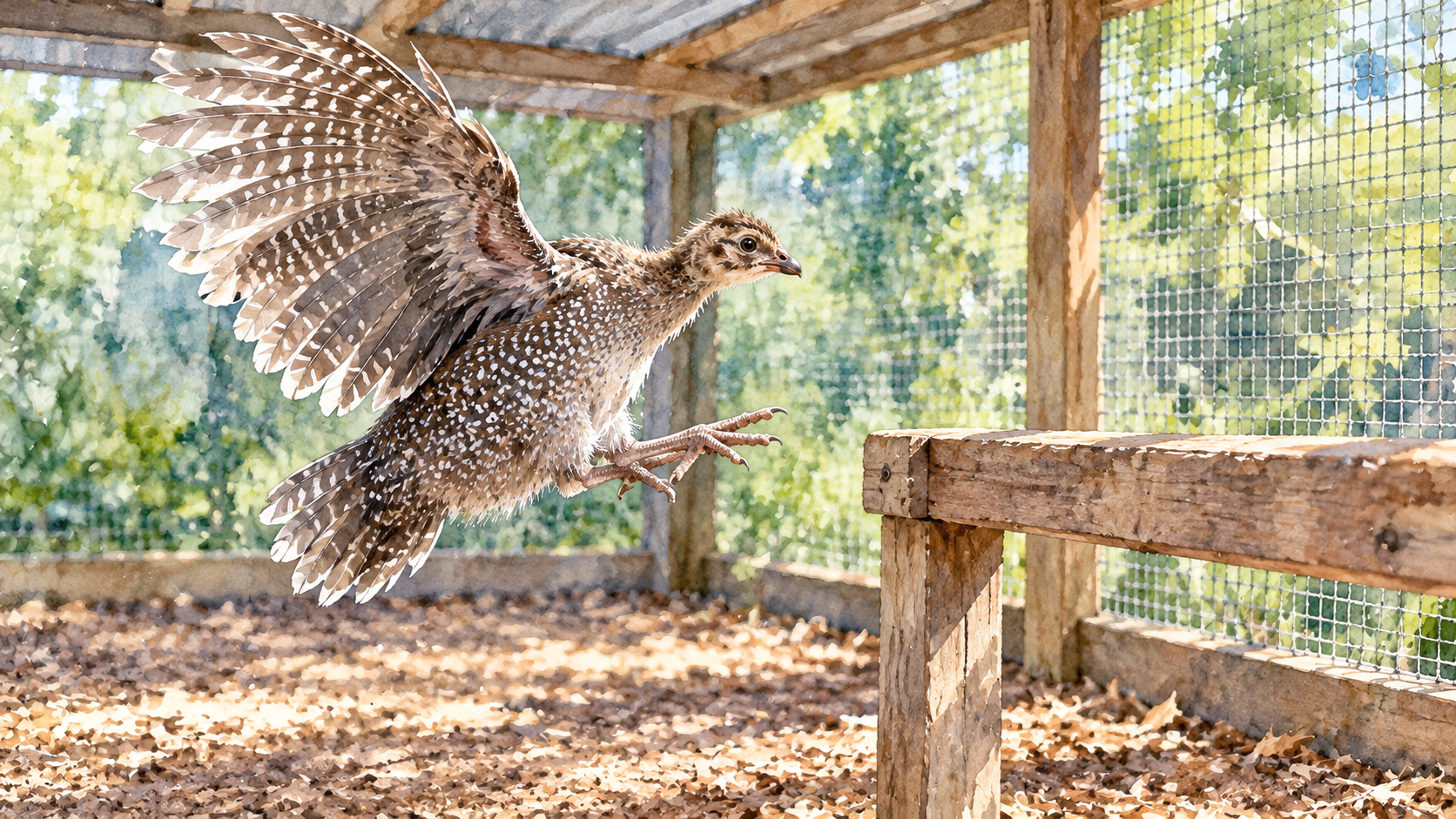
A guinea keet may look too small to fly when it first arrives, but its wings develop surprisingly quickly. A brooder that contains newly hatched birds can become an escape risk within a couple of weeks as the keets begin jumping, fluttering and reaching higher surfaces.
Young guinea fowl can begin making short flights at approximately 10–14 days old. Initially they flutter upward, clear low obstacles and reach nearby perches. Growing feathers and stronger flight muscles allow them to gain height and improve control over the following weeks. Some birds escape an open brooder before two weeks, while others take longer.
At What Age Do Guinea Keets First Fly?
Most guinea keets begin showing useful flight ability around two weeks. Their first flights may resemble powerful wing-assisted jumps rather than smooth movement across a large space. The early flight development of guinea keets often becomes noticeable between 10 and 14 days, when a bird may suddenly reach the top of a container that held it safely only days earlier.
The ability of two-week-old keets to become airborne makes uncovered brooders risky even though the birds remain mostly down-covered. Not every keet follows an identical schedule: wing development, condition, space and confidence affect when flight attempts begin. A bird not previously observed flying may still clear a low wall if startled.
How Flight Ability Changes Week by Week
| Age | Typical flight development |
|---|---|
| Hatch to 1 week | Walking and running, with little useful wing lift |
| Around 10–14 days | Short fluttering flights and low escapes may begin |
| Weeks 3–4 | More frequent wing-assisted jumps and short flights |
| Weeks 5–6 | Greater height, strength and improved direction control |
| Weeks 7–8 | More confident short-distance flights and elevated perching |
| Beyond 8 weeks | Continuing improvements in flight strength and coordination |
These are overlapping stages, not exact deadlines. Early development in young guinea fowl includes increasing movement and a growing need for space. A keet reaching a perch is not necessarily capable of a controlled landing from every height, and a juvenile that flies well may still lack an adult’s experience.
Why Keets Fly Before They Are Fully Feathered
Wing feathers develop before the complete juvenile feather covering of the body. A keet may therefore generate enough lift while its chest, back or belly still retains much of its soft hatchling down. Flight readiness and full feathering are separate developmental events.
The physical changes during guinea keet growth show how juvenile feathers replace down gradually. Lengthening primary feathers offer more surface for lift, while stronger muscles and better coordination make them useful. The relationship between early feathers and flight explains why keets can escape well before looking like miniature adult guinea fowl.
What Do the First Flights Look Like?
A keet may jump, beat its wings rapidly and reach the brooder’s rim or a nearby low object. Others briefly rise above the floor before landing. The first attempts can be uneven: a bird may gain height but land awkwardly, turn poorly or misjudge a surface.
As strength increases, keets begin combining jumps, wingbeats and descents with better control. Running remains an important movement pattern, so a bird may sprint across the floor even when capable of a short flight. One observation does not establish its maximum ability.
When Do Young Guinea Fowl Begin Perching?
Some keets investigate low raised surfaces soon after they begin flying. Over the following weeks many can hop or flutter onto stable perches and use them for exploration and rest. Early perching behavior supports opportunities for movement, but a perch must not be so high that poor landing coordination risks injury.
Use low, broad, stable surfaces rather than narrow, slippery or excessively high perches. Check for spaces where a bird could wedge its head or legs behind equipment. As their strength improves, the stability and positioning of guinea roosts become more relevant to their developing resting habits.
Why Young Keets Escape Open Brooders
An uncovered brooder can become inadequate abruptly. A startled bird may launch upward, especially if someone reaches into the enclosure from above. Multiple keets may jump and flutter together in response to a disturbance.
An escaped keet can land behind furniture, enter a colder area, become separated from companions or reach household hazards. The safety requirements of guinea keet brooders should include overhead protection before the first escape occurs. Waiting for a keet to fly out is unnecessary.
How to Contain Flying Keets Safely
Fit a secure, ventilated cover over the brooder or growing pen. Rigid hardware cloth or suitable small-opening mesh can work if firmly attached and free of sharp edges. The cover must resist access by pets and other animals. Loose netting that droops into the enclosure can entangle wings, legs or heads.
Check gaps around doors, feeding ports, corners and panels. Keets may fit through openings too small for adults. Leave enough space for running and wing movement without repeated collisions. Space needs during early guinea development increase as birds become stronger and more active.
Review the heating arrangement as well. A flying keet may collide with an exposed heat lamp, suffer burns or knock equipment loose. Use securely mounted poultry-rated heating equipment with safe clearance from the birds.
Can Juvenile Guinea Fowl Fly Over Fences?
Yes. Once keets acquire enough strength and coordination, a low fence may be easier to fly over than its owner expects. This ability can arrive while the birds remain too immature to manage hazards beyond their enclosure.
A barrier preventing walking escapes may do nothing against upward flight. Use a securely covered pen for reliable containment during this stage, and examine joints between the roof, fencing and gates. The flight ability of mature guinea fowl develops from these early skills, but juvenile performance should be assessed on its own.
Does Flying Mean a Keet Can Live Outdoors?
No. Wing development and temperature regulation do not progress identically. A keet may fly out of its brooder while retaining substantial down and remaining vulnerable to cold, damp conditions.
Outdoor readiness of guinea keets depends on feather coverage, shelter, weather and acclimation. A two-week-old bird making short flights is not thereby ready for unsupervised outdoor housing. Flight also does not establish readiness to mix with full-grown guinea fowl, which may injure much smaller birds.
What if One Keet Is Not Flying Yet?
Individual variation is normal. A healthy keet may be less inclined to attempt flight or develop coordination later than companions. Check that it walks and runs normally, moves both wings symmetrically and continues growing feathers.
A drooping wing, visible injury, poor balance, persistent weakness or sudden decline requires attention. Guinea fowl illness and injury warning signs should not be dismissed as ordinary differences in flight development. Never throw a bird into the air or force it from a perch to test its ability. Natural movement in a safe enclosure provides a more appropriate assessment.
Questions About When Guinea Keets Start Flying
Can guinea keets fly at one week? They may flutter and jump, but meaningful short flights are more common around 10–14 days.
Can two-week-old guinea keets fly? Yes. Some can reach low elevated surfaces or escape open brooders.
How well can four-week-old keets fly? Many can make short flights and increasingly controlled jumps, though ability varies.
Can six-week-old guinea fowl fly? Many can reach raised perches, clear low barriers and make short flights. Their skill continues improving.
When should a brooder have a lid? Before approximately 10–14 days, preferably from the beginning.
Do young keets need perches? Appropriate low, secure perches can support normal movement, but avoid falling hazards.
Does flying mean a keet is fully feathered? No. Wing feathers can support lift while much of the body remains down-covered.
What if one keet has not started flying? Consider individual variation, but investigate injury, weakness or abnormal wing movement rather than forcing the bird to fly.
One thought on “When Do Young Guinea Fowl Start Flying?”