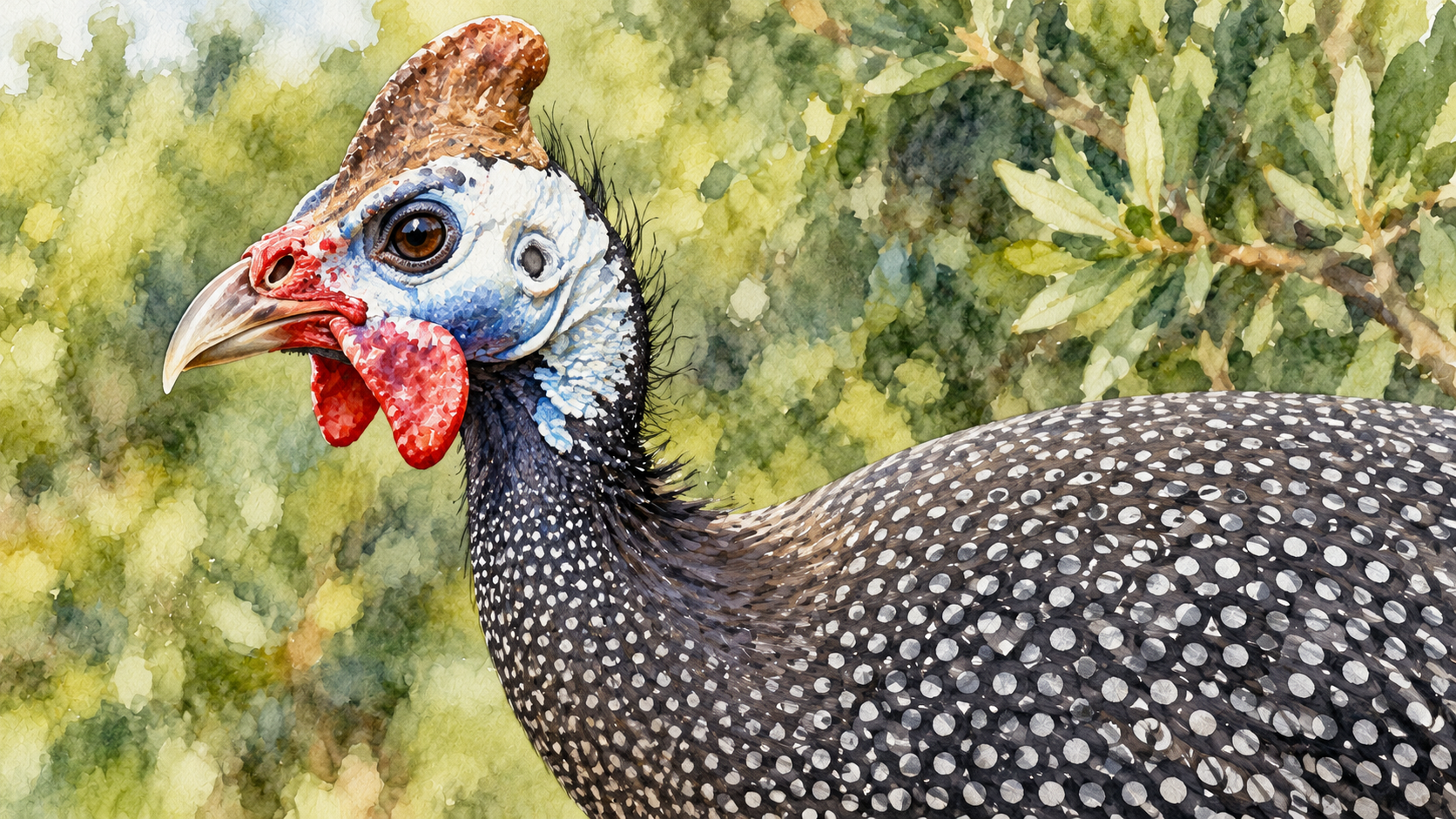
An adult guinea fowl has a rounded, compact body, a relatively small head, a mostly bare upper neck, strong legs, and a short, downward-pointing tail. The familiar domestic helmeted guinea fowl (Numida meleagris) is especially recognizable by the hard, hornlike projection on its head, fleshy wattles beside its beak, and densely spotted feathers. Traditional Pearl Gray birds have dark gray plumage covered with numerous small white dots, giving them a distinctive speckled appearance.
Their silhouette is noticeably different from that of a typical domestic chicken. The head appears small compared with the broad body, while the back forms a smooth curve toward the low-set tail. Their wings lie close against their sides, and their unfeathered legs are clearly visible beneath the body. Although domestic guinea fowl occur in several colors, these structural features make mature helmeted birds recognizable even when their plumage differs from the familiar spotted pattern.
The Helmet, Wattles, and Bare Head
The most distinctive feature of a helmeted guinea fowl is the hard projection rising from the crown of its head. Known as a casque or helmet, it is generally brownish or horn-colored and often curves slightly backward. Unlike a chicken’s soft, fleshy comb, the casque contains bone beneath its skin covering. The anatomy of galliform birds describes this structure as a spongy bony extension associated with the frontal and nasal regions of the skull.
The helmet varies in height, thickness, and curvature among individuals. Some birds have a relatively upright casque, while others possess a more pronounced backward curve. Both sexes develop this feature, although its proportions may differ. The helmet is a normal part of the bird’s anatomy rather than an abnormal growth or injury.
Much of the head and upper neck has exposed skin instead of ordinary body feathers. The skin commonly displays blue-gray, whitish, and reddish coloration, particularly around the face and throat. Guinea fowl have round, dark-brown eyes that can appear nearly black from a distance, along with a short, strong beak that curves downward at its tip. Fine, hairlike feathers may extend along the back of the head, contrasting with the surrounding bare skin.
A pair of fleshy wattles hangs beside the beak. These appendages usually contain red and blue coloration, although their exact appearance varies. Some wattles are relatively flat, while others curve outward and form a more conspicuous shape. The University of Kentucky’s description of guinea fowl external anatomy identifies the casque, wattles, eyes, beak, and exposed head skin as important anatomical features.
The shapes of the helmet and wattles sometimes provide clues about a bird’s sex, but considerable overlap exists between individuals. Male and female guinea fowl have similar physical characteristics, so neither feature should be treated as a universally reliable indicator by itself.
Body Shape, Neck, and Tail
A guinea fowl’s body has a broad, oval outline, with a full breast and rounded back tapering toward the tail. Dense body feathers create a smooth appearance, making the bird look comparatively plump even though its neck and legs are relatively slender. Its head is carried above the body, emphasizing the contrast between the narrow neck and rounded trunk.
The upper neck contains extensive areas of bare skin, while the lower portion is covered with fine, downlike feathers. These gradually merge into the ordinary body plumage. The helmeted guinea fowl’s physical description records this transition from exposed neck skin to downy feathering and finally to the densely feathered body. When a bird extends its neck, the bare section becomes particularly noticeable.
The tail is short and usually carried low behind the body. Unlike many domestic roosters, guinea fowl do not have long, arching ornamental tail feathers. The back slopes gently toward the rump, and the tail continues that downward curve, giving the entire upper body a rounded profile.
Adult birds also vary in their apparent proportions depending on posture. A guinea fowl stretching upward may look noticeably taller and slimmer than the same bird standing with its neck drawn closer to its shoulders. The size and body proportions of adult guinea fowl also differ somewhat with sex, genetics, and breeding background.
What Do Guinea Fowl Feathers Look Like?
The traditional Pearl Gray guinea fowl has dark slate-gray feathers marked with numerous small white spots. This characteristic pattern is called pearling. Individual spots appear on the body feathers, creating a dense, speckled pattern across the breast, back, sides, and wings.
The markings are not distributed identically across every feather. On the breast and back, the white dots usually appear closely spaced and relatively uniform. The wing feathers can show longer markings that form narrow pale bars when the wings are folded. The Cornell Lab of Ornithology’s helmeted guineafowl account identifies the characteristic plumage and other physical features used to recognize the species.
Guinea fowl feathers overlap closely, producing a smooth outer surface. The dark background coloration may appear almost black in shade but show a softer gray or purplish tone in direct sunlight. The contrast between the background feathers and white pearling gives the familiar domestic bird its recognizable appearance.
Not every domestic guinea fowl has the same feather pattern. White birds may have entirely white plumage, while Lavender, Royal Purple, and other varieties display different combinations of pigmentation and spotting. These domestic guinea fowl color varieties can look substantially different from Pearl Gray birds without having a different basic body structure.
Healthy adult feathers should generally form an orderly covering across the body. Temporary irregularities may occur during normal feather replacement, but extensive bald patches, damaged feathers, or irritated skin are not characteristic color patterns. Unexpected feather loss in guinea fowl may require investigation, particularly when accompanied by changes in appetite, activity, or skin condition.
Wings, Legs, and Feet
Guinea fowl have rounded wings that rest closely against their sides when folded. Their outer feathers overlap the longer flight feathers, concealing much of the wing’s surface during ordinary movement. The folded wings follow the contour of the rounded body and rarely stand out prominently unless the bird stretches or opens them.
The wings are functional despite their compact appearance. Guinea fowl can spread them to produce sufficient lift for flight, although their usual posture does not reveal the full wing surface. Their ability to fly is one reason the folded-wing silhouette should not be mistaken for an inability to become airborne.
The legs are strong, relatively slender, and normally unfeathered. Wild-type birds typically have dark gray legs, while domestic populations may display different shank pigmentation. The feet have three main forward-pointing toes and a smaller rear toe, with claws that provide traction on the ground. The University of Kentucky’s anatomical description identifies the straight toes, strong legs, and characteristic body carriage of the species.
Adult helmeted guinea fowl generally lack the prominent leg spurs found on some male chickens. Their legs and feet contribute to their characteristic upright stance, with the rounded body balanced above the ground rather than resting close to it.
How to Recognize a Guinea Fowl Among Other Poultry
A guinea fowl can resemble a small, rounded chicken when viewed from a distance, particularly if its head is obscured. Closer observation reveals a different head structure. The hard helmet, exposed facial skin, and wattles positioned beside the beak are distinctive features of the domestic helmeted species.
The tail also helps distinguish it from many chicken breeds. Domestic chickens frequently have conspicuous upright or curved tail feathers, whereas guinea fowl have a shorter tail carried low. The guinea fowl’s rounded trunk, comparatively small head, and narrow neck create a different overall silhouette.
Young turkeys and certain ornamental poultry may share individual characteristics, such as exposed facial skin or rounded bodies, but their head ornaments and tail structures differ. The relationship between guinea fowl, chickens, turkeys, and peafowl explains their shared general bird anatomy without making their distinctive physical features interchangeable.
The familiar domestic appearance should not be assumed universal across the guinea fowl family. Some wild species have feather crests instead of a helmet, while others possess different head and neck plumage. The University of Nebraska-Lincoln’s comparison of guinea fowl species illustrates how helmeted, crested, and vulturine guinea fowl differ in their external appearance.
How Appearance Changes as Guinea Fowl Mature
Newly hatched guinea fowl do not possess the complete adult combination of prominent helmet, mature wattles, and fully developed body feathers. These features become increasingly recognizable as the birds grow. The appearance of a young guinea keet is therefore noticeably different from that of a mature domestic bird.
The head ornaments develop as the bird approaches adulthood. The casque becomes more conspicuous, while the wattles and exposed facial skin acquire their mature proportions and coloration. Juvenile feathers are gradually replaced by more developed plumage, allowing the characteristic adult color and spotting pattern to become clearer.
Mature birds may still show individual differences in casque shape, facial coloration, and feather condition. Some variation is inherited, while temporary changes in appearance may accompany normal molting and feather replacement. A permanent head structure such as the casque remains identifiable even when the feathers are undergoing seasonal replacement.
Questions About Guinea Fowl Physical Features
Do guinea fowl have ears?
Yes. Guinea fowl have small external ear openings on the sides of their heads, although they lack projecting outer ears like mammals. These openings are relatively inconspicuous compared with the helmet and wattles.
Do guinea fowl have combs like chickens?
Not in the same anatomical sense. Helmeted guinea fowl possess a hard casque rather than the soft, fleshy comb typical of many domestic chickens. Some poultry terminology loosely calls the casque a comb, but the structures are different.
Why do guinea fowl look bald around their heads?
The exposed skin on the head and upper neck is a normal feature of adult helmeted guinea fowl. Fine feathers occur in some areas, particularly toward the back of the head and lower neck, but much of the upper region naturally lacks ordinary body plumage.
Can guinea fowl have different eye or leg colors?
Yes. Adult helmeted guinea fowl typically have dark-brown eyes, while leg and exposed-skin coloration can vary among domestic populations. A sudden change in color, swelling, injury, or the appearance of lesions should not automatically be attributed to normal pigmentation. Such changes may require veterinary examination.
4 thoughts on “What Does a Guinea Fowl Look Like?”