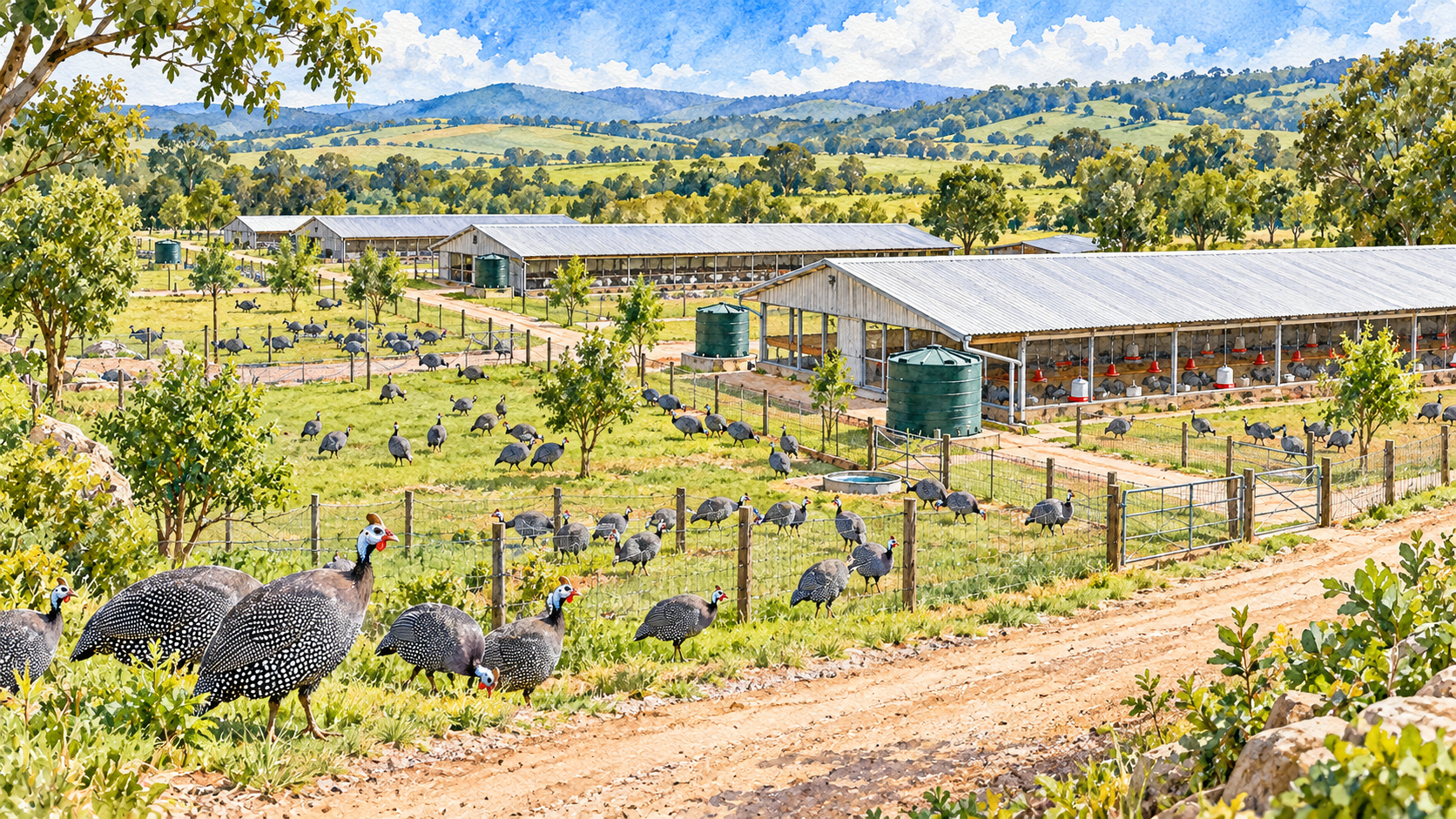
Starting a commercial guinea fowl farm requires a defined market, suitable production facilities, reliable breeding or replacement stock, and a system for managing birds through to sale. Unlike keeping a small backyard flock, commercial production must coordinate bird numbers, seasonal availability, labor, disease prevention, and customer orders.
The most practical approach is to begin with a limited commercial production cycle, establish dependable buyers, and expand only when sales and operational records support it. Guinea fowl occupy a specialized poultry market in the United States, so producing large numbers without confirmed customers can leave a farm with unsold birds and continuing expenses.
Choose a Commercial Production Model
The first decision is what the business will produce. Guinea fowl farms generally concentrate on meat, live birds, breeding stock, fertile eggs, or a combination of related products. Each requires different infrastructure and sales arrangements.
| Production model | Main infrastructure | Commercial consideration |
|---|---|---|
| Meat production | Growing facilities, feed storage, processing access | Consistent carcass specifications and buyers |
| Keet production | Breeding pens, egg collection, incubators, brooders | Seasonal hatch schedules and hatchery capacity |
| Hatching eggs | Managed breeding groups, egg handling and storage facilities | Fertility, handling quality, and shipping arrangements |
| Breeding stock | Separate breeding groups, identification and recordkeeping | Documented characteristics and buyer demand |
| Live growers and adults | Growing pens, holding facilities, transport equipment | Longer holding periods and variable customer orders |
Commercial guinea fowl can be raised for meat or breeding purposes, but the market for specialty poultry is often local unless the producer invests in broader distribution. A farm selling fertile eggs online may reach a different customer base from one supplying dressed birds to nearby restaurants.
Production models can complement one another, but diversification should have a commercial purpose. Maintaining breeding stock solely to supply an occasional meat order may tie up facilities and labor that would otherwise be better used for growing purchased keets.
The revenue potential of guinea fowl farming depends on the quantities sold and the costs attached to each product, not simply the number of activities the farm offers.
Find Buyers Before Establishing Production Capacity
Demand should determine the size and timing of the first commercial flock. Contact prospective customers and establish what they want to purchase, how often they expect deliveries, and what specifications they require.
Restaurants may want a dependable supply of birds within a particular weight range, while hatchery customers may prioritize color varieties, hatch dates, and minimum order quantities. Some buyers require specific packaging, labeling, or documented production practices. An informal expression of interest should not be treated as a confirmed recurring order.
Potential outlets include direct farm sales, independent food retailers, restaurants, breeders, and local food distributors. Local food directories can help identify farmers markets, food hubs, and other potential sales channels, although each outlet must be approached to determine whether it accepts guinea fowl products.
Record expected purchase volumes, seasonal demand, payment terms, and delivery requirements. A restaurant willing to buy ten birds occasionally cannot necessarily support a farm producing several hundred every month. Similarly, hatchery demand may rise around spring and decline later in the year.
Where sales are seasonal, production schedules should reflect actual ordering patterns rather than maintaining maximum output continuously.
Determine a Production Scale the Farm Can Support
Commercial scale should be expressed in birds produced and sold over a defined period, not merely the number housed at one time.
For example, a farm raising 100 birds per batch and completing three batches annually would place 300 birds into production. Its actual annual sales would depend on survival, product quality, and customer orders. A breeding operation requires a different calculation because mature birds remain on the farm while eggs or keets are produced.
Capacity planning should account for:
- The maximum number of birds housed at each production stage.
- Time required between batches for cleaning and preparation.
- Available feeding, watering, and ventilation capacity.
- Labor for daily care, handling, and recordkeeping.
- Space for separating sick birds and newly acquired stock.
- Processing, collection, or shipping dates.
Guinea fowl may fly and roam extensively, so commercial enclosures need dependable containment rather than ordinary low farm fencing. The space requirements of guinea fowl also depend on age and management conditions. A facility that accommodates young growers safely may not provide suitable space for the same number of mature birds.
For the first production cycle, operating below the farm’s maximum physical capacity allows equipment, staffing, and management procedures to be tested without immediately placing the largest possible number of animals at risk.
Develop the Required Farm Infrastructure
A commercial facility should support a predictable movement of birds through receiving, growing, holding, and dispatch. Where breeding and incubation occur on-site, separate areas are needed for egg handling, incubation, hatching, and young-bird accommodation.
Production areas should be arranged to minimize unnecessary movement between age groups. Young birds are particularly vulnerable to environmental problems, and moving contaminated equipment between sections can spread pathogens. Routine biosecurity measures should restrict movement of people, equipment, and animals between poultry areas.
Reliable utilities are essential. Water supply interruptions, electrical failures affecting brooders, and ventilation breakdowns can create serious welfare problems. Farms using powered incubation, heating, or ventilation equipment should develop emergency arrangements appropriate to their systems.
Feed storage must protect rations from moisture, rodents, and spoilage. Buildings also need safe manure-removal access, equipment storage, and adequate drainage. Predator-resistant construction reduces avoidable losses, while working doors and internal partitions make inspections and bird movements easier.
The construction of suitable guinea fowl housing requires attention to the birds’ flight capability and roosting behavior. Commercial facilities should additionally accommodate efficient cleaning, employee access, and the separation of different production groups.
Establish Reliable Stock and Production Schedules
Commercial consistency begins with dependable bird suppliers or well-managed breeding groups. Purchase stock from operations that can provide relevant health information, accurate age records, and the characteristics required for the intended product.
For meat production, the selection of appropriate guinea fowl strains influences growth performance and uniformity. A producer should avoid scheduling customer deliveries around assumed growth rates until actual results are available from the chosen birds and management system.
Breeding operations need identification records, parent-group information, egg collection procedures, and an incubation schedule coordinated with available brooder space. Hatchability should be measured across batches because the number of eggs set will not equal the number of keets available for sale.
A production calendar should include placement dates, anticipated movements between facilities, expected sale periods, and time for sanitation between batches. Recording actual dates allows subsequent cycles to be planned using observed performance rather than optimistic assumptions.
Where live birds or hatching eggs move between states, applicable animal-health requirements must be considered. The National Poultry Improvement Plan provides voluntary testing and certification standards for participating poultry breeding operations and hatcheries, but specific classifications and destination-state rules determine which documentation is relevant.
Confirm Permits, Processing Rules, and Business Requirements
Commercial guinea fowl farming can involve agricultural zoning, building permissions, business registration, waste-management requirements, and animal-health rules. The obligations depend on the state, county, municipality, production scale, and products being sold.
Meat operations require particular attention before constructing facilities or accepting orders. Guinea fowl are recognized as poultry for food purposes, but federal inspection coverage and processing arrangements can differ by species and establishment. The federal framework for poultry inspection and exemptions must be considered alongside state requirements, and a small flock should not be assumed to qualify automatically for an exemption.
Before producing meat for sale, obtain written clarification from the relevant state meat or poultry inspection authority about slaughter arrangements, inspection or exemption eligibility, permitted sales channels, labeling, and storage. The farm should also confirm that any contracted processor accepts guinea fowl and can handle the required quantity and schedule.
Egg sales and hatchery operations have different requirements. Selling fertile eggs for incubation is not equivalent to selling shell eggs for consumption, while live-bird shipments may involve state entry restrictions. Product labels and advertising claims must reflect what the business can substantiate.
Insurance should cover the risks associated with the actual operation. Farm property insurance may not automatically include product liability, commercial poultry losses, customer visits, or transportation. Requirements involving employees, vehicles, and sales taxes also need to be addressed before operations begin.
Organize Daily Operations and Recordkeeping
Commercial management depends on consistent procedures that different workers can follow. Feeding, water checks, environmental monitoring, mortality collection, cleaning, and equipment inspections should have assigned responsibilities.
A practical record system should capture flock identity, stock source, placement date, feed deliveries and consumption, mortality, veterinary interventions, production output, and sales. Recording these figures by batch makes it possible to identify whether unexpected losses or rising feed consumption are associated with particular facilities or production periods.
Enterprise budgets separate variable expenses, fixed costs, and expected receipts, allowing farmers to compare planned performance with actual results. Commercial records should also distinguish saleable birds from total birds placed, because mortality and unsold stock affect the real cost of each unit marketed.
Staff should understand how to recognize abnormal behavior and whom to contact when birds require veterinary assessment. The farm needs a response procedure for significant illness, sudden mortality, escape, predator entry, equipment failure, and interruptions to feed or water availability. Such procedures should be established before the operation reaches full capacity.
Build a Sales and Distribution System
A commercial farm needs a dependable method of delivering products in the condition customers expect. Live-bird sales require appropriate transport arrangements, while hatching eggs need protective packaging and careful handling. Meat distribution may require refrigerated storage and temperature-controlled transportation under the rules applicable to the operation.
Order records should connect customers with specific products, quantities, collection dates, and invoices. For breeding stock or keets, accurate descriptions and identification records help prevent disputes about age or variety. Consistent communication is particularly useful when production is seasonal and customers must reserve stock in advance.
Direct sales can provide access to specialized customers, while wholesale relationships may offer larger or more regular orders. Local and regional food marketing networks can help identify possible distribution outlets, but sellers still need to negotiate quantities, terms, and legal eligibility with individual buyers.
Avoid promising year-round availability before the farm has demonstrated that its production and distribution systems can support it.
Evaluate the First Commercial Cycle Before Expanding
A pilot cycle should establish whether the farm can produce birds to the required standard, deliver them on schedule, and maintain acceptable welfare. Compare planned output with actual placements, losses, feed use, labor, and sales.
An operation may have adequate housing yet struggle with inconsistent hatch rates, unexpected processing delays, or orders concentrated into a short season. These constraints should be corrected before increasing bird numbers.
Expansion is justified when the farm has repeat customers, sufficient working capital, dependable staff and suppliers, and facilities capable of supporting additional production. The commercial performance of a guinea fowl enterprise should be assessed using documented results rather than projected sales alone.
Questions About Establishing a Commercial Guinea Fowl Business
Do you need to own farmland to operate a commercial guinea fowl farm?
Not necessarily. Leased agricultural property may be suitable if the agreement permits poultry production, construction or modification of facilities, and the intended business activities. The lease term should also be long enough to justify investment in infrastructure.
Can a commercial guinea fowl farm specialize in one color variety?
Yes, particularly when serving breeding-stock or ornamental-poultry buyers. Specialization can simplify product identification but may limit the available customer market. Breeding records are important when customers expect particular inherited characteristics.
Should commercial guinea fowl production use separate age groups?
Separate production groups are generally preferable because birds at different developmental stages have different management needs. All-in/all-out management, where a group leaves a production area before the next enters, can also facilitate cleaning and reduce mixing between batches when facilities permit it.
Does a commercial guinea fowl farm need employees?
Not necessarily at the beginning. Some smaller operations are owner-managed, but staffing requirements increase with production volume and the complexity of incubation, processing, deliveries, and customer orders. The farm must have dependable coverage for daily animal care even when the owner is unavailable.