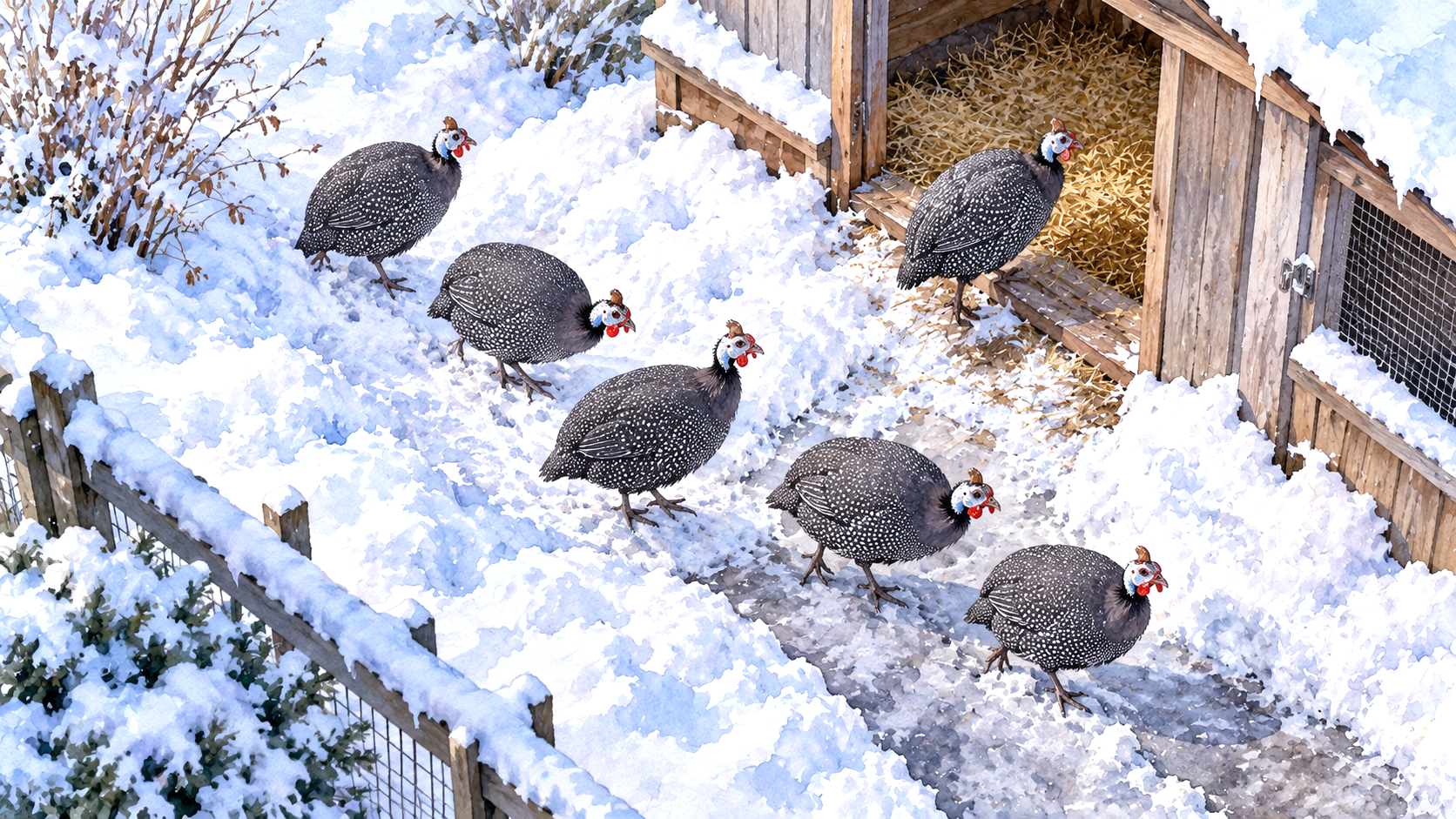
Healthy adult guinea fowl can tolerate freezing temperatures, including snow and periods of substantial winter cold, provided they have protection from harsh conditions. Their feather covering helps conserve body heat, but cold tolerance is not unlimited. Prolonged exposure can cause cold stress, frostbite, hypothermia, and potentially death. However, there is no scientifically established minimum outdoor temperature that is safe for every guinea fowl. A bird may remain comfortable during a brief, calm period below freezing yet struggle at a higher temperature when exposed to strong winds. Age, health, feather condition, and duration of exposure all affect survival.
How Cold Is Too Cold for Guinea Fowl?
A temperature of 32°F (0°C) does not automatically endanger a healthy, fully feathered adult guinea fowl. Temperatures considerably below freezing can also be tolerated under favorable conditions, although the risk increases as exposure becomes colder or longer.
The University of Kentucky’s guinea fowl husbandry guidance describes mature guinea fowl as hardy birds capable of tolerating substantial weather extremes. Guinea Fowl International similarly reports that guinea fowl can withstand considerable cold when protected from damaging environmental exposure.
Neither source establishes a universal safe temperature limit. Claims that guinea fowl can survive temperatures as low as -20°F or -30°F should not be interpreted as evidence that prolonged exposure at those temperatures is harmless.
Survival also differs from comfort. A guinea fowl may remain alive during extreme cold while experiencing significant physiological stress. The cold-weather requirements of guinea fowl therefore depend on more than the lowest temperature recorded outdoors.
How Guinea Fowl Maintain Their Body Temperature
Like other birds, guinea fowl are endothermic animals, meaning they produce metabolic heat to maintain a relatively stable internal body temperature. Their feathers help retain that warmth by trapping insulating air close to the body.
When temperatures fall, birds can fluff their feathers to improve insulation, adopt compact resting postures, and reduce unnecessary movement. They may also position themselves near flockmates, although huddling alone does not establish that they are dangerously cold.
Maintaining body temperature requires additional energy once environmental conditions exceed the bird’s ability to conserve heat without increasing metabolic activity. Poultry cold-stress research identifies body condition, feather coverage, and age as important influences on cold tolerance. These physiological principles are relevant to guinea fowl, but exact temperature thresholds established for chickens should not be applied directly to them.
A bird’s condition going into winter can consequently influence how well it copes with a cold spell. Feather loss, low body weight, and underlying illness reduce its ability to respond to environmental challenges.
Why Some Guinea Fowl Handle Cold Better Than Others
Healthy mature guinea fowl generally withstand low temperatures better than very young birds. Newly hatched guinea keets have immature temperature-regulation abilities and cannot be expected to tolerate adult winter conditions. The species-specific brooding recommendations for keets reflect their need for supplemental warmth during early development.
Older adults may also become less resilient when they have poor body condition, reduced mobility, or chronic health problems. An injured bird unable to maintain its usual resting posture can be especially vulnerable during prolonged cold.
Feather condition introduces another difference. A complete, well-maintained feather covering provides better insulation than damaged, missing, or poorly developed plumage. Guinea fowl experiencing feather loss may consequently tolerate temperatures less effectively than fully feathered flockmates.
Acclimatization can influence responses as well. Birds that experience progressively cooler autumn temperatures have opportunities to adjust their behavior and physiology, whereas sudden exposure to severe cold may be more challenging. Acclimatization does not make any guinea fowl immune to freezing injuries.
Can Guinea Fowl Get Frostbite?
Guinea fowl can develop frostbite, particularly on their toes, feet, wattles, and other exposed tissues. Frostbite occurs when local tissue temperatures become sufficiently low to cause freezing injury. It can affect an otherwise healthy bird even when the rest of its body remains adequately insulated.
Helmeted guinea fowl have distinctive exposed skin around the head, fleshy wattles, and a hard casque rather than a chicken’s typical comb. Their head anatomy and exposed appendages help explain why certain areas require attention during freezing conditions.
Early frostbite may produce pale or discolored skin, swelling, or altered sensitivity. More severe damage can result in darkened tissue and subsequent tissue loss. The University of Kentucky’s poultry frostbite guidance describes these general manifestations, although the observations primarily concern chickens rather than guinea fowl.
Foot injuries may be noticed first through limping, reluctance to stand, or difficulty gripping a perch. Discoloration alone is not enough to diagnose frostbite, and similar signs may occur with injuries or circulation problems.
Suspected frostbite warrants veterinary assessment, particularly when a bird cannot walk normally, develops swelling, or has visibly damaged tissue. Protect the bird from further freezing exposure without rubbing, applying intense heat, removing damaged tissue, or administering medications without veterinary direction.
What Are the Signs of Cold Stress or Hypothermia?
Cold stress develops when a bird must expend additional energy to maintain its normal body temperature. Hypothermia is more serious: the body’s core temperature falls below its normal range because heat loss exceeds heat production.
A guinea fowl experiencing excessive cold may become unusually inactive, remain tightly hunched, tremble, or withdraw from normal flock activity. As its condition deteriorates, weakness, poor coordination, reduced responsiveness, and difficulty standing can develop.
Some of these behaviors resemble symptoms of illness or injury. Veterinary examination guidance for backyard poultry emphasizes evaluating alertness, posture, movement, breathing, and interactions with flockmates rather than relying on a single observation.
A bird that collapses, becomes poorly responsive, or cannot stand requires immediate veterinary attention. Move it carefully into a protected, moderately warm environment while seeking help, avoiding abrupt overheating.
Does Cold Weather Affect How Guinea Fowl Sleep?
During cold conditions, guinea fowl may reduce exposed body surfaces by settling into a compact posture and covering parts of their feet with body feathers. Their ability to do this depends partly on the stability and suitability of their resting surface.
A bird forced to maintain an awkward grip or balance on an unsuitable perch may have difficulty resting comfortably. Appropriate guinea fowl roost positioning helps provide secure footing, although no perch design can completely eliminate frostbite risk during extreme cold.
Birds that habitually sleep outdoors may face extended exposure without the protection available inside a shelter. Cold tolerance should therefore not be used as evidence that guinea fowl can safely go without a coop throughout winter.
Questions About Guinea Fowl Cold Tolerance
Can guinea fowl survive temperatures below 0°F (-18°C)?
Some healthy adult guinea fowl survive temperatures below 0°F when suitable protection is available. This does not establish a safe exposure duration or guarantee that all birds will avoid cold injury.
Are pearl guinea fowl more cold-hardy than lavender or white guinea fowl?
There is insufficient reliable comparative evidence to establish meaningful cold-tolerance differences among these common domestic color varieties. Individual health and environmental conditions are more defensible considerations than plumage color.
Can guinea fowl freeze to death while perched in a tree?
Yes. Prolonged extreme exposure can overwhelm a bird’s capacity to produce and conserve heat, especially if it becomes weakened or unable to seek shelter. An elevated position alone does not prevent fatal hypothermia.
Does a guinea fowl’s helmet protect its head from frostbite?
The helmet, or casque, is a specialized anatomical structure rather than complete thermal protection for the head. Nearby exposed skin and wattles can still sustain freezing injuries.