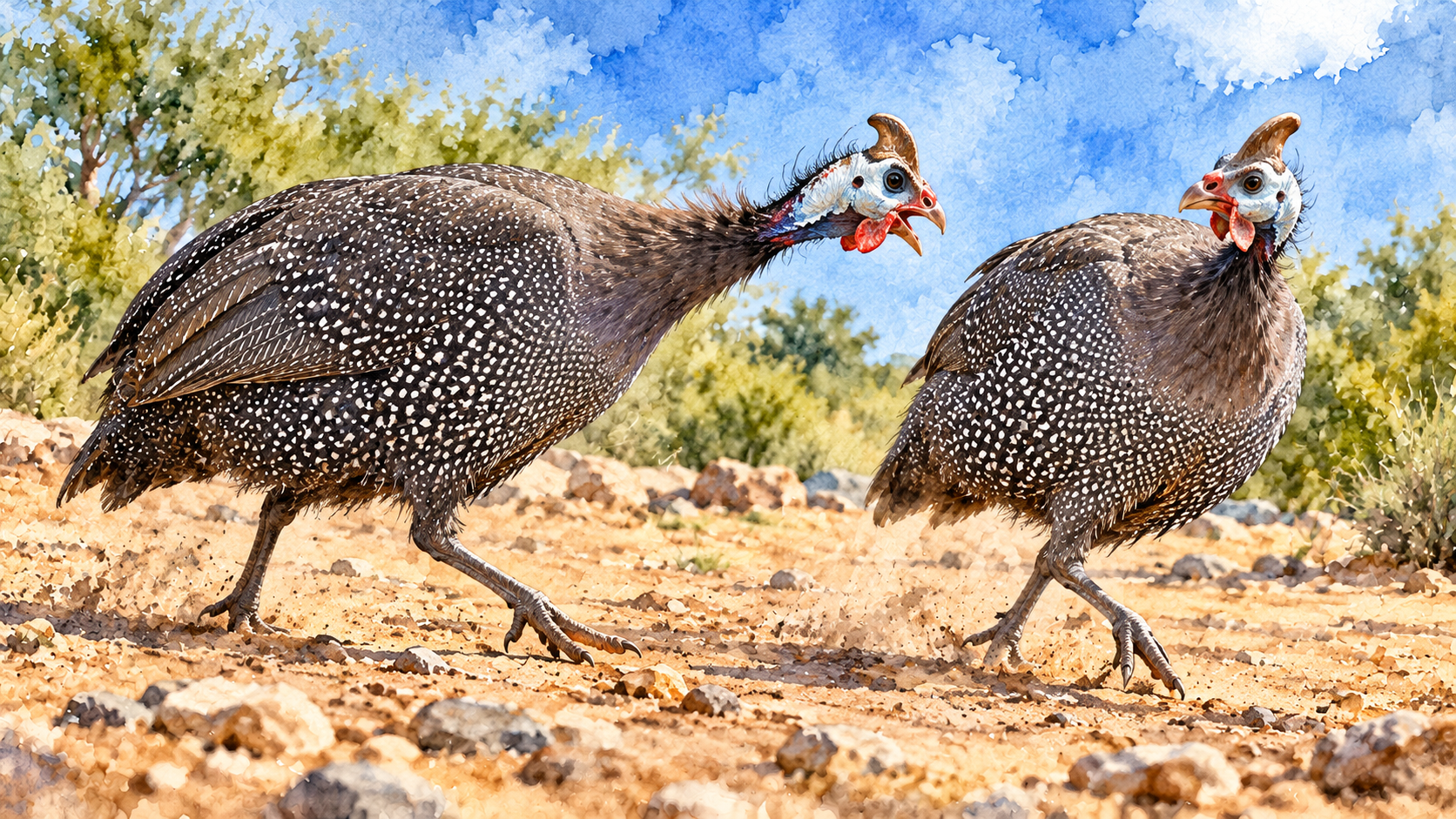
A guinea fowl may spend the morning calmly foraging with its companions, then suddenly charge another bird, deliver several sharp pecks, or pursue a rival across the yard. Such behavior can look alarming, especially when the confrontation involves loud calling and frantic movement. Yet aggression is only one part of guinea fowl social behavior, and it does not define the temperament of every bird.
Guinea fowl can be aggressive, particularly during breeding, territorial disputes, and competition between males. Most established flocks also display extended periods of peaceful activity. Their behavior depends on sex, maturity, social relationships, available space, and the circumstances surrounding an encounter. Some individuals are noticeably more assertive than others, while certain conflicts develop only after changes to the flock or its environment.
How Aggressive Are Guinea Fowl Naturally?
Helmeted guinea fowl (Numida meleagris) are social birds that maintain relationships within their groups. Living in a flock involves cooperation, communication, and competition, but established relationships can allow individuals to interact without repeatedly confronting one another.
A long-term study of wild helmeted guinea fowl in South Africa documented a male dominance hierarchy within a small flock. Higher-ranking males sometimes cooperated to repel unfamiliar guinea fowl, yet aggressive interactions among established members were relatively infrequent. Their social organization therefore involved maintaining rank without constant physical confrontation.
Guinea fowl may also react defensively when unfamiliar animals approach. Their natural vigilance and group responses to potential threats include alarm calling, coordinated movement, and occasionally mobbing. A bird approaching an unfamiliar animal with raised wings or an alert posture may be attempting to discourage intrusion rather than demonstrating indiscriminate aggression.
Individual temperament should be evaluated over time. A single chase or threatening display does not establish that a guinea fowl is persistently aggressive, particularly when the surrounding flock otherwise behaves normally.
Male Guinea Fowl and Dominance Behavior
Competition among males is one of the clearest contexts in which guinea fowl aggression occurs. A male may chase a rival, deliver pecks, or position himself between another bird and a preferred companion. Such encounters can help establish or maintain social rank.
Research published in 2024 examined the formation of pecking orders among helmeted guinea fowl during floor feeding. Male birds directed pecks toward other males, whereas females displayed relatively little pecking under the experimental conditions. The amount of aggression also differed between individuals, indicating that males do not all behave alike.
Rank can affect access to resources. In the same study, subordinate individuals in mixed-sex groups experienced restricted feeding opportunities, suggesting that dominance may have welfare consequences even without severe injuries.
The composition of a flock can influence these interactions. When determining how many guinea fowl to keep together, the birds’ social needs and available space are more important than simply assembling the smallest possible group. Keeping an appropriate number of companions supports normal social behavior, but it does not guarantee the absence of competition.
An assertive male is not necessarily a permanent problem within a stable group. Concern becomes greater when his behavior repeatedly prevents particular birds from accessing food, resting comfortably, or escaping confrontations.
Breeding Season Can Change Their Temperament
Reproductive activity may alter how guinea fowl interact with nearby birds. Males can become more attentive to particular females, challenge rivals, and defend established relationships. These behaviors may appear during periods when the same individuals were previously less confrontational.
Field observations of reproductive and social relationships in helmeted guinea fowl found that breeding females associated more frequently with high-ranking males during the breeding season. The males’ relationships with their companions changed as pairs formed and breeding progressed.
Mate guarding can involve approaching or chasing another male that comes too close to a female. Although such encounters may be brief, they can become more disruptive when several males compete within a restricted area.
The male-to-female ratio in a breeding flock can influence opportunities for competition, although no particular ratio guarantees peaceful behavior. Rank, individual temperament, available space, and the birds’ existing relationships also contribute.
Female guinea fowl may display defensive behavior around nesting areas or young keets. Protecting offspring differs from persistent aggression toward unrelated flock members, and its intensity varies among individuals and situations.
Territorial Behavior and Unfamiliar Birds
Guinea fowl may challenge birds that enter an area regularly occupied by an established group. In wild populations, dominant males have been observed participating in the defense of their flock’s territory against unfamiliar guinea fowl.
Domestic birds can show similar resistance when unfamiliar individuals approach feeding areas, resting places, or established companions. The reaction may involve investigation, threatening postures, pursuit, or physical contact.
Introducing a new bird directly into an established flock can therefore provoke aggression, even when all individuals are healthy. The newcomer lacks existing relationships with the resident birds and may be treated as an intruder until social interactions become more settled.
Careful introduction of new guinea fowl to an existing flock is particularly important when birds differ in size, maturity, or previous social experience. Allowing individuals to become familiar with one another through appropriate barriers can reduce the risk of immediate confrontations, although compatibility still requires observation.
Territorial behavior should not be interpreted as evidence that guinea fowl defend every part of a property. Their responses depend on flock organization, reproductive condition, and familiarity with the surrounding environment.
What Aggression Looks Like in Guinea Fowl
Guinea fowl use movement and posture as well as physical contact during confrontations. Some displays function as warnings, allowing one bird to retreat before a fight develops. Others involve repeated attacks that can injure the targeted individual.
Common aggressive behaviors include:
- Charging: Running directly toward another bird, sometimes with the head lowered or wings partially spread.
- Chasing: Pursuing a retreating individual beyond a brief initial challenge.
- Pecking: Striking another bird, particularly during disputes over rank or access.
- Threatening postures: Raising the body, spreading the wings, or approaching in a manner that causes another bird to withdraw.
- Resource guarding: Preventing particular individuals from approaching food, water, or preferred resting locations.
- Persistent displacement: Repeatedly forcing the same bird away from the group or an occupied area.
A short confrontation followed by ordinary flock activity is different from sustained harassment. Injuries, exhaustion, inability to escape, and repeated exclusion from food indicate a more serious problem.
Guinea fowl vocalizations can accompany these encounters, but loud calls do not independently establish aggression. The different sounds guinea fowl make occur during ordinary communication, excitement, vigilance, and other activities. The birds’ movements and interactions provide better evidence of whether a confrontation is occurring.
Does Confinement Make Guinea Fowl More Aggressive?
A restricted environment can intensify the effects of social competition because birds have fewer opportunities to move away from one another. An individual that could retreat across open ground may be forced into repeated encounters when confined within a smaller space.
The consequences are especially noticeable around limited resources. If one assertive bird occupies the only feeder or repeatedly guards a favored perch, subordinate individuals may struggle to obtain what they need.
The study of feeding competition in helmeted guinea fowl found that dominance affected access to food under certain small-group conditions. This supports taking resource competition seriously rather than evaluating aggression solely by the presence of visible injuries.
Adequate space for guinea fowl kept in a run can help birds maintain distance from unwanted interactions. Multiple accessible feeding locations, suitable roosts, and unobstructed movement are also relevant to flock welfare.
Confinement does not inevitably produce aggression. Some groups remain compatible in well-managed enclosures, while others experience difficulty despite having substantial room. Existing relationships, reproductive activity, and individual behavior continue to influence the outcome.
Are Guinea Fowl Aggressive Toward Other Animals?
Guinea fowl can respond defensively to unfamiliar animals, including pets and livestock that enter their immediate surroundings. They may rush toward an intruder, raise their wings, call repeatedly, or retreat while maintaining visual contact.
The response is not necessarily an attempt to attack. Helmeted guinea fowl use several defensive behaviors during encounters with potential predators, including group vigilance, alarm calling, and mobbing. These behaviors can resemble aggression even when their apparent function is protection rather than competition.
Occasional confrontations are possible between guinea fowl and other poultry. Differences in body size, movement, social signals, and reproductive behavior can influence how the animals respond to one another.
However, an individual incident does not establish that guinea fowl are universally aggressive toward another species. Compatibility varies between animals and requires consideration of their actual interactions rather than assumptions based on species alone.
Guinea fowl should never be encouraged to confront dogs, wildlife, or other potentially dangerous animals. Their assertive behavior provides no assurance that they can defend themselves against serious injury.
Do Guinea Fowl Become Less Aggressive as They Age?
Aggression can change as guinea fowl mature and their social relationships develop. Younger birds may begin competing more noticeably as they approach reproductive maturity, while established adults may interact with fewer confrontations once their relationships are relatively settled.
The social organization observed in wild helmeted guinea fowl suggests that stable hierarchies can limit repeated aggressive encounters. However, stability does not mean that every individual becomes increasingly peaceful with age.
A mature male may remain assertive during breeding, and established relationships can change when birds are introduced, removed, or separated. Individual differences are also important, as demonstrated by experimental observations showing that males did not display identical patterns of pecking.
Sudden behavioral changes deserve particular attention when accompanied by reduced activity, abnormal movement, or other signs of illness. Pain and physical discomfort can affect responses to nearby animals. Persistent changes involving weakness, injury, or unusual coordination warrant assessment by a poultry-experienced veterinarian.
When Aggressive Behavior Becomes a Welfare Concern
Aggression becomes particularly concerning when one bird is repeatedly injured, prevented from obtaining essential resources, or unable to rest without harassment. A flock may appear generally peaceful while a single subordinate individual experiences persistent exclusion.
Watch for birds remaining apart from the group, avoiding feeding locations, losing body condition, or showing damaged feathers and wounds. These observations can indicate that social competition has consequences beyond brief displays of dominance.
Any bleeding or significant injury requires immediate attention. Protect the affected bird from further attacks and arrange veterinary assessment when wounds are substantial, the bird is weak, or its condition is deteriorating.
Repeated aggression should also prompt an evaluation of the flock’s composition and environment. Poorly distributed resources, restricted movement, and sudden changes in social relationships may contribute to continued conflict. Addressing such factors is preferable to punishing birds for expressing instinctive behavior.
Questions About Guinea Fowl Aggression
Are female guinea fowl aggressive?
Females can display defensive or aggressive behavior, particularly around nesting areas or offspring. However, research involving small groups of helmeted guinea fowl found substantially more pecking among males than females under the conditions studied.
Can guinea fowl kill another guinea fowl?
Severe aggression can potentially cause fatal injuries, especially when a targeted bird cannot escape repeated attacks. Although most confrontations do not reach that level, persistent harassment, bleeding, and serious wounds require intervention.
Are guinea fowl aggressive toward young keets?
Interactions between adults and keets depend on familiarity, parental relationships, and the surrounding flock. Adults may protect young birds, but unfamiliar individuals can present risks. Vulnerable keets should not be left with aggressive adults without appropriate protection and supervision.
Can two male guinea fowl live together peacefully?
Yes. Male guinea fowl can coexist, and dominance relationships do not necessarily involve constant fighting. Compatibility depends on individual temperament, available resources, social stability, and reproductive circumstances.
Do guinea fowl attack because they are hungry?
Food competition can contribute to pecking and displacement, but hunger alone does not explain every aggressive encounter. Reproductive competition, unfamiliar birds, and established dominance relationships can also influence behavior.
Do guinea fowl become aggressive when protecting their territory?
They may challenge unfamiliar guinea fowl or other perceived intruders, particularly during breeding. However, territorial responses differ between individuals and situations, and a bird defending a familiar area is not necessarily aggressive under ordinary flock conditions.
One thought on “Are Guinea Fowl Aggressive?”