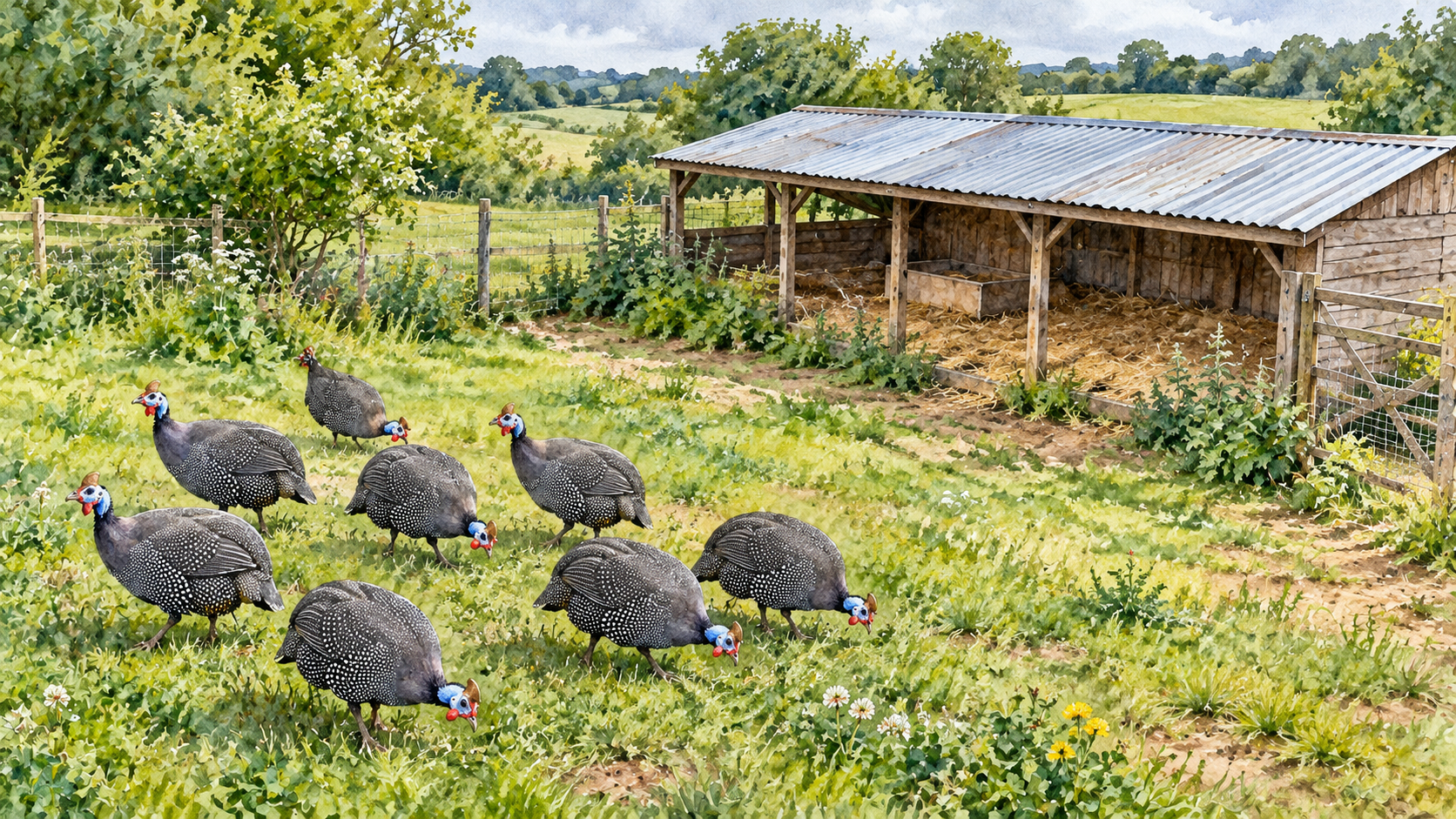
A flock of 5–10 guinea fowl is a reasonable starting point for many small farms, provided there is enough space, secure housing, and sufficient time to care for them. Six birds can be a practical choice for a beginner, while a larger property with established poultry facilities may accommodate considerably more. There is no scientifically established minimum flock size that guarantees good welfare, and the best number depends on the birds’ social needs, the purpose of keeping them, and the resources available.
Guinea fowl are strongly social birds that normally associate with others of their species. A small group offers opportunities for flock movement, communication, and social interaction, but increasing the number of birds does not automatically improve their welfare. A flock of six kept in suitable conditions may be a better arrangement than twenty birds competing for insufficient space, food, or shelter.
Choosing a Starting Flock Size
For beginners, flock size should be based on what can be managed comfortably rather than the maximum number a farm could theoretically accommodate. The following ranges provide planning examples, not prescribed biological minimums or universally suitable stocking recommendations.
| Flock size | General suitability | Main consideration |
|---|---|---|
| 2–3 birds | Small social group, but limited flexibility | Loss of one bird can leave an individual isolated |
| 4–6 birds | Manageable starting group for some beginners | Allows several birds to interact without requiring a large flock |
| 7–10 birds | Suitable for farms with adequate facilities | Greater feed use, cleaning demands, and group activity |
| 11–20 birds | Larger established farm flock | Requires more substantial resources and closer attention to group dynamics |
| More than 20 birds | Possible with sufficient facilities and experience | Management demands increase with flock size |
A poultry husbandry assessment of small guinea fowl flocks suggests starting with approximately five birds, partly because guinea fowl are social and a group provides opportunities for normal flock interaction. That recommendation is a practical starting estimate rather than evidence that exactly five birds constitute an ideal flock.
Six birds are often a useful compromise for a first-time keeper. The group is large enough to contain several social companions while remaining relatively straightforward to observe individually. However, the number of guinea fowl a property can accommodate depends on its facilities and management arrangement, not simply its total acreage.
Buying more birds than the farm can manage may create problems that become difficult to correct after the flock is established. A smaller initial purchase allows the keeper to evaluate behavior, feed consumption, enclosure security, and daily workload before deciding whether expansion is appropriate.
Why Guinea Fowl Prefer Living in Groups
Guinea fowl naturally associate with other members of their species, often moving, feeding, and responding to disturbances together. Their social relationships influence how they use their surroundings, and individuals may remain close to familiar flockmates while exploring an area.
Wild helmeted guinea fowl have been observed in groups whose numbers change with season, habitat, and activity. Research on grouping behavior and responses to predators describes close-knit social groups commonly containing approximately 8–15 birds, with larger seasonal gatherings also occurring. These observations demonstrate the species’ social tendencies, but wild group sizes should not be treated as mandatory numbers for domestic farms.
Group membership provides opportunities for coordinated movement and communication. Guinea fowl may forage together, respond collectively to unfamiliar activity, or gather before roosting. Individual birds can also interact differently within the flock, meaning the presence of companions does not eliminate the possibility of aggression or social exclusion.
Domestic guinea fowl retain many of these social characteristics. A behavioral investigation involving free-ranging domestic and wild helmeted guinea fowl documented social associations and changes in mating behavior, illustrating that flock relationships can be more complicated than birds simply remaining together in one undifferentiated group.
Very small flocks provide fewer opportunities for social choice, particularly if individuals are incompatible. Losing a companion can also leave the remaining birds with limited contact. The welfare concerns associated with keeping a guinea fowl without companions should be considered before selecting an unusually small group.
Match Flock Numbers to Your Farming Goals
The purpose of keeping guinea fowl influences how many birds are useful, although there is no dependable numerical formula linking flock size to a particular agricultural benefit.
Guinea Fowl for Insect Foraging
A small group may be sufficient for a farm that primarily wants guinea fowl as supplementary insect foragers. These birds consume various insects and other small invertebrates, but the number of pests encountered depends on habitat, weather, season, and the birds’ movement patterns.
Keeping twenty birds does not guarantee twice the insect consumption of ten, nor does increasing flock size ensure that a particular pest population will decline. Guinea fowl forage opportunistically, and their activities cannot be directed toward individual pest species with precision. The effectiveness of guinea fowl for farm pest control depends on much more than the number of birds present.
An excessively large flock may also concentrate activity in areas where the keeper does not want repeated disturbance. The practical objective is to maintain a manageable group with appropriate opportunities to forage rather than maximize bird numbers solely for insect consumption.
Guinea Fowl for Eggs
An egg-producing flock should contain enough females to support the intended level of household use, but the total number of birds does not directly establish the number of eggs available. Male birds do not lay eggs, and individual females vary in productivity. Guinea fowl also commonly exhibit seasonal laying patterns rather than producing at a constant rate throughout the year.
Before deciding how many females to keep, consider the annual egg production of guinea hens and the difference between wanting occasional eggs and maintaining a dependable seasonal supply. Adding birds without knowing their sexes can leave a keeper with fewer laying females than expected.
Guinea Fowl for Meat
A meat-producing flock is usually planned around the number of birds the household or farm expects to raise, rather than a permanent adult flock size. Birds intended for meat production may be maintained in groups that change as batches are raised and marketed.
The suitability of guinea fowl for meat production depends on factors including genetics, growth, feeding, and management. A larger group increases the quantity of feed and accommodation required, but it does not necessarily produce more efficient individual growth.
Guinea Fowl for Farmyard Alerts
Guinea fowl are known for vocalizing when disturbed, and a small flock may already produce substantial noise. Adding more birds is not a reliable way to improve detection of unfamiliar activity, and the resulting increase in vocalizations may be undesirable near houses or neighboring properties.
The alarm behavior of guinea fowl should not be confused with dependable protection against predators or intruders. Their calls can alert people to activity, but they do not replace secure housing, supervision, or other protective measures.
How Flock Size Affects Space and Welfare
A flock’s total size determines how much shared accommodation and equipment it requires. Each additional bird needs access to feed, water, resting space, and opportunities for normal movement. The number of guinea fowl that can be kept successfully therefore depends partly on whether all individuals can use these resources without persistent competition.
Guinea fowl kept in close confinement may have difficulty avoiding aggressive flockmates. A 2025 study of stocking density and behavior in growing guinea fowl found that birds housed at lower densities displayed more active and comfort behaviors, while higher densities were associated with increased feather pecking and greater fearfulness in some tests. The experiment involved growing birds under controlled housing conditions, so its numerical stocking densities should not be directly applied as universal recommendations for adult backyard flocks.
For small farms, adding birds should be accompanied by a reassessment of accommodation rather than simply placing more individuals into an existing enclosure. A flock of twelve may require additional feeding positions, resting areas, or other resources even when the building appears large enough to contain them.
The indoor space required by guinea fowl is especially relevant where birds spend extended periods confined because of weather, disease-control measures, or local restrictions. Free-ranging access does not remove the need for suitable nighttime accommodation.
Access to outdoor space also needs careful consideration. A larger flock may spread out while foraging or gather together in preferred areas, and free-ranging guinea fowl can cross property boundaries. A large acreage figure alone does not guarantee that birds will remain within the land available to them.
Consider Your Ability to Care for the Entire Flock
Bird numbers should reflect the amount of attention the keeper can reliably provide. A group of six may allow relatively easy observation of each individual, while identifying a sick or injured bird among thirty animals can require more deliberate monitoring.
Feed and water requirements increase with flock size, as do cleaning and maintenance demands. Equipment must remain accessible to every bird, and the keeper should be able to respond promptly when a drinker fails, a predator breaches an enclosure, or a bird requires separation for veterinary care.
Larger flocks also increase the potential consequences of infectious disease. Poultry pathogens can spread through direct contact, contaminated equipment, water, feed, and movement between bird areas. Consistent biosecurity practices become increasingly important as the number of birds and daily animal contacts increase.
The ability to isolate newcomers or sick individuals should be included in the planning process. Introducing birds from different sources without appropriate precautions can expose the existing flock to infection, and newly purchased poultry should be kept separate for at least 30 days before joining established birds.
Financial capacity should be considered alongside labor. The ongoing cost of maintaining guinea fowl includes feed, bedding, maintenance, replacement equipment, and potential veterinary expenses. A flock that is affordable to purchase may be considerably more expensive to maintain throughout its life.
When Should You Increase or Reduce Flock Size?
Expansion is reasonable when the existing birds are healthy, the facilities are functioning well, and additional animals can be accommodated without reducing welfare. A successful first season may reveal that the farm has adequate resources for more birds, but it may also expose problems that would become more difficult with a larger flock.
Before adding guinea fowl, consider whether the current group uses the available space comfortably, whether all birds can access food and water, and whether the keeper can still observe individual health and behavior. Persistent aggression, excessive feather damage, frequent escapes, or difficulty maintaining clean facilities are reasons to address existing conditions rather than immediately increase numbers.
Reducing flock size may be necessary when resources become insufficient or the birds cannot be managed safely. Rehoming should be planned responsibly, preferably through experienced keepers with suitable facilities. Separating bonded or familiar birds without considering their social needs may create additional stress, so changes should be approached with care.
There is also no reason to fill every available space simply because the enclosure could physically hold more birds. Maintaining unused capacity can make temporary separation, changes in flock composition, and unforeseen management needs easier to accommodate.
More Questions About Guinea Fowl Flock Numbers
Is it better to start with five or ten guinea fowl?
Five may be easier for a beginner with limited experience, while ten can be appropriate where facilities, resources, and daily care arrangements are already sufficient. Neither number is universally preferable. The birds’ welfare and the keeper’s ability to manage the group should determine the choice.
Can you keep an odd number of guinea fowl?
Yes. Guinea fowl do not need to be kept in even-numbered groups. Their social relationships are more complex than permanent pairings, and an odd-numbered flock can function normally. However, social compatibility should still be monitored, particularly if one bird becomes persistently isolated or targeted by others.
Will a larger flock make guinea fowl less likely to wander?
Not reliably. Guinea fowl may travel together, but a larger group can still move beyond its home area. The ability to keep guinea fowl on a property depends more on secure boundaries, acclimation, management, and environmental conditions than on maintaining a particular flock size.
Should all your guinea fowl be the same age?
Keeping similarly aged birds together can simplify feeding and management, particularly during early development. Mixing birds of substantially different ages may introduce competition or injury risks, especially when young birds are not physically ready to join adults. Introductions should be gradual, supervised, and supported by appropriate disease-prevention measures.
4 thoughts on “How Many Guinea Fowl Should You Keep?”