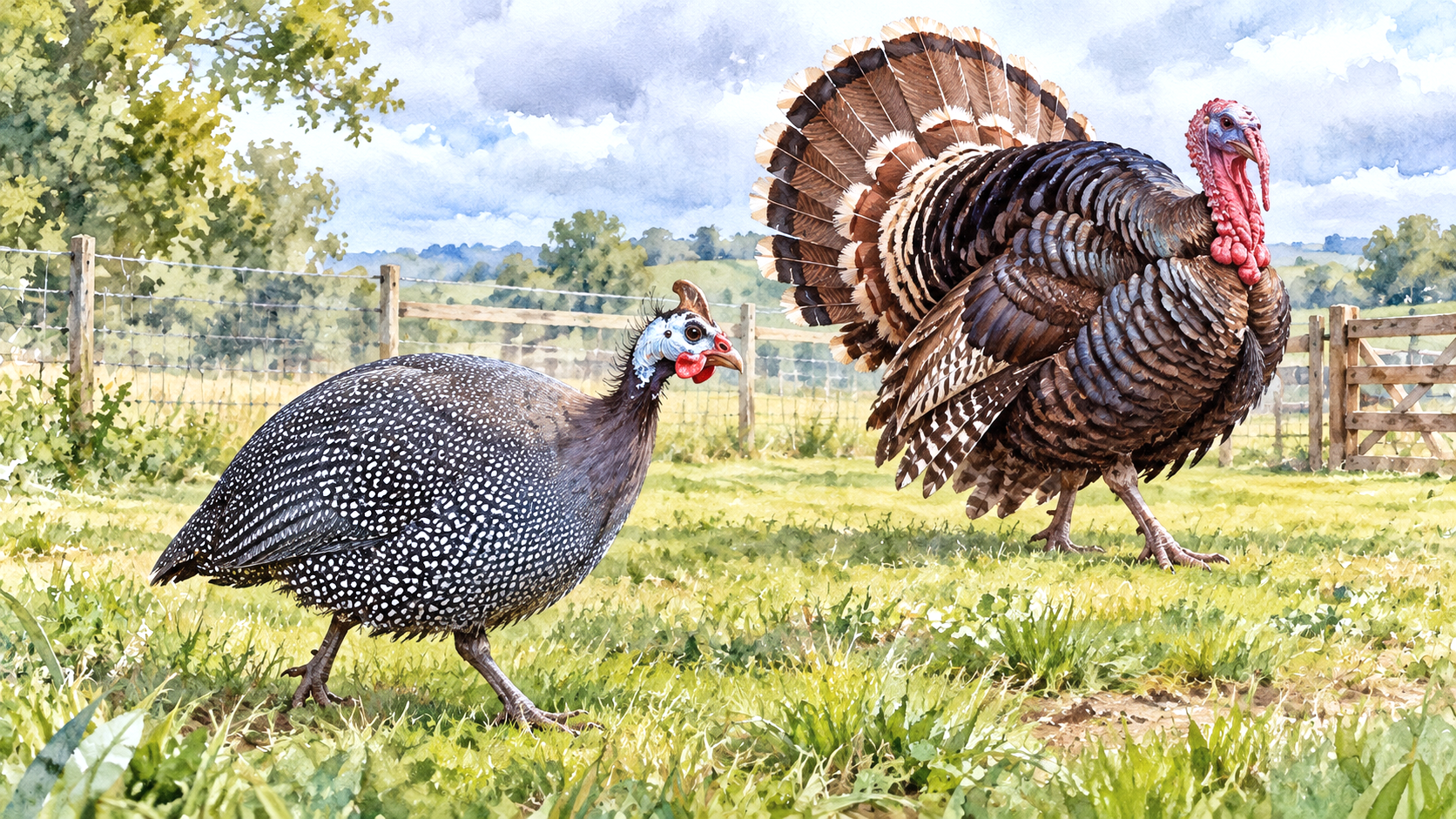
Guinea fowl and turkeys can occupy the same farmyard without immediately coming into conflict. Both are ground-foraging birds, and an established flock may appear comfortable moving through the same pasture. Their differences become more consequential when they share enclosed housing, compete for feed, or encounter diseases that affect one species more severely than the other.
Guinea fowl can live alongside turkeys, but keeping them together is not the safest arrangement for every farm. Separate housing and feeding facilities are preferable, particularly because turkeys are highly vulnerable to histomoniasis, also called blackhead disease. Even when the birds appear socially compatible, shared ground, bedding and equipment can create disease risks that peaceful behavior does not eliminate.
Blackhead Disease Makes This Combination Particularly Risky
The most significant concern is histomoniasis, an infection caused by the protozoan parasite Histomonas meleagridis. Turkeys are especially susceptible and can develop severe, potentially fatal illness. Helmeted guinea fowl are also among the gallinaceous birds susceptible to infection, although their disease outcomes are not necessarily identical to those of turkeys.
The parasite can spread through eggs of the cecal worm Heterakis gallinarum, which may remain infectious in contaminated environments for extended periods. Earthworms can carry infected worm larvae, creating another exposure route when poultry forage in contaminated soil. Direct transmission between turkeys can also occur.
The biology and transmission of histomoniasis make shared outdoor ground an important consideration. A turkey does not need to fight with or even approach another bird to encounter contaminated soil. Separating sleeping areas while allowing birds to use the same potentially contaminated pasture may therefore provide less disease protection than owners expect.
Research-based assessments of susceptibility among poultry species identify turkeys as particularly vulnerable and guinea fowl as another susceptible host. This does not establish that every guinea fowl carries the parasite or that every mixed flock will experience an outbreak. It does mean that an apparently healthy guinea fowl flock should not automatically be considered safe company for turkeys.
There are no medications currently approved in the United States for treating histomoniasis in poultry, making prevention especially important. A veterinarian familiar with poultry health should assess the risks before turkeys are placed on ground previously occupied by other gallinaceous birds, particularly where histomoniasis has occurred.
How Guinea Fowl and Turkeys Behave Around Each Other
Outside disease concerns, the success of a mixed flock depends heavily on individual behavior. Guinea fowl often move quickly in groups, while turkeys may spend time foraging separately or associating with their own companions. Their activity patterns can overlap without either species necessarily becoming part of the other’s social group.
Adult size creates another consideration. Mature turkeys, particularly large commercial strains, can substantially outweigh guinea fowl. A turkey’s weight and strength may cause injury during a confrontation or when birds crowd around an entrance. Conversely, smaller guinea fowl can be persistent chasers, and their movement may disturb a turkey even without physical contact.
Breeding activity can increase tension. Male guinea fowl may pursue other birds, while turkey toms can become more assertive around competitors or favored spaces. Such behavior is not inevitable, and there is insufficient controlled research to predict aggression between the two species from sex or breed alone.
A farmer should look beyond obvious fighting. A turkey that repeatedly abandons a feeder, a guinea fowl that avoids entering the shelter, or birds that crowd into a corner when another approaches may be experiencing ongoing stress. Aggression and territorial behavior in guinea fowl also vary among individuals, so apparent compatibility must be assessed through continued observation.
Housing Two Species With Different Space Requirements
Guinea fowl prefer accessible elevated perches, whereas turkey housing must accommodate the birds’ considerably greater body size and, in heavy commercial strains, potentially limited perching ability. A coop designed primarily for small guinea fowl may be uncomfortable or unsafe for adult turkeys.
Domestic guinea fowl need dry, ventilated shelter with suitable roosts. Turkeys also require clean, dry housing, but their space and equipment must account for their size, movement and production type. A large turkey should not have to force its way through a narrow opening intended for guinea fowl, and a high perch should never create a fall hazard for a bird unable to use it safely.
If the birds occupy one building, guinea fowl roosting arrangements must not expose turkeys below to falling droppings or cause collisions during takeoff. Separate resting compartments can address these physical differences, although they do not eliminate disease transmission through shared litter, equipment or outdoor ground.
The available indoor space for guinea fowl must also be considered alongside turkey-specific stocking requirements. Simply adding the number of birds together and applying one species’ space allowance is inappropriate. Both groups need enough room to rest, reach food and water, and avoid unwanted contact.
Separate coops are generally more practical when a farm has breeding turkeys, heavy-bodied production birds or guinea fowl that frequently rush between perches.
Can Guinea Fowl and Turkeys Eat the Same Feed?
The answer changes with age and reproductive status. Both species can eat appropriately formulated poultry diets, but that does not mean a single ration is suitable for every bird in a mixed flock.
Young turkeys need a high-protein starter feed to support rapid growth. Turkey starter rations commonly contain about 28% protein, followed by age-appropriate growing diets. Guinea keets also need a relatively high-protein starter ration, although the recommended formulation and feeding schedule are not automatically identical to those used for turkey poults.
During early development, feeding guinea keets appropriately means using a complete ration that meets their nutritional needs rather than assuming any turkey starter will be suitable. Medication is another concern. Some commercial feeds contain drugs intended for particular poultry species, and a product labeled for turkeys should not be given to guinea fowl without confirming that its use is appropriate and legal.
Adult birds have different requirements from growing poults and keets. A maintenance diet may be suitable for certain mature birds of both species when its nutrient profile is appropriate, but laying, breeding and production conditions can require additional adjustments. Choosing a balanced adult guinea fowl ration should therefore be based on the actual formulation rather than the assumption that all game birds have interchangeable nutritional needs.
Separate feeding stations are advisable even when the birds receive compatible rations. Turkeys may need equipment positioned for their height and reach, while guinea fowl need places where they can eat without being displaced. Observe whether both species are maintaining normal body condition rather than judging feeding arrangements only by the amount of feed left in the containers.
Why Raising Keets and Turkey Poults Together Requires Extra Care
Raising young birds together may seem easier than combining adults, particularly when they hatch at similar times. However, similar ages do not guarantee similar development, nutritional requirements or vulnerability to environmental problems.
Guinea keets are particularly sensitive to chilling and damp conditions during their earliest weeks. Turkey poults also need careful temperature management, suitable bedding and reliable access to appropriately designed feeders and waterers. Young birds of both species may become distressed or injured when stronger individuals crowd their feeding and resting areas.
The early care requirements of turkey poults include carefully controlled brooding conditions and adequate feeder space. Guinea keets need similarly attentive husbandry, but the two species should not be managed under a single unchanging temperature or feeding schedule simply because they share a brooder.
Separate brooding facilities make it easier to monitor consumption, identify individuals becoming weak and adjust environmental conditions independently. They also limit opportunities for disease transmission during a vulnerable stage.
Mixing young birds does not guarantee adult compatibility. As turkeys grow substantially larger and guinea fowl develop mature social behavior, an arrangement that appeared satisfactory during brooding may require complete separation.
Introducing Adult Guinea Fowl to Turkeys
Disease precautions should be considered before allowing unfamiliar birds to meet. Newly purchased guinea fowl or turkeys should not be placed directly into an existing poultry flock, even when the seller reports that they are healthy. Appropriate quarantine and veterinary evaluation are particularly important when turkeys are involved.
For newly acquired guinea fowl undergoing quarantine, separate equipment, housing and observation help limit the introduction of infectious organisms. Quarantine alone cannot prove that birds are free from every parasite, including organisms associated with contaminated outdoor environments.
If veterinary advice and the farm’s disease history support limited contact, a cautious social introduction can begin with separate enclosures that permit visual familiarity without physical access. Supervised encounters should occur where neither species can trap the other against a wall or feeder. Any persistent chasing, forceful pecking, blocked access to resources or injuries should end the encounter.
The principles of gradually introducing unfamiliar guinea fowl remain useful, but they do not override the additional disease considerations that apply when turkeys are present. Social acceptance should never be treated as evidence of biological safety.
Other Diseases and Biosecurity Concerns
Guinea fowl and turkeys can share exposure to infectious poultry diseases through contaminated water, equipment, litter and direct contact. The greater the interaction between groups, the harder it becomes to maintain separate exposure pathways.
Both species are susceptible to avian influenza viruses, and severe outbreaks can have devastating consequences for domestic poultry. Birds may become infected through contact with other birds or contaminated environments, including areas visited by wild birds.
Effective prevention includes restricting unnecessary visitors, protecting feed and water from wildlife, cleaning equipment and avoiding movement between flocks without appropriate hygiene. Biosecurity recommendations for farms keeping multiple animal species emphasize managing contact between groups and reducing contamination of housing and shared spaces.
A mixed flock that suddenly develops weakness, unusual droppings, respiratory distress, abnormal movement or unexpected deaths needs prompt veterinary attention. Such signs are not specific enough to identify histomoniasis, avian influenza or another disease without examination and appropriate testing.
In the United States, suspected highly pathogenic avian influenza and certain other poultry diseases may trigger mandatory reporting and movement restrictions. Farmers should follow their state veterinarian’s instructions rather than moving potentially affected birds to another property.
When Keeping Turkeys and Guinea Fowl Separate Is the Safer Choice
Permanent separation is strongly advisable where histomoniasis has occurred, where ground contamination is suspected or where turkeys are being raised in circumstances that make exposure especially consequential. A history of disease on the property cannot be erased simply by replacing bedding or allowing a paddock to rest briefly.
Separation is also appropriate when large turkeys intimidate smaller guinea fowl, when guinea fowl repeatedly pursue turkeys, or when feeding requirements cannot be met independently. Maintaining suitable housing for guinea fowl alongside dedicated turkey accommodation often makes daily management more predictable.
Keeping the species on the same farm does not require mixing their flocks. Independent facilities, equipment and ground areas, combined with appropriate biosecurity, can allow a keeper to raise both while substantially reducing the risks associated with direct contact.
Questions About Guinea Fowl and Turkeys
Can guinea fowl give turkeys blackhead disease?
Guinea fowl are susceptible to the parasite responsible for histomoniasis, and contaminated environments can transmit infection among gallinaceous birds. Whether a particular guinea fowl has introduced the parasite cannot be determined without appropriate veterinary investigation.
Can a turkey live with only guinea fowl for companionship?
Guinea fowl do not reliably replace appropriate social companionship with other turkeys. Housing and group composition should support species-specific social needs rather than relying on the presence of any other poultry species.
Can guinea fowl and turkeys sleep on the same roost?
Some individuals may attempt to share elevated resting structures, but size and weight differences create practical safety concerns. Separate, appropriately designed resting areas are preferable.
Will guinea fowl attack turkey poults?
An adult guinea fowl may peck or chase a smaller bird, particularly around resources. Turkey poults should not be exposed to unsupervised contact with unfamiliar adult guinea fowl.
Can turkeys and guinea fowl share pasture if they have separate coops?
Separate coops reduce direct housing contact but do not eliminate exposure through shared soil, droppings or earthworms. Veterinary assessment of histomoniasis risk is advisable before allowing shared pasture access.
Can guinea fowl eat turkey starter feed?
Some unmedicated turkey starter formulations have protein levels suitable for certain stages of guinea keet growth, but suitability depends on the complete formulation and the birds’ age. Medicated feed must not be assumed safe for guinea fowl without checking the label and obtaining appropriate professional guidance.