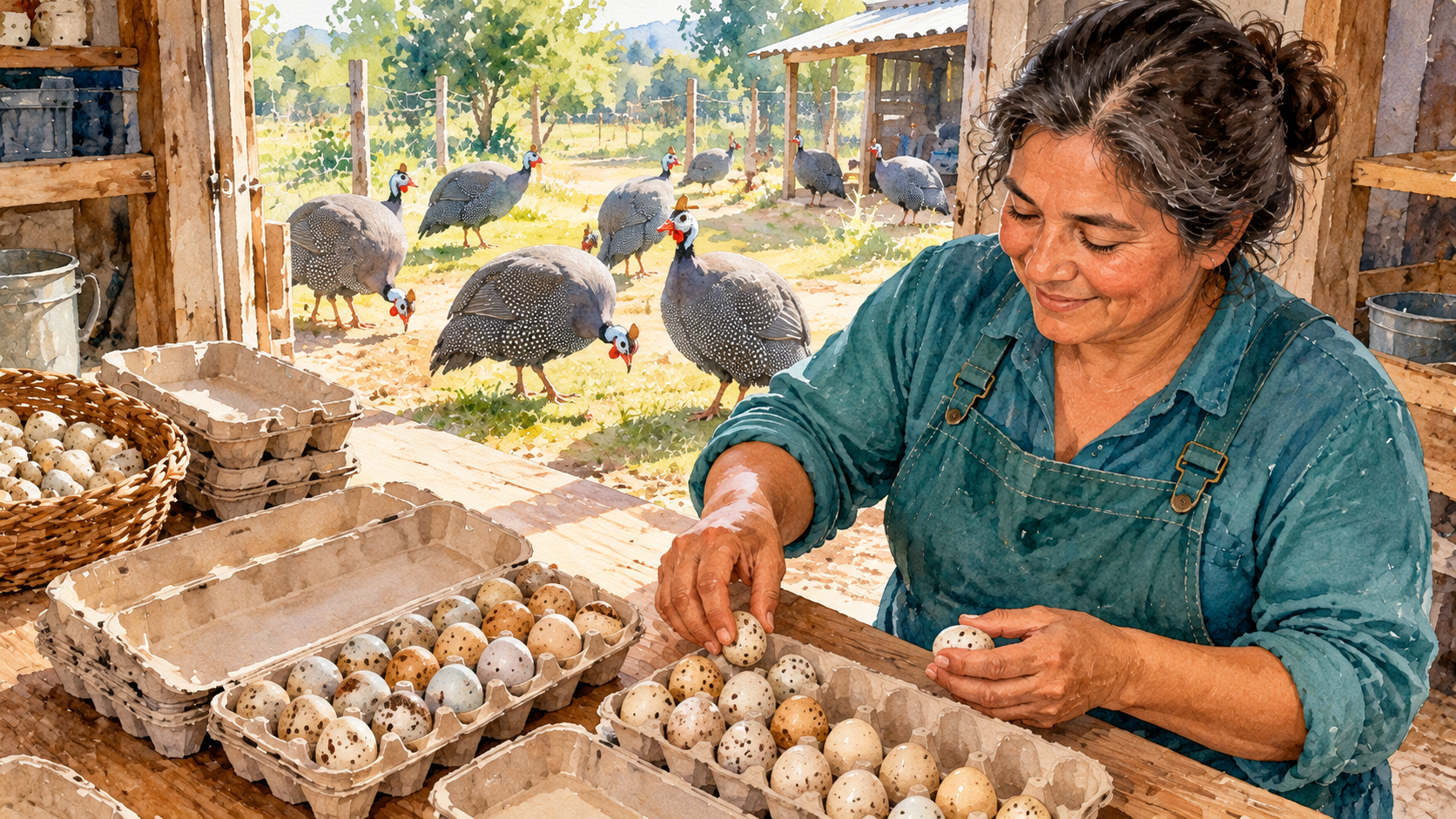
Guinea fowl farming can be profitable in the United States, particularly when producers have dependable buyers for live birds, breeding stock, hatching eggs, or specialty meat. However, it is a niche poultry business with less predictable demand than conventional chicken production. A flock may generate sales without earning a profit once feed, losses, labor, marketing, and equipment expenses are included.
Profitability depends more on the margin earned from each sale than the number of guinea fowl raised. A producer selling birds directly to customers may receive higher prices than one supplying wholesale buyers, but direct sales also require additional marketing and customer service. Before expanding production, farmers need evidence that buyers will purchase their products at prices sufficient to cover the actual cost of producing them.
Which Guinea Fowl Products Generate Revenue?
Guinea fowl farms can earn revenue through several products, although each serves a different customer market. Live birds and fertile eggs generally appeal to poultry keepers and breeders, while meat and eating eggs require buyers interested in specialty food products.
| Product | Potential customers | Main commercial consideration |
|---|---|---|
| Day-old keets | Small farms, hobby keepers, breeders | Seasonal demand and successful hatching |
| Juveniles and adults | Farms establishing or expanding flocks | Longer feeding periods before sale |
| Hatching eggs | Breeders and poultry enthusiasts | Fertility, shipping, and seasonal availability |
| Eating eggs | Local households and specialty-food buyers | Limited production periods and local demand |
| Guinea fowl meat | Restaurants, specialty retailers, direct customers | Processing costs, legal requirements, and carcass yield |
| Selected breeding stock | Breeders seeking particular characteristics | Documented quality and a smaller customer base |
Live birds can offer opportunities for farms with suitable breeding facilities because customers purchase them for future use rather than immediate consumption. The selling price of guinea keets and adult birds varies with age, variety, location, and quantity, making a dependable local customer base particularly valuable.
Hatching eggs may provide an additional product from established breeding birds. However, their commercial value depends on fertility, proper handling, and buyer confidence. Eggs sold for incubation should not be priced or advertised as though every one will produce a healthy keet.
Commercial meat production serves a different market. Guinea fowl may attract customers seeking alternatives to conventional poultry, but a premium retail price does not establish that the producer receives a high margin. The suitability of guinea fowl for meat production must be considered alongside growth performance, processing arrangements, and the quantities customers are prepared to purchase.
Does Guinea Fowl Meat Production Make Money?
Meat profitability depends on how efficiently birds reach a marketable weight and how much revenue their carcasses generate. Feed conversion, growth rate, losses before sale, processing charges, and the proportion of the bird sold as meat all influence the result.
Guinea fowl do not necessarily grow as efficiently as commercial broiler chickens. In one controlled comparison, birds slaughtered at 18 weeks averaged approximately 2.64 pounds (1.20 kg) of live weight, and feed conversion ratios differed between barn-raised and free-ranging guinea fowl. The study found ratios of approximately 5.80 and 6.43, respectively. These findings concern the specific birds and conditions studied, not a guaranteed performance standard for every commercial strain.
Improved meat-type genetics can change the calculation. Research involving commercial meat-type guinea fowl raised on different feeding programs demonstrates how growth, carcass characteristics, and feeding performance can be measured when assessing production efficiency. Farmers should use results from their own birds rather than assume that all domestic guinea fowl reach the same market weight.
The choice of guinea fowl for meat production influences the quantity of saleable meat produced from a batch. A higher-priced bird may be economically worthwhile if its production characteristics justify the additional expense, but that relationship must be demonstrated through actual performance records.
Meat sales also depend on processing arrangements. Guinea fowl intended for food must be handled under the applicable federal and state requirements. Poultry slaughter and processing exemptions have specific eligibility conditions; a small flock does not automatically qualify for unrestricted meat sales. Inspection status, permitted sales channels, processing availability, and transportation should be established before estimating revenue.
Can Selling Keets and Hatching Eggs Be More Profitable?
Breeding operations may avoid some expenses associated with producing market-ready meat, particularly slaughter and carcass handling. Nevertheless, breeding stock must be maintained even when customers are not purchasing keets or fertile eggs, so sales revenue needs to cover the continuing cost of the breeding flock.
Guinea hens generally lay seasonally, making annual production less consistent than a simple monthly sales projection might suggest. The number of eggs guinea fowl produce annually affects how many eggs may be available for incubation or sale. Fertility and hatchability then determine how many keets can actually be marketed.
For example, collecting 200 eggs does not guarantee 200 saleable keets. Some eggs may be infertile, others may fail during incubation, and a proportion of hatchlings may not survive to sale. Advertising expenses, shipping materials, brooder electricity, and unsold birds further reduce the margin.
Breeders with established customer relationships may be better positioned to sell unusual color varieties or selected breeding birds at higher prices. However, producing uncommon varieties without confirmed demand can leave the farm maintaining birds that are difficult to sell.
How to Calculate Guinea Fowl Farming Profit
Profit should be calculated from actual income and the full cost of producing that income.
Net profit = Total sales revenue − Total production and business costs
Revenue is the amount collected from customers. Gross margin subtracts variable production costs, while net profit also accounts for fixed costs and other business expenses. Enterprise budgeting for poultry production provides a framework for separating these figures and evaluating whether an operation genuinely earns money.
Consider a hypothetical batch of 36 guinea fowl raised for meat, with 30 birds ultimately sold. The numbers below illustrate the calculation rather than represent typical US production costs or verified market prices.
| Item | Example amount |
|---|---|
| Revenue: 30 birds sold at $40 each | $1,200 |
| Purchase of 36 young birds | $180 |
| Feed | $300 |
| Processing | $240 |
| Packaging and marketing | $90 |
| Labor | $180 |
| Allocated equipment and facility costs | $110 |
| Total costs | $1,100 |
| Net profit | $100 |
The example produces a profit margin of approximately 8.3%, before any additional costs not included in the assumptions. Selling the same 30 birds at $35 each would reduce revenue to $1,050 and create a $50 loss if costs remained unchanged.
The break-even selling price in this example is approximately $36.67 per bird. In general, the break-even price for an agricultural enterprise is calculated by dividing total costs by the number of saleable units.
Farmers should maintain separate records for each production activity rather than combining every expense and sale into one total. The ongoing cost of raising guinea fowl includes expenses that continue even when sales slow, while individual production batches may have substantially different margins.
Market Demand Matters More Than Premium Prices
Guinea fowl occupy a specialized market in the United States. Their products may attract customers interested in game birds, traditional foods, alternative poultry, or breeding stock, but this demand is not distributed evenly across regions.
A high retail asking price is only useful when customers are willing to pay it. Producers should distinguish between prices advertised by specialty retailers, prices offered to farms by wholesale buyers, and the amounts customers actually pay in the local market.
Identifying buyers before increasing production can prevent a farm from accumulating unsold animals or perishable products. Specialty game-bird marketing can be seasonal, and access to a dependable market is an important consideration before committing to production.
Direct-to-consumer sales may offer better prices but require time spent advertising, responding to inquiries, arranging collections, and maintaining customer relationships. Farmers markets and other local food marketing channels can help producers reach customers, subject to the rules governing the particular product.
Eating eggs and hatching eggs also have different market requirements. Food sales must comply with applicable state and local egg-handling rules, while interstate movements of live poultry or hatching eggs may involve animal-health requirements. Revenue projections should reflect only sales channels the producer can legally use.
Does a Larger Guinea Fowl Farm Earn More Profit?
Larger production can reduce certain costs per bird when existing facilities, equipment, and labor are used more efficiently. Bulk purchasing may also lower feed or young-bird prices. These advantages do not guarantee higher profits because expansion increases financial exposure and may require additional buildings, employees, transportation, or marketing.
A farm capable of raising 500 guinea fowl but selling only 200 at its intended price has a marketing problem that cannot be solved through production efficiency alone. Discounting surplus birds may reduce margins, while maintaining unsold adults generates further expenses.
Growth should therefore follow demonstrated sales rather than anticipated demand. Comparing production results over several batches helps establish whether the farm can increase output without sacrificing animal welfare, product quality, or profitability.
The commercial setup requirements for guinea fowl farming become more substantial as production expands, but scale should be evaluated against the market rather than treated as an objective by itself.
Questions About Guinea Fowl Farming Returns
Can six guinea fowl generate meaningful business income?
A small flock may provide occasional revenue from birds or eggs, but significant income is unlikely without an unusually strong market or specialized breeding activity. Small operations also distribute fixed expenses across fewer saleable products.
Are rare guinea fowl colors more profitable?
Not automatically. Some buyers pay premiums for particular varieties, but the market is smaller and demand may be inconsistent. Higher asking prices do not guarantee that breeding and marketing those birds will produce a higher net return.
How long does it take for a guinea fowl farm to recover its initial investment?
There is no reliable universal payback period. Recovery depends on startup investment, sales volume, operating margins, and the timing of revenue. A farm that earns a positive operating margin may still require several production cycles to recover its initial expenditure.
Can guinea fowl pest control be counted as farming revenue?
Only when the farm receives actual payment for a service or sells a measurable product. Reduced pest-management spending may represent a potential cost saving, but it should not be recorded as sales revenue without evidence of the value saved.
One thought on “Is Guinea Fowl Farming Profitable?”