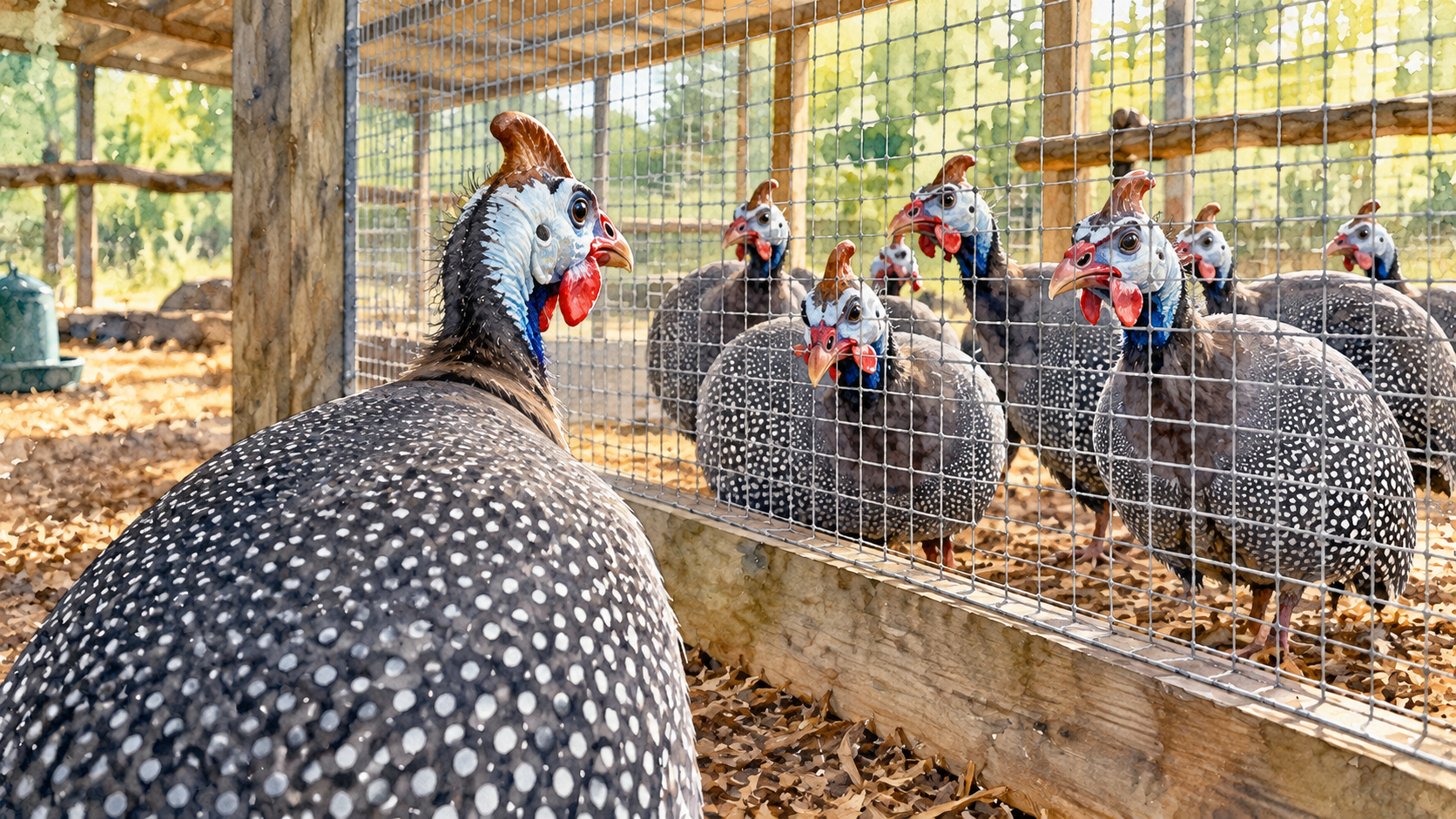
A guinea fowl can survive alone, but permanent solitary living is not recommended because guinea fowl are naturally social birds. Domestic helmeted guinea fowl (Numida meleagris) normally maintain contact with other members of their species, moving, feeding, communicating, and resting within established groups. An isolated bird may become distressed, particularly if it has recently lost familiar flockmates or has been separated from birds with which it previously lived.
Some guinea fowl tolerate temporary separation without obvious difficulty, while others become restless or repeatedly call and search for companions. There is no established number of days that makes isolation safe for every bird, nor is there sufficient research to predict how an individual guinea fowl will respond to prolonged solitude. When a bird must be kept alone, its physical safety, opportunities for social contact, and behavior require careful attention.
Why Guinea Fowl Need Companionship
Social relationships are a normal part of guinea fowl behavior rather than an optional feature of domestic life. Wild helmeted guinea fowl maintain recognizable groups in which individuals interact repeatedly, coordinate movement, and respond to activity around them. Their social organization includes familiar associations and group cohesion, with individual birds participating in feeding, movement, and interactions within the flock.
Domestic guinea fowl retain many of these tendencies. Birds commonly travel together while foraging, exchange contact calls, and gather with familiar companions when disturbed. Research involving free-ranging domestic and wild helmeted guinea fowl has documented relationships between individuals, including associations that change during the breeding season. A guinea fowl’s social environment therefore involves more than simply having another bird somewhere on the same property.
Flock membership also influences responses to danger. Guinea fowl use vocalizations and changes in posture to communicate while moving or responding to unfamiliar activity. Observations of grouping and predator avoidance in helmeted guinea fowl show that birds frequently maintain close contact and adjust their spacing when threatened. A solitary guinea fowl lacks the opportunity to participate in these coordinated responses, although the precise effect on an individual domestic bird has not been quantified.
The number of companions needed for a suitable domestic group depends on the birds and their circumstances. The social considerations involved in choosing flock numbers extend beyond simply preventing one bird from being alone. Compatibility, familiar relationships, adequate resources, and freedom from persistent aggression also influence welfare.
How Isolation Can Affect a Guinea Fowl
A bird accustomed to moving with companions may react strongly when it suddenly loses contact with them. Repeated calling, increased movement around an enclosure, or attempts to reach other birds can occur following separation. These behaviors may reflect attempts to reestablish contact, but they do not independently prove that the bird is experiencing a specific level of psychological distress.
Changes in feeding, resting, and activity patterns are more concerning when they persist. An isolated guinea fowl might spend more time near a door or fence, repeatedly move along the enclosure boundary, or become unusually quiet. Such observations need to be compared with the bird’s previous behavior because individual temperament, unfamiliar surroundings, illness, and predator activity can produce similar changes.
Social separation is recognized as a potential welfare concern in poultry. Research evaluating isolation stress in laying hens identifies fear, frustration, and abnormal behavior as possible consequences of prolonged separation from other birds. Those findings concern chickens rather than guinea fowl, so they cannot establish an identical response in both species. They nevertheless provide relevant evidence that social deprivation deserves attention in the welfare of domesticated birds.
There is limited guinea-fowl-specific research measuring long-term isolation through physiological stress indicators or controlled comparisons of solitary and group housing. Claims that every isolated guinea fowl will stop eating, become depressed, or die prematurely go beyond the available evidence. The established social nature of the species is sufficient reason to avoid unnecessary prolonged isolation without making those unsupported predictions.
What to Do When One Guinea Fowl Is Left Behind
A lone survivor may remain after predators, accidents, illness, or the natural loss of older flockmates. Its immediate needs depend on why the other birds are absent.
If flockmates have disappeared following a predator attack, secure the surviving bird before attempting to change its social situation. Check the housing and surrounding area for access points, injuries, and continuing threats. A frightened bird should have a protected environment with accessible food, water, and a place to rest. The risk of predators attacking guinea fowl remains relevant even when only one bird survives.
When several birds have died unexpectedly or shown signs of illness, avoid immediately bringing replacement birds into the same accommodation. Unexplained mortality requires investigation, particularly if the surviving bird develops abnormal breathing, weakness, poor appetite, or changes in droppings. The possibility of infectious disease in a poultry flock makes veterinary guidance and appropriate biosecurity more urgent than rapidly restoring the flock’s original size.
If the remaining bird is healthy and the environment is safe, arrange suitable companionship rather than treating solitary housing as the permanent solution. Replacement birds should be obtained responsibly, and new arrivals should be kept separate initially to reduce disease-transmission risks. New poultry should remain separated from an established flock for 30 days, with health observations continuing throughout that period.
Restoring companionship should not involve abruptly placing unfamiliar birds together in a small enclosure. Existing birds may react defensively to newcomers, and social tension can develop even between members of the same species. The introduction of additional guinea fowl requires attention to gradual familiarization, available space, and individual behavior.
When Temporary Isolation Is Necessary
There are circumstances in which separating a guinea fowl is appropriate despite its social needs. An injured bird may need protection from further pecking or disturbance, while an animal suspected of carrying an infectious disease may require isolation to protect other birds. A newly acquired bird also needs a period of separation before joining an established flock.
The purpose of separation determines how it should be arranged. An injured but noninfectious bird may sometimes benefit from remaining within sight or hearing of familiar flockmates, provided this does not interfere with recovery or create additional stress. A bird separated because of suspected contagious disease may require a physically distinct location with dedicated equipment and precautions against contamination. Visual proximity should not override veterinary advice about infection control.
Isolation should be maintained for as long as the underlying health or safety reason requires, rather than ended simply because the bird appears restless. The care of guinea fowl with health problems may involve conditions that require professional diagnosis, treatment, and a carefully planned return to ordinary housing.
During separation, provide a quiet, secure environment with appropriate temperature, ventilation, bedding, food, and water. Observe whether the bird is eating, drinking, moving normally, and resting. Avoid excessive handling intended merely to provide stimulation, especially when the bird is frightened or recovering from illness. A veterinarian can help determine when social contact can safely resume.
Can Human Attention Replace Other Guinea Fowl?
Regular interaction with a familiar keeper may help some guinea fowl become comfortable around people, particularly birds accustomed to human presence from an early age. However, human companionship does not reproduce the full range of communication and social behavior that occurs between guinea fowl.
People cannot consistently participate in the bird’s ordinary flock activities, including species-specific contact calling, coordinated movement, and interactions with familiar companions. A guinea fowl that approaches its owner willingly may still benefit from the presence of other guinea fowl. Conversely, a bird that avoids people is not necessarily poorly socialized with its own species.
Human attention should support the bird’s welfare rather than serve as the sole justification for keeping it without avian companions. Its willingness to accept food, approach a person, or remain near a house does not establish that permanent isolation meets its social needs.
When Solitary Housing May Be the Lesser Risk
A guinea fowl should not be forced to remain with birds that repeatedly injure or seriously harass it. Social living is beneficial only when the arrangement is reasonably safe. A bird that cannot escape persistent aggression may require temporary separation while its condition and the cause of the conflict are assessed.
Groups of helmeted guinea fowl can develop social hierarchies, and pecking relationships may influence access to feeding areas. Incompatible birds, restricted space, or inadequate access to resources can make an existing group unsuitable for a particular individual.
Where repeated attempts at safe social housing have failed, a veterinarian familiar with avian behavior and welfare can help evaluate the bird’s circumstances. Long-term separation may sometimes be necessary for an individual’s protection, but it should be treated as a special management decision rather than evidence that guinea fowl ordinarily thrive in isolation.
Rehoming to a suitable experienced keeper may be preferable when the original farm cannot provide safe companionship. The receiving property should have appropriate facilities and the ability to manage introductions without exposing the bird to additional injury or unnecessary stress.
More Questions About Guinea Fowl Living Alone
Can a guinea fowl stay alone overnight?
An otherwise healthy bird can remain in secure individual housing overnight when temporary separation is necessary. Provide suitable shelter, ventilation, and access to water, and avoid exposing it to predators or unsuitable temperatures. One night alone does not establish that permanent solitary housing is appropriate.
Will a guinea fowl recognize its former flockmates after separation?
Guinea fowl form familiar social associations, so recognition after a period apart is plausible. However, reliable species-specific evidence establishing how long individual birds remember former companions is limited. A reunion should still be supervised because familiarity does not guarantee that the birds will interact peacefully.
Can an isolated guinea fowl become quieter?
Some birds may become less vocal following separation, while others call more frequently. Vocal activity alone cannot establish whether a bird is comfortable. A sudden reduction in calling accompanied by weakness, reduced feeding, or inactivity is a reason to assess its health rather than assume it has adjusted to being alone.
Can a guinea fowl recover from a stressful period of isolation?
An otherwise healthy bird may return to its usual behavior after suitable social conditions are restored, but the outcome depends on the duration of separation, its cause, and the individual’s health. Persistent abnormal behavior, refusal to eat, or signs of illness warrant veterinary evaluation rather than assuming the bird simply needs more time.