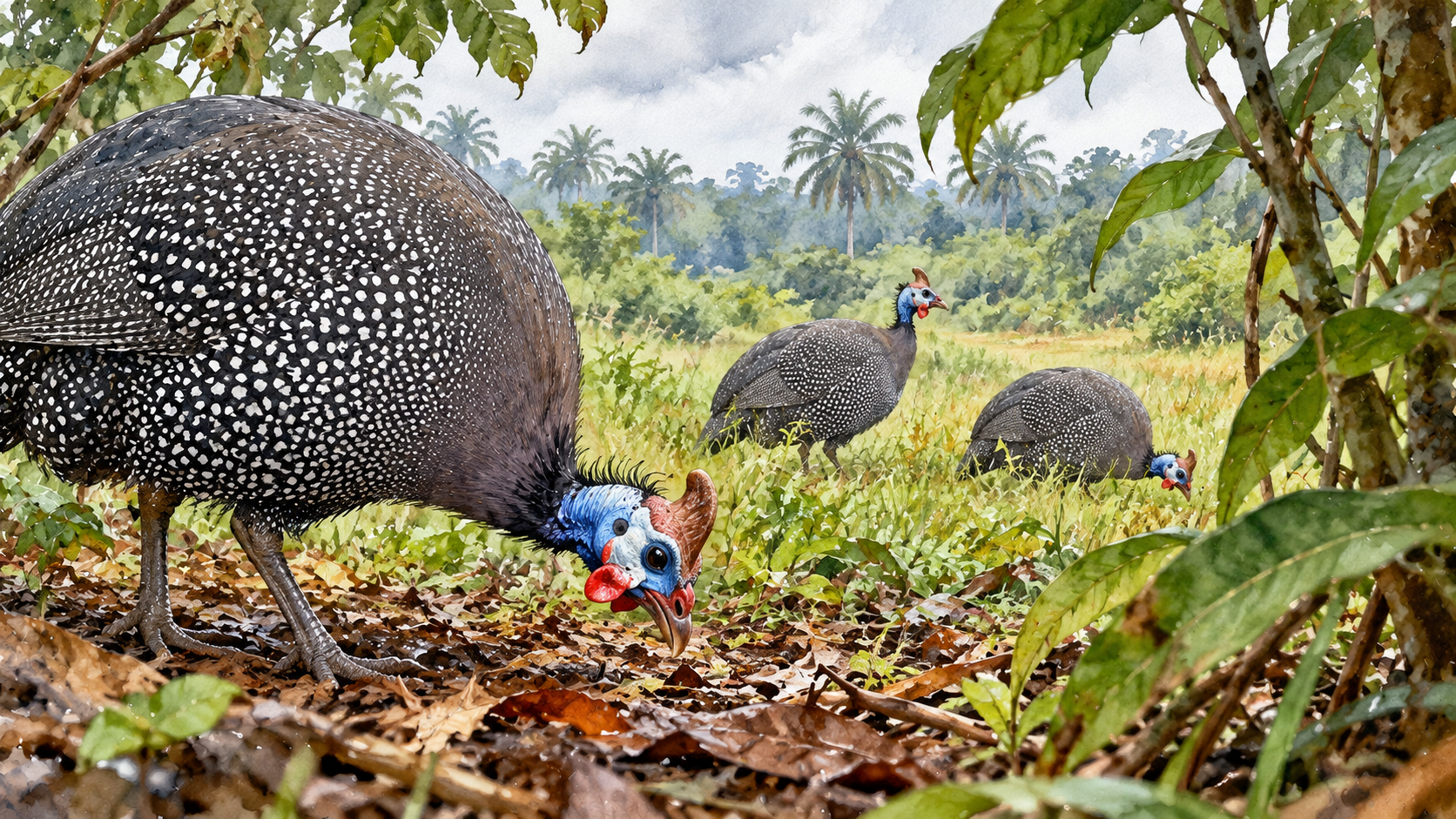
Guinea fowl are named after Guinea, a historical region of West Africa from which the birds were transported to Europe. European traders associated the birds with the African coast where they obtained them, and the geographical name became part of their English identity. The word fowl simply means bird or domestic poultry, making guinea fowl a name that originally identified the bird by its perceived place of origin.
The name became established during the expansion of European trade with West Africa in the 15th and 16th centuries. Earlier Greek and Roman writers had known these African birds by different names, including meleagrides and Numidian hens. Their changing names reflect the geographical knowledge and trading connections of the societies that encountered them.
What Does Guinea Mean in Guinea Fowl?
Guinea was historically used by European traders and geographers to describe a broad region along the western African coast. Its geographical boundaries varied considerably over time, and the name did not originally refer exclusively to the present-day Republic of Guinea.
The historical geographical meaning of Guinea encompassed territories that were later divided among several modern African countries. European merchants used the term when describing trade along the Atlantic coast, and animals and commodities transported from the region sometimes acquired geographical names reflecting their commercial origins.
Guinea fowl became associated with this region because birds were exported from West Africa into European markets. The etymology of the word Guinea records Guinea hen in English during the 1570s, referring to domestic poultry imported from Africa. The name identified a familiar source of imported birds rather than a particular biological characteristic.
The reference to Guinea does not establish that every wild guinea fowl originated in the modern country bearing that name. The African distribution of guinea fowl extends well beyond its borders, and the domesticated helmeted guinea fowl has ancestral connections with a broader West African region.
How the Name Entered European Languages
The English name developed during a period when African guinea fowl were being introduced or reintroduced to European poultry keeping through maritime trade. Portuguese merchants were especially important in transporting birds from West Africa, and European writers increasingly associated the unfamiliar poultry with its African source.
The bird was not entirely unknown in Europe before these voyages. Ancient Mediterranean civilizations had encountered guinea fowl, but knowledge of the species was not continuously widespread throughout medieval Europe. By the 16th century, naturalists were describing birds arriving through contemporary trade routes, sometimes without clearly connecting them to the animals recorded by classical writers.
An early French name was poulle de la Guinée, meaning Guinea hen. The French naturalist Pierre Belon used this designation in 1555, demonstrating that the geographical association had already become established in European descriptions. The historical Encyclopaedia Britannica account of guinea fowl records this terminology alongside other names used by naturalists during the same period.
The English expression followed a comparable pattern, combining a geographic identifier with a familiar word for poultry. The word fowl originated from Old English fugel, meaning bird, and gradually developed more specialized associations with domestic birds. Its linguistic history explains why an African bird introduced into European agriculture could be described using an established English poultry term.
The resulting name was straightforward from the perspective of European traders: a bird associated with Guinea became a Guinea fowl.
What Were Guinea Fowl Called in Ancient Greece and Rome?
Before the English name existed, ancient Mediterranean writers used names with different geographical and cultural associations. The Greeks knew guinea fowl as meleagrides, a name connected with the mythological figure Meleager. According to a Greek legend, Meleager’s grieving sisters were transformed into birds, with their spotted feathers associated with the tears they shed. The association was mythological rather than an explanation of the birds’ actual origin.
The name survived in classical literature and eventually influenced scientific nomenclature. The historical linguistic treatment of meleagris connects the ancient Greek term with later Roman usage and the scientific names assigned to guinea fowl.
Roman writers also used geographical descriptions such as gallina Numidica, meaning Numidian hen. Numidia was an ancient North African region associated principally with territory in present-day Algeria and neighboring areas. The designation reflected the Romans’ understanding of the bird’s African associations rather than the full geographical distribution recognized today.
These earlier names illustrate how different societies identified the same familiar bird through mythology, regional geography, or comparison with domestic hens.
Why Is the Scientific Name Numida meleagris?
The scientific name of the domestic helmeted guinea fowl preserves elements of its ancient European naming history.
Numida refers to Numidia, linking the genus with North Africa and the terminology used by classical writers. Meleagris derives from the ancient Greek name associated with Meleager and the legendary birds bearing his sisters’ tears.
The name therefore combines two historical traditions: a geographical association with North Africa and a name inherited from Greek mythology. Neither term means guinea fowl in the modern English sense.
Scientific naming also explains why guinea fowl and turkeys can appear confusingly connected in older literature. The domestic turkey bears the scientific name Meleagris gallopavo, using Meleagris as its genus, while the helmeted guinea fowl uses meleagris as its species epithet. This shared historical terminology does not make them members of the same genus. Their evolutionary relationship to chickens, turkeys, and peafowl is established through biological evidence, not similarities in names.
Why Were Guinea Fowl Once Confused With Turkeys?
The introduction of American turkeys into Europe created considerable confusion among people already familiar with African guinea fowl. Both birds were relatively unfamiliar to many European consumers, and their routes into European markets contributed to inconsistent naming.
The English word turkey was used for guinea fowl during the 1540s, before becoming established for the larger American bird. Historical accounts indicate that African guinea fowl were sometimes associated with trade passing through Ottoman territories, while American turkeys were subsequently confused with the birds already carrying that name.
The historical development of the word turkey records this overlap and explains how the name eventually became attached to the North American species. The two birds retained different common names as European naturalists developed clearer descriptions of their origins and identities.
Although guinea fowl and turkeys differ in appearance and agricultural characteristics, early terminology reflects a period when foreign poultry was frequently identified through trading routes rather than precise zoological classification.
Other Names Used for Guinea Fowl
Not every language adopted a name referring directly to Guinea. Some names describe the bird’s appearance, while others preserve geographical associations from different periods.
| Language | Common name | Meaning or association |
|---|---|---|
| English | Guinea fowl | Bird associated with the historical Guinea region |
| French | Pintade | Derived from terminology associated with painted or marked plumage |
| Portuguese | Galinha-d’angola | Angola hen, a geographical reference to Africa |
| Spanish | Gallina de Guinea | Guinea hen |
| Italian | Faraona | Pharaoh hen, reflecting an association with ancient Egypt |
| German | Perlhuhn | Pearl hen, referring to its spotted feathers |
These names show how descriptions of the same bird developed through different linguistic traditions. The German name emphasizes its pearled appearance, while the Portuguese and English names retain African geographical references.
The modern English language also uses guinea hen, although guinea hen and guinea fowl are not always interchangeable in precise poultry terminology. Guinea fowl is the general name, whereas guinea hen specifically identifies a female bird.
More Questions About the Guinea Fowl Name
Is guinea fowl named after the modern country of Guinea?
Not specifically. The name developed from the historical Guinea region of West Africa, which covered a much broader and less consistently defined geographical area than the present-day country. The modern republic inherited the geographical name rather than being the sole original source of the bird’s English designation.
When did the name guinea fowl first appear in English?
Related English names were recorded during the 16th century, with Guinea hen documented by the 1570s. The expression guinea fowl became established later, with dictionary evidence placing its use in the 17th century. The historical dictionary record dates the expression to approximately 1645–1655.
Does guinea fowl have anything to do with guinea pigs?
No. Guinea fowl are African birds, while guinea pigs are South American rodents. Their names both contain Guinea, but the origin of guinea pig is less certain and may involve historical trading routes or geographical confusion. The animals have no special biological relationship.
Is guinea fowl also written as guineafowl?
Yes. Guinea fowl, guineafowl, and the hyphenated guinea-fowl all occur in English writing. The two-word form is common in agricultural contexts, while the single-word form also appears in ornithological publications. These spelling differences do not indicate different birds.
One thought on “Why Are They Called Guinea Fowl?”