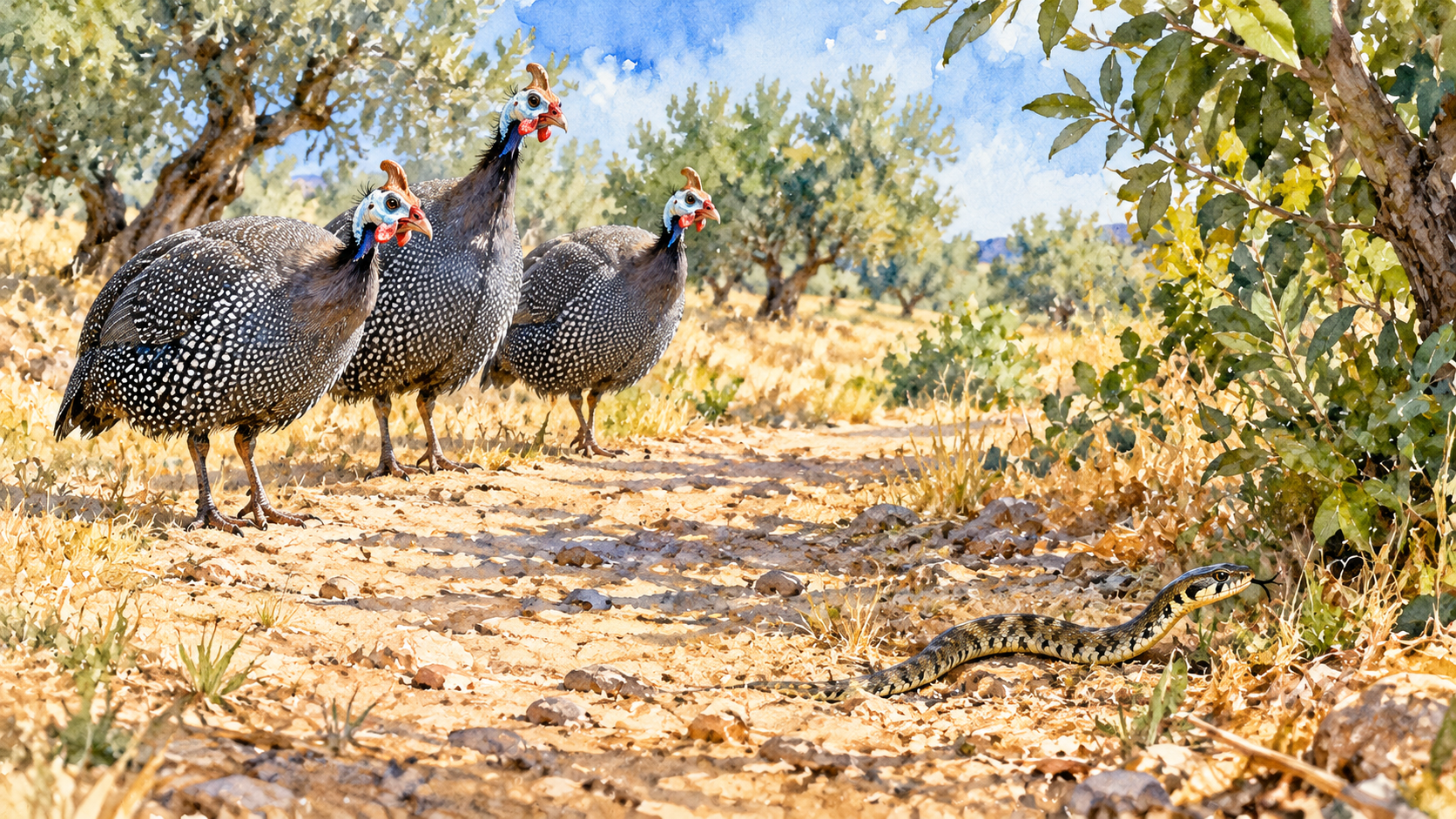
Guinea fowl have a reputation for confronting snakes, sometimes surrounding them while making loud alarm calls. Their reactions can be dramatic, particularly when several birds notice the same intruder. However, these encounters do not necessarily end with the snake being killed or driven off the property. Guinea fowl can occasionally kill and eat small snakes, but they are not reliable snake hunters or proven snake deterrents. Their more characteristic responses include alarm calling, approaching cautiously, grouping together, and sometimes mobbing a perceived threat. A snake may retreat during such an encounter, but there is no strong evidence that keeping guinea fowl consistently reduces snake populations.
What Happens When Guinea Fowl Encounter a Snake?
A guinea fowl that notices a snake may stop foraging, raise its head, stare toward the animal, and begin calling. Other flock members may approach, investigate the disturbance, or move away. Some encounters develop into noisy group confrontations, while others end when the birds withdraw or the snake disappears into nearby cover.
These reactions are consistent with the species’ broader defensive behavior. A 2024 study of predator responses in helmeted guinea fowl documented alarm calling, coordinated movement, and mobbing during encounters with predators. Researchers observed groups confronting black-backed jackals with loud calls, sometimes causing the predators to retreat. The study did not establish that guinea fowl respond identically to snakes, but it confirms that collective defensive behavior is part of their natural repertoire.
Mobbing differs from hunting. Birds may approach a snake, make repeated threatening movements, or attempt to peck it without intending to consume it. The behavior can help maintain awareness of a nearby threat and may encourage an intruder to leave. It can also expose the birds to injury if they move within striking distance.
Not every flock reacts aggressively. Individual experience, group composition, vegetation, escape routes, and the snake’s behavior may influence whether the birds approach, remain stationary, or flee. Reports from individual keepers describe possible reactions but cannot establish how frequently each occurs.
Can Guinea Fowl Kill and Eat Snakes?
Guinea fowl are omnivorous birds capable of consuming some small vertebrates. Their documented natural diet includes reptiles, alongside insects, seeds, plant material, and other animal foods. This makes occasional consumption of a small snake biologically plausible, although detailed observations of snake predation by guinea fowl are limited.
A sufficiently small snake may be vulnerable to pecking or physical attacks, particularly if several birds surround it. However, guinea fowl lack the specialized adaptations used by dedicated snake-hunting predators. They do not possess venom resistance that can be assumed to protect them from dangerous bites, and their ordinary feeding behavior is directed primarily toward smaller, more readily accessible foods.
Snake size is especially relevant. A small juvenile snake presents a different encounter from a large adult capable of delivering a powerful bite or constricting prey. Guinea fowl may investigate either, but their ability to injure one does not establish that they can safely subdue the other.
A further limitation concerns the difference between consumption and killing. A bird pecking at an already injured or dead snake provides evidence of feeding, not necessarily successful hunting. Videos of individual encounters may document what happened in that instance but cannot establish a regular dietary pattern.
Do Guinea Fowl Keep Snakes Away From a Property?
There is no established scientific basis for describing guinea fowl as dependable snake repellents. Their activity and alarm calls might temporarily disturb a snake, yet an animal that retreats from one encounter may remain somewhere else on the property or return when conditions are favorable.
Snakes generally select habitats according to prey availability, shelter, temperature, and suitable breeding or overwintering conditions. Rodents around grain storage, dense vegetation, woodpiles, and accessible outbuildings can support snake activity independently of whether guinea fowl are present.
The factors attracting snakes to residential and agricultural properties include food sources and protective cover. Removing those attractants can reduce encounters, whereas adding a flock of noisy birds does not necessarily change the conditions that brought snakes into the area.
Guinea fowl also cannot continuously patrol a property. They spend much of their active period searching for food, may concentrate in preferred areas, and generally roost at night. Snakes can move through vegetation, beneath structures, and into enclosed spaces without crossing a flock’s immediate path.
A keeper might observe fewer snakes after introducing guinea fowl, but such observations do not establish causation. Changes in weather, rodent populations, vegetation, and seasonal snake activity can produce similar results.
Can Snakes Prey on Guinea Fowl Instead?
The relationship can operate in the opposite direction. Certain snakes are predators of birds, their eggs, and their young. The danger depends on the snake species and the size of the guinea fowl.
Large constrictors may be capable of taking birds that fit within their prey-size range. In parts of Africa, where helmeted guinea fowl occur naturally, snakes are among their recorded predators. In the United States, some snakes are more likely to encounter guinea fowl eggs or vulnerable keets than healthy adult birds.
Eggs can attract snakes into nesting areas, particularly when nests are concealed in vegetation or accessible from the ground. Newly hatched keets are especially vulnerable because they are small and lack the physical defenses of mature birds.
The risk should not be exaggerated: most snakes encountered around American farms are not capable of swallowing an adult guinea fowl, and many species primarily eat rodents, amphibians, fish, or invertebrates. Nevertheless, assuming that every snake will flee from guinea fowl can leave eggs and young birds unnecessarily exposed.
Are Guinea Fowl Safe Around Venomous Snakes?
Guinea fowl should never be encouraged to confront venomous snakes. A bird that approaches closely enough to peck a snake may also come within striking distance. The fact that guinea fowl sometimes behave boldly around predators does not make them resistant to venom.
In the United States, venomous snake species include rattlesnakes, copperheads, cottonmouths, and coral snakes, with their distributions varying by region. The hazards associated with venomous snake encounters make close contact dangerous for people as well as animals.
A venomous bite may cause serious local injury or systemic illness in a bird. The effects depend on the snake species, venom delivered, bite location, and the bird’s condition. A puncture wound may be difficult to identify beneath feathers, so sudden swelling, weakness, abnormal coordination, or collapse after a suspected encounter warrants immediate veterinary assessment.
If guinea fowl discover a potentially venomous snake, keep people and domestic animals away from the area. Do not attempt to make the birds attack it, capture the snake yourself, or approach closely for a photograph. Contact an appropriately qualified wildlife professional when intervention is necessary.
Does Having More Guinea Fowl Make Snakes Less Likely?
Larger flocks may provide more opportunities for individuals to detect disturbances, but that does not establish a measurable snake-deterrent effect.
Research on helmeted guinea fowl has demonstrated that group formation influences predator surveillance and responses to threats. Multiple birds can detect activity and communicate danger through calls and movement. However, group size also changes visibility and exposure to predators, so increasing flock numbers does not automatically improve safety.
There is no validated number of guinea fowl per acre for preventing snake encounters. Claims that a certain number will protect a barn, garden, or pasture are not supported by reliable field evidence.
The birds’ social needs and welfare should determine appropriate flock management. Adding animals solely to create a supposed defensive barrier can increase feed consumption, housing requirements, and management responsibilities without addressing the actual conditions supporting snakes.
Why Snakes May Still Enter a Guinea Fowl Coop
A snake entering poultry housing is usually seeking food, shelter, or a suitable temperature rather than deliberately challenging the resident birds. Eggs, small animals, and rodents attracted by spilled feed can make the surrounding area particularly appealing.
Some snakes can squeeze through surprisingly small openings, and others are capable climbers. Ordinary poultry fencing may contain guinea fowl without excluding snakes. Openings around doors, damaged mesh, ventilation gaps, and spaces beneath structures can provide access.
The principles of reducing snake access to yards and poultry housing emphasize suitable exclusion barriers and reducing attractants. A coop containing guinea fowl should not be regarded as snake-proof merely because the birds are active and vocal.
Snake encounters also require consideration of wildlife protection laws. Regulations concerning capture, possession, relocation, and killing differ by state, and certain snake species are legally protected. Avoid harmful deterrents, glue traps, or attempts to make snakes swallow artificial eggs. These methods can cause prolonged suffering and may violate applicable laws.
Questions About Guinea Fowl and Snakes
Are guinea fowl afraid of snakes?
Guinea fowl may respond to snakes with alarm calls, avoidance, cautious inspection, or defensive behavior. Bold behavior does not necessarily indicate an absence of fear, and individual reactions can differ even within the same flock.
Will guinea fowl attack a rattlesnake?
They might approach or attempt to peck a rattlesnake, but their behavior cannot be predicted reliably. Such encounters are dangerous because rattlesnakes can deliver venomous bites. Guinea fowl should never be used to confront them deliberately.
Do guinea fowl make noise when they see snakes?
They can produce loud alarm calls after noticing a potential threat. However, the same calls may occur in response to unfamiliar people, other animals, or general disturbances. Calling alone cannot identify the presence of a snake.
Can guinea fowl eat snake eggs?
Their ability to consume animal foods makes occasional investigation or consumption of exposed reptile eggs possible, but reliable evidence identifying snake eggs as a regular component of their diet is lacking. Snake eggs are often concealed beneath soil, debris, or vegetation.
Will snakes avoid guinea fowl because of their smell?
There is no reliable evidence that guinea fowl produce an odor that consistently repels snakes. Snake behavior is strongly influenced by environmental conditions and sensory cues, but claims of a special guinea fowl scent deterrent are unsupported.
Do guinea fowl protect chickens from snakes?
Their alarm calls may alert other nearby birds to a disturbance, but guinea fowl cannot be relied upon to defend chickens, chicks, or eggs from snakes. Each flock still requires appropriate housing and protection suited to the animals being kept.