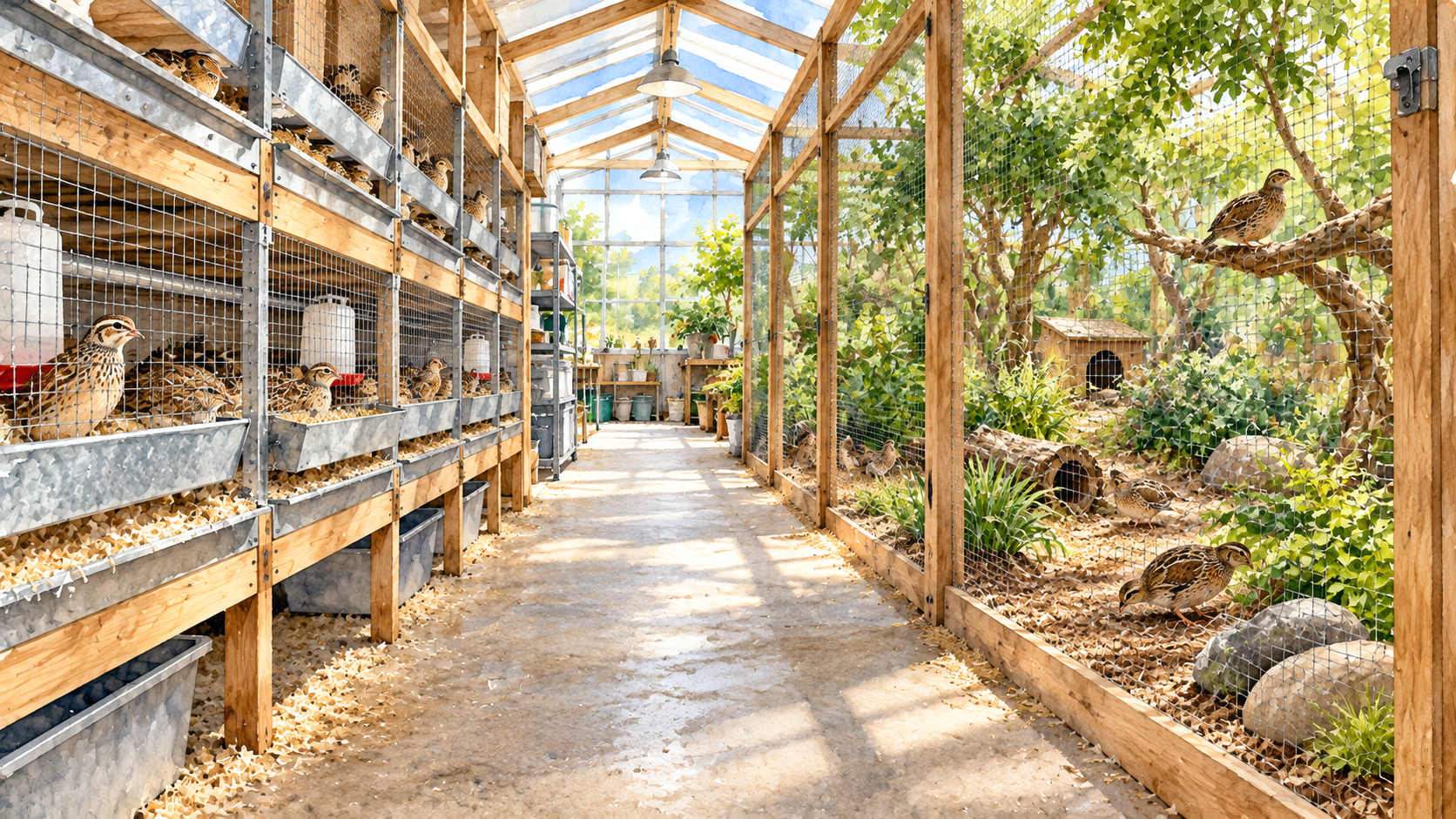
Cages can simplify egg collection, feeding and individual bird management, while aviaries offer more opportunities for Coturnix quail to move, forage, dust bathe and retreat from flockmates. An enriched aviary generally meets more behavioral needs than a conventional battery cage, though poor litter conditions, overcrowding or incompatible birds can create problems in any system.
Cages vs. Aviaries for Quail: Key Differences
| Factor | Conventional cages | Enriched aviaries |
|---|---|---|
| Movement | Often restricted | More room to walk and move |
| Foraging and dust bathing | Often limited or absent | Can support natural behavior |
| Egg collection | Frequently easier | Floor-laid eggs may take more work |
| Foot health | Perforated floors can cause problems | Depends on litter and floor condition |
| Injuries | Head collisions and restricted escape | Flight hazards and aggression still possible |
| Hygiene | Waste may collect below birds | Litter requires close management |
| Labor | Convenient fixed access points | More inspection and searching for eggs |
These are tendencies rather than guarantees. Welfare guidance for Japanese quail recommends avoiding the conventional cage systems assessed because of their restrictions and injury risks.
Which System Is Better for Quail Welfare?
Coturnix spend much of their time on the ground, exploring, scratching, dust bathing and using cover. Barren cages restrict many of these activities. Solid littered floors, nesting cover and fine dust-bathing material address important needs. Aviaries can accommodate such features with greater freedom of movement, but benefits depend on accessible resources and stable social groups.
Do Quail Lay More Eggs in Cages or Aviaries?
Some controlled comparisons have found production advantages under cage management. In one experiment, cage-reared Japanese quail matured sooner and achieved higher egg-production and feed-efficiency measures than floor-reared quail under the studied conditions. This does not establish that every cage outperforms every aviary, or that higher productivity means better welfare.
Aviaries may require more time to locate eggs outside nesting sites. Regardless of system, the age at which Coturnix start laying and their annual laying potential vary with strain, feeding, health and environment.
How Do Injury Risks Compare?
Quail can spring upward when startled, causing head and neck injuries against hard ceilings. This problem is often associated with cages, while aviaries also need appropriate clear height and safe cover. Mature males may injure one another through pecking under either system. Captive-quail welfare evidence describes both escape-related injury and social aggression. The causes of aggression among quail need attention in every housing type.
Floor choice matters too: particular perforated surfaces have produced increased footpad inflammation and thickened skin on quail feet. Neither a wire grid nor a littered floor should be assumed safe without considering its condition.
Are Cages More Hygienic?
A cage with waste collection below birds can simplify removal of droppings, but easier cleaning is not the same as lower disease risk. Aviaries expose birds to more litter and ground material, creating both behavioral opportunities and a need to control dampness and manure. Comparisons of housing, eggshell cleanliness and animal health demonstrate that flooring and management details affect outcomes.
Ventilation, clean water, feed protection and poultry biosecurity measures are essential in both systems.
Which Requires More Labor?
| Task | In cages | In aviaries |
|---|---|---|
| Feeding and water | Often fixed-access equipment | Multiple stations may require checks |
| Egg collection | Roll-out channels can help | Nests and ground areas may need searching |
| Inspecting individuals | Birds may be easy to locate | Cover can complicate observation |
| Waste management | Trays or collection systems | Littered floor maintenance |
| Bird capture | Shorter reach in some systems | May require moving through enclosure |
Management convenience is meaningful but must not outweigh welfare. The handling needs of nervous quail should be considered when selecting access arrangements.
Which System Better Handles Social Groups?
Aviaries can give birds more options to retreat, but larger groups can also create complex interactions. Conventional compartments may make it easier to identify individuals, without necessarily permitting adequate movement or escape. The social needs of Coturnix and the choice of compatible flock size are important regardless of the housing type.
What About Space and Investment?
Multi-tier cages concentrate more birds into a building’s footprint, whereas aviaries often require greater structural volume and keeper-access space. The actual indoor space allowance for quail should not be overridden by an equipment supplier’s advertised capacity. Total cost should include equipment, labor, ventilation and maintenance; the costs of raising quail vary greatly with facilities and operating methods.
Are Aviaries Better for Breeders and Growers?
Breeding groups need retreat options to reduce repeated mating pressure, while juvenile grow-out groups require changing space and management as birds mature. Group stability, sex composition, observation and accessibility may matter more than a generic cage-or-aviary label. Compartmentalized housing may help recordkeeping, but should not compromise behavioral opportunities.
Should You Choose Cages or Aviaries?
For a small domestic Coturnix flock, an enriched aviary or spacious floor-based enclosure is generally the stronger welfare choice when maintained well. Conventional battery cages can make egg collection and some routine tasks easier but impose substantial behavioral restrictions. Assess protection, ventilation, movement, flooring, nest access, social interactions and keeper time together. The range of suitable quail housing options extends beyond a simple two-category choice.
Common Questions About Quail Cages and Aviaries
Are aviaries healthier for quail? Enriched aviaries offer more behavioral opportunities, but health still depends on hygiene, ventilation, compatibility and management.
Do quail lay more eggs in cages? Some trials report production advantages for cages under specific conditions; results are not universal and do not demonstrate welfare superiority.
Are quail cages easier to maintain? They can simplify collection and some inspections, while aviaries may require more time for litter and egg management.
Can quail fight in an aviary? Yes. More room may help avoidance, but incompatible adults can still injure one another.
5 thoughts on “Cages vs. Aviaries for Quail: Pros and Cons”