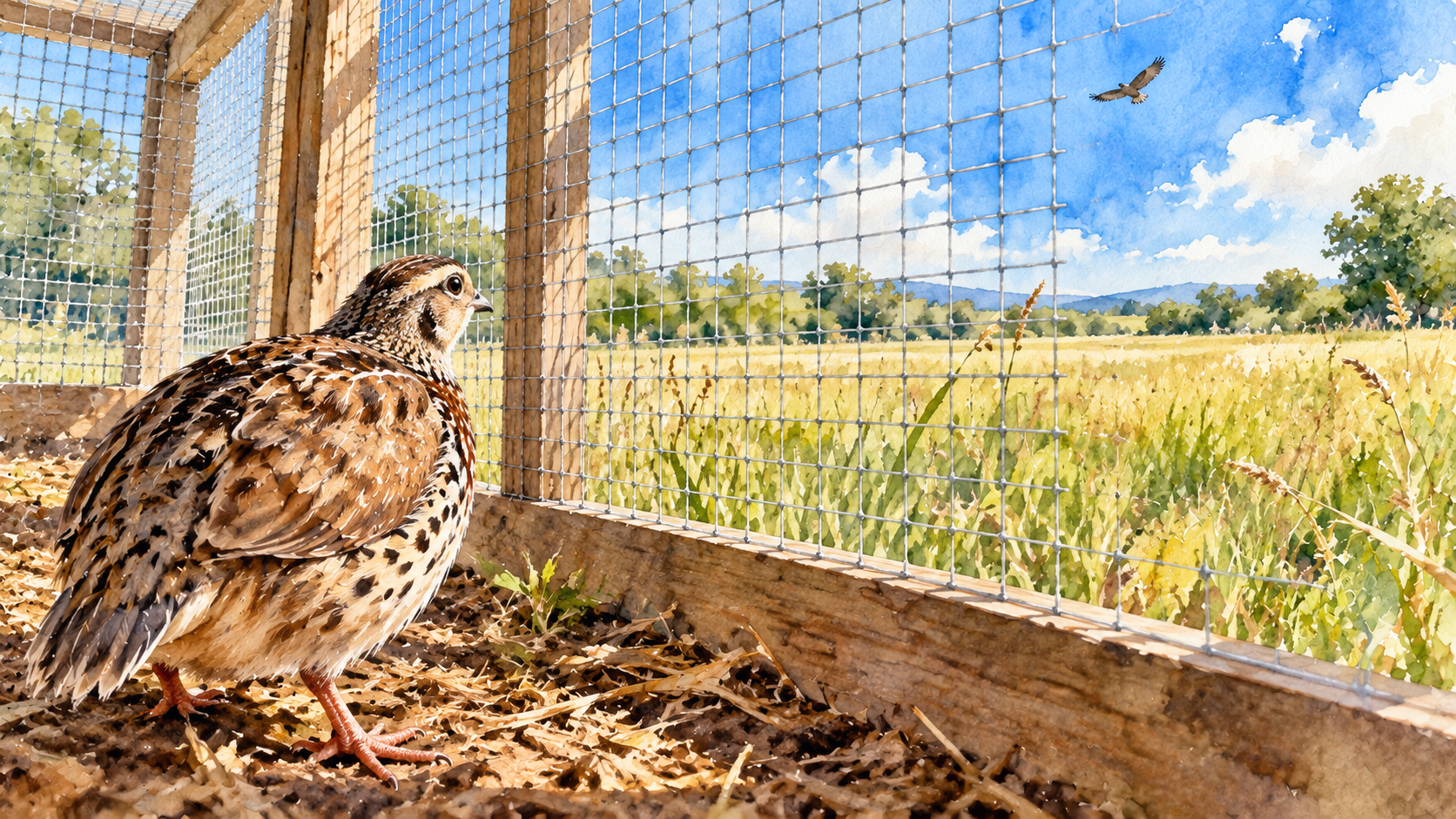
Domestic Coturnix quail should not be allowed to free-range unrestricted in an open yard or pasture. They can fly when startled, disappear into vegetation, and become vulnerable to predators. Unlike chickens accustomed to returning to a familiar coop, Coturnix cannot be relied upon to return after release. A fully enclosed outdoor pen offers foraging, dust bathing and exploration with considerably better control over escape and exposure risks.
Why Is Free-Ranging Domestic Quail Risky?
Domestic Japanese quail usually run or hide when alarmed but can launch into sudden, rapid flights. Their escape and flight behavior makes an apparently calm bird difficult to contain once frightened. Open ground also makes it hard to account for every bird or control contact with other animals.
Will Coturnix Quail Fly Away?
Yes. Some birds may remain near familiar feeding areas for a time, but their behavior is unpredictable when startled. The flight capabilities of Coturnix mean ordinary garden fencing is not adequate. A bird returning once does not prove dependable homing or recall.
Can Quail Be Trained to Return?
Quail may learn familiar feeding schedules and recognize routine activity. However, food association is not dependable recall training. Fear can override a routine in seconds, and an escaped bird may be impossible to locate in vegetation. Use familiar cues for calmer management inside secure housing, not as a substitute for containment.
How Vulnerable Are Free-Ranging Quail to Predators?
Quail’s small size and ground-level habits leave them exposed to aerial and terrestrial attacks. Dense vegetation can offer hiding places but cannot guarantee safety; supervision does not prevent a sudden attack. Welfare guidance on outdoor access identifies predation, adverse weather and infection as management challenges for quail.
Does Free-Ranging Increase Disease Risk?
Yes. Uncontrolled roaming exposes birds to ground and water contaminated by wildlife. Wild birds can carry avian influenza without appearing ill, and pathogens can move through droppings, water, clothing and equipment. Limiting contact with wild birds and standing water and maintaining consistent poultry biosecurity are easier in covered accommodation. Even secure outdoor housing cannot eliminate every risk.
Is Free-Ranging Better for Welfare?
Outdoor access can provide stimulation, varied surfaces, foraging and dust bathing, but the benefits need not require unrestricted roaming. Farmed-quail welfare recommendations recognize covered outdoor areas as a compromise providing natural light and enrichment with fewer management risks. Evidence does not establish that unprotected free-ranging is better overall than secure enriched accommodation.
Domestic Coturnix vs. Gamebirds Raised for Release
| Factor | Domestic Coturnix | Gamebirds for authorized release |
|---|---|---|
| Usual purpose | Eggs, meat, breeding | Specialist gamebird production |
| Normal management | Secure captive housing | Species-specific conditioning |
| Return after release | Unreliable | Not necessarily expected |
| Dispersal | Unwanted escape | May be part of a managed release |
| Rules | Poultry and local bird-keeping provisions | Wildlife permits and release rules may apply |
Northern bobwhite may be conditioned in flight pens for specialized programs, as described in gamebird-rearing guidance. But tracking of released pen-raised bobwhite illustrates their survival difficulties. This is not evidence that domestic Coturnix should roam freely.
Can Farm Quail Forage Outdoors Without Free-Ranging?
Yes. A covered, secure outdoor pen permits exploration, dust bathing and movement without relying on recall. The outdoor pen arrangement for Coturnix can incorporate natural substrates and cover. The welfare trade-offs between cages and aviaries also help explain why natural behavior can be supported without unrestricted access.
What If a Quail Escapes?
An escaped bird may seek shrubs, tall grass or nearby cover. Avoid frantic pursuit, which can trigger another flight. Keep people and pets away and attempt calm retrieval with a suitable carrier only when safe. The safe handling of quail helps avoid injuries. Inspect the remaining enclosure for openings before using it again; there is no guarantee an escaped bird will return.
Are There Legal Issues With Releasing Quail?
Yes, potentially. Keeping captive quail and releasing birds into the environment can involve different wildlife and agricultural rules. The permit requirements for raising quail depend on the species and jurisdiction, and possession permission does not automatically authorize release. Never intentionally release captive birds without confirmation from the relevant wildlife authority.
Should You Free-Range Coturnix Quail?
For ordinary domestic Coturnix, unrestricted free-ranging is generally a poor choice. Escape flight, predation and disease exposure make reliable containment important. A secure, enriched outdoor enclosure allows natural activity while making daily supervision and welfare protection more practical.
Common Questions About Free-Ranging Quail
Will Coturnix quail return home after free-ranging? Not reliably. Familiarity with food or a keeper does not guarantee recall.
Can quail roam in a fenced backyard? Ordinary fencing cannot prevent flight over the boundary; secure overhead containment is important.
Are bobwhite better suited to release? Some bobwhite are reared for legally authorized release programs, but captivity-raised birds can struggle to survive in the wild.
Can Coturnix exercise without free-ranging? Yes. A spacious enriched enclosure can support walking, foraging, dust bathing and limited flight.
3 thoughts on “Can Farm Quail Free-Range?”