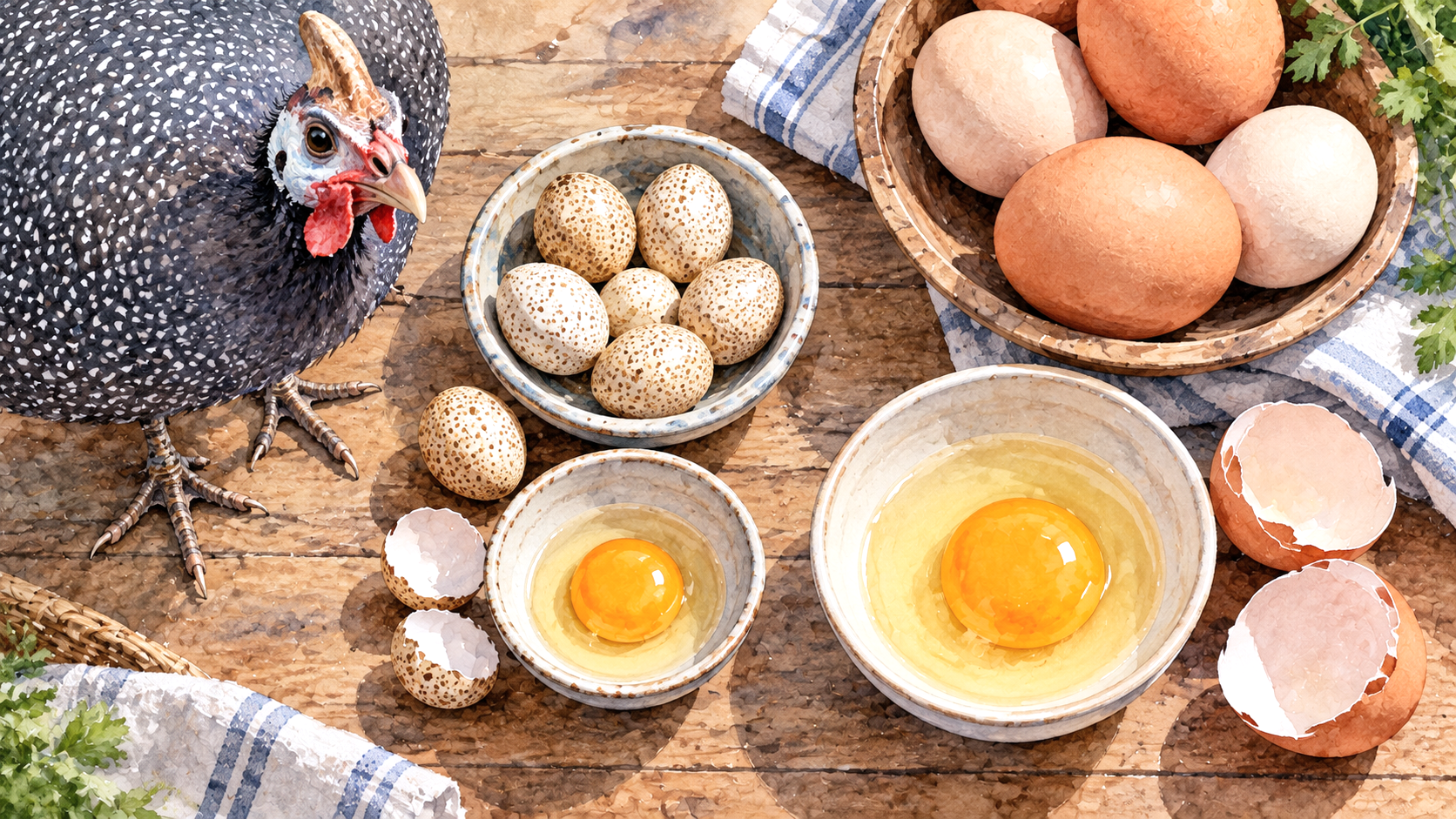
A guinea fowl egg can look like a miniature chicken egg at first glance, but pick one up and the differences become easier to recognize. It is generally smaller, often more pointed, and enclosed in a shell that feels surprisingly solid. Both eggs are useful in a kitchen, though substituting one for the other sometimes requires a little adjustment. Guinea fowl eggs are typically smaller and more thick-shelled than standard large chicken eggs. Both contain a yolk and white, can be cooked in familiar ways, and provide similar categories of nutrients. Their actual size, shell characteristics, and proportions vary with breed, age, and flock conditions.
Guinea Fowl Eggs vs. Chicken Eggs at a Glance
| Characteristic | Guinea fowl egg | Chicken egg |
|---|---|---|
| Common weight | About 35–45 g | About 50–60 g for a large retail egg, including shell |
| Shape | Often noticeably pointed at the narrow end | Usually more oval, with a gentler taper |
| Shell color | Commonly cream, buff, tan, or speckled brown | White, brown, blue, green, or tinted, depending on breed |
| Shell | Generally thicker and more resistant to cracking | Generally thinner, though strength varies |
| Inside | Yolk and albumen (white) | Yolk and albumen (white) |
| Cooking | Boiling, frying, scrambling, baking | The same basic uses |
| Recipe substitution | Adjust by total contents or weight | Standard reference egg for many recipes |
The weight figures are practical reference ranges, not identification rules. Some small chicken eggs overlap with large guinea eggs. Studies directly comparing the physical characteristics of guinea and chicken eggs have found differences in weight, length, diameter, and shell thickness, although egg shape indices did not always differ significantly.
Which Egg Is Bigger?
A conventional large chicken egg is usually heavier. Guinea fowl eggs commonly weigh around 35–45 grams, while the USDA’s large chicken egg size category is based on a minimum of 24 ounces per dozen, equivalent to an average of approximately 56.7 grams per egg including the shell.
That means a guinea egg weighing 40 grams is about 70% of the mass of a 57-gram chicken egg. It does not mean that every guinea egg contains exactly 70% as much edible material, because the shell accounts for a different proportion of the total weight.
A reference comparison of poultry egg composition lists an example guinea egg weighing 41 grams and a chicken egg weighing 58 grams. The comparison also finds that the shell makes up a larger percentage of the guinea egg. In practice, you may need more guinea eggs than chicken eggs to obtain the same amount of liquid egg for a recipe.
Small farm chicken eggs can be considerably lighter than grocery-store large eggs, while individual guinea eggs can be unusually large. Comparing actual weights is more useful than assuming every egg follows the average.
How Their Shapes and Colors Compare
Guinea eggs often have a rounded broad end and a distinctly tapered narrow end, creating a compact, slightly pear-shaped outline. Chicken eggs are also asymmetrical, but the taper is often less pronounced.
This visual difference is helpful, not definitive. A study comparing guinea egg genotypes found differences in shape between the white and grey varieties. An individual guinea egg can therefore look less pointed than expected.
Color provides another clue. Guinea shells are commonly buff, cream, tan, or light brown, sometimes with fine brown spotting. Chicken shell color varies widely by breed, from white and brown to blue-green shades. A plain pale guinea egg could easily be confused with a small chicken egg if its source is unknown.
The normal appearance of guinea fowl eggs includes substantial variation in shade and speckling. Neither egg color nor spotted markings establish whether the contents are fresh or fertile.
Why Are Guinea Fowl Eggshells Harder?
The shell is the most striking physical difference. Guinea eggs generally have thicker shells and strong resistance to breakage relative to their size.
A direct study of guinea fowl and White Leghorn chicken eggs found that guinea eggs had a thicker and heavier shell portion. The investigators attributed this partly to greater mineral deposition on a thicker shell membrane during egg formation.
In another comparison of eggshell ultrastructure, researchers investigated the crystal organization and composition behind the strong guinea shell. A separate comparison of marketed poultry eggs reported guinea shell thickness at approximately 0.414 mm and described greater resistance to cracking during handling.
This does not make guinea eggs unbreakable, nor does a thick shell eliminate contamination risks. Fine cracks can still form during transport or collection. A chicken egg with a healthy shell may also withstand normal handling perfectly well.
When opening a guinea egg, a firmer tap and a little more care may be needed. Cracking it into a separate bowl before adding it to a recipe helps catch shell fragments, just as it does with chicken eggs.
Is There More Yolk in a Guinea Egg?
It is common to hear that guinea eggs contain a much larger proportion of yolk than chicken eggs. Research suggests the answer is more nuanced.
One published composition comparison reported guinea eggs as approximately 28.9% yolk, 55.0% white, and 16.1% shell, compared with 31.9% yolk, 55.8% white, and 12.3% shell for its chicken reference eggs. In those examples, the guinea egg did not have a larger yolk percentage.
Other comparative work on guinea and chicken eggs shows that internal composition depends on the population examined and the particular measurement. Yolk color can also differ according to the hen’s diet and pigments in feed.
The safest conclusion is that both eggs have comparable basic internal components, but their yolk-to-white ratios are not fixed across every breed or flock. A richly colored yolk is not proof that the egg contains more protein or vitamins, and smaller eggs cannot be assumed to have the same usable volume.
Do Guinea Fowl Eggs Taste Different?
Both are broadly similar in flavor and can be used for the same kinds of dishes. Some cooks describe guinea eggs as slightly richer, but taste depends on feed, freshness, cooking method, and individual perception. There is no dependable rule that one species’ eggs always taste stronger or better.
The differences are often more noticeable in appearance and handling than in the final dish. For example, a fried guinea egg has a smaller footprint on the plate, while its firm shell can require a stronger tap before cooking.
Nutrient comparisons also require care. Egg size changes the nutrients delivered per egg, so a large chicken egg generally provides more edible mass than a small guinea egg even when nutrient concentrations are similar. Comparisons should use equal edible weights where possible instead of assuming two eggs represent equal servings.
Can You Substitute Guinea Eggs for Chicken Eggs in Recipes?
Guinea eggs can be boiled, fried, scrambled, poached, or used in baking. The main adjustment is quantity.
For flexible recipes such as scrambled eggs, omelets, or fried eggs, use however many suit the intended portion. Exact equivalence matters more in cakes, custards, and other recipes where the ratio of egg to flour or liquid influences texture.
An ordinary US large chicken egg supplies about 50 grams of edible egg without the shell, although individual eggs vary. Because guinea shells are relatively heavy, weighing their contents is more reliable than counting eggs by a fixed conversion.
For a recipe calling for two large chicken eggs, for example, aim for approximately 100 grams of combined beaten egg if precision matters. Crack enough guinea eggs to reach that weight; avoid assuming that two, three, or four will always be correct.
This is particularly useful when guinea eggs come from hens of different ages and vary in size. Changes in guinea egg size during a hen’s laying years can influence how many are needed for the same recipe.
Boiling times also cannot be copied mechanically. A smaller egg may heat through faster, while cooking starts at different temperatures and the desired center varies. Use an appropriate fully cooked endpoint rather than relying on shell thickness or an untested timing shortcut.
Which Eggs Are More Practical on a Small Farm?
For a household that already keeps chickens and guinea fowl, the most useful egg is often the one that can be collected cleanly and consistently. Chicken hens kept for laying commonly use accessible nest boxes. Guinea hens, particularly when free-ranging, may choose concealed ground nests.
That difference affects the collection experience. Guinea fowl often lay in sheltered vegetation or secluded corners, and finding eggs outside the coop may require observing the birds’ movements rather than checking a familiar box.
Guinea eggs may be convenient for small portions and everyday cooking, but their smaller size and harder shells can add a little work during recipe preparation. Chicken eggs have the advantage of standardized retail sizes, making many published recipes easier to follow directly.
Shell strength should not be confused with permission to leave eggs outdoors longer. The FDA’s egg safety advice emphasizes safe handling and cooking because apparently intact eggs can contain harmful bacteria. Guinea eggs deserve the same caution.
Farmers using either type should keep their egg collection and handling practices consistent with the source, condition, and intended use of the eggs.
Questions About Guinea Fowl and Chicken Eggs
Are guinea fowl eggs smaller than chicken eggs?
Usually, yes, when compared with standard large chicken eggs. Some small chicken eggs and unusually large guinea eggs can overlap in weight.
Are guinea fowl eggs harder to crack?
Often. Their shells are generally thicker and mechanically stronger relative to their size, although individual shell quality varies.
Do guinea eggs have more yolk?
Not necessarily by percentage. The proportion of yolk differs among studies and flocks, so claims that every guinea egg has proportionally more yolk are too broad.
Can guinea fowl eggs be used in cakes?
Yes. For predictable results, substitute by the edible weight of the cracked eggs rather than a fixed egg count.
Do guinea fowl eggs taste the same as chicken eggs?
They are similar enough for most of the same dishes. Some people perceive differences in richness, but diet and preparation also affect flavor.
Are guinea egg shells naturally speckled?
They often are, but a guinea egg can also have a relatively plain cream or tan shell.
Does a thicker shell make guinea eggs safer than chicken eggs?
No. Shell strength does not guarantee the absence of pathogens, damage, or unsafe temperature exposure.