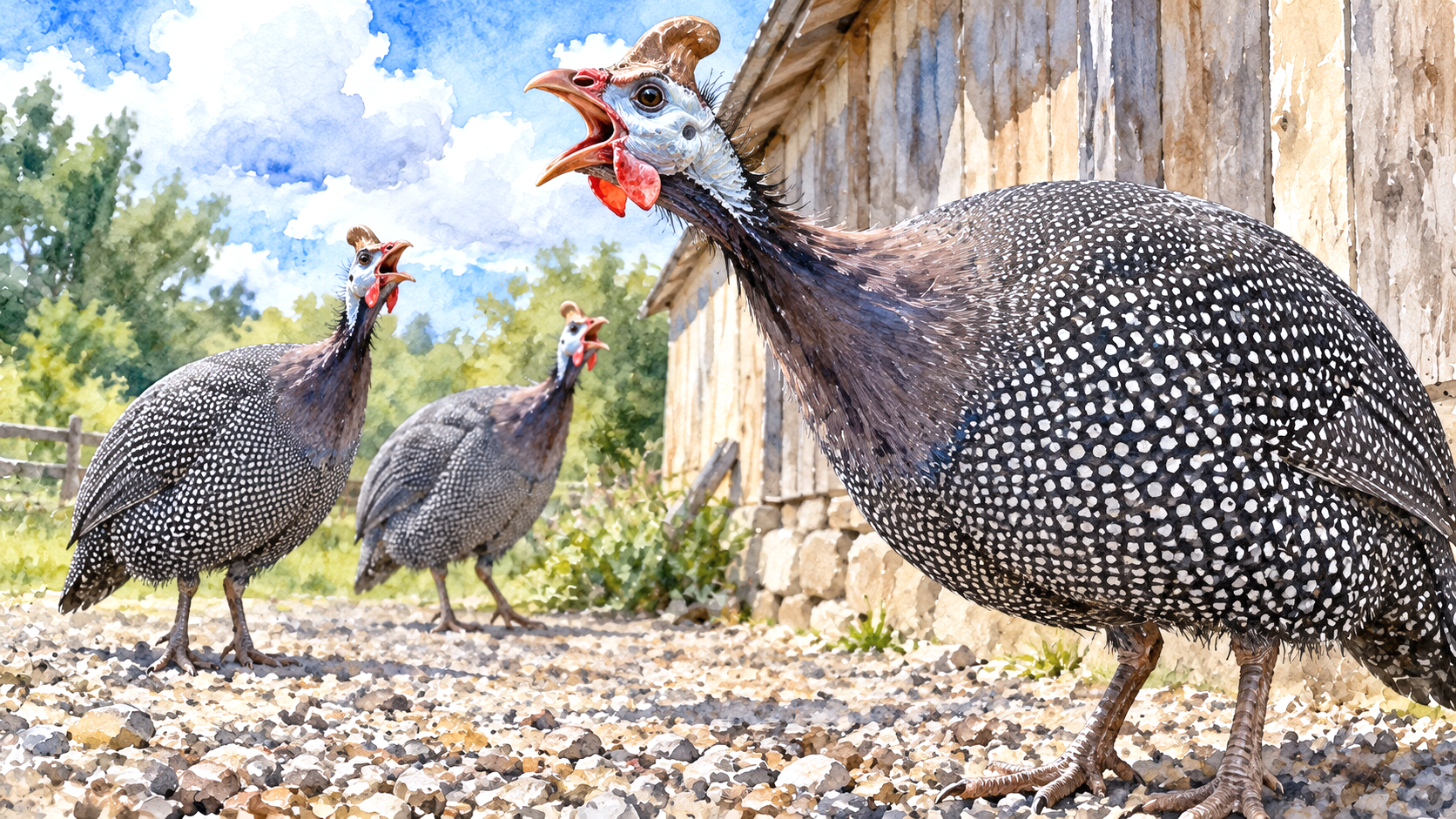
Guinea fowl are loud birds, particularly when alarmed, excited, or disturbed. Their sharp, repetitive calls can carry considerable distances, making them one of the more noticeable types of poultry on a farm. Although guinea fowl are not constantly calling at maximum volume, periods of intense vocalization can be frequent enough to disturb nearby households. Their noise is especially important to consider before introducing them to a suburban backyard or a small rural property with close neighbors. Even people accustomed to chickens may find guinea fowl considerably more intrusive because of the harsh quality and repetition of their calls.
How Loud Are Guinea Fowl in Decibels?
A 2024 study of wild helmeted guinea fowl recorded different sound levels depending on the birds’ behavior. Quiet contact calls measured approximately 40 decibels (dB), preliminary warning calls ranged from 50 to 60 dB, and louder alarm calls reached 70–85 dB.
These measurements demonstrate that guinea fowl do not produce every vocalization at the same intensity. Their quieter communication may blend into ordinary farm activity, while collective alarm calling can become conspicuous and disruptive.
The recorded figures should not be interpreted as universal maximum noise levels for domestic guinea fowl. Measurements depend on microphone distance, surroundings, recording equipment, and the particular birds observed. A flock calling together may also create a different listening experience from an individual bird, even when the measured sound pressure level is similar.
Decibels alone cannot describe how irritating a sound may be. Guinea fowl produce sharp, repeated vocalizations that some listeners find more distracting than a steady background noise of comparable intensity. The acoustic characteristics of helmeted guinea fowl vocalizations reflect their use of several signals for communication within social groups.
How Often Do Guinea Fowl Make Noise?
Guinea fowl vocalize throughout their active periods, although the intensity and frequency of calling fluctuate considerably. A settled flock may spend extended periods walking and foraging while making relatively quiet contact sounds. A sudden disturbance can produce repeated loud calls from several individuals.
Field observations of helmeted guinea fowl communication describe birds maintaining vocal contact while searching for food and increasing their calling when excited or threatened. Their social behavior means that one bird’s reaction can quickly involve others.
The amount of noise heard on a particular property depends on the flock’s circumstances. Birds occupying a familiar environment with relatively little disturbance may have fewer prolonged alarm episodes than birds regularly exposed to unfamiliar animals, people, or activity. Individual differences are also possible, so there is no dependable daily calling schedule applicable to every flock.
Owners sometimes report that older, established guinea fowl appear quieter than younger birds. Guinea Fowl International’s observations of flock behavior suggest that vocal activity may settle as birds mature and become accustomed to their surroundings. Such keeper observations are useful, but they do not establish that every adult flock becomes substantially quieter with age.
Why Guinea Fowl Are So Vocal
Guinea fowl are highly social birds that use sound to communicate while moving together, maintaining contact, and responding to unfamiliar circumstances. Their natural behavior includes vigilance for potential threats, making vocal communication important to group coordination.
In observations of wild helmeted guinea fowl, researchers recorded quieter contact calls during ordinary foraging and substantially louder calls when birds detected approaching predators. The relationship between vigilance, group behavior, and alarm calling demonstrates how vocal intensity can change rapidly according to the situation.
From a keeper’s perspective, an approaching vehicle, unfamiliar visitor, passing animal, or unexpected movement may trigger calling that seems disproportionate to the actual danger. Guinea fowl respond to what they perceive as unusual or threatening, not exclusively to genuine emergencies.
Their willingness to announce disturbances is one reason some farmers appreciate them as farmyard alarm birds. However, frequent false alarms can diminish their usefulness as a warning system while increasing the amount of unwanted noise.
Are Guinea Fowl Louder Than Chickens?
Guinea fowl are generally considered noisier than ordinary backyard hens, particularly during alarm calling. Their vocalizations tend to be sharper and more repetitive, and several birds may call simultaneously when something attracts their attention.
The comparison becomes less straightforward when roosters are involved. A rooster’s crow can be extremely conspicuous, but its pattern and duration differ from repeated guinea fowl calls. A flock of guinea fowl may generate an extended period of noise rather than a series of relatively brief crows.
There is insufficient standardized research comparing the overall daily sound exposure produced by equivalent domestic guinea fowl and chicken flocks. Consequently, claims that guinea fowl are a specific number of times louder than chickens are not well supported.
People considering guinea fowl alongside chickens should judge the likely disturbance by the character, repetition, and circumstances of the calls rather than decibel figures alone.
Can Neighbors Hear Guinea Fowl From Far Away?
Guinea fowl calls may be audible well beyond the immediate enclosure, especially across open land with relatively little competing background noise. Their distinctive vocal quality also makes them recognizable at distances where ordinary poultry activity might go unnoticed.
There is no reliable universal distance, measured in feet or miles, at which guinea fowl can be heard. Sound transmission depends on terrain, vegetation, wind, buildings, atmospheric conditions, and the position of the listener.
An open pasture bordered by neighboring houses presents different acoustic conditions from a sheltered farmyard surrounded by woodland. Noise can also be more noticeable during quiet mornings when traffic and other environmental sounds are relatively low.
Even a small number of birds can disturb neighbors if their calls occur close to bedrooms, patios, or outdoor living spaces. A larger flock may increase the number of calling individuals and opportunities for group vocalization, but noise does not increase according to a simple bird-per-decibel formula.
Are Guinea Fowl Suitable for Farms Near Neighbors?
Guinea fowl are generally better suited to properties where their vocalizations will not regularly interfere with surrounding households. Their presence may be entirely acceptable on a spacious rural farm while becoming contentious on a narrow lot with houses on either side.
Before acquiring a flock, consider how far the proposed poultry area is from neighboring residences, how frequently people and vehicles pass nearby, and whether the surrounding area is ordinarily quiet. The University of Maine’s guinea fowl husbandry guidance specifically identifies potential noise problems with neighbors as an important consideration before keeping the birds.
Property size alone does not guarantee compatibility. Birds may move toward roads, houses, or neighboring yards, placing their calls much closer to other people than their original housing location would suggest.
Local regulations also require attention. Municipal and county ordinances may distinguish between agricultural and residential properties, regulate the keeping of poultry, or prohibit animals that create unreasonable noise. Homeowners association rules may impose additional restrictions even where local government permits guinea fowl.
Someone choosing poultry primarily for a peaceful backyard should not assume that guinea fowl will meet that expectation simply because the birds are smaller than many other farm animals.
Does a Small Flock Make Less Noise?
A smaller flock may produce less simultaneous calling than a large group, but it is not necessarily quiet. Individual guinea fowl can vocalize loudly, and two or three birds may still create noticeable disturbance when excited.
Their social requirements also complicate attempts to minimize noise through flock size. Guinea fowl are naturally group-living birds, and keeping one alone merely to reduce the number of callers can compromise its social welfare.
The number of birds should reflect their welfare needs and the keeper’s ability to provide suitable housing, space, and care. It should not be reduced below an appropriate social group simply because the property cannot accommodate normal vocal behavior.
Flock size also affects the cumulative opportunities for disturbance. A larger group may contain more individuals responding to unfamiliar activity, although the relationship between flock size and overall noise is not sufficiently established to justify a universal numerical prediction.
Should You Keep Guinea Fowl If You Prefer Quiet Poultry?
Guinea fowl are unlikely to satisfy someone who requires consistently quiet surroundings. Their vocal behavior is a normal characteristic of the species, not an occasional defect that can be assumed to disappear with familiarity or age.
The natural history of helmeted guinea fowl includes social calling during foraging, agitation, and group movements. These behaviors occur in ordinary circumstances, independently of poor husbandry.
Noise tolerance differs between people. Someone living on an isolated farm may appreciate hearing guinea fowl around the property, while a person working from home or living beside neighbors with young children may find the same calls disruptive.
Listening to recordings can provide an initial impression, but recordings played through a phone or computer rarely reproduce the full intensity of live calling. Spending time near an established flock offers a more realistic understanding of what keeping guinea fowl may involve.
Questions About Guinea Fowl Noise
Are guinea fowl loud all day?
Not continuously. They have quieter periods during normal activity, interrupted by calls of varying intensity. A flock experiencing frequent disturbances may nevertheless produce loud episodes throughout the day.
Are guinea keets as loud as adult guinea fowl?
Newly hatched keets produce smaller, higher-pitched vocalizations rather than the full-volume calls characteristic of mature birds. Their voices and calling behavior develop as they grow.
Are guinea fowl louder than ducks?
Many keepers find guinea fowl alarm calls more intrusive than the ordinary vocalizations of domestic ducks, but duck breeds and individuals vary considerably. There is insufficient consistent acoustic evidence to rank every guinea fowl and duck population by loudness.
Can guinea fowl be kept in suburban neighborhoods?
Possibly, where local rules permit them and surrounding conditions are suitable. However, their vocal behavior makes them a potentially poor choice for closely spaced residential properties, even if other poultry are allowed.
Do guinea fowl become completely quiet when they mature?
No. Some established adult flocks may appear less reactive than younger birds, but mature guinea fowl retain their normal contact and alarm vocalizations. Age does not eliminate their capacity for loud calling.