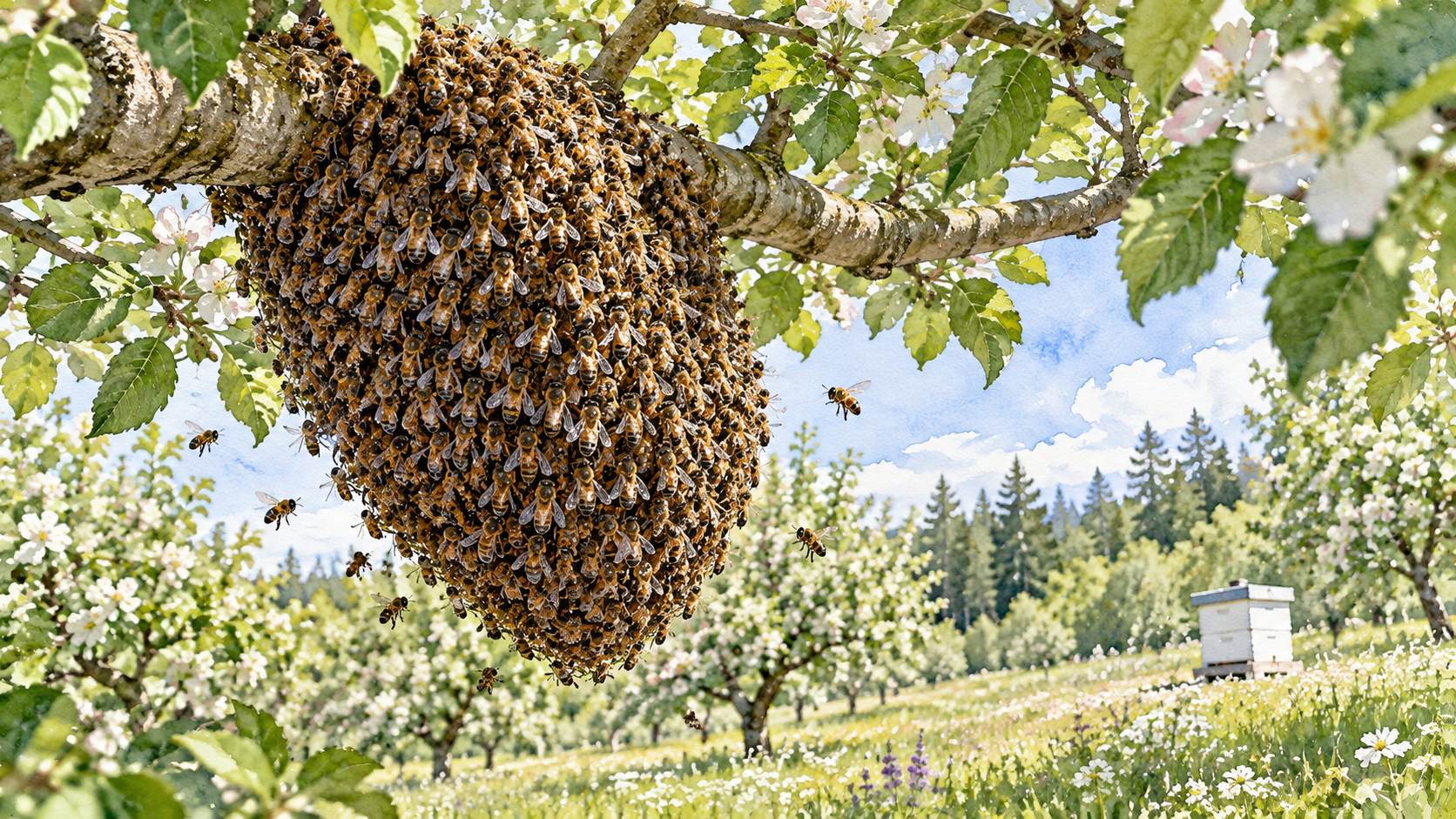
Honey bees swarm because a colony is reproducing. In a typical reproductive swarm, the existing queen leaves with a substantial share of the adult workers while the original hive raises a successor. Swarming is most likely when a colony has grown rapidly, its brood nest is congested, food and mating conditions are favorable, and queen-associated signals are less effectively distributed among workers. No single cause reliably explains every swarm.
For a beekeeper on a US farm, this distinction matters: a colony can swarm while apparently healthy and productive, and an extra empty box does not automatically remove the conditions encouraging a split. This explanation concerns managed western honey bees (Apis mellifera) and the biological reasons they form reproductive swarms, not methods for catching them or a step-by-step swarm prevention program.
Swarming Reproduces the Colony, Not Just Individual Bees
A honey bee queen lays eggs to produce new workers, drones and potential replacement queens. Swarming operates at a different level. An established colony divides so that one part can establish a second nest while the parent colony continues in its existing home. The swarm biology described by the University of Florida’s beekeeping program makes this distinction explicit: producing a new colony is the purpose of reproductive swarming, even when that behavior is inconvenient for a beekeeper.
Usually, the old queen departs in the first, or prime, swarm. Workers left behind care for developing queen cells, and a surviving new queen must emerge, mate and begin laying for the original colony to rebuild its workforce. A swarm may cluster temporarily on a tree, fence or other object while scouts search for a protected nesting cavity. The cluster is a stopover, not the colony’s intended permanent nest. Occasionally, additional smaller swarms leave with virgin queens, so one parent hive can lose bees more than once.
Rapid Population Growth Can Crowd the Brood Nest
A strong spring colony may raise successive waves of worker brood while foragers bring in nectar and pollen. The adult workforce increases, young bees occupy brood comb and food stores fill cells. The relevant constraint is not simply the number of boxes stacked on the hive. It is the usable space in the brood-rearing area relative to the number of bees and the colony’s expanding needs.
When brood and food occupy most available cells, the queen has fewer places to lay and workers become concentrated in the remaining brood-nest space. Purdue’s explanation of honey bee colony biology identifies limited space among brood, honey and pollen as an important part of the swarm impulse. The seasonal colony-growth guidance from Mississippi State likewise distinguishes population increase from congestion within the brood area.
This also explains why comparing two hives by total box count can be misleading. A colony may have room for honey above while its queen has little accessible laying space in the brood nest. Another colony can be populous without having the same degree of internal congestion. A small hive can swarm if the population outgrows its available space; a large colony does not inevitably swarm merely because it has many bees. This distinction concerns usable brood space and worker distribution, not an automatic instruction to add equipment.
Queen Pheromones and Worker Age Help Shape the Swarm Impulse
The queen produces chemical signals that influence worker behavior and help maintain colony organization. Workers near her contact these pheromones and pass them to nestmates through physical interactions. As the population grows denser, distribution of the queen’s signal across the workforce may become less effective. Reduced exposure to queen-associated pheromones is one factor associated with workers beginning to rear additional queens. It does not mean the original queen must be absent or unable to lay.
Researchers have directly investigated this communication system. A 2024 study of pheromone relay networks found that queen movement and worker-to-worker messaging both contribute to dispersing the fertility signal. The study helps explain how contact-based communication works in a crowded social colony, but should not be interpreted as proof that a particular measured pheromone level always triggers a swarm.
The age structure of workers also matters. A colony with many newly emerged and nurse-age workers can differ from one with the same number of adults but a larger proportion of older foragers. A 2025 study in Scientific Reports observed higher expression of a nutrition-related protein, vitellogenin, in certain nurse-age workers from colonies preparing to swarm. That finding offers evidence of a physiological difference associated with swarming, not a simple field test or a proven single cause. Together, colony crowding, worker demographics and chemical communication provide a more useful explanation than either ‘too many bees’ or ‘a bad queen’ on its own.
Spring Forage Creates Conditions Favorable for a New Colony
Swarming usually peaks during spring or early summer in much of the United States, but local timing follows climate and flowering patterns rather than one nationwide date. Increasing daylight, warming conditions and new pollen and nectar supplies support brood rearing. The growing workforce can then create congestion, while an outgoing swarm has a better prospect of building comb and collecting provisions in a new home. Spring also tends to provide opportunities for young queens to mate when mature drones are available.
Abundant forage can therefore contribute to a swarm even though it is beneficial to colony growth. This is different from saying the bees leave because they lack food. The British Columbia honey bee technology-transfer program’s explanation of swarming connects seasonal nectar and pollen resources with rapid expansion and swarm preparations. A southern colony may reach these conditions much earlier than a northern one. Late-season reproductive swarms are possible under favorable conditions, but spring and early summer are the typical peak for commonly managed European-derived honey bee stocks.
Queen Age, Genetics, Weather, and Hive Conditions Modify the Odds
Older queens are often associated with a greater tendency for colonies to swarm, partly because queen condition and pheromone output can change over time. Yet a colony headed by a young, productive queen can still swarm when other conditions align. Queen age belongs among the contributing factors, not as a stand-alone diagnosis. Genetic background and the colony’s inherited swarming tendency can also affect how readily its workers initiate reproduction. These are influences seen across groups of colonies, not reliable predictions about a particular queen based only on her advertised strain.
Weather can determine when a prepared swarm departs without being the original cause of its preparations. An expanding colony confined by cold or rainy weather may remain crowded; a subsequent spell of suitable flying weather can allow a swarm already developing to leave. Ventilation and overheating have also been identified as contributing hive conditions, although warmth or bees fanning at an entrance are not, by themselves, evidence of reproductive swarming. These interacting factors are discussed in regional colony management guidance and the University of Florida swarm biology overview.
Since these influences vary by locality and colony, no responsible explanation can assign a universal hive size, temperature, queen age or weather forecast at which swarming becomes inevitable.
What Changes When a Colony Begins Preparing to Divide?
Once the reproductive process advances, workers rear developing queens in enlarged queen cells so that the original nest has a possible successor. The old queen is fed differently and her egg laying often declines before the first swarm leaves. Changes in her body condition help make flight possible. Workers preparing to depart carry food reserves, and scout bees investigate potential new nest cavities. The timing of departure is coordinated with queen development and suitable flight conditions.
The division is costly to the parent colony in the short term. It loses many adults, including valuable foragers, and may experience a gap before a new queen begins laying. Published swarm biology guidance describes the parent colony’s remaining brood and developing queens, as well as the possibility of later afterswarms. Whether the original hive recovers promptly depends on successful replacement of the queen and sufficient remaining workers, food and favorable conditions. The basic sequence explains the biology; evaluating specific queen-cell patterns and predicting imminent departure requires a separate assessment.
Do Not Confuse Reproductive Swarming With Other Colony Changes
Not every event involving queen cells or bees leaving a hive is reproductive swarming. A cell containing a developing queen has a different meaning from an empty queen cup, and the context of the colony matters. Colonies also raise replacement queens when an existing queen declines or disappears, a process called supersedure or emergency queen replacement according to the circumstances. Both can involve queen cells, but the colony is not necessarily planning to divide. The distinction between swarm and replacement cells is important, and location alone is not a reliable diagnosis because queen cells can occur in different places on comb.
Another behavior, absconding, involves a colony abandoning its nest rather than dividing and leaving a continuing parent colony behind. Comparative research on honey bee swarming and absconding documents how disturbance, declining nest conditions and resource problems can contribute to abandonment in some Apis populations; the tendency varies across species and geographic stocks. This distinction should not be used to diagnose the cause of an empty managed hive without evidence. Resource shortage should therefore not be casually described as the typical cause of a healthy spring reproductive swarm. Likewise, a busy hive entrance, ordinary foraging traffic or bees gathering around water does not mean a colony is swarming.
A Better Way to Think About the Causes on Your Farm
Swarming is best understood as an accumulation of conditions rather than a single warning light. The following framework synthesizes the colony-development and pheromone research for interpretation. It is not a prediction model, a diagnostic test or a substitute for examining an individual hive.
| Colony situation | What the biology supports | What it does not establish |
|---|---|---|
| Heavy spring brood rearing, abundant food and a dense brood nest | Resources and population growth can create conditions favorable for reproductive swarming. | That the colony has already committed to leave. |
| Spare space in upper honey boxes but limited open brood comb | Brood-nest congestion may persist despite apparently unused overall hive volume. | That total hive size alone explains the colony’s behavior. |
| An older queen or changes in queen-associated signals | Queen condition and pheromone distribution can contribute to queen rearing or swarm propensity. | That queen cells necessarily mean a reproductive swarm rather than replacement. |
| A sunny day after an extended spell of poor flying weather | Weather may release a swarm whose preparations were already underway. | That sunshine itself initiated the biological decision to swarm. |
This separates factors that make swarming more likely from events that merely coincide with its departure. It also prevents a common reasoning error: treating strong colony growth as a disease problem, or assuming a healthy colony could not have a reproductive impulse. The precise threshold for swarming remains an active research question, including in the 2025 work on worker physiology.
Why Swarming Matters Beyond the Hive
For the bees, reproductive swarming is a normal route to establishing another colony. For the farm, it can mean a sudden loss of worker population, a temporary break in brood production and reduced ability to collect a honey surplus in the original hive. That is not proof of poor beekeeping, nor is it a harmless event when hives sit near livestock pens, workers, guests, neighboring homes or public paths.
A clustered swarm is often less defensive than an established colony guarding brood and food, but honey bees can still sting, and temperament or species identity should not be assumed from appearance alone. If a swarm settles where people or animals might encounter it, keep others away and contact an experienced local beekeeper or appropriate authority rather than spraying, shaking or attempting an untrained removal. The University of Georgia’s public safety guidance specifically advises protecting children and animals and obtaining qualified help for problem locations.
2 thoughts on “Why Do Honey Bees Swarm?”