Catching a guinea fowl in an open yard can quickly become a pursuit neither the keeper nor the bird intended. The bird runs, launches into the air when cornered and may strike a wall or fence as it tries to escape. A safe catch depends less on speed than on preparing a controlled space and knowing how to support the bird once it is within reach.
The safest approach is to catch guinea fowl calmly in a secure, uncluttered area, control both wings, support the body and keep handling brief. Catching after the birds have settled inside a coop is often easier than pursuing them outdoors, provided the handler can see well enough to work safely. Never lift a guinea fowl by one leg, its wings, head, neck or tail.
Prepare the Catching Area Before Approaching a Bird
Decide what will happen after the catch before attempting it. If the bird needs to be moved, place an appropriately sized carrier nearby with its door open, check the latch and clear a safe path. Move buckets, loose tools and other obstacles away from the catching area. A frightened guinea fowl can accelerate abruptly, so wire edges, protruding nails and narrow gaps become collision hazards.
The Humane Slaughter Association’s catching guidance recommends quiet approaches, reduced lighting when suitable and temporary small enclosures for birds that otherwise have room to flee. Although its guide addresses poultry handling in slaughter settings, the catching principles also help when moving a bird for a veterinary appointment or routine examination.
Whenever possible, bring the bird into familiar guinea fowl housing rather than pursuing it across fields. Do not block ventilation, deliberately frighten the flock into piling up or crowd several birds into a corner. If the bird is already weak or showing abnormal breathing, reduce disturbance and arrange prompt veterinary assistance instead of repeated capture attempts.
The Best Time to Catch a Guinea Fowl
Guinea fowl often resist capture most strongly when they have room to run or fly. Waiting until birds are settled on a reachable indoor roost can reduce the amount of movement needed, especially when the catch is not urgent. Plan the approach while there is enough light to identify the correct bird and inspect the surroundings.
Virginia Tech’s humane poultry transport guidance advises approaching birds quietly and calmly, sometimes using dim lighting to limit panic. Darkness itself is not a handling method: the person must still be able to see the bird, footing, equipment and escape route. A bright light suddenly directed into the flock or an unexpected grab from behind can cause other birds to launch off their perches.
A reachable, stable guinea fowl roost makes a controlled catch more practical than a high branch outside. If a bird is roosting in a tree or other inaccessible location, do not climb precariously or knock it down. Necessary capture may require a safer opportunity or assistance from an experienced poultry handler.
How to Lift and Hold a Guinea Fowl Without Injury
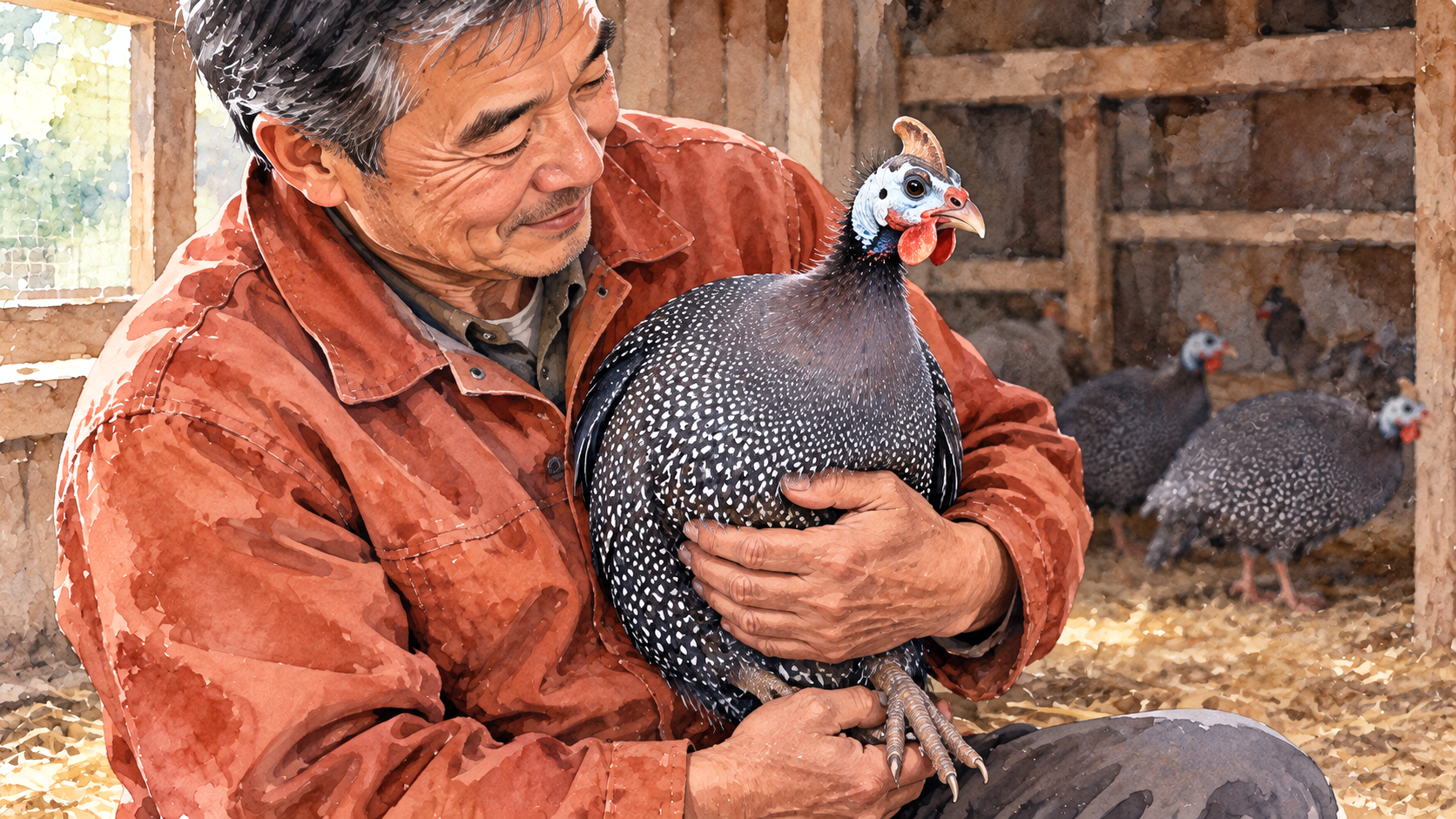
The guinea-fowl-specific instructions from the Humane Slaughter Association recommend placing both hands securely over the wings, lifting the bird bodily and then transferring one hand beneath the body to support its breast while controlling the legs. The opposite hand restrains the wings, or the bird can be kept close against the handler’s side. The guidance expressly warns that catching a guinea fowl by one leg risks hip dislocation or broken bones.
For a brief examination or transfer, a controlled sequence is useful:
- Approach slowly from a position where you can reach the bird’s body without lunging.
- Place your hands around both sides of its body, keeping the folded wings against it.
- Lift with the breast and body supported, rather than allowing its weight to hang from a limb.
- Keep the bird upright and close to your torso while securing its legs gently enough to avoid twisting or excessive pressure.
- Lower it directly onto a stable surface or into its carrier when the task is complete.
The Penn State Extension handling demonstration specifically includes guinea fowl among the poultry for which supporting the body while controlling wing movement can be used. A secure hold is firm without squeezing. Birds must be able to breathe freely; pressure on the chest or body can impair breathing, especially while an animal is struggling.
Avoid carrying several birds at once. One bird per handler is easier to support and monitor, and a startled bird should not be swung, shaken, inverted or held by dangling legs in an attempt to calm it.
Catching a Bird That Is Still Active During the Day
A guinea fowl needing immediate attention may not be available at roosting time. In that situation, guiding it gradually into a smaller safe enclosure is generally preferable to repeated high-speed chasing. Two calm handlers can sometimes position portable panels to narrow the available space without driving the bird into a corner. Stop if the bird begins striking barriers or appears exhausted.
A suitable poultry net may help in experienced hands, but its rim, mesh and handling method can injure a flapping bird. The Humane Slaughter Association’s guidance on nets warns against striking birds with the rim and stresses removing a captured bird gently. Keep the mesh from entangling toes, feathers or wings, and immediately transfer to a supported hold. Nets should not be used to lift birds by tangled limbs.
Guinea fowl can take flight during a sudden escape, so overhead obstacles matter as much as fences. Working inside an appropriate enclosure is safer than grabbing a bird as it flies. If a catch is not urgent, allowing the bird to settle and trying again later may prevent an unnecessary injury.
What to Do When a Guinea Fowl Struggles
Wing flapping, kicking and loud vocalizing during restraint may reflect fear or an effort to escape, not hostility. An agitated bird needs a more stable hold, less stimulation and a shorter handling session—not physical punishment. If it is slipping free, lower it toward a secure surface while maintaining control of its body rather than grabbing a leg or wing as it falls.
A major European Food Safety Authority assessment of transported birds found that upright handling with breast support reduces risks associated with poor restraint and inversion. The report covers several domestic bird species, so it should be applied alongside guinea-fowl-specific handling guidance rather than treated as an experiment exclusively on guinea fowl.
Do not cover the head with an airtight material, tape the wings, bind the legs or compress the bird to suppress movement. When the task requires more time than the bird tolerates safely, a poultry-experienced veterinarian may be better equipped to examine it. A bird that pecks or lunges toward its handler may be frightened by restraint; avoid interpreting every defensive movement as a reason for harsher control.
Transporting Guinea Fowl in a Carrier
For a farm transfer or veterinary journey, use a clean, secure, well-ventilated carrier with a solid or appropriately supported floor, a non-slip surface and no protruding wire or sharp edges. Its opening should allow the bird to enter without scraping its wings or head, while its interior must allow an upright posture and adequate space without permitting uncontrolled flapping during vehicle movement.
The Virginia Tech transport guidance emphasizes careful loading, suitable ventilation and protection from extreme temperatures. Ontario’s small-flock transport guidance similarly advises securing crates, positioning birds upright and keeping the vehicle ventilated; these are general poultry principles, not a guarantee that every carrier suits guinea fowl.
Lower the bird into the crate, check that its feet are beneath it, and confirm that no part of its body is caught when closing the door. Secure the carrier against sliding or overturning. Never place live guinea fowl in an enclosed car trunk, leave them unattended in a parked vehicle or expose them to direct exhaust, drafts or overheating. Keep the journey as short as practical and make appropriate arrangements for water and feed when transport is prolonged.
When moving new guinea fowl between premises, use cleaned equipment and avoid unnecessary mixing of unfamiliar birds. After arrival, quarantine procedures for newly acquired guinea fowl may be necessary before contact with the resident flock. Interstate movements may also be subject to destination-state poultry health and entry requirements, which should be checked before travel.
Releasing the Bird and Checking for Handling Injuries
Release a bird close to the ground in a secure area, with its feet placed beneath it and a clear route away. Do not throw it into the air or assume it will spread its wings to land safely. Watch for unusual walking, one wing held lower than the other, bleeding, open-mouth breathing or prolonged immobility. If signs appear after restraint or transport, prompt veterinary evaluation is appropriate.
A bird that has undergone stressful handling may initially remain cautious or seek companions. Give it quiet surroundings and an opportunity to return to normal behavior without immediate recapture. The care of an injured guinea fowl involves different decisions from routine catching; substantial injury should not be managed by simply releasing the bird into the flock.
Clean and disinfect equipment appropriately after use, particularly when moving between separate groups. Preventing disease spread is part of humane handling, not an optional step after the bird has been caught.
Questions About Catching and Handling Guinea Fowl
Can you pick up a guinea fowl by its legs?
Do not catch or suspend a guinea fowl by a single leg. The Humane Slaughter Association specifically warns of fractures and hip injuries. Support the body and control the wings and legs together during a brief transfer.
Should you wear gloves when catching guinea fowl?
Clean gloves may protect against scratches, but they must still permit a secure, sensitive grip. Bulky gloves that cause the bird to slip are counterproductive. Wash hands after poultry contact even if gloves were worn.
Can you put a towel over a guinea fowl?
A light towel may sometimes help limit visual stimulation while an experienced handler secures a bird, but it must never cover the breathing passages, restrict chest movement or allow overheating. Supporting the body and controlling the wings remain essential.
Is it safe to catch a guinea fowl when it is molting?
Necessary handling is possible, but newly growing pin feathers can be sensitive and easily damaged. Avoid pressure and pulling on developing feathers, and postpone unnecessary handling if the bird is uncomfortable.
How long can a guinea fowl be held?
There is no universal safe duration. Keep restraint only as long as needed for the immediate purpose, monitoring breathing and struggle throughout. Prolonged holding should be avoided, especially in heat.
Should children catch guinea fowl?
Young children should not attempt to chase or restrain these fast, easily startled birds. An experienced adult should perform necessary catches, with children observing from a safe distance.