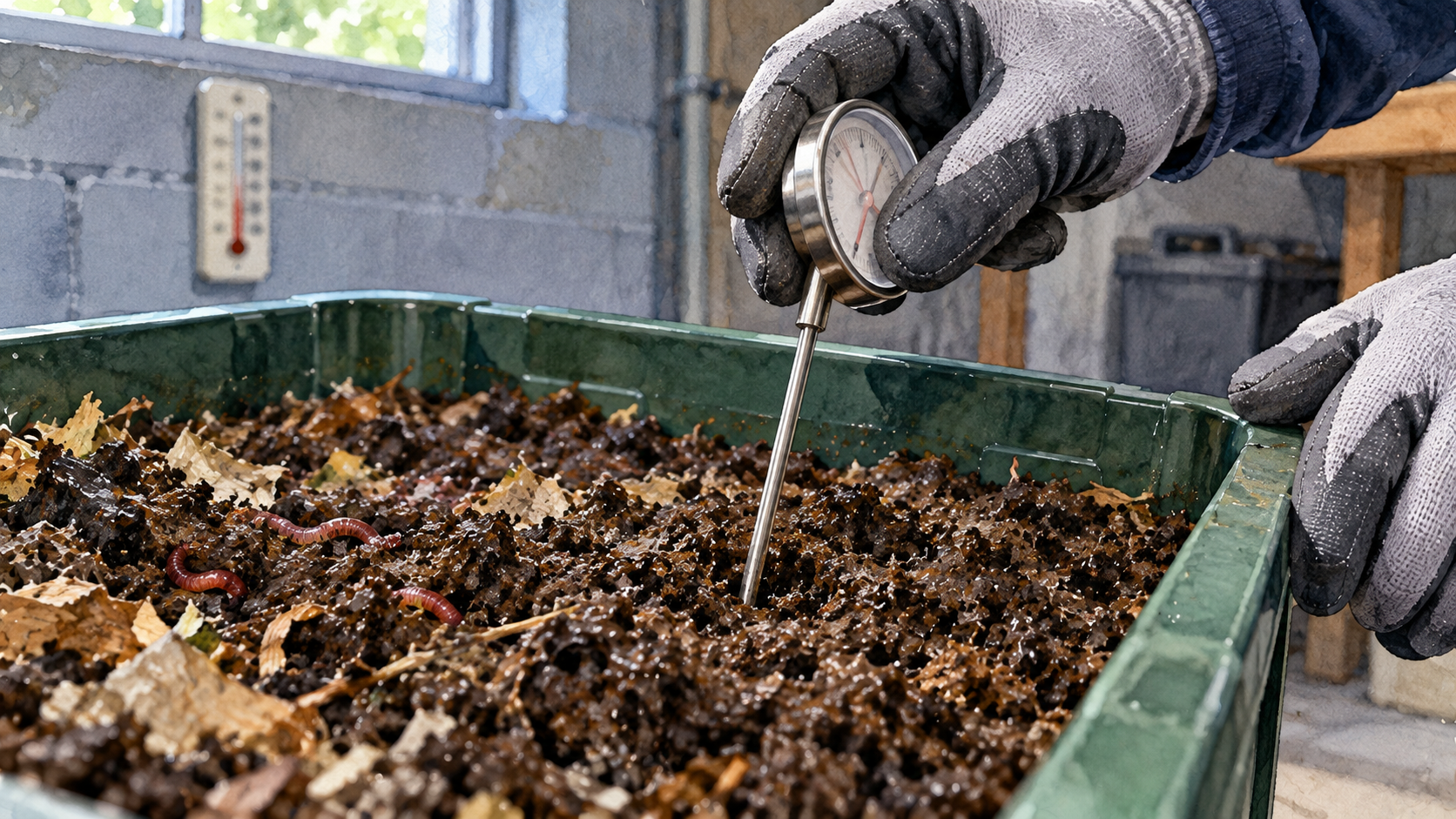
Most red wiggler composting bins should be kept around 55–77°F (13–25°C), with a steady 60–75°F (16–24°C) a practical target for routine care. Measure the temperature inside the worm bedding, not just the air beside the bin. A worm that survives a brief cold or hot spell is not necessarily feeding, reproducing, or avoiding injury at that temperature.
If the bedding is already climbing through the mid-80s°F, stop adding fresh feed and check for an overheated pocket; a hot bin warrants action before attempting to optimize routine husbandry.
That range is intended primarily for red wigglers (Eisenia fetida) in household bins or managed beds. NC State Extension identifies 59–77°F as optimal; the US Environmental Protection Agency gives 55–80°F for vermicomposting systems. The figures overlap, but they should not be treated as exact biological boundaries. Worm species, exposure time, bedding condition, and the difference between air and core temperature all matter.
The normal temperature range should not be confused with procedures for summer cooling, winter protection, or assessing whether worms survived a freeze.
A useful temperature guide for red wigglers
The following bands are an editorial monitoring guide synthesized from extension recommendations, not experimentally established universal cutoffs. A reading near a boundary deserves attention to the trend and to the worms’ behavior, rather than an assumption that every worm will react identically.
| Temperature measured in bedding | Practical interpretation | What to monitor |
|---|---|---|
| 55–77°F (13–25°C) | Common recommended operating range for red wiggler bins | Stable readings, normal feeding and movement |
| Below 55°F (13°C) | Activity and processing generally slow as conditions cool | Leftover feed, gradual decline in activity, direction of temperature change |
| Near or below 50°F (10°C) | More pronounced cold-related slowing is likely; avoid relying on normal production rates | Core versus edge temperatures and whether conditions continue toward freezing |
| Above 77–80°F (25–27°C) | Warmer than many routine-care targets; assess whether the bedding is still heating | Hot food pockets, changing readings, worms moving away from the warmest material |
| About 84–85°F (29°C) or higher | A significant heat-warning zone for red wigglers, especially with prolonged exposure | Rapidly rising core readings, distress, attempts to escape, dead worms |
| Approaching freezing or around 90°F (32°C) and higher | Potentially life-threatening conditions, depending on exposure and available refuges | Immediate ability to move worms into a safe, ventilated temperature range |
Washington State University Extension warns that bedding above 84°F may be harmful or fatal, while Utah State University warns that temperatures approaching 90°F can be fatal. Those cautions are more useful for protecting a bin than trying to use the highest published survival temperature as a normal set point.
The EPA’s broad survival range of 32–95°F is conditional on protection and bedding, not a recommendation to keep worms at either extreme. Individual worms in a large bed can sometimes retreat to a safer pocket that does not exist in a small plastic bin.
Measure the bedding rather than guessing from room temperature
An inexpensive room thermometer can show whether a storage area is getting colder or hotter, but it does not tell you what the worms are experiencing. Microorganisms breaking down newly added organic material can warm the bedding. Meanwhile, the outside wall of a container may follow room temperature more quickly than its moist center. Utah State University emphasizes that the temperature inside the bin matters more than the ambient reading.
Use a clean compost thermometer or a waterproof food-safe probe suitable for the measured range. Insert it gently into the active bedding, keeping the tip away from the plastic wall and waiting for a stable reading. Measure at roughly the depth where worms are active, rather than touching only the surface or the floor of the container. Avoid crushing worms, forcing a probe through compacted material, or placing an electrical sensor where moisture could damage it.
For a typical household bin, take one reading in the middle of the active bedding and another near any recently fed area. A large, deep bed or windrow may justify several locations and depths. Keep a brief record of time, feeding location, and temperature if the readings are changing. Checking more often during unusual weather or after introducing a substantial amount of prepared material is a sensible precaution, not a fixed scientific schedule.
A useful comparison is the bedding reading against the surrounding air, taken at about the same time. If the core grows much warmer than the room while a fresh feed pocket is present, investigate heat from decomposition. If both fall together, the surrounding environment is a more plausible contributor. Neither pattern identifies a problem by itself: moisture, oxygen, and feed condition still need consideration.
Why the recommended range differs among reputable sources
Not every reference is answering the same question. Some describe a comfortable operating range for a home bin; others report growth, cocoon production, temporary survival, or conditions observed in a larger bed. For example, NC State’s household guidance describes about 70°F as ideal, while a separate Oklahoma State technical overview discusses maximum growth between 65 and 85°F. Oklahoma State’s introductory home guide instead describes 60–75°F as the range where red wigglers work best.
These figures should not be averaged into a supposed new optimum. Growth, reproduction, and safe long-term husbandry can have different peaks, while feedstock and moisture also change the outcome. For the ordinary red-wiggler bin, the shared conservative portion of the guidance is more useful than the hottest temperature that appears in a study or extension fact sheet.
A bin reading 79°F, for example, is not automatically a catastrophe, but it warrants a look at the trend and any hot pockets. A bin rising through the mid-80s is a different decision because prolonged heat can injure the population. The direction and duration of the change matter alongside the number.
Do different composting worm species prefer different temperatures?
Yes. The common name “composting worm” covers species with different temperature responses. The following comparison is about temperature-related rearing considerations, not a recommendation to purchase or mix species. Confirm the species supplied before applying a species-specific range.
| Common composting worm | Temperature evidence | Care implication |
|---|---|---|
| **Red wigglers (Eisenia fetida)** | Widely recommended about 55–77°F for managed bins; greater tolerance outside this range has been reported under particular conditions | Use the conservative red-wiggler range for normal bin care |
| **Red worms (Eisenia andrei)** | Discussed alongside E. fetida in UConn’s account of cool-condition tolerance | Similar husbandry may be appropriate, but do not assume every published E. fetida threshold was tested independently for E. andrei |
| **European nightcrawlers (Dendrobaena veneta, also called Eisenia veneta)** | A laboratory study compared reproduction and development at 59°F and 77°F: maturation and cocoon output favored the warmer treatment, while hatching success was greater at the cooler treatment | Avoid calling one temperature the optimum for every life-stage outcome |
| **African nightcrawlers (Eudrilus eugeniae)** | A controlled study found poor tolerance below about 61°F and highest cocoon production at 77°F | More sensitive to sustained cold than red wigglers; do not assume tropical origin means unlimited heat tolerance |
| **Indian blue worms (Perionyx excavatus)** | A comparative study reported a narrower climate tolerance than E. fetida | Check supplier species identification and proven local rearing conditions, particularly where temperatures fluctuate |
A controlled comparison involving five earthworm species found that the best growth and reproduction in its tested conditions occurred around 68–77°F (20–25°C), with reduced growth at 86°F (30°C) and mortality under the study’s 95°F (35°C) treatment. Those are experimental results under defined conditions, not a guarantee that every worm in every bin will die or thrive at those exact numbers.
Importantly, a source reporting a tolerated range is not necessarily describing sustained safe husbandry. The African nightcrawler research also found that extended exposure at 86°F and above led to substantial mortality under the trial conditions. A warm-climate species still needs protection from excessive heat.
What happens when the bin becomes too cold?
Cooling generally reduces movement, feeding, microbial decomposition, and reproductive performance before it causes outright mortality. Oregon State’s vermicomposting guide notes reduced feeding below 50°F, while Iowa State Extension explains that an indoor bin can remain active over winter when its rearing temperature stays suitable.
The first practical consequence is often unprocessed food building up because a keeper continues feeding at the warmer-season rate. The odor or material left behind should prompt a check of temperature and bedding, not an assumption that the worms have died. The cooler the bedding becomes, the less reliable normal feeding and breeding expectations are.
Freezing is a separate survival question. Some cocoons may endure conditions that kill exposed adults, and worms in a large insulated mass may find warmer refuges, but neither outcome is guaranteed for a shallow household bin. Do not deliberately let the working bedding freeze to test a colony’s hardiness. Detailed winter housing and freeze-related recovery belong to the separate winter-care and freezing-survival articles.
How heat stress develops, and what counts as a warning
High ambient temperature is one possible reason for dangerous readings. Another is localized microbial heating after too much fresh organic material is added at once, especially in dense or poorly aerated feed pockets. NC State recommends keeping added food layers shallow to avoid heat buildup, and the University of Georgia distinguishes the relatively cool vermicomposting environment from hot composting.
Watch for worms gathering away from a newly added warm pocket, moving toward the sides or lid, or attempting to escape. Reduced movement, dead worms, foul odors, and uneaten material are also reasons to inspect the system. These signs are not specific diagnoses of heat stress. Excess moisture, low oxygen, irritating feedstock, and other unfavorable conditions can produce overlapping signs. A thermometer reading and examination of the bedding are more informative than behavior alone.
If the bedding is rapidly warming into the mid-80s or hotter, stop adding fresh feed, assess the heat source, and move the worm population away from the dangerous material or location if that can be done safely. Use ordinary ventilated, suitably moist bedding for temporary refuge rather than a sealed container. Do not add ice directly to worms, immerse them in cold water, or attempt an abrupt extreme-temperature change. A full summer heat-prevention plan belongs to the separate article about keeping worm farms cool in summer.
A two-reading decision check for a changing worm bin
This framework is an editorial synthesis of the temperature-monitoring and bedding guidance above. It is a way to decide what to inspect next, not a diagnostic instrument or a replacement for measured temperatures throughout a large bed.
| What you observe | Plausible interpretation | Next check |
|---|---|---|
| Bedding and surrounding air both remain within the usual range | Conditions may be stable | Continue ordinary observation and look for feeding, airflow, or moisture issues separately |
| Air is mild, but a recent feeding spot is much warmer | Local microbial activity may be adding heat | Measure another area of bedding, inspect that feed pocket, and avoid piling on more material |
| Bedding and air are both cooling steadily | Ambient cold may be influencing the system | Recheck the core and edges; do not assume feeding will remain unchanged |
| Air is hot, but the bedding is presently moderate | The bed has not yet reached the same temperature | Monitor the trend; current separation is not proof it will remain safe |
| Any bedding area is rising toward a clearly hazardous temperature | Worms may have limited room to escape the hot zone | Stop feeding and prioritize a safe, ventilated rearing environment immediately |
An important limitation is that one safe reading does not establish that the entire colony is safe. A warm pocket under fresh feed or a cold edge beside an exterior wall can be missed by a single centrally placed probe. Conversely, a hot measurement from an isolated clump should not be taken as the temperature of the entire system without checking nearby areas.
The decision is to keep the active bedding in a stable, species-appropriate range, not to chase an exact number every hour. A written record of unexpected temperatures, feed additions, and visible worm behavior can help you spot a repeatable problem without claiming that any one observation proves the cause.
Questions worm keepers ask about temperature
Is 70°F a good temperature for red wigglers? Yes. Approximately 70°F (21°C) falls within the commonly recommended range and is identified as near ideal in NC State’s household guidance. Check the bedding itself, since the room can read 70°F while recently added feed is warmer.
Does a worm bin need a heater? Not when its bedding already remains at a suitable temperature. Whether supplemental heat is needed in an unheated location depends on real readings, the worm species, and the enclosure. Any electrical equipment near moist bedding requires equipment rated and installed for that use; ordinary household heaters should not be placed inside the bin.
Can composting worms survive a brief temperature outside the ideal range? Sometimes, especially when they can retreat into a safer part of a deep bed. That possibility does not establish a safe exposure duration or justify keeping a small colony near freezing or in the high-80s. Protect the colony based on measured conditions rather than testing the published survival limits.
7 thoughts on “What Temperature Do Composting Worms Need?”