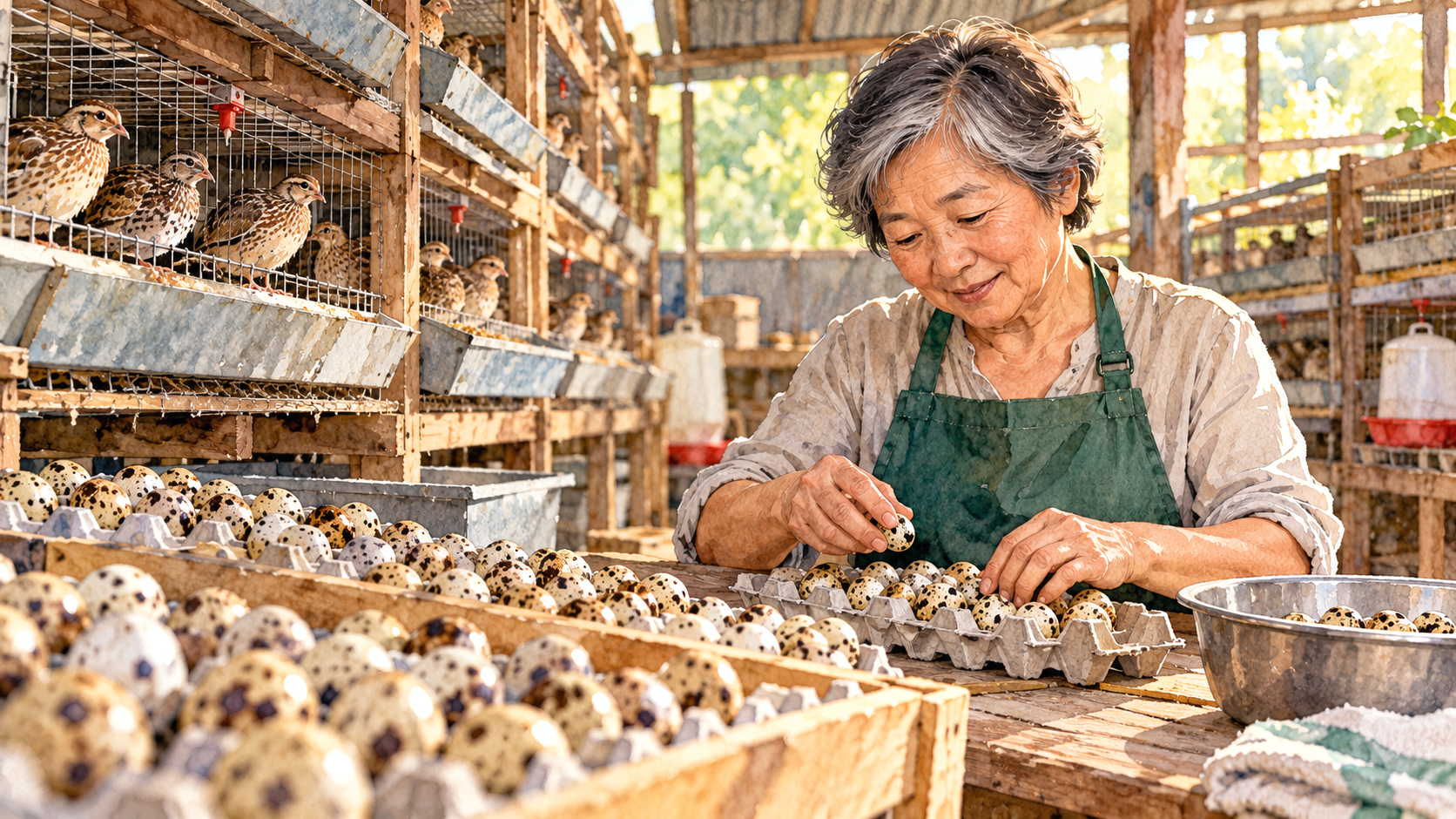
Quail farming can be profitable, but healthy birds and high egg production do not guarantee a successful business. Domestic Coturnix quail mature quickly and may earn revenue from edible eggs, meat, fertile hatching eggs, chicks, and adult breeding stock. Actual profitability depends on completed sales, local demand, losses, labor, and the costs of reaching buyers.
Direct sales at specialty-product prices can be more promising than wholesale sales, but customers must be willing to buy repeatedly. A financial study of small-scale quail and chicken enterprises found that selling prices and channels strongly influenced estimated returns. Its modeled 1,000-bird enterprise is not directly comparable to a backyard flock.
How Do Quail Farms Make Money?
| Product | Typical buyer | Main risk |
|---|---|---|
| Edible eggs | Households, grocers, restaurants | Regular buyers and perishability |
| Quail meat | Households and specialty food buyers | Processing and limited demand |
| Fertile hatching eggs | Breeders and poultry hobbyists | Fertility, shipping, hatch expectations |
| Live chicks and growers | Small farms and new keepers | Unsold stock and brooding losses |
| Adult breeding stock | Established breeders | Reputation and narrow buyer pool |
The usual egg and meat uses of domestic Japanese quail support several potential revenue streams, but a new producer is better served by validating one market first.
How Profitable Is Selling Quail Eggs?
Coturnix can begin laying at around seven weeks under suitable conditions. The number of eggs a hen produces varies with strain, age, nutrition, lighting, and management. Actual selling price and the proportion sold matter as much as eggs collected.
Published 2026 specialty-market asking-price estimates suggest roughly $5–$8 per dozen at farm pickup and sometimes $9–$12 at farmers’ markets; these are not established transaction averages. A farm with 30 hens collecting 600 eggs monthly, selling 85% at $6 per dozen, would have $255 gross monthly revenue before expenses.
A U.S. financial comparison of quail and laying-hen enterprises found better modeled performance for quail in its studied scenarios, while warning that some locations may have trouble finding consumers for specialty eggs.
Can Quail Meat Be Profitable?
Quail meat may appeal to restaurants and specialty households, but small carcasses require considerable handling and processing relative to total meat sold. The practical suitability of quail for meat depends on strain, processing arrangements, portions, and confirmed customer demand.
A premium price is useful only if buyers repeatedly order enough birds to offset feed, mortality, labor, processing, refrigeration, delivery, and unsold inventory. Farm expansion should follow actual orders rather than assumed restaurant interest.
Are Hatching Eggs and Breeding Stock More Profitable?
Fertile eggs and selected breeding birds may earn higher prices than ordinary edible eggs or birds, but the seller assumes added risks from fertility, hatchability, shipping, records, and buyer expectations. Not every egg can be sold as hatching quality, and not every fertile egg hatches. The breeding maturity of Coturnix affects production planning.
Specialty variety names do not by themselves justify premiums. The difference between Coturnix colors and selected genetic lines matters when advertising stock accurately.
Can Selling Live Quail Generate Income?
Chicks, growers, and mature breeding stock can be sold to other keepers, often with variable seasonal demand. The market price of live quail changes with age, sex, line, and local availability. Unsold birds continue requiring appropriate feed and housing; a hatch with too many males may be difficult to sell.
What Does a Small Quail Farm Profit Calculation Look Like?
The following example is entirely hypothetical, using 30 laying females and assumed U.S. dollar costs. It demonstrates the importance of including labor, not average U.S. profits.
| Monthly assumption | Amount |
|---|---|
| Eggs collected: 30 hens × 20 | 600 eggs |
| Eggs sold: 85% | 510 eggs (42.5 dozen) |
| Selling price | $6 per dozen |
| Gross revenue | $255 |
| Feed | $45 |
| Packaging | $25 |
| Bedding and cleaning | $20 |
| Delivery and selling | $40 |
| Equipment/replacement reserve | $30 |
| Surplus before labor | $95 |
| Owner labor: 20 hours × $15 | $300 |
| Result after assigned labor | −$205 |
Taxes, interest, some overhead, and unexpected losses are excluded, so this is not a complete income statement. The operation appears positive before labor but negative once the owner’s time is valued. A study of quail farms of different sizes likewise found that enterprise economics changed with scale, although its regional price conditions cannot be transferred directly to U.S. farms.
What Is the Break-Even Point?
Break-even means generating enough realized sales to cover modeled expenses. In this example, nonlabor costs total $160 and labor adds $300, giving $460 in modeled expenses. At $6 per dozen, the farm would need to sell about 76.7 dozen monthly, more than its projected 50 dozen produced. It would need a higher price, lower expense, more saleable output, another revenue stream, or some combination.
The operating expense categories for keeping quail must be included consistently rather than treating revenue minus feed alone as profit.
Why Do Small Quail Farms Lose Money?
A producer may succeed at husbandry yet struggle to sell specialty products. Unsold eggs and birds, irregular restaurant orders, low local prices, marketing time, customer travel, production losses, and purchasing equipment before confirming demand all erode profitability.
The location-specific market for quail products makes repeat customers particularly important. Expressions of interest are not the same as committed orders.
Does a Larger Quail Farm Automatically Earn More?
No. Larger operations may distribute fixed expenses across more birds but also need additional labor, facilities, buyers, cash reserves, and reliable product movement. A regional analysis of Japanese quail operations found different benefit-cost ratios by scale, but that does not mean expansion guarantees profits.
How Can You Test Quail Farming Profitability Locally?
Collect real selling prices and ask likely buyers about consistent quantities, product requirements, and purchasing schedules. Model conservative production, unsold stock, feed, replacement birds, packaging, transport, labor, and reserve costs. Test demand at manageable scale before expanding.
Published gamebird enterprise budgets illustrate the importance of replacing sample figures with actual farm inputs. Their bobwhite assumptions must not be copied into Coturnix egg operations, but the budgeting method applies.
Common Questions About Quail Farming Profitability
Can a small quail farm make money? Yes, if enough products are sold at prices that cover all expenses, including labor and replacement costs.
Are quail eggs profitable to sell? They can be in specialty direct-sales markets, but unsold eggs and time spent selling may erase a margin.
Is quail meat more profitable than eggs? Neither automatically wins. Buyers, production methods, processing arrangements, and complete costs determine the result.
Can quail farming replace a full-time income? A viable commercial enterprise may be possible, but a small flock does not guarantee reliable full-time earnings.