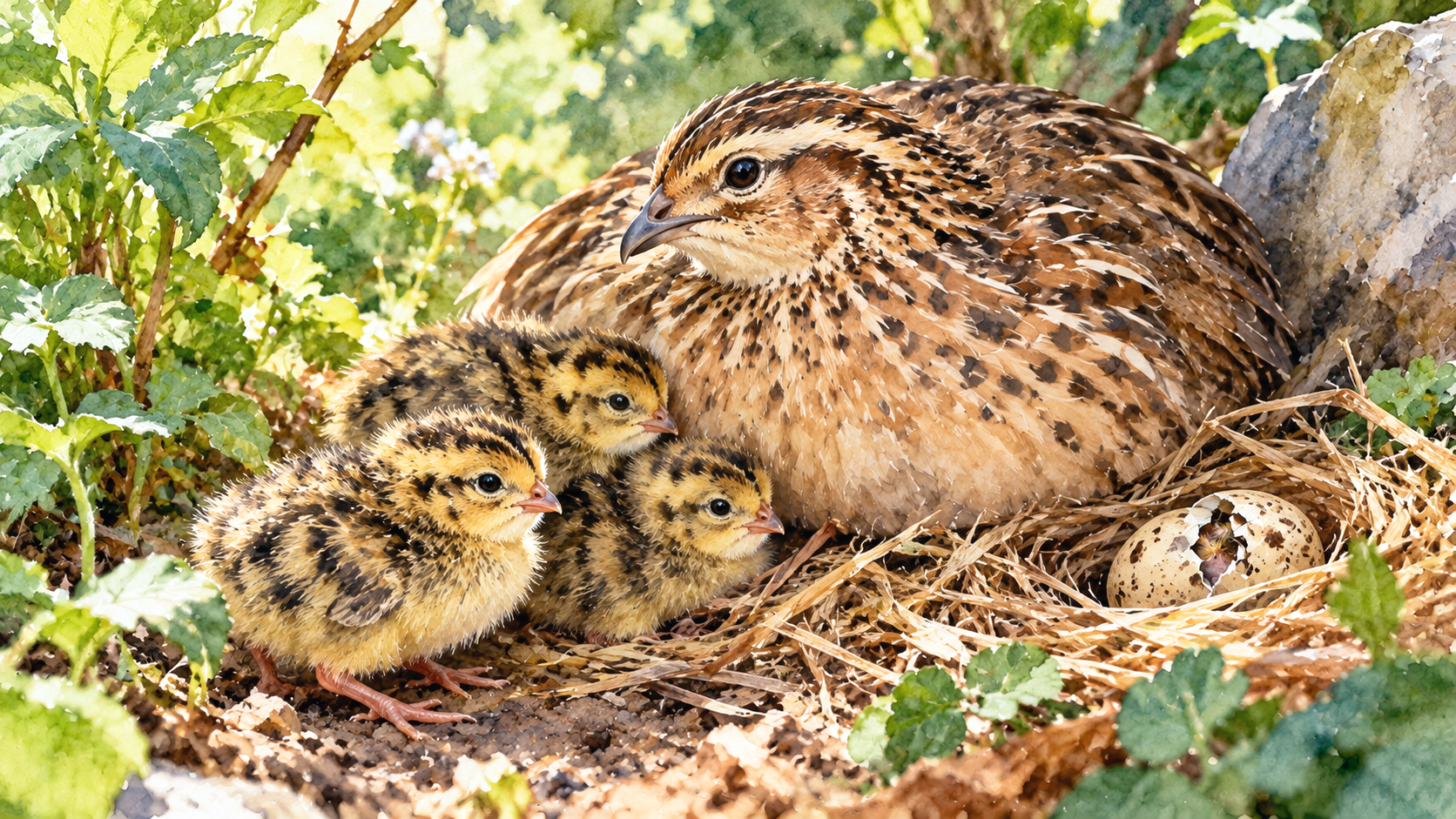
Quail can hatch their own eggs and raise their chicks naturally, but success depends heavily on the species, the individual bird, and the environment. Northern bobwhite and California quail regularly incubate eggs and care for their young in suitable natural habitats. Domestic Japanese or Coturnix quail can also show maternal behaviour, although dependable natural hatching is much less common in many captive breeding lines.
For farm keepers, the main consideration is whether a bird can complete the entire process, from maintaining a nest through incubation to protecting and warming newly hatched chicks. A hen that lays fertile eggs will not necessarily sit on them, and a successful hatch does not guarantee that the parent will care for the chicks properly.
Which Quail Are Most Likely to Hatch Their Own Chicks?
Natural breeding behaviour differs considerably among quail species. Their nesting habits, parental responsibilities, and responses to captivity can all affect the outcome.
Japanese and Coturnix quail
Domestic Japanese quail (Coturnix japonica) are commonly raised for eggs and meat. Many captive lines seldom complete natural incubation, making them relatively unreliable choices for keepers hoping to obtain chicks without artificial assistance.
This does not mean Japanese quail have completely lost their maternal instincts. Research has demonstrated that parental behaviour can occur under appropriate semi-natural conditions, even in birds from populations where it is difficult to establish consistently. The reproductive and parental behaviour of domestic Japanese quail includes nesting, incubation, and interactions between hens and chicks.
Some individuals may therefore sit successfully and subsequently care for their offspring. However, occasional examples should not be mistaken for dependable performance across all domestic strains.
Northern bobwhite quail
Northern bobwhite quail (Colinus virginianus) have well-established natural incubation and parental-care behaviours. They construct concealed ground nests, incubate their eggs, and lead their chicks through suitable habitat after hatching.
Unusually, either sex can assume responsibility for incubation and brood care. The breeding biology of northern bobwhites includes male incubation, with males responsible for a substantial minority of nesting attempts in the populations described.
Captive bobwhites may express these behaviours when their surroundings support normal nesting and minimize disturbance. Nevertheless, confinement, unsuitable cover, and individual differences can interfere with successful reproduction.
California and other New World quail
California quail (Callipepla californica) also incubate and raise their young naturally. The female generally incubates the eggs, while both parents can participate in caring for the chicks after hatching.
Their parental behaviour includes protecting young birds, maintaining contact, and helping them navigate their surroundings. California quail may also form mixed family groups in which several adults help care for the young.
Gambel’s quail exhibit natural nesting and parental care as well, although keepers should not assume that their behaviour and captive breeding requirements are identical to those of California quail.
King or Chinese painted quail
King quail (Synoicus chinensis), sometimes called Chinese painted quail or button quail, can incubate eggs and care for chicks in captivity. Their small size, ground-nesting behaviour, and particularly tiny hatchlings make the safety of the enclosure especially important.
A successful nesting attempt requires a protected location with suitable cover and unobstructed access to food and water. Newly hatched chicks can escape through surprisingly small gaps, so an enclosure appropriate for adults may still be unsafe for a family.
How Natural Incubation Works
A naturally incubating quail settles over a clutch of eggs and maintains the conditions needed for embryo development through body heat, positioning, and regular attendance. The parent generally leaves the nest briefly to meet its own needs before returning.
In northern bobwhites, incubation commonly lasts approximately 23 days, although published descriptions of the usual period vary slightly. California quail generally incubate for roughly 18 to 23 days. Japanese quail have a shorter natural incubation period, commonly around 17 to 18 days.
Incubation cannot begin successfully simply because eggs have accumulated in a nest. The eggs must be fertile, the parent must begin sustained incubation, and the nesting environment must remain suitable throughout development.
Frequent nest abandonment, excessive disturbance, predators, and unfavorable weather can all interrupt this process. A hen that sits intermittently without establishing sustained incubation may never produce a successful hatch.
The distinction between broodiness and ordinary nesting behaviour is therefore important when judging whether a quail is genuinely preparing to incubate its eggs.
What Happens When the Chicks Hatch?
Quail chicks are precocial, meaning they hatch with down feathers, open eyes, and the ability to move around relatively quickly. Unlike helpless songbird nestlings, they can walk and begin searching for food shortly after hatching.
However, being mobile does not make them independent.
A parent caring for newly hatched chicks provides several important forms of support:
- Warmth: Chicks shelter beneath the adult bird because their ability to regulate body temperature is still developing.
- Protection: The parent may use alarm calls, concealment, or defensive behaviour to respond to threats.
- Guidance: Chicks follow the parent and develop familiarity with suitable feeding and resting areas.
- Social contact: Calls and close physical contact help maintain cohesion between the parent and young.
Studies of Japanese quail have found that maternal care influences the later behaviour of chicks, including their fear responses and social interactions. This demonstrates that parental care can influence more than immediate survival.
Chicks begin feeding themselves rather than depending on their mother to place food directly into their mouths. They still require an appropriate, accessible diet, and the nutritional needs of baby quail differ from those of mature birds.
Creating an Environment for Natural Hatching
A suitable natural-hatching enclosure should allow a parent to establish a concealed nest and care for its chicks without constant disturbance. It must also provide protection from predators, unsafe temperatures, and aggression from other birds.
Provide secure nesting cover
Quail generally prefer sheltered ground-level nesting locations rather than exposed, elevated nests.
Clumps of vegetation, appropriate dry nesting material, and protected corners can provide concealment. Nesting areas should remain dry, reasonably quiet, and protected from trampling by other birds.
A well-designed outdoor quail pen can incorporate natural cover while retaining secure boundaries. The appropriate layout depends on the species and its management requirements.
A nesting bird should not be repeatedly lifted or chased from the nest to check its eggs. Observations from a distance are less disruptive.
Keep the family protected
A brooding parent and its chicks need an enclosure with secure walls, a protected top where appropriate, and openings too small for hatchlings to pass through.
Chicks are especially vulnerable to rats, snakes, domestic pets, and other predators. The measures used to protect quail from predators must therefore account for the much smaller size of hatchlings.
The ground should offer secure footing and remain dry. Avoid deep containers, hazardous gaps, exposed wire openings, and structures that could trap young birds.
Make food and water accessible
Once chicks hatch, they need immediate access to appropriately formulated chick feed and a water source designed to prevent drowning.
Adult quail feeders may be too high or difficult for very small chicks to use. Similarly, ordinary open water containers can pose a serious danger.
Food and water should be positioned so chicks can reach them without becoming separated from the parent. The adult must also have access to suitable nutrition.
Reduce stress and social interference
A parent attempting to incubate eggs may be disturbed by crowding, repeated handling, or aggressive flock members. Other birds may enter the nest, damage eggs, or threaten young chicks after hatching.
Providing suitable space for quail helps reduce crowding, but additional space alone will not necessarily prevent aggression.
A protected family enclosure, without unnecessary interference from unrelated adults, may be safer when natural nesting is being attempted.
How Successful Is Natural Hatching?
There is no reliable universal success rate for naturally incubated quail eggs across species, domestic strains, and housing systems.
Success needs to be assessed at several stages. A parent may establish a nest but abandon it before hatching. Another may hatch several chicks but fail to keep them warm or protected. Even a family that initially appears successful can experience losses during the first days.
Wild nesting studies show how difficult natural reproduction can be. For example, Maryland’s northern bobwhite account reports an estimated 25% success rate for nesting attempts, with predation and weather contributing to failure.
That figure describes nesting attempts in a particular wild-bird context. It must not be applied as the expected hatch rate for captive Coturnix, king quail, or other species.
For domestic Japanese quail, the largest practical limitation is often whether a bird will establish and maintain natural incubation in the first place. For species that incubate more readily, nest security, parental behaviour, and chick survival become especially important.
A keeper assessing natural reproduction should distinguish between:
- Nesting attempts that produce at least one chick.
- The proportion of fertile eggs that hatch.
- The number of chicks remaining alive after the vulnerable early period.
These are different measurements. Reporting only the number of eggs hatched can give an overly optimistic impression of reproductive success.
Why a Quail Parent May Abandon Its Eggs or Chicks
Nest abandonment can occur when a bird is frightened, disturbed, exposed to unsuitable conditions, or otherwise unable to maintain incubation.
Possible contributing factors include repeated handling, aggressive flockmates, predator activity, poor nesting cover, and environmental stress. Not every abandoned clutch has an identifiable cause.
Maternal behaviour after hatching can also vary. Research involving Japanese quail found that fearfulness was associated with differences in maternal care, including interactions with chicks and the quality of early parent-offspring contact.
This helps explain why the presence of a sitting hen does not automatically establish that she will be a capable parent.
An adult that repeatedly attacks, injures, or refuses to shelter its chicks should not be assumed to improve simply because it has previously incubated eggs. Injured or cold chicks require prompt protective action and appropriate professional advice.
When Should You Intervene?
Natural parental care is generally best observed with minimal disturbance when the adult is attentive, the chicks are active, and the enclosure is safe.
Intervention becomes necessary when there is clear evidence of danger. Warning signs include chicks being repeatedly attacked, unable to reach water, trapped outside the protected nesting area, or persistently cold and unresponsive.
If a parent abandons newly hatched chicks, they should not be left exposed while waiting indefinitely for maternal behaviour to resume. Immediate access to a safe, appropriately warm environment becomes essential. Weak, injured, or unresponsive chicks require prompt veterinary assessment.
A hen temporarily leaving a nest or stepping away from mobile chicks does not, by itself, prove abandonment. Observe the broader pattern before interfering, provided the young are not in immediate danger.
The goal is to support natural care when it is functioning and prevent avoidable suffering when it is not.
Is Natural Hatching Worth Trying on a Farm?
Natural hatching can be a reasonable option for keepers whose quail species and individual birds show dependable parental behaviour and whose facilities can safely accommodate an adult with chicks.
It can allow chicks to experience normal early social interactions and receive warmth and protection directly from a parent. However, it offers less predictability than a carefully managed production system, particularly with domestic Coturnix strains that rarely maintain incubation.
Farmers relying on a consistent supply of young birds should not assume that natural incubation will provide predictable results. For keepers prioritizing observation of species-typical reproductive behaviour, providing safe opportunities for natural nesting may be worthwhile without expecting every attempt to succeed.
The best outcome is not simply a clutch of hatched eggs. It is a parent that completes incubation successfully and continues caring for viable chicks in a secure environment.
Common Questions About Quail Raising Their Chicks
Can male quail raise chicks without a female?
Yes, in some species. Northern bobwhite males can incubate eggs and independently raise their chicks. This is an established aspect of bobwhite reproduction, but it should not be assumed to occur routinely in domestic Japanese quail.
Will a quail accept chicks that are not its own?
Some quail may accept unrelated chicks, and communal care occurs naturally in species such as California quail. Acceptance is not guaranteed, however. Introducing unfamiliar chicks directly to an adult can expose them to aggression or rejection.
Do baby quail stay with their mother after leaving the nest?
They can remain with their parent or family group after leaving the nest. The duration and social arrangement vary by species. Although the chicks become mobile rapidly, they continue benefiting from parental protection and warmth during early development.
Can a quail hen hatch eggs more than once in a season?
Some quail species can produce more than one clutch during a suitable breeding season. Whether a bird actually completes repeated incubation depends on species, breeding condition, environmental conditions, and the outcome of earlier nesting attempts.
One thought on “Will Quail Hatch and Raise Their Own Chicks?”