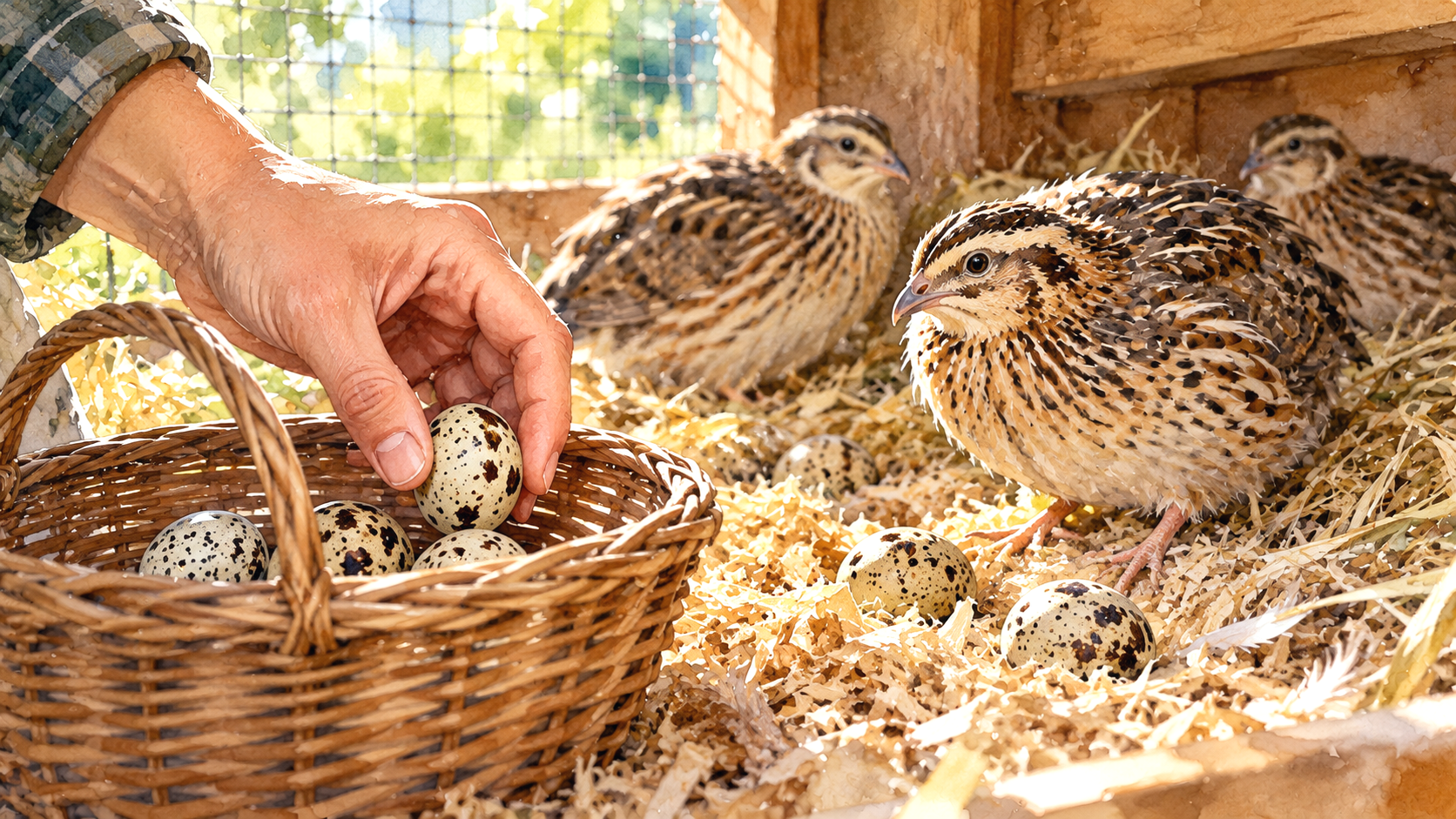
A healthy, mature Japanese (Coturnix) quail hen can lay approximately one egg per day during an active laying period, although not every hen lays on seven consecutive days. Many productive hens lay an egg on most days, with occasional gaps between successive eggs. In managed flocks, Japanese quail also tend to lay later in the day, particularly during the afternoon.
Other quail species follow different schedules. Northern bobwhites generally lay about one egg per day while building a seasonal clutch, whereas California and Gambel’s quail concentrate egg laying within their breeding seasons. The distinction matters because a regular daily laying rhythm in domestic Coturnix should not be expected from every quail species.
How Many Eggs Does One Quail Lay in a Day?
For Japanese quail, one egg is the normal daily maximum for an individual hen. Producing an egg requires the coordinated release of a yolk, formation of albumen and membranes, and deposition of a shell. These processes take time, so a hen does not normally produce two complete eggs every day.
A productive Coturnix hen may lay one egg on several consecutive days. Another hen may produce eggs less consistently while still following a normal reproductive rhythm. Successive laying intervals approach 24 hours in highly productive Japanese quail, although individual intervals can be longer.
Finding several eggs in one enclosure does not mean one hen laid all of them. In a group of females, multiple birds may use the same sheltered area, and the eggs found during one collection may have been laid at different times.
Do Coturnix Quail Lay Eggs Every Day?
Many domestic Japanese quail lay on most days when they are in active reproductive condition. However, daily laying is not guaranteed, even in healthy birds.
Their laying rhythm consists of successive ovipositions—the release of completed eggs from the reproductive tract. The interval between eggs and the time of day at which they are laid both vary among individual hens. Some maintain a remarkably regular pattern, while others have longer intervals or occasional days without an egg.
For practical flock management, it is reasonable to expect regular egg collection from established Coturnix layers without assuming that every female must contribute an egg every calendar day. A daily egg count reflects the combined activity of the flock rather than the exact schedule of every hen.
How Many Hours Apart Do Quail Lay Eggs?
In a productive Japanese quail, the interval between successive eggs is often close to 24 hours. Individual laying cycles may be slightly longer, and the interval can vary within the same bird.
This helps explain why a hen might lay at a similar time on several consecutive days but not maintain precisely the same clock time indefinitely. The reproductive rhythm of Japanese quail is coordinated with the light–dark cycle, so daily lighting influences when eggs are released.
A laying interval should not be interpreted as a countdown that begins each time an egg is collected. The bird’s reproductive system operates independently of whether a keeper removes the egg immediately or several hours later.
What Time of Day Do Quail Usually Lay Eggs?
Japanese quail commonly lay during the afternoon or later part of their daily light period. This differs from the familiar morning-laying tendency of many domestic chicken flocks.
In a group of Japanese quail maintained under a 14-hour light period, eggs were laid between 6.5 and 14 hours after the lights came on. Another observation of managed quail found that many eggs were laid between 2 p.m. and 5 p.m..
These are observed patterns rather than fixed clock times for every flock. A bird’s laying time depends partly on when its light period starts. Quail housed under a different lighting schedule may lay earlier or later by the clock while following a similar biological rhythm.
Do Quail Lay Eggs in the Morning or at Night?
Morning laying is possible, but afternoon laying is more characteristic of domestic Japanese quail. Nighttime laying is less common under a regular day–night schedule, although it can occur.
The daily distribution of egg laying in Japanese quail shows that most eggs in one managed population were laid during the latter part of the light period, while a smaller proportion appeared during darkness.
A quail egg found early in the morning may therefore have been laid the previous evening or overnight. Unless the enclosure is monitored continuously, discovery time should not automatically be treated as laying time.
For routine collection, the birds’ actual pattern is more useful than assuming they follow the same schedule as chickens.
How Often Do Quail Lay Eggs Throughout the Week?
An established Coturnix hen may lay on most days in a typical week, but individual schedules vary. Some hens produce a continuous sequence of daily eggs, while others have shorter sequences separated by days without laying.
Eggs produced in succession are sometimes described as a laying clutch or laying sequence. In domestic egg production, this refers to a run of consecutive laying days rather than necessarily a group of eggs being accumulated for natural incubation.
The length of laying sequences varies considerably among Japanese quail. Some hens maintain long runs of consecutive eggs, while others alternate shorter runs with occasional gaps.
A flock’s weekly egg collection may appear relatively steady even when individual hens follow different patterns. For that reason, the number of eggs collected from a shared enclosure should not be divided into rigid daily expectations for every bird.
How Does the Laying Schedule Differ Among Quail Species?
Japanese quail raised for table eggs are managed differently from species whose egg laying is closely associated with seasonal nesting.
| Quail species | Typical laying pattern | Seasonal influence |
|---|---|---|
| Domestic Japanese (Coturnix) | Often one egg on most days during active laying | Can lay across much of the year under suitable management |
| Northern bobwhite | Approximately one egg per day while completing a nest clutch | Strongly associated with spring and summer breeding |
| California quail | Usually successive eggs during formation of a seasonal clutch | Primarily spring and summer |
| Gambel’s quail | Eggs laid during suitable seasonal nesting periods | Strongly influenced by breeding-season conditions |
| King or Chinese painted quail | Can lay repeated eggs in captive reproductive condition | Timing varies with environment and individual birds |
These patterns should not be treated as identical production expectations. The different types of quail have distinct reproductive histories, and domestic Coturnix strains have undergone selection that makes regular egg laying particularly characteristic of their management.
How Often Do Bobwhite Quail Lay Eggs?
Northern bobwhite hens generally lay approximately one egg per day while completing a clutch. The eggs accumulate in a concealed ground nest before sustained incubation begins.
Bobwhites sometimes skip a day during clutch formation, so completing a nest can take longer than simply counting one uninterrupted day per egg. The daily rate applies to an active nesting period, not every day throughout the year.
Unlike managed Japanese quail that may be kept primarily for regular egg collection, bobwhite laying is organized around seasonal reproduction. Their age and seasonal readiness for breeding influence when this pattern begins.
Do California and Gambel’s Quail Lay Eggs Daily?
During clutch formation, California and Gambel’s quail typically lay successive eggs over a series of days. Their overall laying activity, however, is concentrated within the breeding season.
For California quail, nesting and egg laying are primarily associated with spring and summer. Gambel’s quail also follow seasonal patterns, with favorable environmental conditions influencing reproductive activity.
A captive bird belonging to either species should not be expected to produce a table egg every day throughout the year. Its pattern is better understood as periodic clutch formation than as continuous domestic egg production.
How Does Lighting Influence the Daily Laying Schedule?
Light helps synchronize the reproductive rhythm of Japanese quail. Under a stable lighting schedule, many hens develop a predictable tendency to lay during a particular part of the day.
Changing the length of light and dark periods can shift oviposition timing. This explains why the same breed might show different clock-time laying patterns in two facilities with different light schedules.
A consistent daily routine is more useful than repeatedly changing lighting in an attempt to force eggs to appear at a preferred hour. Birds also require suitable darkness and rest, so their welfare should not be compromised simply to make collection more convenient.
The appropriate management of laying quail includes meeting nutritional needs alongside a suitable daily environment.
Does a Quail Lay All Its Eggs in the Same Place?
Not necessarily. Domestic Japanese quail may deposit eggs in different parts of their enclosure rather than consistently returning to one nest.
This makes it possible to overlook eggs during an early inspection and discover them later. The apparent increase in egg numbers may reflect eggs that were previously hidden rather than a sudden change in laying frequency.
The nesting habits of quail differ according to species and management conditions. A hen does not need to use a conventional nesting box to follow a normal laying cycle.
When Is the Best Time to Collect Quail Eggs?
For domestic Japanese quail, a late-afternoon or early-evening collection often captures a large proportion of the day’s eggs because many hens lay during the latter part of their light period.
The ideal collection routine depends on the flock’s schedule and environmental conditions. Check regularly enough to keep eggs from accumulating in dirty or vulnerable areas, and do not assume that every egg will appear before or after one particular hour.
Where practical, an earlier inspection can identify eggs left from a previous laying period, followed by another collection after the main afternoon activity. Eggs intended for consumption should be handled and refrigerated appropriately.
The cleanliness of quail housing affects how easily eggs can be collected in good condition, particularly when birds lay directly on enclosure surfaces.
Does a Male Quail Change How Often Females Lay?
A male is not necessary for a female to follow her normal laying rhythm. Mature hens can produce eggs without mating, because egg formation is regulated by their own reproductive systems.
A compatible male may be present in a breeding group, but his presence does not establish how frequently an individual female will lay. Fertilization and egg production are separate biological processes.
The ability of female quail to lay without males also makes female-only Coturnix groups practical for keepers interested in edible eggs rather than producing chicks.
Common Questions About Quail Laying Schedules
Do Coturnix quail lay one egg every 24 hours? Many productive hens lay at intervals approaching 24 hours, but individual cycles may be longer. An egg every single day is not guaranteed.
Do quail lay eggs every afternoon? Domestic Japanese quail often lay in the afternoon or later part of their light period, although individual timing varies and some eggs are laid at other hours.
Do bobwhite quail lay eggs every day? Bobwhite hens commonly lay about one egg daily while completing a seasonal clutch, sometimes skipping a day. They do not normally follow that schedule year-round.
Can several quail eggs appear in one nest on the same day? Yes. More than one hen may lay in the same location, and some eggs may have remained unnoticed from an earlier collection period. Multiple eggs found together do not necessarily come from one bird.
3 thoughts on “How Often Do Quail Lay Eggs?”