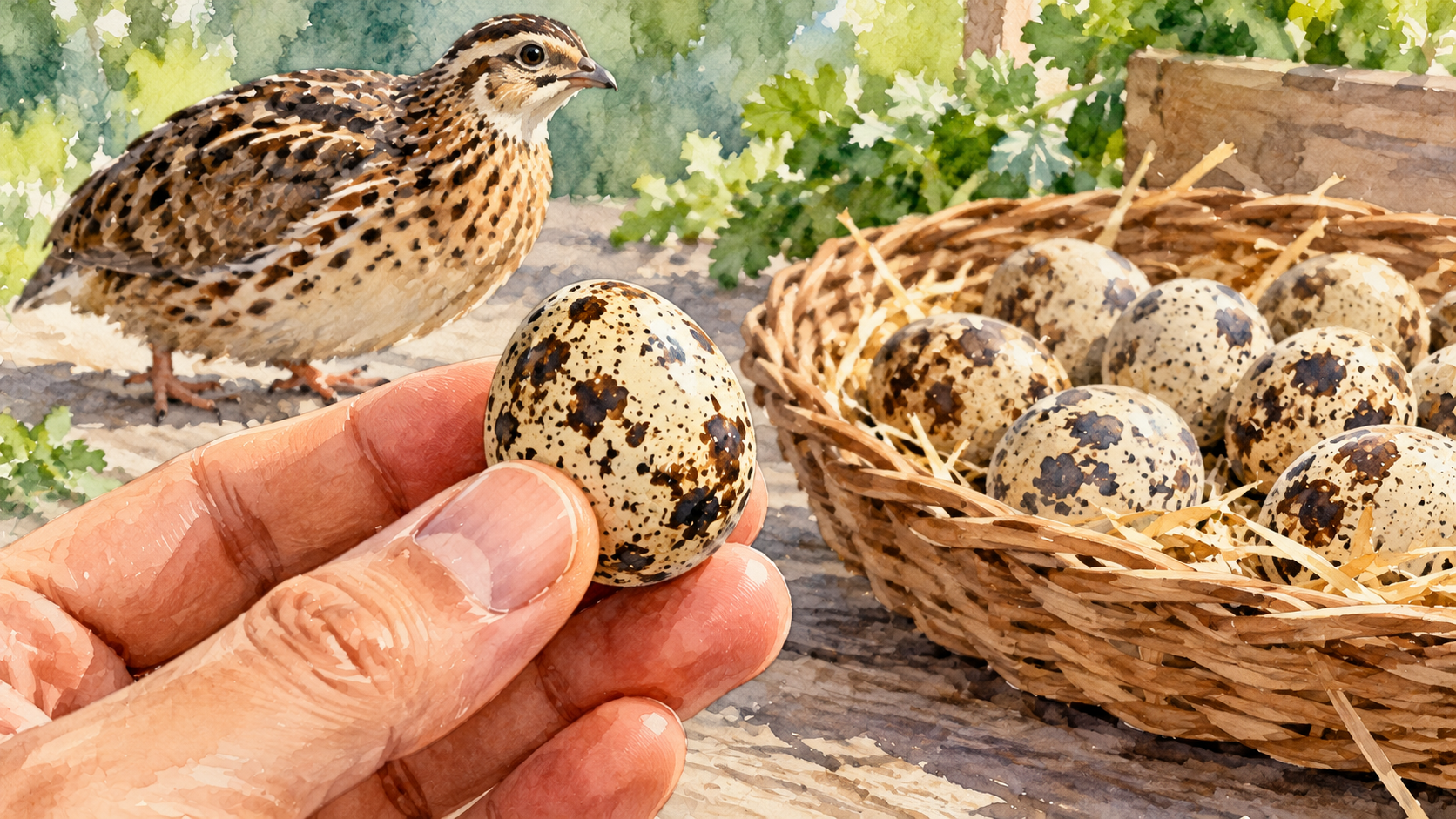
Most domestic Japanese (Coturnix) quail eggs weigh approximately 10–13 grams (0.35–0.46 ounces) and measure about 3–3.5 cm (1.2–1.4 inches) long. Their widest diameter is generally around 2.4–2.7 cm (0.9–1.1 inches). These measurements are typical rather than fixed limits, and some domestic quail produce noticeably larger or smaller eggs.
Egg size also differs among species. Northern bobwhite, California quail, and Gambel’s quail produce eggs with somewhat different dimensions, while domestic Coturnix strains vary according to genetics and breeding purpose. A hen’s age, body development, and nutrition can further influence the mass of her eggs.
What Is the Average Size of a Coturnix Quail Egg?
A typical Japanese quail egg is approximately 33 mm long and 25 mm wide. Its weight commonly falls around 10–12 grams, although studies have reported different averages depending on the population examined.
In one investigation, eggs averaged 11 grams, 33 mm in length, and 25 mm in width. Another population of Japanese quail produced eggs averaging 12.84 grams, with a mean length of 33.5 mm and width of 26.47 mm.
These differences reflect normal variation among laying populations. An egg measuring 34 mm long is not necessarily oversized, just as a 31 mm egg is not automatically undersized.
The physical measurements of Japanese quail eggs are also influenced by individual hens, making an average more useful for describing a flock than judging a single egg.
How Much Does a Quail Egg Weigh?
Egg mass is the most convenient measurement for comparing quail egg sizes because two eggs can have similar lengths but different widths and weights.
For domestic Japanese quail, 10–13 grams is a useful everyday expectation, with a wider range possible across breeds and individual birds.
| Egg weight | Approximate equivalent | Interpretation for Coturnix |
|---|---|---|
| 7–9 g | 0.25–0.32 oz | Small, but recorded in some populations |
| 10–11 g | 0.35–0.39 oz | Common weight for standard domestic quail |
| 12–13 g | 0.42–0.46 oz | Common in larger or well-developed laying populations |
| 14–15 g | 0.49–0.53 oz | Larger than many standard quail eggs |
| Above 15 g | Above 0.53 oz | Large; interpretation depends on strain and individual hen |
These are descriptive ranges, not official grading categories. In one comparison of Japanese quail strains, individual eggs ranged from approximately 7.08 to 13.84 grams, even though the strain averages were close to 11.2 grams.
An unusually heavy egg should not be assessed by weight alone. Its shape, shell condition, and the laying hen’s health also matter.
How Long and Wide Are Eggs From Different Quail Species?
Quail species differ in egg dimensions, but their ranges overlap enough that measurements alone cannot always establish which bird laid an egg.
| Quail species | Typical egg length | Typical egg width |
|---|---|---|
| Japanese (Coturnix) quail | Approximately 3.1–3.5 cm | Approximately 2.4–2.7 cm |
| Northern bobwhite | Around 3.0 cm | Around 2.5 cm |
| California quail | Around 3.2 cm | Around 2.5 cm |
| Gambel’s quail | Approximately 2.8–3.4 cm | Approximately 2.3–2.6 cm |
| Scaled quail | Approximately 3.1–3.3 cm | Approximately 2.4–2.5 cm |
Northern bobwhite eggs are typically about 3 cm long and 2.5 cm wide. California quail eggs measure approximately 3.2 cm long and 2.5 cm wide, while Gambel’s quail eggs span a slightly broader range.
Scaled quail eggs are similarly compact, with recorded lengths around 3.09–3.26 cm.
These dimensions describe typical eggs, not absolute biological limits. The differences among quail species should be considered before using Coturnix measurements as a universal standard.
Are Jumbo Coturnix Eggs Bigger Than Standard Coturnix Eggs?
Jumbo Coturnix strains are selected primarily for larger body size, and their hens may produce larger eggs than some smaller domestic lines. However, the word jumbo does not establish a guaranteed egg weight.
Egg mass depends on multiple inherited traits. A larger hen may tend to produce larger eggs, but body size and egg size do not increase together in a perfectly predictable ratio.
The distinction is supported by research comparing Japanese quail varieties with different adult body weights. Although the varieties differed in several physical characteristics, the results did not show a consistent significant difference in every egg dimension.
A breeder advertising jumbo quail should ideally provide actual egg-weight averages from the breeding flock. The range of domestic quail strains and varieties is too diverse for one strain label to determine exact egg size.
Do Young Quail Lay Smaller Eggs?
Yes. Newly established laying hens often produce smaller eggs than they do after further reproductive development.
The reproductive tract continues adjusting as a young female enters regular production. Over the following weeks, yolk development and other aspects of egg formation may become more consistent, allowing average egg size to increase.
In one Japanese quail population, average egg weights increased from 9.39 grams at eight weeks of age to 11.19 grams at 24 weeks.
This illustrates why the first eggs from young hens may not represent their eventual average size. It also explains why comparisons between young birds and established adult layers can be misleading.
The timing of the first eggs in quail is related to reproductive development, but egg-size changes can continue after laying has begun.
Do Older Quail Lay Larger Eggs?
In some Japanese quail populations, egg weight continues to increase with age even as the number of eggs produced declines.
A comparison of young, mature, and older Japanese quail hens recorded mean egg weights of 11.66, 12.11, and 13.16 grams, respectively. The older group produced larger eggs on average but had a lower laying rate.
These age-related changes in egg mass and reproductive performance demonstrate that producing larger eggs does not necessarily mean a hen is becoming more productive.
The pattern varies between strains and individuals. Not every older hen will produce larger eggs, and age alone cannot predict the weight of her next egg.
The productive laying lifespan of quail should therefore be distinguished from changes in individual egg size.
Does a Quail’s Body Weight Affect Egg Size?
Body weight can influence egg mass, but the relationship is not exact.
Larger hens may have greater reproductive capacity to produce heavier eggs, especially within a relatively uniform population. However, genetics, age, nutrition, and physiological condition also contribute.
The relationship between body measurements and egg characteristics in Japanese quail illustrates why egg weight is best understood as a trait influenced by several factors rather than the hen’s size alone.
Comparing the eggs of a small standard Coturnix hen with those of a much larger meat-type hen may reveal differences, but there will often be considerable overlap.
Does Nutrition Influence the Size of Quail Eggs?
Yes. Adequate nutrition helps quail produce eggs appropriate to their inherited potential.
Egg formation requires energy, protein, essential amino acids, fatty acids, vitamins, and minerals. When a hen receives an unsuitable ration or cannot consume enough feed, reproductive performance and egg characteristics may be affected.
The nutritional needs of laying quail differ from those of growing chicks. A balanced laying ration is more appropriate than increasing a single nutrient in the hope of producing unusually large eggs.
Providing excess feed or supplements does not guarantee larger eggs. Overfeeding may create other health problems, while deficiencies can affect reproductive function and overall bird condition.
Why Are Some Eggs Bigger Than Others in the Same Flock?
Even when quail are the same species and receive identical feed, they do not necessarily produce identical eggs.
Differences in inherited traits, age, body condition, and individual reproductive physiology contribute to variation. A flock containing hens from different breeding lines may show a wider distribution of egg weights than one composed of closely related, similarly aged birds.
Measurements of several Japanese quail varieties found average egg weights ranging from approximately 10.58 to 11.6 grams in the groups examined. Individual eggs within those groups could also differ.
The most useful comparison is often between a hen’s current eggs and her established pattern rather than between every hen in a mixed flock.
How Should You Measure a Quail Egg?
A digital kitchen scale and a small caliper are sufficient for basic egg-size records.
- Weigh the complete egg, including its shell, in grams.
- Measure its length from the broad end to the narrow end.
- Measure the maximum width across the middle.
- Record the date and the hen or flock, if known.
- Compare several eggs before determining an average.
Using grams and millimeters makes measurements easier to compare with published research. Egg length and width should be recorded separately because two eggs with the same weight can have different proportions.
The normal laying patterns of quail make repeated measurement practical for an established flock without requiring every egg to be collected at exactly the same hour.
Is an Unusually Large or Small Quail Egg a Problem?
Not always. Individual variation is normal, particularly among newly mature hens and birds from different genetic lines.
An unusually small egg may occur during reproductive development. A particularly large egg can also appear occasionally without indicating that the hen is unhealthy.
However, repeated extreme changes in egg size, abnormal shell formation, or signs of discomfort deserve attention. A bird that is straining, weak, or unable to move normally should not be left untreated because the egg appears merely oversized.
The health and welfare of laying quail matter more than achieving a particular egg weight. There is no reason to encourage abnormally large eggs at the expense of the hen’s well-being.
Common Questions About Quail Egg Size
What is the average weight of a Coturnix quail egg?
Approximately 10–13 grams is a useful general range, although some studies report averages closer to 10 or 11 grams and others nearer 13 grams.
How long is a typical Japanese quail egg?
Most are approximately 3.1–3.5 cm (1.2–1.4 inches) long, with individual and strain differences.
Do jumbo Coturnix quail always lay jumbo eggs?
No. Jumbo strains may produce larger eggs, but the exact weight depends on the breeding line and individual hen. The label does not guarantee a particular size.
Do quail eggs get bigger as hens mature?
Often, yes. Egg weight commonly increases after laying begins and may continue changing as the hen ages, although the pattern varies.
One thought on “How Big Are Quail Eggs?”