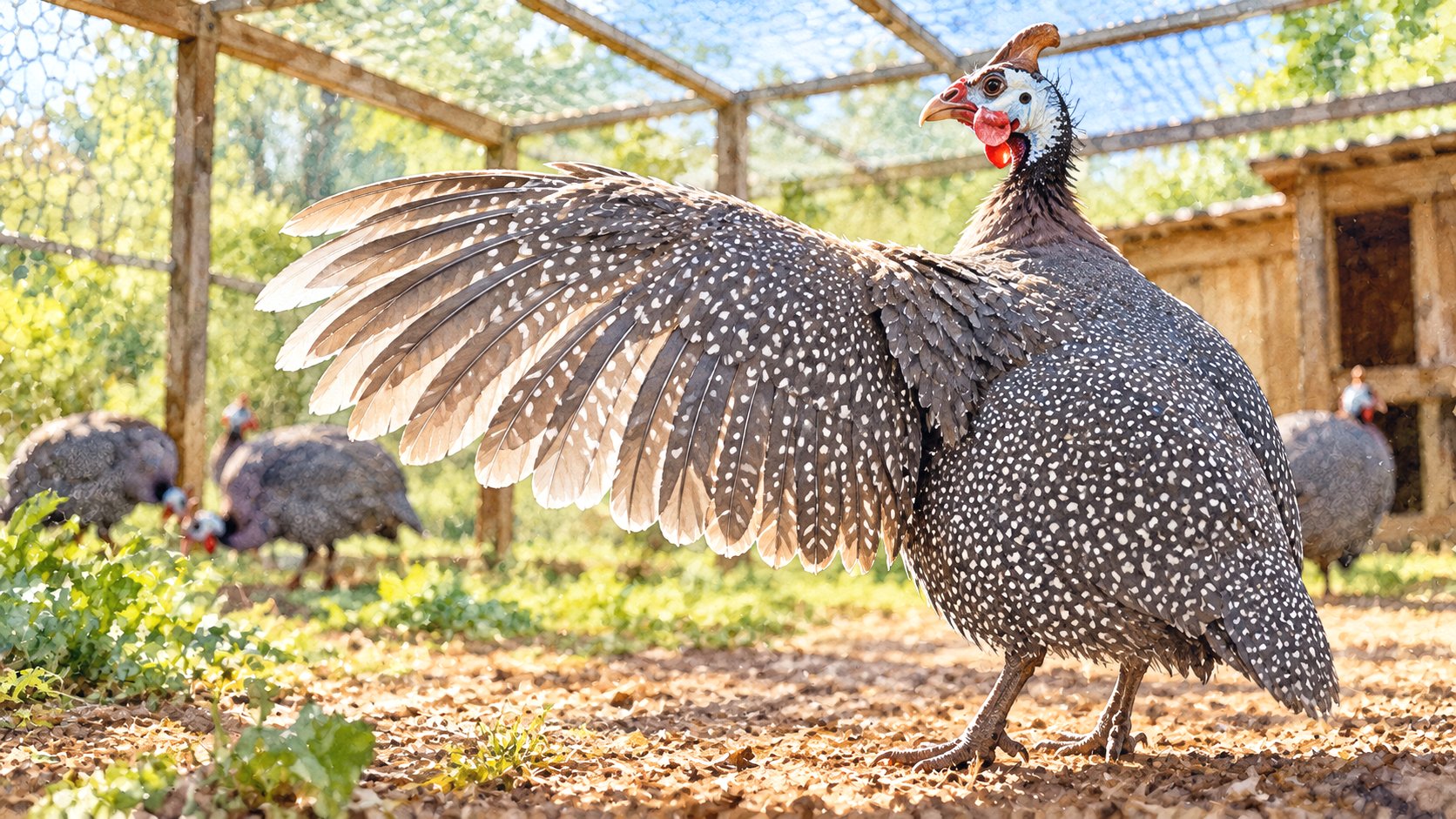
Clipping guinea fowl wings is generally not recommended when the birds free-range, because reducing their flight ability can make them more vulnerable to predators and injuries. Wing clipping may discourage some guinea fowl from flying over fences, but it does not guarantee containment. A secure, covered enclosure is usually a safer solution when birds must remain within a defined area. Guinea fowl are strong flyers that use their wings to reach elevated resting places and escape danger. Their natural flight abilities make wing clipping a more consequential decision than it may be for heavier, less flight-capable poultry.
What Happens When You Clip a Guinea Fowl’s Wings?
Wing clipping involves shortening selected primary flight feathers, which are the long feathers extending from the outer portion of each wing. It does not involve cutting the wing itself, removing bones, or surgically altering the bird.
Trimming mature feathers reduces the wing’s ability to generate lift and can interfere with sustained flight. However, the result depends on the individual bird, the feathers affected, and environmental conditions. Veterinary guidance on wing trimming emphasizes that even clipped birds may retain some flight capability, particularly outdoors in windy conditions.
An appropriately performed feather trim does not ordinarily cause pain when only fully developed feathers are cut. Nevertheless, handling the bird, altering its flight balance, and reducing its ability to land safely introduce welfare concerns.
Wing clipping is also different from pinioning, which involves permanently removing part of the wing. Pinioning is an invasive procedure and should never be treated as an ordinary alternative to trimming feathers.
Will Wing Clipping Stop Guinea Fowl From Escaping?
Clipping can reduce the height or distance some guinea fowl achieve during flight, but it cannot reliably prevent every escape. Birds may still jump, flutter over low barriers, or reach elevated objects that allow them to cross a fence.
Poultry extension guidance describes clipping primary feathers to discourage escape. However, reducing a bird’s ability to fly is not equivalent to establishing a dependable enclosure.
A guinea fowl may also leave through an open gate or an accessible gap without needing to fly. The effectiveness of clipping therefore depends partly on how the birds attempt to escape.
When containment is essential, covered fencing designed for guinea fowl addresses their ability to cross the upper boundary without deliberately impairing flight.
Why Clipping Can Increase Predator Risks
Flight allows guinea fowl to escape some approaching threats and reach elevated locations. Reducing that ability may leave a bird unable to clear an obstacle or gain height quickly enough to avoid an attacking animal.
A guinea-fowl-specific extension response identifies increased vulnerability to predators as a disadvantage of wing clipping. Another guinea fowl management response acknowledges that clipping can discourage flight, but its practical usefulness must be weighed against the birds’ safety.
Clipping is particularly difficult to justify for guinea fowl that spend the day roaming through open pasture or wooded areas. These birds may encounter loose dogs, foxes, or other threats without the protection of an enclosed run.
The predators that threaten guinea fowl vary by location, and clipping does not make an otherwise dangerous ranging environment safer.
Can Wing Clipping Injure Guinea Fowl?
An excessively severe or uneven trim may interfere with balance and controlled landings. A guinea fowl accustomed to flying onto elevated surfaces could fall or collide with obstacles after losing some of its usual lift.
Recommendations also differ on whether one or both wings should be trimmed. Traditional poultry guidance sometimes describes trimming one wing to disrupt balanced flight, whereas avian veterinary recommendations generally discourage one-sided clipping because it can produce unstable flight and landings. Guinea-fowl-specific research establishing the safest trimming pattern is limited.
Young, growing feathers present another concern. Newly developing flight feathers contain blood vessels and should not be cut. Accidentally cutting a blood feather can cause substantial bleeding and require veterinary attention.
Guinea fowl can also injure themselves while struggling during restraint. Anyone considering wing clipping should first consult a poultry-experienced veterinarian who can assess the bird and explain the risks. Birds with existing wing injuries, impaired mobility, or other health concerns require particular caution.
Do Clipped Guinea Fowl Feathers Grow Back?
Wing clipping is temporary because the affected feathers are eventually shed and replaced during normal molting. The cut portion does not regenerate independently; flight ability may improve as new feathers grow.
The timing varies with the individual bird and its molt cycle. A guinea fowl may regain enough lift to cross a fence before every clipped feather has been replaced. Poultry wing-clipping guidance notes that the effect generally needs reassessment after molting.
Repeated clipping would expose the bird to the associated handling and flight-related risks again. It should not be regarded as a permanent containment method.
When Might Wing Clipping Be Considered?
A limited feather trim may occasionally be considered when a bird repeatedly escapes into an immediate hazard and safer containment cannot be established promptly. Such circumstances require an individual welfare assessment rather than routine clipping of the entire flock.
Even then, trimming should not be used to justify keeping birds beside dangerous roads, loose predators, or unsuitable boundaries. Where possible, managing guinea fowl within a secure property should rely on appropriate housing and containment rather than reduced mobility.
For birds kept in a properly enclosed outdoor run, wing clipping is ordinarily unnecessary. The enclosure can prevent escapes while preserving the birds’ natural ability to use their wings.
Questions About Clipping Guinea Fowl Wings
Should you clip both wings or just one?
There is no universally validated guinea-fowl-specific trimming pattern. Traditional poultry advice sometimes favors one wing, while avian veterinarians generally recommend balanced trimming when a procedure is justified. A veterinarian should determine whether clipping is appropriate and how to minimize injury.
Can guinea keets have their wings clipped?
Clipping developing keets is generally inadvisable. Young birds are still developing coordination and flight skills, and growing feathers may contain active blood vessels. Their safety should be managed through suitable housing instead.
Does wing clipping make guinea fowl calmer?
No reliable evidence establishes that trimming flight feathers makes guinea fowl calmer or easier to handle. Restricting escape options may instead increase distress in frightened birds.
Can clipped guinea fowl still roost in trees?
Some may retain enough flight ability to reach lower branches or elevated structures, while others may struggle to reach their usual resting places. The outcome is unpredictable and creates additional concern if the birds attempt jumps they can no longer complete safely.