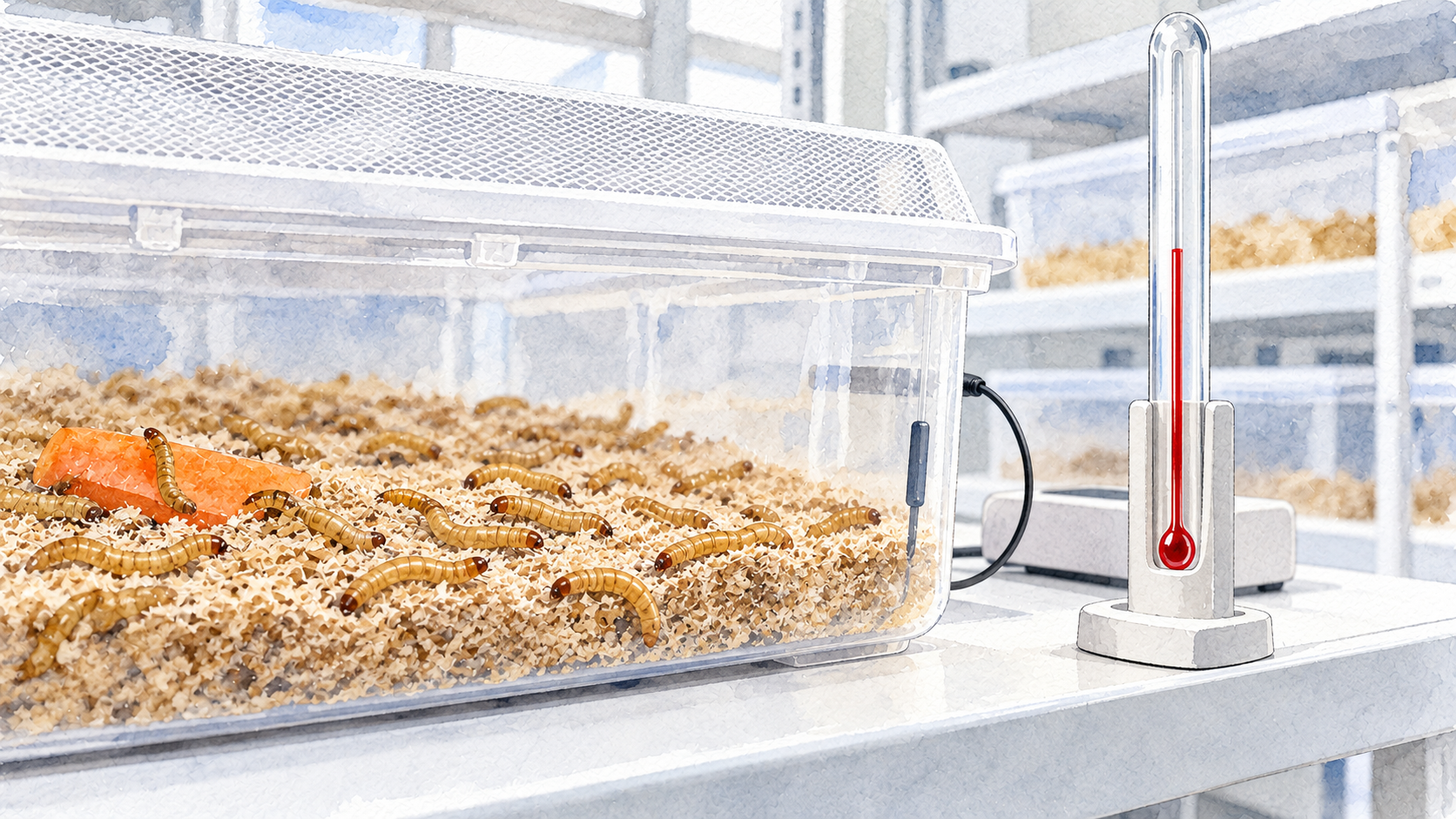
*Yellow mealworms (Tenebrio molitor) generally grow well at 25–28°C (77–82°F), making this a practical target range for a farm colony.* Research also reports successful larval growth at approximately 22–30°C (72–86°F), although performance varies with temperature, diet, developmental stage, and rearing conditions. A stable temperature near 27°C (81°F) is a sensible starting point when raising both larvae and breeding beetles.
Mealworms are ectothermic insects, meaning their body temperature and metabolic activity depend strongly on surrounding conditions. Warmer temperatures can encourage feeding and growth within a suitable range, but excessive heat can reduce reproduction, stress the insects, and cause losses. The aim is not to make the colony as warm as possible.
What Is the Best Temperature for Raising Mealworms?
For a general-purpose colony, 25–28°C (77–82°F) offers a well-supported balance between larval development and overall colony performance. A scientific review of yellow mealworm rearing identifies this range as favorable for cultivation.
However, the ideal temperature depends partly on the outcome being measured. In a controlled study comparing larval growth at different temperatures, mealworms raised at 25°C and 30°C showed favorable survival and growth under the tested conditions. A separate 2025 investigation of growth and reproduction found the strongest overall population performance at 27°C.
These findings do not mean that every colony must be maintained at exactly 27°C. Instead, they support a practical warm range with room for differences among populations and management systems.
How Does Temperature Affect Mealworm Growth?
Temperature influences how quickly mealworms feed, metabolize nutrients, and accumulate body mass. At temperatures below their favorable range, these activities generally slow. As conditions become warmer, growth can improve until increasing heat begins to produce unfavorable effects.
In a 2024 study examining larvae at 22°C, 25°C, and 28°C, larvae at 28°C grew faster than those at 22°C. Another study of temperature and larval development confirmed that temperature substantially influenced development across the tested range of 22.5–30°C.
Growth and survival should be evaluated together. A temperature associated with rapid development in one experiment may not produce the highest survival, reproductive output, or overall colony productivity in another. Feeding conditions and the population being studied also affect the results.
Can Mealworms Grow at Room Temperature?
Yes. Yellow mealworms can grow at ordinary indoor temperatures, including rooms cooler than the preferred commercial rearing range. However, their feeding activity and growth are usually reduced as temperatures move toward the cooler end of their tolerated range.
A controlled experiment at 20°C, 25°C, and 30°C found temperature-dependent differences in larval growth and survival. The stronger performance observed at 25°C and 30°C demonstrates why a household maintained near 20°C (68°F) may produce different results from a warmer rearing room.
A colony kept at room temperature is not automatically unhealthy. What matters is whether conditions remain suitable for normal activity and development. The basic process of starting a mealworm farm can begin without sophisticated heating equipment, although a thermometer is important for understanding the conditions actually experienced by the insects.
What Happens When Mealworms Get Too Hot?
Excessive heat can disrupt normal physiological functions and eventually kill mealworms. Larvae may become stressed as temperatures rise beyond their suitable range, and their survival can decline even if the room initially appears only moderately warm.
The 2025 thermal study of Tenebrio molitor discusses how heat tolerance varies with developmental and acclimation conditions. The 2024 temperature-and-growth study also identifies 35°C (95°F) as unfavorable for normal rearing.
A separate population-performance experiment estimated a thermal maximum near 39°C (102°F) under its model. That figure is a research result, not a recommended operating limit or a guarantee that a colony can safely withstand such heat.
The safest approach is to avoid prolonged high temperatures and prevent local hot spots, particularly where containers are exposed to direct sunlight or heating equipment.
Is 30°C Too Warm for Mealworms?
Not necessarily. Mealworms can grow successfully at 30°C (86°F), and some experiments report good larval performance at this temperature.
However, 30°C should not automatically be considered better than 27°C. In the 2025 study assessing several favorable temperatures, overall reproduction and population performance were strongest at 27°C rather than at the warmer tested settings.
For a beginner maintaining both larvae and breeding adults, a slightly lower target within the commonly recommended range may provide a more conservative margin against accidental overheating.
A container that averages 30°C may also become warmer locally when it receives sunlight, sits against a heat source, or develops heat within a dense group of feeding larvae. This makes actual substrate temperature more important than the thermostat setting alone.
Do Adult Mealworm Beetles Need the Same Temperature as Larvae?
Adult yellow mealworm beetles also depend on suitable temperatures for normal activity and reproduction. However, the temperature that promotes rapid larval growth is not necessarily identical to the one that gives the best reproductive results.
A 2025 study of yellow mealworm breeding performance compared adult reproduction at 27°C, 29°C, and 31°C. Females produced an average of 5.25 eggs per day at 27°C, compared with 1.55 at 31°C. Egg viability was approximately 74% at 27°C and 27% at 31°C.
These results indicate that relatively small temperature differences can have substantial consequences for an adult breeding population. Consequently, temperature management should account for reproduction as well as larval growth.
The reproductive behavior of darkling beetles depends on mature adults, while female egg-production levels should be interpreted in relation to the conditions under which the colony is maintained.
Does Temperature Affect Pupae and Newly Emerged Beetles?
Yes. Pupae and newly emerged beetles are living developmental stages whose physiological functions respond to temperature. Conditions experienced during pupal development can also influence the thermal tolerance of the resulting adults.
In a 2025 experiment on pupal development and adult acclimation, researchers found that temperature exposure during pupal development influenced subsequent cold and heat tolerance.
This does not establish a separate ideal temperature for every stage in an ordinary farm colony. Rather, it shows why avoiding severe or repeated temperature stress matters throughout development.
The mealworm pupal stage is different from an actively feeding larva, but pupae should still be protected from overheating and abrupt environmental extremes.
How Should You Measure a Mealworm Bin’s Temperature?
Use a reliable digital thermometer to monitor the air around the bins. For larger colonies, a probe thermometer can also help measure temperature within the substrate rather than relying entirely on the room thermostat.
The temperature inside a container may differ from room air because of its location, airflow, lighting, and the heat released by the insects themselves. A practical insect-rearing guideline notes that larvae produce metabolic heat, which can make a lower ambient temperature appropriate in some production systems.
Check measurements at the times when the room is likely to be warmest and coolest. If several bins are placed on shelving, the upper and lower levels may experience different temperatures.
A stable average is useful, but it should not conceal brief overheating events. Record unusual readings and investigate differences between the room and the material containing the insects.
How Can You Prevent a Mealworm Colony From Overheating?
Position containers away from direct sunlight, radiators, heat lamps, and other concentrated heat sources. If artificial heating is used, it should be thermostatically controlled and arranged so the insects cannot be exposed to unexpectedly hot surfaces.
Ventilation also matters. A sealed container can develop localized conditions that differ from the surrounding room, while tightly packed bins may restrict the dissipation of heat.
The scientific review of mealworm environmental requirements identifies temperature as a central variable in production, and research on larval growth at different temperatures demonstrates that the insects respond measurably to their thermal environment.
The construction of a ventilated mealworm farming bin helps provide appropriate airflow and accessibility. However, ventilation cannot compensate for a room that is excessively hot or a heat source directed at the container.
Should You Keep Mealworm Temperatures Constant?
Relatively stable temperatures make a colony easier to manage and its performance easier to interpret. Large fluctuations can change feeding activity and development, making it difficult to compare batches maintained under different conditions.
Absolute constancy is not necessary. Mealworms can tolerate ordinary variation within a suitable range, and small daily changes are different from severe thermal stress.
For a beginner, monitoring temperature consistently is generally more useful than attempting to maintain an exact fraction of a degree. A practical target near 27°C (81°F), with appropriate protection from overheating, provides a reasonable starting point.
More complicated commercial mealworm production may use automated environmental controls, but the underlying principle remains the same: measure the conditions experienced by the insects and keep them within a suitable range.
Questions About Mealworm Rearing Temperatures
Is 25°C warm enough for mealworms? Yes. Approximately 25°C (77°F) falls within a commonly supported range for normal yellow mealworm growth.
Can mealworms survive at 20°C? Yes. Mealworms can survive and develop at 20°C (68°F), although their growth is generally slower than under favorable warmer conditions.
Is 35°C safe for raising mealworms? It is not a recommended routine target. Temperatures around 35°C (95°F) can create unfavorable conditions and increase the risk of heat stress.
Should you measure the room or the substrate temperature? Both can be useful. Room readings describe the general environment, while substrate measurements help identify local warming inside the colony.
4 thoughts on “What Temperature Do Mealworms Need to Grow?”