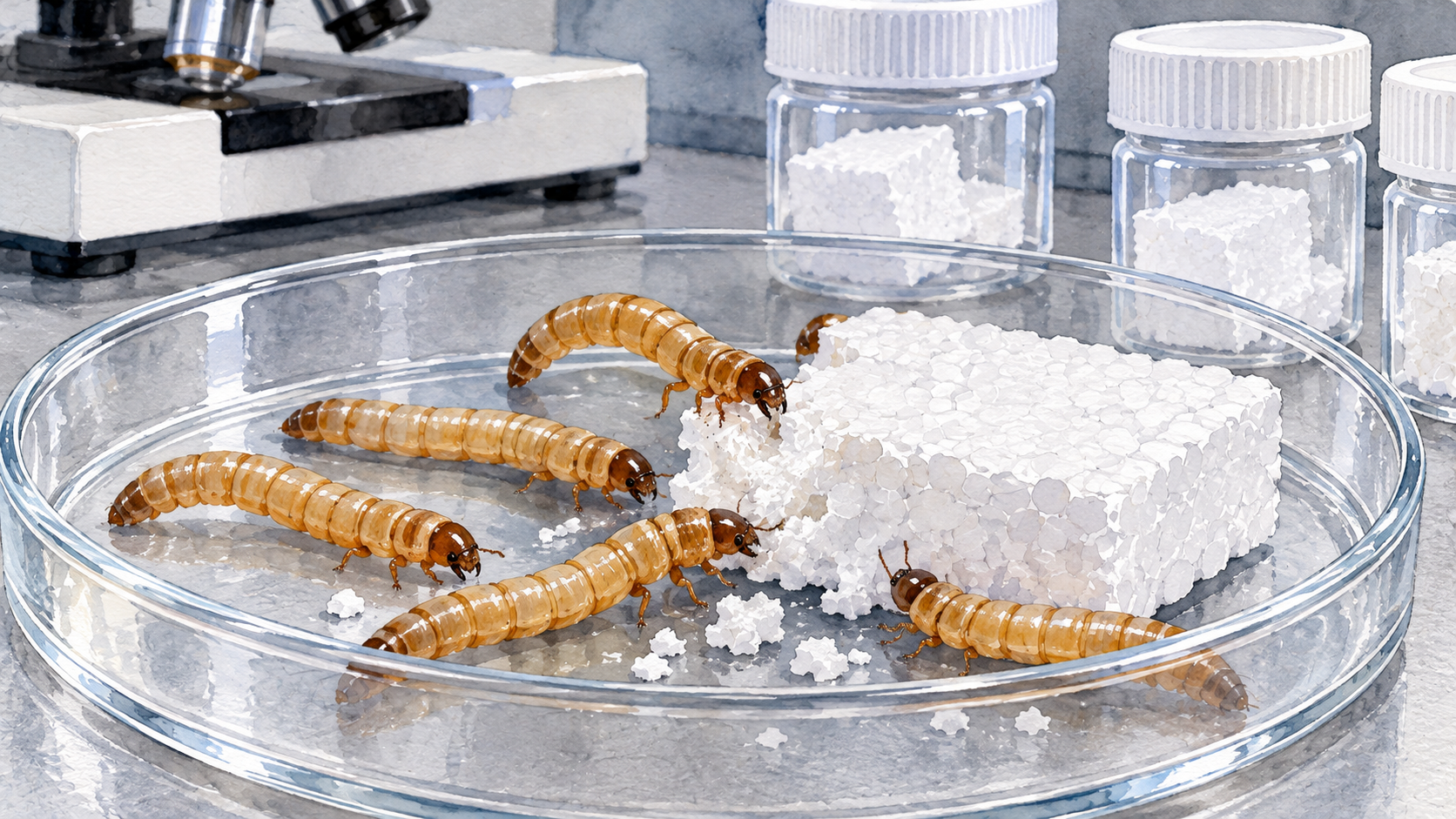
Yellow mealworms (Tenebrio molitor larvae) have been observed chewing and swallowing expanded polystyrene foam, often called Styrofoam, and some experiments also report consumption of polyethylene. However, eating plastic is not the same as completely biodegrading it, and scientists disagree about how much chemical breakdown actually occurs. These findings concern experimental waste-processing research, not normal livestock feed. Mealworms exposed to plastic should not be assumed safe for chickens, quail or other farm animals.
What Happens When Mealworms Eat Styrofoam?
Expanded polystyrene (EPS) is a lightweight foam made from the plastic polymer polystyrene. Mealworms can bite pieces from it and pass material through their digestive systems, leaving visibly damaged foam and waste containing residues.
In a 2015 isotope-tracing experiment, researchers reported that 47.7% of ingested polystyrene carbon became carbon dioxide over 16 days, while approximately 49.2% was recovered in excreted material. Those findings suggested more than simple chewing because labeled carbon appeared in carbon dioxide.
Yet a 2025 controlled study found no chemical breakdown of the pure polystyrene backbone, while commercial foam showed limited changes attributed to additives. The conflicting results mean claims that mealworms reliably digest all Styrofoam require caution.
Can Mealworms Consume Polyethylene and Other Plastics?
Polystyrene is not the only polymer investigated. A 2018 study of polyethylene and mixed plastics reported changes in polymer molecular weight and chemistry after passage through mealworms, with evidence consistent with partial degradation. A 2025 investigation using oxygen monitoring also reported consumption and chemical changes in polystyrene and polyethylene under controlled conditions.
These findings do not establish that mealworms can safely digest every plastic. Polyethylene film, rigid containers, polystyrene foam, plastic blends and coated materials differ in their molecular structures, additives and physical properties.
Plastic type matters. A laboratory finding involving a defined polymer does not validate feeding mealworms random packaging, painted foam, PVC, treated insulation or mixed plastic waste from a farm.
Do Gut Bacteria Actually Break Down the Plastic?
Several experiments suggest that microorganisms in the mealworm digestive tract help transform ingested plastics. The 2018 polystyrene study across multiple locations found chemical changes in residual material and observed that suppressing gut bacteria reduced measured depolymerization.
However, the mechanisms remain disputed. The 2025 pure-versus-commercial EPS experiment found that the apparent changes in commercial foam could be explained by additive-associated oxidation rather than enzymes breaking its polystyrene backbone.
Gut-community changes alone do not prove complete biodegradation. Investigators must distinguish chewed particles, altered additives, shorter polymer chains and actual conversion of polymer carbon into simpler substances. That distinction explains why different experiments reach different conclusions.
Why Disappearing Plastic Does Not Mean It Is Gone
A piece of foam becoming smaller shows consumption or fragmentation, not necessarily harmless disposal. Plastic may leave the insect as partially altered polymer, microscopic fragments or residues containing chemical additives.
A 2023 investigation of plastic-fed mealworm waste detected microplastics in frass after polystyrene and polyethylene feeding. The study also reported evidence of chemical changes, showing that fragmentation and partial degradation can occur together.
That uncertainty matters on farms. Plastic-exposed insect waste should not automatically be spread as soil amendment or mixed with compost simply because it resembles ordinary insect droppings. Its chemical composition and environmental suitability need independent assessment; the usual discussion of mealworm frass as fertilizer does not establish safety for plastic-derived residues.
Can Mealworms Survive on Plastic Alone?
Short experiments have produced mixed findings. The 2015 polystyrene research reported survival comparable to bran-fed larvae over a month, while other researchers have measured changes in growth, metabolism and the gut microbiome under plastic-containing diets.
In contrast, the 2025 expanded-polystyrene study found that larvae fed only pure or commercial EPS performed no better than starved controls; none completed metamorphosis in that experiment. A 2022 feeding study likewise found that different plastic-containing diets changed nutritional composition and developmental outcomes.
Together, these results show why plastic should not be treated as an established, nutritionally adequate mealworm diet. The question of what mealworms ordinarily eat is separate from whether they can chew synthetic waste.
Are Plastic-Fed Mealworms Safe for Chickens or Other Farm Animals?
There is not enough evidence to recommend feeding plastic-raised mealworms to farm animals. Plastic products can contain additives, processing residues or contaminants, and the fate of every substance cannot be inferred from a single experiment.
One 2020 study tracking the flame retardant HBCD found little accumulation in mealworm tissues and no detected higher-trophic-level accumulation in the shrimp tested. That is a useful finding for one substance and experimental system, not a general safety clearance for plastic-fed insects or poultry diets.
Plastic-derived residues and changes in insect nutritional composition also deserve consideration. Research on plastic-fed mealworm composition and cell assays does not substitute for validated long-term feed-safety assessments. Mealworms intended for livestock should come from appropriate feed-production practices, not improvised plastic-waste experiments. The suitability of mealworms as poultry treats must not be extended to insects raised on plastic.
What Do These Findings Mean for Farm Waste Management?
Mealworm plastic research may eventually contribute to understanding polymer degradation or identifying microorganisms and enzymes of interest. For now, the evidence does not support treating mealworm bins as a dependable, farm-scale plastic recycling system.
The experiments generally involve controlled plastic types, measured conditions and chemical analysis. Real agricultural waste may contain coatings, flame retardants, pesticides, adhesives and mixed polymers, complicating both degradation and residue safety.
Keep plastic packaging and foam separate from feed insects, livestock rations, bedding and compost. Use appropriate local waste-collection or recycling routes for plastics that qualify. The wider question of whether darkling beetles benefit a farm should not be confused with experimental plastic consumption.
Questions About Mealworms and Plastic
Can mealworms eat Styrofoam packaging? They may chew some expanded polystyrene foam, but packaging additives and contamination vary; feeding it to farmed insects is not recommended.
Do mealworms turn all Styrofoam into carbon dioxide? No. Experiments have reported partial conversion or chemical changes, while other work questions whether pure polystyrene is degraded.
Is mealworm waste safe after plastic feeding? Safety has not been established for general farm or garden use. Residual plastic particles and additives may remain.
Will feeding plastic to mealworms make them safe poultry feed? No. Plastic consumption does not validate the resulting insects as safe feed for chickens or other livestock.