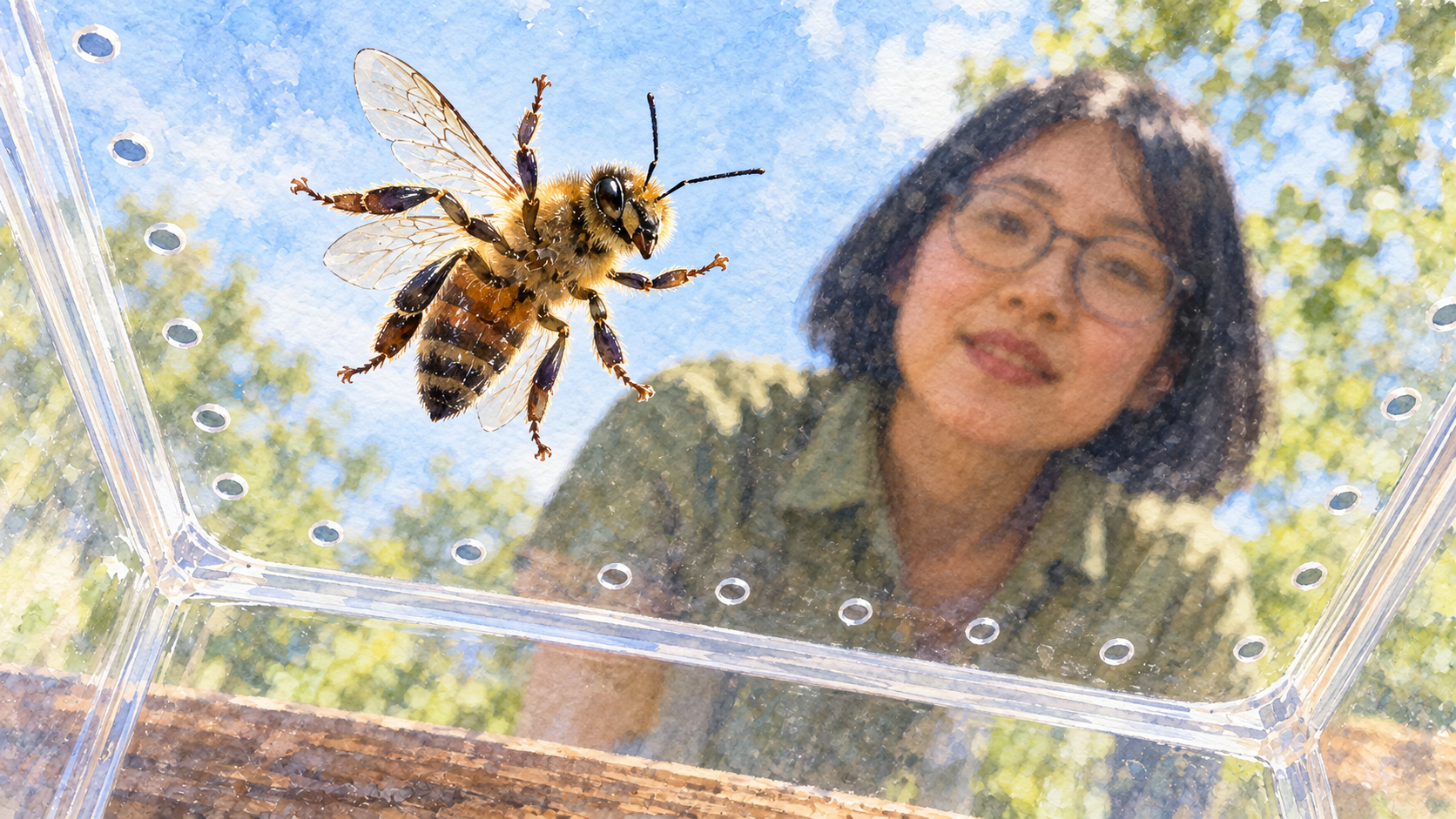
Honey bees are insects. They belong to the class Insecta within the larger phylum Arthropoda, and they have the defining characteristics of insects: six jointed legs, three main body regions, one pair of antennae and an external skeleton. Honey bees also belong to the order Hymenoptera, which includes ants, wasps and other bees.
The western honey bee, Apis mellifera, is the species most familiar on U.S. farms. Its scientific classification establishes that it is an insect regardless of whether it lives in a managed beehive or an unmanaged colony. Understanding this classification helps distinguish biological relationships from common names and from the bee’s particular behavior.
Where Do Honey Bees Fit in Animal Classification?
Biologists classify organisms in nested groups based on evolutionary relationships. A honey bee is an animal, an arthropod, an insect, a hymenopteran and a member of the bee family Apidae. Within that family, the genus Apis contains the honey bees. The U.S. Fish and Wildlife Service taxonomic tree and University of Missouri Extension’s insect classification guide independently place Apis mellifera in these groups.
| Classification rank | Western honey bee |
|---|---|
| Kingdom | Animalia |
| Phylum | Arthropoda |
| Class | Insecta |
| Order | Hymenoptera |
| Family | Apidae |
| Genus | Apis |
| Species | Apis mellifera |
These ranks answer different questions. Insecta identifies the broad animal class, Hymenoptera its order and Apis its genus. Classification does not mean all members of an order or family share identical nesting or social behavior. The separate guides to what a honey bee is and honey bee types cover those broader topics.
Why Are Honey Bees Classified as Arthropods?
Arthropods are invertebrate animals with segmented bodies, jointed appendages and an exoskeleton. Honey bees meet these criteria. They have no internal backbone, their legs bend at joints and their external covering provides protection and support. Their appendages and body segments are part of the same general body organization found across an enormous range of arthropods.
The arthropod group also contains spiders, mites, ticks, crustaceans, centipedes and millipedes. Sharing a phylum does not make these animals insects: a spider is an arthropod but not a member of Insecta. The Smithsonian’s arthropod overview distinguishes the six-legged insect class from eight-legged arachnids and many-legged myriapods.
This hierarchy explains why every honey bee is an arthropod but not every arthropod is a bee or even an insect. It also prevents a common misunderstanding: the absence of a backbone alone is not enough to identify an insect, because many other invertebrates lack backbones too.
What Physical Features Make Honey Bees Insects?
The most straightforward identifying traits are six legs arranged in three pairs and the division of the adult body into a head, thorax and abdomen. Adult honey bees also have a single pair of antennae and two pairs of wings. The thorax bears the legs and wings, while the hard external skeleton protects the body. The Smithsonian National Museum of Natural History uses these same features to explain what qualifies an animal as an insect.
These traits should be considered together rather than in isolation. A butterfly also has six legs and three main body regions, whereas a spider has eight legs and no antennae. Not every insect has visible functional wings, and wings are not required for insect classification. What matters is the overall biological organization and evolutionary relationship.
The features listed here establish the insect identity of honey bees without examining every body structure. Wing mechanisms, eyes, mouthparts and the fine details of pollen-carrying structures belong in the dedicated honey bee anatomy and appearance article.
Are Honey Bees Related to Wasps and Ants?
Yes. Honey bees, other bees, wasps and ants all belong to the insect order Hymenoptera. Members of this order share a common evolutionary history, but it contains many different families and lifestyles. Bees are associated particularly with obtaining pollen and nectar from flowers, whereas other hymenopterans may feed or provision their young in quite different ways.
Honey bees are classified in the family Apidae, which also contains other groups of bees. Ants belong to their own family, Formicidae. The classification reflects biological relationships and does not imply that honey bees and ants have the same structures, food sources or methods of colony organization. The University of Kentucky’s bee taxonomy overview places bees within Hymenoptera and explains their flower-related specializations.
The important point is that “bee,” “wasp” and “ant” are not categories outside insects: they are groups within Insecta. Detailed comparisons of field identification, nesting and behavior belong in the planned honey bees versus wasps article, rather than this classification guide.
Are Honey Bees Insects Throughout Their Life Cycle?
Yes. Classification follows the organism throughout its life, not just its adult appearance. Honey bees undergo complete metamorphosis: they develop from eggs into legless, worm-like larvae, then pupae, before emerging as adults with the familiar six legs and wings. The immature stages do not resemble flying bees, but they are still insects of the same species.
Complete metamorphosis occurs in several insect orders, including butterflies, beetles, flies and Hymenoptera. The Animal Diversity Web’s Apis mellifera account describes the honey bee’s developmental stages. Being unable to fly or lacking adult legs during the larval stage does not turn an insect into a worm or another type of animal.
This distinction is useful when looking at developing bees in a colony. Their life stage changes their appearance and behavior, not their classification. Developmental timing and differences among types of developing bees are covered in the honey bee life-cycle guide and the honey bee brood guide.
Does Living in a Colony Make a Honey Bee a Different Kind of Animal?
No. Honey bees are social insects, but “social” describes their way of life rather than a separate animal class. Ants, some wasps and termites also live in organized societies, and these groups do not all belong to the same insect order. Conversely, many insects live alone for most of their lives. Social cooperation cannot, by itself, be used to classify an unknown animal as a honey bee.
A western honey bee working alone at a flower remains an insect even though its survival and behavior are shaped by a colony. Likewise, a queen, worker and drone are all insects of the same species despite their different reproductive roles and physical traits. The queen, worker and drone guide explains those roles, while worker honey bee activities explores how labor is divided.
Scientific classification and practical farm terminology therefore answer different questions. “Insect” describes the kind of animal a honey bee is; “worker” identifies a role within its colony; and “managed honey bee” describes a bee kept under human care. None changes its placement in the class Insecta.
Why Does Honey Bee Classification Matter on a Farm?
Correct classification gives farmers and readers a foundation for understanding bee biology and interpreting extension guidance. A honey bee is not a bird, mammal or vertebrate livestock animal. It is an invertebrate insect with its own developmental stages, environmental requirements and biological vulnerabilities. Knowing the appropriate scientific name also makes it easier to distinguish information about western honey bees from information about unrelated insects.
Classification alone does not establish whether an insect is beneficial, hazardous or suited to a particular use. Those conclusions require information about its ecology, behavior and interaction with crops. In farming, honey bees are frequently discussed because of pollination, but sharing the class Insecta with a crop pest does not make their roles equivalent. The honey bee pollination guide explores that agricultural process, while the crop pollination guide covers where bees are useful.
The most reliable approach is to pair the common name with the scientific classification and use the relevant guidance for that organism. This avoids treating every flying insect, every stinging insect or every flower visitor as interchangeable.
Questions About Honey Bees as Insects
Are honey bees insects or animals? Both. Honey bees belong to the animal kingdom, Animalia, and to the insect class, Insecta, within the arthropods.
Are bees technically bugs? In casual speech, “bug” often means any small arthropod. In technical entomology, true bugs belong to the order Hemiptera, while honey bees belong to Hymenoptera.
Is a honey bee an invertebrate? Yes. It has no backbone and is supported and protected by an external skeleton.
Is a honey bee larva still an insect? Yes. Its larval form looks different from the adult, but both stages belong to the same insect species.