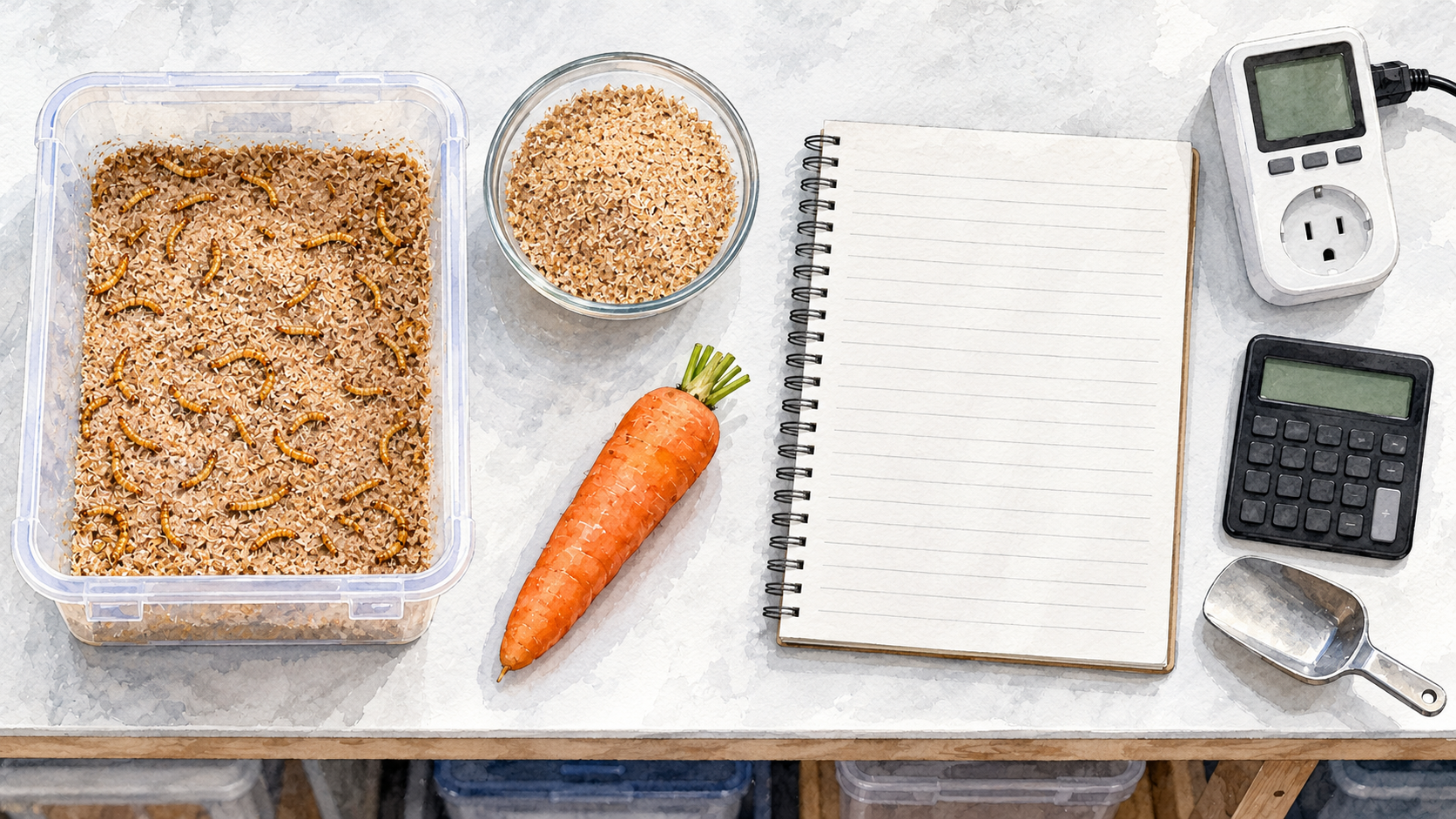
The ongoing cost of raising mealworms depends mainly on feed, electricity, heating, labor, substrate replacement, and losses within the colony. A small yellow mealworm (Tenebrio molitor) farm maintained in an existing, suitable indoor space may cost only a few dollars per month in purchased supplies, excluding labor. A heated operation with more larvae, frequent substrate changes, or paid workers can cost substantially more.
There is no dependable flat monthly price for every mealworm farm. A useful estimate begins with the quantity of feed consumed, the energy actually used, and the time spent maintaining the colony. These operating expenses should be tracked separately from the initial purchase of insects, containers, and equipment.
What Are the Main Operating Costs of a Mealworm Farm?
Mealworm farming has several recurring expenses, although their importance varies with the colony’s size and management system.
| Operating expense | What creates the cost |
|---|---|
| Dry feed | Bran, grains, and other edible ingredients consumed by larvae and adults |
| Moist food | Fresh produce or other suitable moisture-providing ingredients |
| Electricity and heating | Climate control, ventilation, monitoring, and supplemental warmth |
| Labor | Feeding, separating insects, cleaning, transferring adults, and harvesting |
| Substrate replacement | Replacing exhausted edible material and losses during screening |
| Consumables | Labels, cleaning supplies, gloves, and worn screening materials |
| Colony losses | Feed and labor invested in insects that die or cannot be used |
Research comparing mealworm production systems found that feed and labor were the largest variable expenses, although their shares differed between farms. Electricity and other utilities were also relevant. These findings were reported in a 2024 analysis of mealworm production economics.
For a small home colony, labor may be unpaid and electricity may be shared with household use. Those expenses still matter when calculating what production actually requires.
How Much Does Mealworm Feed Cost?
Feed is one of the most consistent recurring expenses because larvae consume grain-based material throughout their development. The total depends on the feed formulation, purchase price, amount eaten, and material lost during maintenance.
Consider a simple example. If suitable feed costs $0.60 per pound and a colony uses 10 pounds over a month, the dry-feed expense is $6. If the same colony uses 20 pounds at $1 per pound, that expense becomes $20.
These are illustrative calculations, not verified current retail quotes. Local grain availability and purchasing arrangements can produce very different costs.
A mealworm production study reported a feed conversion ratio of approximately 2.2 kilograms of concentrated feed per kilogram of live mealworm weight under its experimental conditions. Other studies report different results, demonstrating why feed consumption cannot be estimated accurately using one universal conversion factor.
The best feed for farmed mealworms depends on nutrition and performance. For operating-cost calculations, the important measurement is how much usable feed is consumed and what the farmer pays for it.
How Does Feed Conversion Affect Running Costs?
Feed conversion describes the relationship between feed input and live-weight gain. If larvae need more feed to produce the same amount of growth, their feed cost rises even when the ingredient price stays unchanged.
For example, at an illustrative feed price of $0.80 per kilogram:
| Feed required per kg of live-weight gain | Feed cost |
|---|---|
| 2.0 kg | $1.60 |
| 3.0 kg | $2.40 |
| 4.0 kg | $3.20 |
| 5.0 kg | $4.00 |
The calculation excludes labor, heating, losses, and other supplies. It also assumes feed quantities are measured on a comparable basis.
A 2024 study of feed conversion discusses variability in mealworm conversion efficiency according to feeding materials and production conditions. For a farm, comparing feed used against larval weight gained is more informative than comparing ingredient prices alone.
How Much Does Electricity Cost for Raising Mealworms?
Electricity expenses depend on whether the colony needs supplemental heating, fans, ventilation, or other powered equipment. A colony maintained in a room that is already suitable may have little additional electricity use, while a dedicated heated enclosure can become a significant recurring expense.
The U.S. Energy Information Administration’s October 2026 outlook projects an average residential electricity price of approximately 18.2 cents per kilowatt-hour for 2026. Actual local rates differ.
At an illustrative electricity price of $0.18 per kilowatt-hour, the following equipment would cost approximately:
| Electricity use | Monthly cost |
|---|---|
| 10 kWh | $1.80 |
| 25 kWh | $4.50 |
| 50 kWh | $9.00 |
| 100 kWh | $18.00 |
These figures represent electricity consumption, not assumed equipment costs. To estimate consumption, multiply equipment power in kilowatts by its operating hours. A 40-watt device running continuously for 30 days would consume 28.8 kWh, costing approximately $5.18 at that example rate.
A thermostat-controlled heater may cycle on and off, so its actual electricity use can be considerably different from its rated power multiplied by every hour of the day. A plug-in energy meter can provide a more useful measurement.
Why Can Heating Become a Major Expense?
Mealworms develop more slowly under cooler conditions, and maintaining an actively growing colony through winter may require supplemental warmth.
The energy required depends on room insulation, outdoor weather, enclosure size, heat loss, and the efficiency of the heating system. Heating an entire poorly insulated outbuilding can cost considerably more than maintaining a small protected space.
An environmental assessment of mealworm production found that heating gas and electricity made substantial contributions to the energy demand of the studied operation. Although that research measured environmental impacts rather than current U.S. utility bills, it demonstrates why heating cannot be ignored in production planning.
A Canadian economic review of insect farms likewise documented substantial variation in energy use between facilities.
For a small farm, measure the additional energy needed specifically for the insects rather than assigning the entire household heating bill to the colony.
The winter care of mealworms includes practical heating considerations, while operating-cost records should capture the additional energy actually consumed.
How Much Does Labor Add to Mealworm Farming Costs?
Labor can be one of the largest expenses when a colony is maintained regularly, even if no employee receives a paycheck.
Daily feeding inspections, removing deteriorating food, transferring insects, managing breeding groups, changing substrate, and collecting larvae all require time. Larger operations may reduce some repetitive work with equipment, but they still need monitoring.
The 2024 economic study of mealworm farms found major differences in labor requirements across the producers examined. Breeding and reproduction were among the more labor-intensive activities.
A simple way to value your own work is to multiply the hours spent by an assumed hourly rate. At $15 per hour, 30 minutes of work each day over 30 days represents $225 in labor value. At five minutes per day, the same calculation represents $37.50.
These are hypothetical labor valuations rather than cash expenses when the owner performs the work without wages. Recording them separately helps distinguish money paid out from the total resources consumed.
What Does Substrate Replacement Cost?
Mealworms often live in the same grain-based material they consume. As the edible portion becomes depleted and waste accumulates, additional material is needed.
Some replacement substrate is simply new feed, so it should not be counted twice. If bran purchases are already included in the feed budget, adding the entire same quantity again as a substrate expense would exaggerate costs.
A separate substrate-related operating expense may arise from unusable material discarded during cleaning, additional bedding that is not counted as feed, or replacement required following accidental spoilage.
The best substrate for raising mealworms considers different materials, while routine mealworm farm maintenance determines when exhausted material should be replaced.
Track the total quantity purchased and distinguish edible material consumed from avoidable losses whenever practical.
Do Fresh Vegetables Add Much to the Cost?
Fresh vegetables and other suitable moisture-providing foods create a recurring expense, but the amount depends on what is supplied and how efficiently the insects consume it.
Carrots and potatoes are commonly used in mealworm production research. Their cost varies with local food prices, quantity, and whether the farmer purchases them specifically for the colony.
In the environmental study of mealworm production, carrots were a distinct material input alongside concentrated grain feed. That distinction is useful for recordkeeping because the two inputs have different moisture contents and prices.
For a small colony, record the actual amount purchased and used each month. Avoid assigning a zero cost to fresh food merely because it is already available on the farm; it may still have a replacement or alternative-use value.
The water requirements of mealworms are a separate husbandry question. In an operating budget, the concern is the cost of providing suitable moisture sources consistently.
How Do Mortality and Wasted Feed Affect Costs?
When larvae die before they can be used, the feed, energy, and labor already invested in them may be lost. Repeated losses can make a colony more expensive to operate even if monthly spending appears unchanged.
For example, consider two groups that consume the same quantity of feed. If one experiences greater mortality, the feed expense is spread across fewer surviving larvae.
Wasted substrate and spoiled fresh food can produce similar inefficiencies. These losses may arise from overfeeding, poor environmental conditions, or handling problems, but their causes should be investigated rather than assumed.
The causes of mealworm deaths require separate assessment. For financial records, track how much feed is discarded, whether mortality is increasing, and the approximate proportion of each group that remains usable.
A simple loss log often reveals more about operating expenses than a record of purchases alone.
What Do Cleaning Supplies and Equipment Maintenance Cost?
Small recurring expenses can include detergent, gloves, cleaning cloths, labels, replacement mesh, and damaged containers.
These purchases are usually less frequent than feed purchases, but they should still be included when evaluating the cost of maintaining the colony.
For example, if a reusable sieve costs $12 and provides two years of service, spreading that expense across 24 months gives an illustrative equipment-use cost of $0.50 per month. The same approach can be applied to other durable items already used in production.
This is an accounting allocation, not a new monthly cash payment. The original purchase of equipment belongs to the initial investment budget, while its depreciation or replacement allowance can be considered part of ongoing operating costs.
The methods used to separate mealworms from beetles may influence how quickly screening equipment wears or needs replacement.
What Is an Example Monthly Operating Budget?
A small indoor colony might have the following hypothetical monthly expenses. This example assumes existing containers, moderate feed consumption, and modest supplemental electricity use. It is not a quoted industry average.
| Expense | Example monthly cost |
|---|---|
| Dry feed | $12 |
| Fresh moisture-providing food | $4 |
| Additional electricity | $6 |
| Cleaning supplies and consumables | $2 |
| Replacement and waste allowance | $3 |
| Cash operating expenses | $27 |
| Owner labor: 6 hours at $15/hour | $90 |
| Total including labor value | $117 |
The labor figure represents an assigned value for the owner’s time. If no wages are paid, it does not leave the farm as cash. Likewise, the replacement allowance is a planning allocation unless a replacement purchase occurs that month.
A farm located in a cold outbuilding could have much higher heating expenses. Another farm operating in an already suitable room might have substantially lower additional utility costs.
This example intentionally excludes the original purchase of insects, equipment, building improvements, and income from sales.
How Do You Calculate Your Own Monthly Mealworm Expenses?
Record each operating input over a consistent period, preferably one month. Separate purchases from quantities actually used whenever possible.
A useful calculation is:
Monthly operating cost = feed + fresh food + incremental energy + paid labor + consumables + equipment-use allowance + other recurring expenses.
If you want a broader economic cost, add the value of unpaid owner labor separately.
For more detailed records, include the amount of feed used, hours worked, electricity consumed, and losses observed. These measurements allow costs to be compared across different months without confusing changes in colony size with changes in efficiency.
The stocking density of mealworms can affect feeding and maintenance demands, but there is no universal monthly cost per container.
How Can You Reduce Ongoing Costs Without Harming the Colony?
The most useful savings generally come from avoiding waste rather than cutting essential care.
Purchase suitable feed in quantities that can be stored safely, compare its cost against larval performance, and avoid paying for nutritional additions that provide little measurable improvement. Supply fresh food in portions the colony can consume before spoilage.
Maintain a regular schedule so dead insects, deteriorating food, and exhausted substrate do not accumulate unnecessarily. Keep records of heating use rather than assuming a low-wattage appliance has negligible operating costs.
The feeding schedule for mealworms influences waste, while the mealworm harvesting process affects how much handling is required when collecting live larvae.
Reducing labor through an organized workflow can also lower ongoing costs without compromising animal welfare.
Questions About Mealworm Operating Costs
Is mealworm feed usually the biggest expense? Feed is often a major expense, but labor and heating can equal or exceed it depending on the operation.
Does raising mealworms indoors increase electricity bills? It may. The increase depends on supplemental equipment and actual energy consumption, not simply the presence of insect containers.
Should unpaid labor count as a cost? Yes, when evaluating the total economic resources used. Keep it separate from cash expenses to avoid confusing the two.
Can you calculate operating costs without knowing harvest quantities? Yes. Monthly expenses can be recorded directly, although additional production measurements are needed to evaluate cost efficiency per unit of output.
3 thoughts on “How Much Does It Cost to Raise Mealworms?”