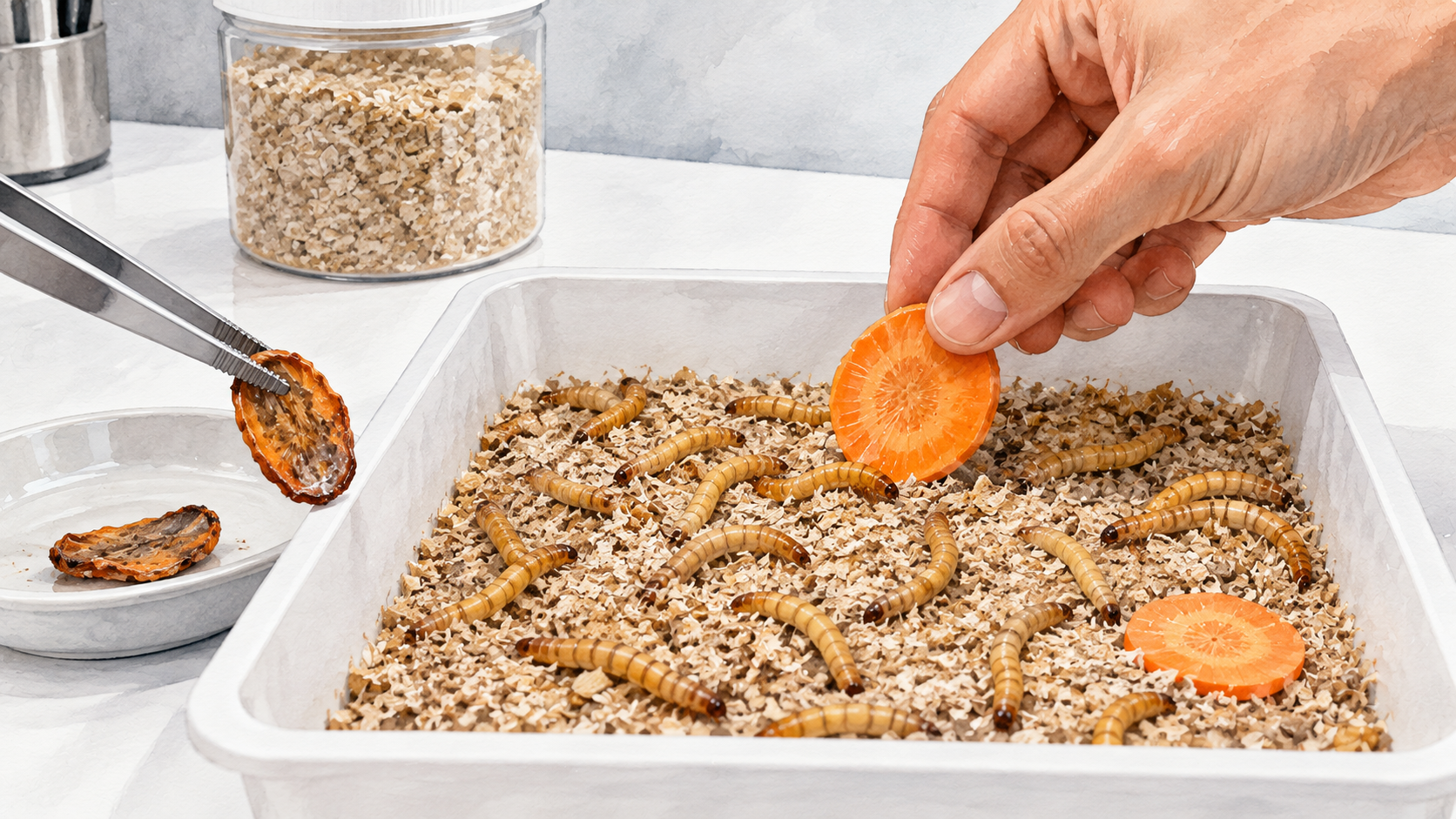
Mealworms should have dry food available continuously, while fresh moisture-rich food can usually be offered two or three times per week. For an actively growing yellow mealworm (Tenebrio molitor) colony, check the containers daily or every other day, replenish cereal-based food before it runs out, and remove fresh leftovers before they spoil.
There is no universal feeding schedule that fits every colony. Larger populations and growing larvae consume food at different rates, so the most reliable routine combines regular inspections with adjustments based on what the insects actually eat.
How Often Should You Replenish Dry Mealworm Feed?
Dry food such as wheat bran or oats should remain available throughout larval development. Because mealworms live within their edible substrate, they can feed repeatedly without requiring separate scheduled meals.
In a controlled study of yellow mealworms raised on different grains, researchers replenished wheat bran as needed rather than replacing it on a fixed daily schedule. Another feeding experiment checked and replenished food once or twice weekly while maintaining an adequate supply.
For a small farm, inspecting the dry food every few days is a reasonable starting routine, provided the colony is also observed regularly. Add more when the edible material is noticeably depleted instead of allowing the larvae to consume nearly everything before the next feeding.
How Often Should You Give Mealworms Fresh Vegetables?
Offering small portions of moisture-rich vegetables two or three times weekly is a practical starting schedule for many actively growing colonies. Adjust that interval if the portions disappear quickly or remain uneaten.
Research colonies have successfully used different schedules. The grain-comparison experiment supplied fresh potato slices twice weekly, while a 2026 food-safety and nutrition study supplied fresh food two or three times per week.
These examples establish workable routines rather than a mandatory frequency. A large, active colony may consume a modest portion rapidly, whereas a smaller colony may leave food behind. The aim is to keep an appropriate moisture source accessible without accumulating decaying leftovers.
Should You Check Mealworm Food Every Day?
Yes. A brief daily inspection is useful even when dry feed is replenished less frequently. Check how much of the previous fresh portion remains, whether the grain-based material is becoming depleted, and whether any food has changed appearance or developed an unusual odor.
Daily inspection does not mean the entire container must be emptied or every insect handled. Mealworms can remain concealed within their food, and unnecessary disturbance makes routine care more complicated.
A practical insect-farming guide recommends checking feeding trays regularly and replenishing food before it is exhausted. This approach allows feeding frequency to follow the colony’s actual needs rather than an inflexible calendar.
How Can You Tell When Mealworms Need More Food?
Look at how much recognizable dry food remains and whether the colony is still surrounded by usable material. As larvae feed, the substrate gradually changes, leaving finer waste particles and shed skins among the remaining grain.
If little recognizable bran or oats remains, replenish the edible material. Avoid assuming that a container still contains plenty of food simply because there is a substantial layer of fine particles at the bottom.
The distinction between usable food and accumulated mealworm frass becomes increasingly important as the colony develops. The choice of an appropriate edible substrate can also affect how easily depletion is recognized.
For fresh portions, observe whether they disappear, dry out, or remain untouched. Those differences provide a useful basis for adjusting the next serving.
When Should You Remove Uneaten Fresh Food?
Remove fresh food before it becomes moldy, slimy, or decomposed. For a simple beginner routine, checking and removing leftover vegetable pieces within approximately 24 hours is a conservative practice, especially when conditions favor rapid spoilage.
The mealworm care instructions recommend removing uneaten vegetable slices daily to prevent mold. Fresh food may also dry out without visibly rotting, but it should still be inspected rather than left indefinitely.
Do not continually place new pieces on top of old ones. This can conceal deteriorating food and leave damp patches beneath the surface. The risks associated with unsuitable or spoiled mealworm foods make prompt removal important, especially when larvae will eventually be used as animal feed.
Is Feeding Once a Week Enough?
For an actively growing colony, a single weekly feeding event may be insufficient if it means food or accessible moisture runs out between visits. However, a large enough supply of clean dry food can remain available throughout the week without being replaced daily.
The important distinction is between checking a food supply and feeding only once. Mealworms do not need their entire ration delivered in a new portion every morning, but they should not be left with depleted food for several days.
Some refrigerated feeder-insect storage instructions use weekly feeding sessions because cooling greatly reduces activity. A mealworm supplier’s care guide describes such a routine for refrigerated insects. That schedule is intended for temporary storage, not for a warm breeding colony where normal growth and reproduction are desired.
Do Young and Large Mealworms Need the Same Feeding Schedule?
Not necessarily. Young larvae are small and consume much less food individually than mature larvae, while larger groups can deplete a food supply more quickly.
However, a container with many tiny mealworms can still require substantial total food. Both insect size and population size matter. The stages of mealworm growth help explain why a colony’s consumption changes as larvae develop.
Rather than using a rigid age-based schedule, check each group according to its consumption. Avoid allowing small larvae to run out of food merely because their feeding activity is difficult to see.
Do Adult Beetles Need Feeding as Often as Larvae?
Adult yellow mealworm beetles should also have suitable food available, but their feeding demands differ from those of growing larvae. The adults use nutrients for maintenance and reproduction rather than accumulating larval body mass.
A review of insect-rearing methods notes that adult Tenebrio molitor generally consume less food than larvae and can receive fresh vegetables periodically.
Breeding containers should still be inspected for depleted substrate and aging fresh food. The diet of adult darkling beetles differs in purpose from the larval ration, so feeding quantities should not simply be copied from a similarly sized larval container.
How Do You Adjust Feeding as the Colony Grows?
The easiest method is to establish a routine, record what is consumed, and change the amount or interval when the observations justify it.
For example, if a colony consistently consumes its fresh portion shortly after feeding, smaller but more frequent servings may maintain availability better than one large piece. If considerable fresh material remains at every inspection, reduce the portion rather than allowing it to accumulate.
Dry feed should be topped up as necessary to keep usable food available. Track how often this becomes necessary because an expanding population can consume the same initial quantity much faster than before.
The number of mealworms housed together affects total demand, while farm-level feed selection determines what nutrients the ration provides. Feeding frequency is the separate task of making those nutrients available consistently.
What Is a Simple Weekly Feeding Routine?
A small, actively growing colony can use the following example as a starting point:
| When | Feeding task |
|---|---|
| Daily | Briefly check remaining food and remove deteriorating fresh pieces |
| Monday | Check dry feed; offer a small fresh portion |
| Wednesday | Recheck dry feed; offer fresh food if needed |
| Friday | Check consumption; provide another fresh portion |
| Weekend | Review food remaining and adjust the next week’s quantities |
This schedule is illustrative, not a requirement to feed on particular days. If a colony consumes fresh food much sooner, check and replenish it more frequently. If the dry substrate is still abundant, do not add extra simply because a scheduled day has arrived.
A consistent feeding routine also makes the beginner mealworm farming process easier to manage. The purpose is to avoid food shortages and spoiled leftovers without creating unnecessary handling work.
Questions About Mealworm Feeding Frequency
Do mealworms need to be fed every day?
They should have food available every day, but you do not necessarily need to add new dry food daily.
How long can carrot slices stay in a mealworm container?
Inspect them daily and remove them before they deteriorate. Removing leftovers within about 24 hours is a conservative starting practice.
Should you add more bran when some is still present?
Yes, if the remaining edible material is becoming depleted. Do not wait until only fine waste is left.
Can you overfeed mealworms?
Providing abundant clean dry food is different from leaving excessive fresh food to decay. The latter increases spoilage risk without necessarily improving feeding.
3 thoughts on “How Often Should You Feed Mealworms?”