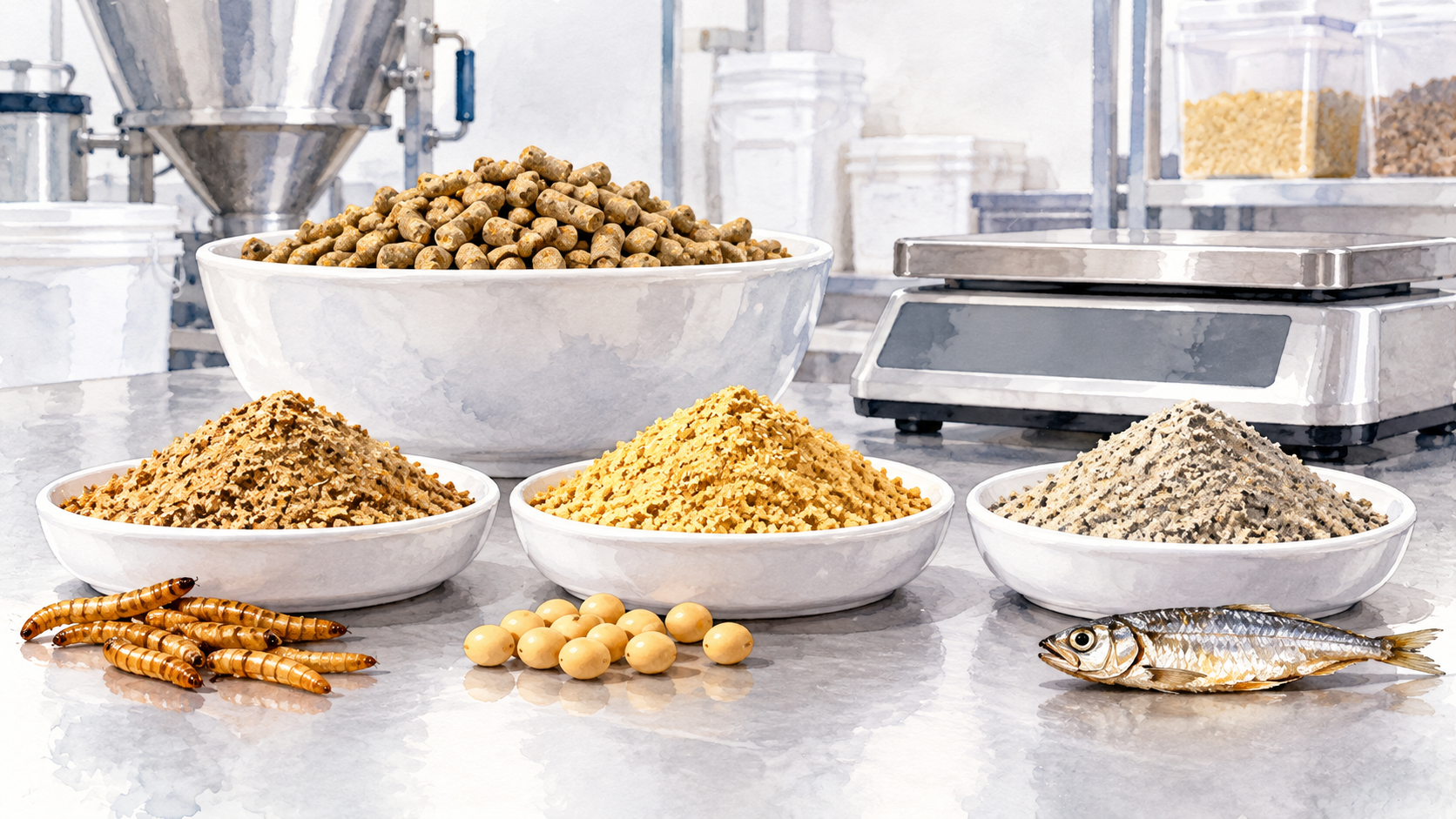
Mealworms can replace some soybean meal or fishmeal in certain animal feeds, but they are not universally suitable as complete, one-for-one replacements. Research on yellow mealworm (Tenebrio molitor) ingredients has demonstrated successful partial substitution in selected poultry, pig, and aquaculture diets. The results depend on amino-acid balance, digestibility, fat content, inclusion level, animal species, and the rest of the ration.
There is also an economic obstacle. Mealworm protein generally costs more to produce than conventional feed proteins, particularly soybean meal. A replacement must therefore make nutritional, financial, and regulatory sense rather than simply provide a similar crude-protein percentage.
How Do Mealworm Meal, Soybean Meal, and Fishmeal Compare?
The three ingredients can all supply concentrated protein, but they differ in fat, minerals, amino acids, and processing requirements.
Soybean meal is a widely used plant-derived protein ingredient. Fishmeal is an animal-derived ingredient that typically supplies concentrated protein and substantial minerals. Full-fat mealworm meal combines protein with comparatively high levels of fat, while defatted mealworm products have a different nutritional profile.
An analysis comparing insect meals with conventional protein ingredients provides the following illustrative values:
| Ingredient | Crude protein | Crude fat |
|---|---|---|
| Yellow mealworm larvae meal | 55.8% | 25.2% |
| Soybean meal, 48% grade | 47.5% | 1.0% |
| Menhaden fishmeal | 61.3% | 9.4% |
These figures represent specific ingredients, not guaranteed compositions. They should not be used as direct mixing instructions, especially when comparing products with different moisture contents.
The fat content is particularly important. Replacing soybean meal with full-fat mealworm powder changes both protein supply and dietary energy. Replacing fishmeal can also alter the ration’s mineral balance.
The processing characteristics of mealworm powder help explain why full-fat and defatted products cannot be treated as interchangeable.
Is Mealworm Protein as Good as Soybean or Fishmeal Protein?
Mealworm protein contains essential amino acids, but protein quality depends on their individual concentrations and how much the animal can digest and use.
A feed ingredient with 55% crude protein is not automatically superior to one with 48%. If the higher-protein ingredient supplies less of an essential amino acid, the complete ration may still require adjustment.
A comparison of amino acids in insect and conventional feed meals reported approximately 3.18% lysine and 0.54% methionine in the tested mealworm meal, compared with 2.96% lysine and 0.67% methionine in soybean meal and 4.51% lysine and 1.63% methionine in menhaden fishmeal.
These results illustrate that mealworm meal can compare favorably for some nutrients while falling behind for others. The relationship changes across products and analytical studies.
Consequently, replacement decisions must consider the actual amino-acid profile rather than crude protein alone.
Which Amino Acids Can Limit Replacement?
Lysine, methionine, cysteine, threonine, and other essential amino acids may influence how successfully mealworm meal replaces a conventional ingredient.
The comparative review of insect meals for animal feed identifies lysine and sulfur-containing amino acids as important considerations in livestock feeding. It also shows that the relative strengths of mealworm and soybean proteins depend on which amino acids are examined.
The potential limitation becomes more significant when a large proportion of a familiar protein source is removed. A ration that previously met an animal’s amino-acid requirements may no longer do so after an equal-weight substitution.
Mealworm larvae also contain chitin, whose nitrogen can inflate conventional crude-protein estimates. Digestible amino-acid measurements are therefore more informative than the protein percentage printed on a general product description.
Can Mealworm Meal Replace Soybean Meal in Poultry Feed?
Controlled poultry research indicates that partial soybean meal replacement is possible, but results differ according to the inclusion level and ration.
A 2023 broiler study replacing soybean meal with mealworm meal reported increased final live weights in some mealworm treatments. However, feed costs also increased, and the study’s return-on-investment measure declined as more mealworm meal was included.
A review of mealworms as feed ingredients for monogastric animals likewise describes both favorable and neutral poultry performance results.
Neither finding justifies a universal substitution percentage. The studied diets were deliberately formulated, not created by simply exchanging equal weights of ingredients.
This distinction matters when considering supplementary mealworms for chickens or mealworms in quail diets. Offering larvae as a treat is nutritionally different from replacing a measured protein ingredient in manufactured feed.
Can Mealworm Meal Replace Fishmeal in Aquaculture?
Mealworm meal is a promising partial fishmeal substitute in some aquaculture feeds. Researchers have investigated it in freshwater and marine species, measuring growth, feed conversion, digestibility, and fish health.
A review focused on yellow mealworms in aquaculture identified studies where partial or complete fishmeal substitution was possible under specific experimental conditions. It also found that outcomes differed across species and replacement levels.
An important consideration is the overall lipid and fatty-acid profile. Mealworm fat does not automatically provide the marine-derived fatty acids supplied by certain fishmeals and fish oils. Fishmeal also contributes minerals that a mealworm ingredient may not replace adequately.
Successful trials therefore depend on the composition of the complete aquaculture diet. A high replacement percentage in one fish species cannot be assumed safe or effective in another.
What Does Research Show for Pig Feed?
Mealworm meal has been studied in diets for young and growing pigs as an alternative source of dietary protein.
The review of mealworm feeding trials in pigs reports potentially favorable results for protein utilization, amino-acid digestibility, and growth in certain experimental diets.
Nevertheless, the findings remain tied to specific ingredients and nutritional formulations. They do not establish that whole mealworm powder can replace soybean meal at any chosen percentage.
Pig diets must still meet digestible amino-acid and energy requirements. An ingredient’s apparent protein concentration cannot determine its effectiveness without that broader nutritional context.
Why Do Replacement Percentages Vary Between Studies?
Two frequently confused measurements are ingredient inclusion and protein-source replacement.
An inclusion of 10% mealworm meal means the insect ingredient accounts for 10% of the complete diet by weight. Replacing 10% of the fishmeal protein means something different, especially when fishmeal and mealworm meal contain different protein concentrations.
Published experiments may also express replacement as a percentage of the original ingredient’s weight, rather than its protein contribution. These results should not be compared until their definitions are clear.
Other reasons outcomes vary include:
- Differences between full-fat and defatted mealworm ingredients.
- The animal’s species, age, and production stage.
- Differences in digestibility and amino-acid availability.
- How the remaining diet is adjusted.
- Changes in the mealworms’ rearing substrate and processing.
The review of mealworm replacement trials in aquaculture demonstrates why one universal inclusion ceiling is not supported by the evidence.
Is Defatted Mealworm Meal Better for Protein Replacement?
It may be more convenient for some formulations because removing fat increases the percentage of protein in the remaining ingredient.
Full-fat mealworm meal supplies additional energy, which can complicate an otherwise balanced ration if it replaces a low-fat ingredient such as soybean meal.
Defatted meal may allow feed manufacturers to control the added fat separately, but its nutritional value still depends on amino acids, digestibility, processing, and quality.
Defatting also requires equipment and creates additional processing costs. A product with more concentrated protein is not necessarily the less expensive source of digestible protein.
Is Mealworm Protein Economically Competitive?
Cost is one of the strongest barriers to replacing conventional feed proteins with mealworm meal.
A 2024 economic assessment of insect-based livestock feed concluded that commercial insect meals generally faced substantial price disadvantages compared with soybean meal and fishmeal. Production costs, limited scale, and the cost of processing all affected competitiveness.
A 2025 rainbow trout study estimated that its mealworm ingredient remained approximately 130% more expensive than fishmeal. Replacing fishmeal increased feed formulation costs and worsened the study’s economic feed-conversion outcomes, despite the nutritional potential.
That percentage is specific to the study and should not be treated as a current market quotation.
A realistic comparison calculates the cost per unit of usable nutrient, accounting for digestible amino acids, energy, transport, processing, and the animal’s production response. Purchase price per kilogram alone can be misleading.
The production costs of farm-raised mealworms include expenses that remain relevant even when the insects are raised for use on the same farm.
Does Raising Mealworms on the Farm Make Replacement Cheaper?
Not automatically. On-farm production may reduce dependence on purchased insects, but the mealworms still require feed, space, labor, environmental control, and processing.
A farm should compare the cost of producing a kilogram of usable, adequately processed mealworm meal with the cost of the conventional ingredient it would displace.
Moisture loss is especially important: a kilogram of living larvae does not yield a kilogram of dry mealworm meal.
Scaling production can change labor requirements and equipment costs. The commercial scaling of mealworm farming and the profitability of mealworm farming both depend on production efficiency and achievable product value.
Without credible cost and nutritional data, on-farm production should not be assumed cheaper than purchasing soybean meal.
Is Mealworm Meal More Sustainable Than Soybean Meal or Fishmeal?
It depends on how the insects are raised, what they eat, how much energy production requires, and which environmental impact is measured.
Mealworm production may offer opportunities to diversify protein sources, but drying and climate-controlled rearing consume energy. Suitable insect feed substrates may also compete with conventional agricultural resources.
A critical review of insect farming’s environmental claims found that insect meal is not consistently environmentally superior to soybean meal or fishmeal across different production systems and impact measures.
Sustainability claims therefore require a production-specific life-cycle assessment rather than an assumption that insect protein is automatically better because it comes from insects.
Do U.S. Feed Regulations Limit Replacement?
Yes. An ingredient’s nutritional performance in a research trial does not establish that it is legally permitted for every commercial animal-feed application.
The FDA’s animal-food ingredient framework requires feed ingredients to have an appropriate legal basis for their intended uses. Requirements can differ by ingredient definition, processing, target species, and federal or state rules.
Before substituting mealworm meal in commercial feed, verify the current authorization for that precise ingredient and animal species.
This is particularly important for feed intended for livestock or fish entering the human food supply.
When Is Replacing Conventional Protein Worth Considering?
Mealworm meal is most promising when a well-characterized, legally permitted ingredient can meet a defined nutritional need at an acceptable cost.
A useful assessment compares its digestible amino acids, energy, minerals, product consistency, price, and documented performance against the conventional ingredient being displaced.
The existing research supports carefully formulated partial replacement in selected applications. Complete replacement may be possible under particular experimental conditions, but it is not established as a general recommendation across farm animals.
For most farms, replacing soybean meal or fishmeal requires more evidence than similar protein percentages on two product labels.
Questions About Mealworm Protein Replacement
Can mealworm meal completely replace soybean meal?
Some experimental diets have used substantial replacements successfully, but complete replacement is not universally supported. The resulting ration must still meet the animal’s nutritional requirements.
Is mealworm meal nutritionally identical to fishmeal?
No. The ingredients differ in essential amino acids, fat, mineral content, and other characteristics.
Does higher crude protein make mealworm meal a better ingredient?
Not necessarily. Digestible amino acids, energy, mineral balance, and cost can matter more than crude-protein percentage alone.
What is the biggest obstacle to replacing conventional feed proteins?
Cost is a major obstacle, alongside ingredient variability, formulation requirements, production scale, and regulatory authorization.