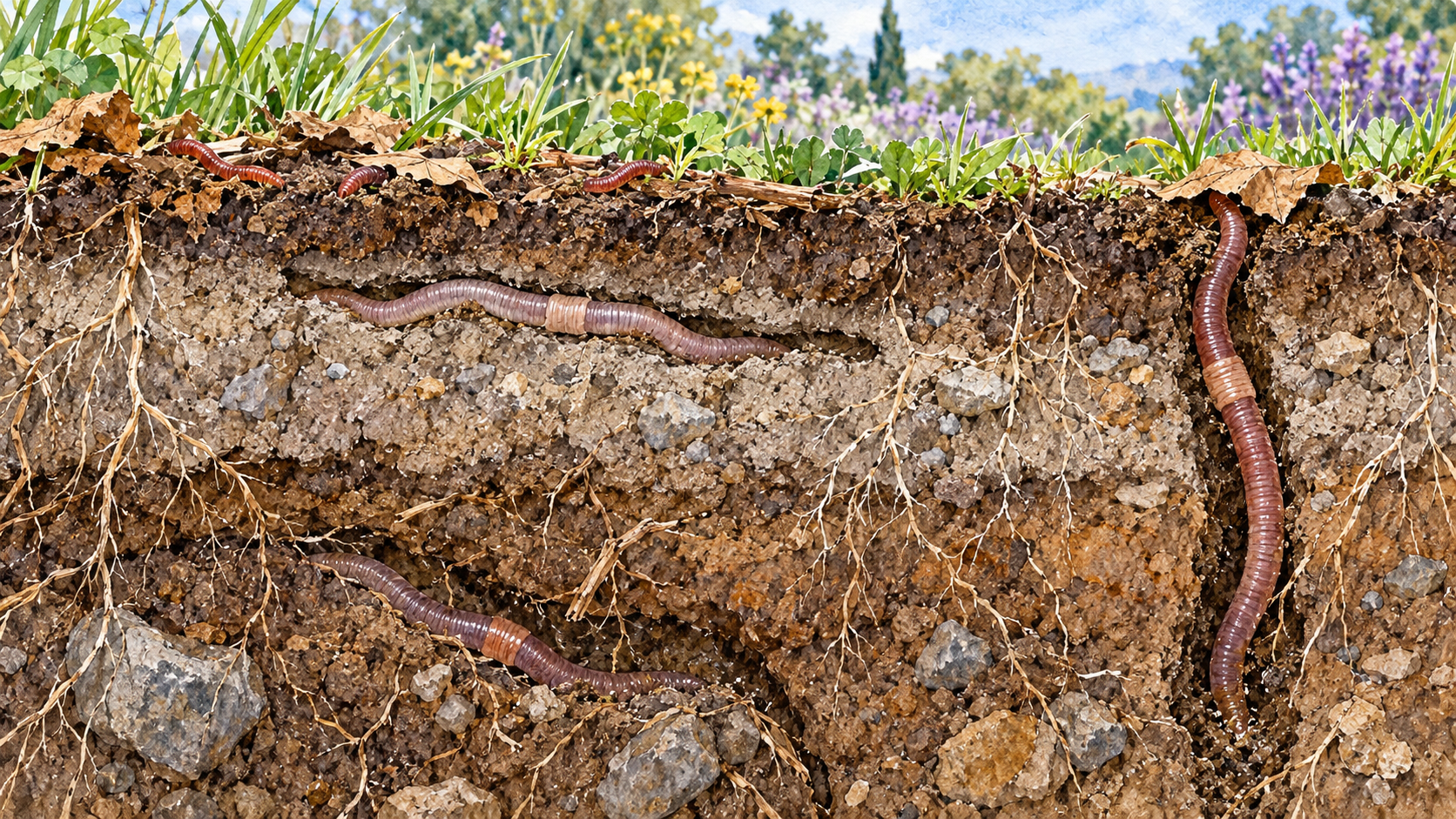
Earthworms are not all the same kind of worm. For gardens and farms, the most useful distinction is between surface-dwelling earthworms (epigeic), soil-dwelling earthworms (endogeic), and deep-burrowing earthworms (anecic). These groups differ in where they feed, the burrows they make, and their effects on soil and organic residues. Within them are numerous species, including red wigglers, red earthworms, gray field worms, and common nightcrawlers.
A small red worm in a manure pile and a large nightcrawler emerging from a lawn after dark may both be earthworms, yet their habitat requirements are quite different. Recognizing the main groups helps explain what you are finding in a field, garden bed, pasture, or compost area without assuming every worm belongs in the same environment.
Three Main Earthworm Groups, Classified by How They Live
Earthworms are commonly grouped by ecology, meaning how they use their habitat and obtain food. This is different from scientific taxonomy: an ecological group contains multiple species, and related species need not behave identically. The three-group classification used in agricultural soil studies focuses on feeding location and burrowing habits rather than just color or size.
| Ecological group | Where it usually lives | Typical feeding and movement | Familiar examples |
|---|---|---|---|
| Epigeic (litter dwelling) | Leaf litter, decomposing surface residues, manure-rich material | Feeds mainly among organic debris; generally does not maintain deep, permanent soil burrows | Eisenia fetida, Dendrobaena octaedra |
| Endogeic (soil dwelling) | Mineral soil, commonly the upper soil horizons | Ingests soil containing organic matter; forms branching or largely horizontal passages | Aporrectodea caliginosa, Aporrectodea rosea |
| Anecic (deep burrowing) | Persistent burrows extending from the surface into deeper soil | Pulls surface litter into deep, often vertical burrows | Lumbricus terrestris |
The categories are practical descriptions, not rigid biological boxes. Some worms use more than one habitat and are described as epi-endogeic or by other intermediate terms. The ecological classification review explains that researchers do not always assign the same species to the same category. That is particularly relevant when a worm spends time in both leaf litter and shallow mineral soil.
For identification, first notice where a worm was found. Its color, size, and movement can provide supporting clues, but location and burrowing pattern often say more about its likely ecological role than an isolated photograph.
Epigeic Earthworms: Worms That Live in Litter and Organic Material
Epigeic earthworms spend most of their lives in decomposing material at or above the soil surface. They are associated with fallen leaves, rotting plant residues, organic-rich bedding, and manure heaps. Many are reddish or reddish-brown, and they generally avoid the extensive mineral-soil burrows made by deeper-dwelling worms.
One familiar species is the red wiggler, Eisenia fetida, which is commonly associated with organic-rich habitats and managed worm systems. A closely similar species, Eisenia andrei, is also found in worm culture. These are distinct species even though commercial names and older sources sometimes blur them. Another surface-associated worm is Dendrobaena octaedra, a smaller species that can be found in leaf litter rather than established field-soil tunnels. The Great Lakes field descriptions document how litter dwellers differ from earthworms that feed primarily in mineral soil.
The red earthworm, Lumbricus rubellus, deserves a qualification. It feeds in surface litter but may also occupy the upper mineral soil. Some references therefore describe it as epi-endogeic rather than strictly epigeic. A reddish worm found just below decomposing leaves is not automatically Eisenia fetida.
On a farm, epigeic worms are especially relevant where organic residues accumulate. Their feeding fragments material being broken down by microorganisms. That does not make every litter-dwelling species equally suitable for captivity, nor does it mean that releasing compost worms into ordinary garden soil will establish the same population. Those are separate species-selection questions addressed in the comparison of worms for vermicomposting.
Endogeic Earthworms: The Soil Feeders of Fields and Gardens
Endogeic earthworms live mainly within mineral soil instead of relying on a layer of loose organic material at the surface. As they move, they swallow soil containing decomposed organic matter and microorganisms. Their passages tend to branch through the soil rather than form one permanent, deep shaft from which the worm regularly emerges to collect leaves.
Many are relatively pale, with gray, pink, yellowish, or occasionally greenish tones. Their limited skin pigmentation is one reason they can look less conspicuous than red litter worms. They may be found when someone digs into a vegetable bed or inspects soil beneath a pasture, even if few worms are visible on the surface.
Aporrectodea caliginosa is a well-documented example in gardens and agricultural soils. Aporrectodea rosea is another endogeic species recorded in the Great Lakes region. The green worm, Allolobophora chlorotica, is a further example, although its coloring is variable and not a secure identification feature by itself. The agricultural earthworm species accounts provide examples of these differences in soils used for crop production.
Endogeic worms contribute to the processing and redistribution of material within soil. Their feeding and casting activities can influence aggregation and the arrangement of soil pores. These effects do not mean that any one species guarantees good drainage or fertile soil. The outcome also depends on soil texture, organic matter, moisture, other soil organisms, and land management.
A pale worm found several inches below the surface is therefore more suggestive of an endogeic habit than a worm living in a surface compost layer. It is a clue to the ecological group, not enough for a confident species name.
Anecic Earthworms: Deep-Burrowing Nightcrawlers
Anecic earthworms maintain comparatively deep, persistent burrows, often extending well below the soil layers regularly disturbed in gardens. They usually obtain food at the surface, dragging fallen leaves or other plant residues toward the entrance of their tunnels. Some leave small piles of castings and gathered plant material near the opening, known as middens.
The common nightcrawler, Lumbricus terrestris, is a classic anecic species. It is generally larger than many surface-litter worms and is often dark near the front with a paler rear. Its recognizable combination of a deep burrow and surface foraging is more useful than size alone. The earthworm ecology reference identifies L. terrestris as a deep-burrowing example and describes why its underground home matters.
Another deep-burrowing earthworm found in some regions is Aporrectodea longa. However, anecic species are not equally common everywhere in the United States. Climate, soil, disturbance history, and introductions all affect which are present. A field can contain endogeic worms without supporting a substantial population of deep-burrowing nightcrawlers.
For farmers, the distinguishing feature is the persistent channel that connects surface residues with deeper soil. Such burrows may provide routes for air, water, and roots, while the worms transport organic material downward. Frequent disruption of those channels can change this function. The detailed consequences for soil aeration and drainage belong to a separate soil-management question.
Common Earthworm Names That Can Cause Confusion
Terms on bait containers, worm-farm advertisements, and gardening websites are not always scientific names. The same common name may be applied to more than one species, while one species may be sold under several names. That matters when a buyer assumes a worm described as a “nightcrawler” will behave like the familiar deep-burrowing species.
Red worm or red wiggler. These names commonly refer to Eisenia fetida, Eisenia andrei, or sometimes other reddish species. The two Eisenia species are distinct; taxonomic guidance on their identification cautions that color and banding alone cannot distinguish them with complete confidence. A red worm found naturally in field litter may instead be Lumbricus rubellus. The red wiggler identification guide addresses one species in more detail.
Common or Canadian nightcrawler. These terms frequently refer to Lumbricus terrestris, the deep-burrowing species familiar from lawns and bait markets. “Canadian” is a commercial or geographic description, not a separate taxonomic rank.
European nightcrawler. This name is commonly used for a different cultivated worm, often listed as Dendrobaena veneta or Eisenia hortensis in reference and trade materials. It should not automatically be treated as the same kind of deep-burrow specialist as L. terrestris. The nightcrawler terminology comparison covers these naming problems more closely.
African nightcrawler. Eudrilus eugeniae is another earthworm encountered in cultivation and bait discussions. Despite sharing “nightcrawler” in its name, it is not the same species as L. terrestris and should not be assumed to have the same environmental requirements.
Scientific names provide a more reliable starting point than trade names, but they should still be checked against an up-to-date reference when correct identification matters.
Which Earthworm Types Are You Likely to Find Around a Farm?
Several locations on the same property may support different ecological groups. Rather than treating a random handful of worms as representative of the entire farm, consider the material they were living in and the activity visible around them.
| Where you find the worm | Group that may fit | What the observation suggests, and what it does not prove |
|---|---|---|
| In a moist heap of decaying leaves or manure-rich material | Epigeic | A surface-organic-matter habitat; not proof the worm is a red wiggler |
| Mixed through soil in a dug garden bed | Endogeic | Feeding within mineral soil; not enough to identify a species |
| At the entrance of a persistent vertical burrow with gathered leaves | Anecic | A possible deep-burrowing earthworm; the burrow pattern matters more than the worm’s color |
| Under mulch where litter meets the upper soil | Epigeic or intermediate | Some species use both zones, so a strict category may be premature |
Agricultural guidance on earthworm groups in managed soil notes that endogeic worms are often prominent in cultivated fields, while anecic worms may be more associated with grassland and relatively undisturbed soil. This is a tendency, not a rule that applies to every farm or season.
A pasture with persistent plant cover and an arable field repeatedly cultivated to the same depth can offer very different habitats. Compost piles introduce yet another type of environment, with abundant decomposing material but without the same mineral-soil structure as a field. This is why where earthworms naturally live is not the same question as which species should be raised in a worm bin.
How to Work Out Which Group an Earthworm Belongs To
An ecological group is often easier to infer than an exact species. Observe the worm where it was found before removing it, since disturbing its surroundings can erase evidence of its normal habitat. Photographing the worm with a scale, together with the surrounding soil or litter, can preserve clues for later comparison.
Start with four observations:
- Original location: Was the worm in loose decomposing material, mixed into mineral soil, or at the entrance to a deep burrow?
- Feeding evidence: Was it associated with surface leaves, a cast-filled soil passage, or a persistent entrance surrounded by gathered litter?
- Appearance: Is it strongly reddish, generally pale, or darker toward the front? These are supporting clues rather than diagnostic tests.
- Maturity and condition: Is the reproductive band, or clitellum, present? Juveniles may be smaller or less distinctly marked than adults, while movement and handling can temporarily change body length.
The ecological-group field guide warns that measurements from preserved specimens cannot be compared directly with a fully extended living worm. Exact species identification may require close examination of adult structures, geographic records, and a specialist key. A photograph or common name is not always sufficient.
Do not cut, dry out, or expose worms to prolonged sunlight to examine them. When observation is complete, return a worm gently to the place it was found unless there is a relevant concern about moving an invasive species. For a more systematic field survey, a standardized earthworm-counting method is more useful than comparing casual discoveries made under different conditions.
Native, Introduced, and Potentially Invasive Earthworms
An earthworm’s ecological group does not tell you whether it is native to your region. The United States has native earthworm lineages, including Diplocardia, Bimastos, and Sparganophilus in appropriate habitats. It also has many introduced earthworms. Some familiar species, including Lumbricus terrestris and Lumbricus rubellus, originated outside North America. The regional earthworm field guide distinguishes several native groups from commonly introduced species.
Native status matters particularly in ecosystems whose plant communities developed with few or no earthworms. In parts of the northern United States formerly covered by glaciers, introduced worms can consume forest-floor litter and alter the habitat needed by native plants and other organisms. A worm that plays a useful role in a cultivated field may have different effects in an undisturbed woodland.
Some invasive Asian earthworms are commonly called jumping worms, but recognizing that particular group requires features beyond the three general ecological categories. Its distinctive identification and associated risks are covered separately in the jumping worm guide.
For farm and garden readers, the practical lesson is to distinguish identifying what is present from deciding whether to move or release it. Finding an unfamiliar earthworm is not a reason to transfer it into another field, a compost system, or nearby woodland. Understanding the species and local ecological context should come before any introduction. The questions surrounding native and introduced earthworms are especially relevant when soil, mulch, plants, bait, or worms move between properties.
6 thoughts on “What Are the Different Types of Earthworms?”