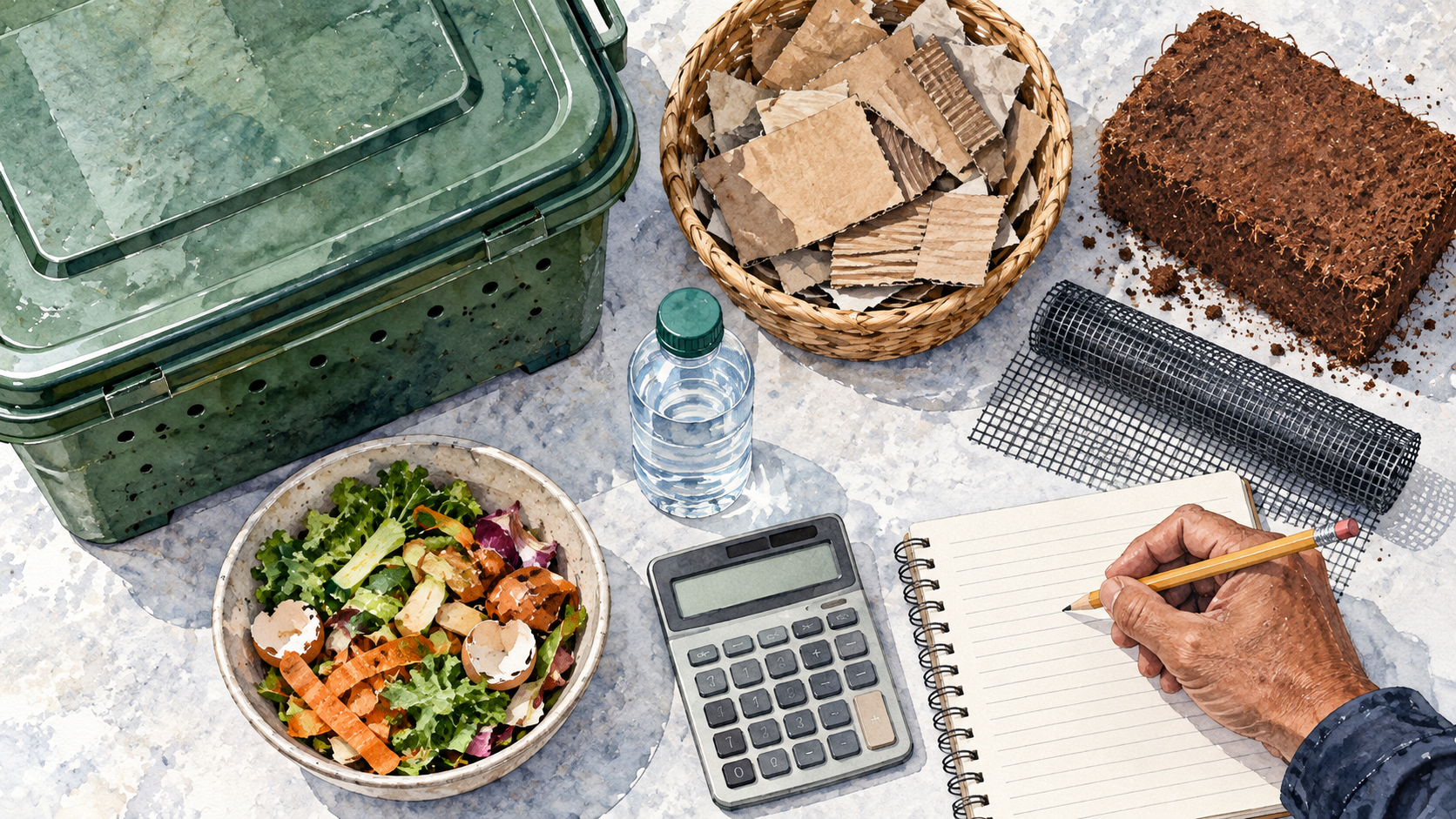
A small, established worm farm can cost only a few dollars per month in purchased supplies if it uses suitable scraps, recycled bedding, and a naturally temperate location. The amount changes when bedding must be bought, heating or cooling is required, equipment wears out, or someone is paid to maintain the worms. There is no defensible nationwide flat monthly cost, because a single composting bin and a multi-bed farm have different material needs, climates, and labor requirements.
To calculate what it costs to maintain a worm farm, separate cash operating expenses from the value of labor and from irregular replacement costs. The examples below are US-dollar planning scenarios, not national averages or measured expenses from an operating farm. They cover an established system raising common composting worms, especially red wigglers (Eisenia fetida), and exclude the initial purchase of worms, construction, and any revenue from worm products.
Two Worked Monthly Budgets for an Established Worm Farm
The following examples use deliberately stated assumptions so you can replace the numbers with your own. For bedding, a 650-gram coconut-coir brick was listed at $9.99, while a three-pack was listed at $16.99 by a US retailer on October 28, 2026. Neither price is a guaranteed local quote; taxes, delivery, availability, and changes after the check are excluded. They are examples of purchased bedding, not a requirement to buy coir.
For electricity, the US Energy Information Administration’s October 2026 forecast put the 2026 national residential average near 18.2 cents per kilowatt-hour (kWh). A farm’s actual tariff may be higher or lower, particularly on a commercial meter. The water rate of $0.01 per gallon, the $20 hourly labor value, and the maintenance reserves below are illustrative inputs chosen for the calculation, not verified market averages.
| Monthly expense | One bin in a suitable indoor space | Four sheltered beds with powered climate support |
|---|---|---|
| Bedding | $3.33: one $9.99 coir brick every three months | $16.99: one three-brick pack per month |
| Acceptable feedstock | $0: suitable scraps already available | $0: suitable farm organic materials already available |
| Water | $0.05: five gallons × assumed $0.01/gallon | $0.30: 30 gallons × assumed $0.01/gallon |
| Additional electricity | $0: existing space stays suitable without extra power | $10.92: assumed 200-watt combined load for 10 hours/day, 30 days |
| Repairs and replacement-stock reserve | $2.00: planning allowance, not a purchase each month | $10.00: planning allowance, not a purchase each month |
| Illustrative monthly cash allowance | $5.38 | $38.21 |
| Labor time, valued separately | 20 minutes/week × 52/12 weeks × $20/hour = $28.89 | 2 hours/week × 52/12 weeks × $20/hour = $173.33 |
| Cash plus assigned labor value | $34.27/month | $211.54/month |
These are transparent what-if budgets, not promises that a particular bin uses that much bedding, water, energy, or time. The larger example assumes the full 200-watt load operates for 300 hours during the month: 0.2 kW × 300 hours = 60 kWh, or $10.92 at $0.182/kWh. In reality, thermostats, weather, ventilation, and facility heating can change the result considerably. The examples do not include land rent, building heating shared with other farm activities, taxes on purchased supplies, or professional services.
A small grower using clean shredded cardboard instead of purchased coir could reduce the first scenario’s bedding cash expense to zero, while a cold outbuilding that needs substantial heat could push electricity well above either example. Labor likewise rises sharply when feedstock needs sorting, manure requires preparation, or castings must be separated frequently. The purpose of the calculation is to show which assumptions move the monthly bill.
Recurring Bedding and Feedstock Costs
Bedding is consumed and disturbed as worms process organic material, so an established system still needs fresh carbon-rich material. Shredded plain cardboard, suitable uncoated paper, and clean dry leaves can be low-cash-cost options when they are already available. Purchased coconut coir is convenient but creates a repeat expense. These materials can provide the moisture retention and airflow a worm bed needs, although their suitability depends on cleanliness and how the material has been prepared.
Do not count reused material as completely free when it takes paid time to collect, inspect, shred, or transport. A farm with plentiful cardboard may pay little for bedding but more in handling labor. Keep unsuitable or contaminated paper, chemically treated residues, and material that heats aggressively as it decomposes out of the beds; saving on supplies is not worthwhile if it injures the colony. More detailed comparisons belong to bedding selection, not an operating-cost calculation.
Food costs can also be very low when suitable vegetable trimmings and other acceptable materials are already produced on-site. There may still be labor, storage, and transportation costs. Bought produce is usually unnecessary just to keep a small composting colony fed, while large operations that purchase or collect feedstock have to account for delivery and sorting. Transporting feedstock to the beds, whether through farm pickups or paid deliveries, can add to the operating costs of earthworm production operations. Excess feeding can cause heating, low oxygen, and losses, so buying more material does not automatically improve production.
Water, Heating, Cooling, and Electricity
Water is usually a small direct bill for a modest enclosed bin, but maintaining the right moisture level is nonnegotiable. Red wigglers need moist, breathable bedding. Waterlogged material can lose the air spaces they need, while excessively dry material puts the worms at risk. Wet food can supply part of a bin’s moisture, so additional watering needs depend on the feedstock, airflow, and container.
Energy can be nearly zero when the existing space remains suitable year-round. It can become the largest cash expense in a shed exposed to summer heat or winter freezing. Commonly farmed red wigglers do well in the roughly 55–77°F temperature range, while temperatures approaching 90°F can be fatal. Track the bedding temperature, not only the room temperature; the habitat itself may warm as material decomposes.
Calculate powered equipment by actual consumption rather than its purchase price: monthly kWh = watts ÷ 1,000 × hours operated. Multiply kWh by the rate on the utility bill. As a second illustration, a 40-watt device operating six hours daily for 30 days uses 7.2 kWh, about $1.31 at the national forecast rate used above. This is an energy calculation, not a recommendation that a 40-watt heater or fan will protect any particular bin. Use equipment suited to damp environments, keep electrical components away from leaks and contact with bedding, and have installation assessed appropriately where farm electrical work is involved.
Where space is already heated for another reason, allocate only the extra electricity or energy demonstrably attributable to the worm operation rather than charging it for the entire building bill. Where a building is heated specifically to keep worm beds functioning, that expense belongs fully in the worm-farm ledger. Outdoor operations may instead need shade, water access, protective covers, and seasonal relocation; those measures can save power but still require work.
Labor Is Often More Important Than the Supply Bill
Feeding, monitoring moisture, checking temperature, removing unsuitable materials, cleaning working areas, harvesting finished material, and maintaining records all take time. Even a system that uses no purchased food or bedding is not a no-maintenance enterprise. Vermiculture can reduce turning labor compared with regular compost windrows, yet worms still need attention throughout the year.
The worked budgets intentionally put time on a separate line. At an assumed $20 per hour, a weekly 20-minute check and feed routine is valued at roughly $28.89 per month, even if the owner performs it without receiving a wage. That figure is a bookkeeping choice, not an established wage, a universal maintenance schedule, or a verified time study. More beds, difficult feedstocks, and complicated harvesting can make the actual hours much greater.
Write down each task and the minutes it takes over four consecutive weeks. Include getting materials from storage, carrying water, sorting waste, preparing fresh bedding, and cleaning up afterward. If someone is paid to do the work, use actual wages and applicable employment costs. For an owner-operated farm, tracking unpaid hours allows a fair comparison with other farm chores without pretending the time is cash leaving the bank.
Replacement Worms, Wear, and Unexpected Losses
Buying replacement composting worms should not be a scheduled monthly requirement for a stable, reproducing colony. The population can replenish itself in suitable conditions. Not all types of earthworms are suitable composting stock, however, so collecting random soil worms is not a reliable replacement plan. Recurring mass deaths, rapid departures from the bed, or persistent failure to reproduce indicate that habitat or feedstock problems need investigation before buying replacements. Overfed or poorly aerated beds can overheat or become oxygen-deprived, sometimes killing the worms.
That does not mean replacement stock costs are always zero over the life of an operation. Accidental overheating, a failed watering system, contamination, an escape incident, or lost production stock may require restocking. Keep two distinct records: what was actually paid for replacement worms and a modest contingency allowance reserved for future repairs or losses. A reserve is not an expense incurred every month; it is a way to prevent rare bills from disappearing from planning.
Likewise, estimate wear on lids, screening mesh, thermometers, pumps, watering tools, storage containers, and protective covers. Replacing a broken tool is an operating repair when it restores an existing system; adding a new major production bed is an expansion or capital expense and is outside this maintenance budget. Emergency electrical faults or drainage problems should be corrected safely rather than patched with improvised equipment near wet bedding.
How to Build a More Accurate Monthly Maintenance Figure
The quickest way to replace the model with a farm-specific answer is a 30-day expense log. Record the amount of bedding used, the source and hauling cost of feedstock, metered or calculated power use, water use, worker time, repairs, and any stock losses. Distinguish cash purchases from materials already on hand and hours supplied by the owner. A maintenance ledger is especially useful when annual seasons differ, because a mild October cannot describe a whole year’s heating costs.
- List recurring consumables. Price the quantity actually used, not the full pack bought or the amount stored.
- Measure time and energy. Use hours worked and actual operating time for fans, heaters, or pumps. Keep shared building utilities separate unless a reasonable allocation can be documented.
- Record exceptions. Note replacement stock, damaged screens, unusually high water use, and extra harvesting sessions in the month they occur.
- Compare seasons. Repeat or adjust the calculation for the hottest and coldest months rather than presenting one mild-weather month as an annual average.
For a typical month’s accounting, monthly cash cost = purchased bedding + purchased feedstock + water + incremental energy + paid labor + actual repairs and restocking. Add a separate assigned value for owner labor if you want the total resource cost, and show any reserve as a planning allowance rather than claiming it was spent. If only a yearly repair total is known, dividing it by 12 can provide a clearly labeled historical monthly average.
Keep the estimate within the boundaries of maintaining an established colony. The price of the first bin, the initial breeding population, and one-time site construction belong in a startup estimate. Income from vermicompost or worm sales belongs in a profitability assessment. Similarly, the effects of earthworms on soil do not establish a measurable cash saving without farm-specific evidence. This article addresses what the worms cost to maintain, not whether the enterprise makes money.
Three Maintenance-Cost Questions Worth Asking
Can a worm farm really cost nothing to maintain? Its extra cash spending can approach zero during some months if feedstock, bedding, suitable space, and basic equipment are already available. Water, labor, replacement materials, and occasional failures still use resources, so “free” is not an adequate long-term budget.
Should I add the full cost of home heating to my worm-bin budget? Count only the part caused by keeping the worms unless a dedicated room or structure exists solely for the system. A separate meter or measured energy consumption is stronger evidence than guessing a percentage of the household bill.
Do worms need to be repurchased every year? A healthy, established breeding colony does not require automatic annual replacement. Budget for unexpected losses, but address any underlying housing or feedstock problem before introducing more stock; purchasing worms repeatedly is not a substitute for maintaining safe conditions.