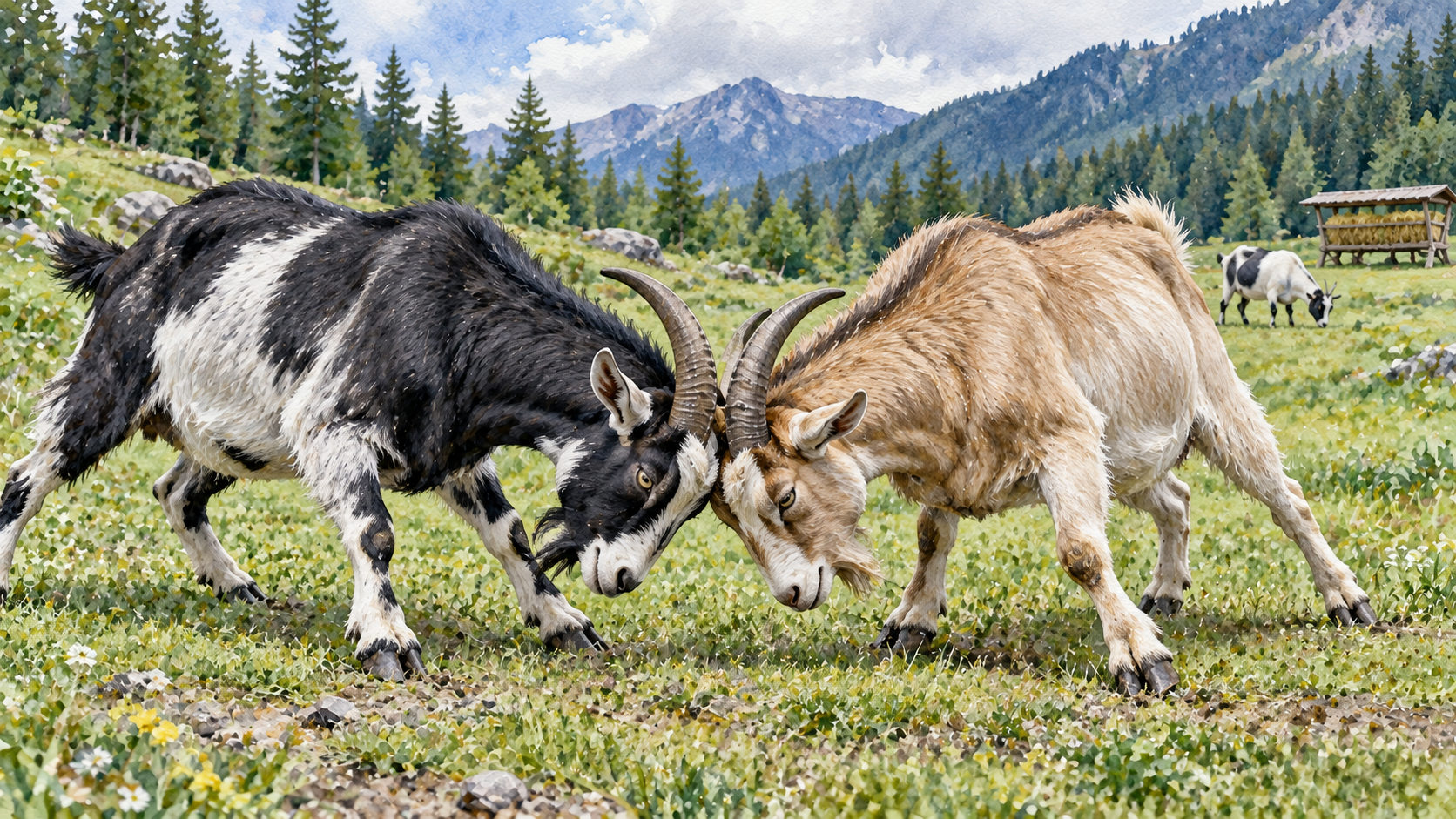
Two goats may stand forehead to forehead, lean against one another, or rear up and clash heads, then return to eating as though nothing happened. Goats headbutt each other to establish or reinforce social rank, compete over resources, and sometimes play. A brief contest between familiar animals can be normal herd behavior. Repeated hard blows, injuries, or one animal continually being driven away are different: they may indicate a serious welfare problem.
On a farm, the sound of a collision is less informative than the whole interaction. Who approached whom? Did both goats participate? Could the retreating animal leave? What happened at the feeder afterward? Those details help distinguish ordinary social negotiation from harmful aggression without assuming every headbutt means the same thing.
Headbutting Helps Goats Establish a Herd Hierarchy
Goats live in social groups where individuals develop relationships and recognize relative status. A goat with a higher position in a particular pair may be able to approach a favored spot while the other gives way. Headbutting is one visible part of that social system, along with threatening postures, chasing, and displacement without physical contact. These competitive behaviors in goats help maintain dominance relationships without requiring constant physical fighting.
A familiar herd does not need to fight constantly to maintain its social order. A lower-ranking goat may move away when another approaches, even when no heads touch. Threats and other cues frequently settled access to food without a physical clash during controlled food-patch trials. In that experimental setting, the researchers reported physical aggression in only about 10% of the dominance-testing interactions. That percentage is not a normal daily fighting rate for every farm; it illustrates that an established relationship can be expressed without repeated collisions.
Rank also is not determined by one dramatic contest that establishes a permanent, unquestionable leader. The outcome depends on the animals involved and can change as goats mature or the group changes. On a small farm, look for recurring patterns of yielding and access to space, rather than trying to declare a winner from a single headbutt. Age, sex, and horn status all influence goat herd relationships, but none alone explains every interaction.
Food, Resting Places, and Other Resources Can Trigger a Clash
Headbutting may occur when two goats want the same thing at the same time. A goat feeding at a preferred spot might turn and strike at another trying to enter. An animal standing on a favored platform might push away an approaching herd mate. These incidents can reflect a dispute over immediate access, even if the goats’ broader social relationship was already established.
Watch the direction of the movement. A headbutt aimed at the shoulder or side of a goat that is eating often serves to displace that animal, rather than begin a symmetrical head-to-head contest. Both head and flank butting, along with threats without contact, occurred during observed competition over food. Those patterns help explain why conflict can appear most visible around a feeder even in a herd that otherwise seems settled.
Crowding can intensify the consequences of a dispute. A goat with room to withdraw may leave the confrontation quickly; one trapped beside a wall or feeder may receive repeated blows. Social relationships and available space also shape how close goats can comfortably feed beside one another, as examined in research on feeding distances and rank. The detailed task of redesigning feeding access and stopping bullying belongs in a separate management guide. Here, the key observation is whether the disagreement ends or repeatedly prevents an animal from using essential resources.
Young Goat Kids Also Headbutt During Play
Play-fighting resembles adult sparring, but its social context differs. Goat kids may touch foreheads, push lightly, hop apart, circle, and return for another short exchange. They can alternate which animal starts the interaction, and the activity may be mixed with running or other playful movements. These episodes are not automatically attempts to seize a place in the adult hierarchy.
Play-fighting has been defined in behavioral research as simulated fighting without one kid being made to withdraw, involving light forehead contact or gentle pushing. Play-fighting also varied with early social rearing conditions in a 2022 study of 40 female goat kids. That result is a useful reminder that the amount of play depends on context; a playful-looking exchange alone is not a complete measure of welfare.
Light contact is only one clue. Two kids that voluntarily re-engage and then resume normal activity may be playing. If one continually flees, is cornered, or is struck much harder than it can reciprocate, the interaction should not be dismissed as play merely because the animals are young. Head pressing, running, jumping, and rearing are all recognized forms of social and locomotor play in kids, and may appear together in an active group.
Do Bucks Headbutt More During Breeding Season?
Intact male goats may engage in especially conspicuous contests when they compete for access to females. Rearing, clashing heads, and displaying their size or horns can occur in that setting. Breeding-related competition is one reason a clash may become more serious than a passing disagreement at a feeder. Aggressive encounters between males can involve reproductive competition as well as social rank.
That does not mean every headbutt between bucks is a mating contest, or that does and castrated males never spar. Females also have dominance relationships, and mixed groups can show ordinary competition for feed or space. The breeding context matters: the presence of receptive females, changes in social grouping, and the way particular animals respond to rivals all affect what a clash may mean. Do not infer sexual motivation from the animal’s sex alone.
A buck’s size and horns can increase the consequences of an impact. Even goats that have lived together peacefully can behave differently when reproductive circumstances change. This article explains the behavior, not a procedure for managing fighting bucks or a breeding-pen design.
Are Horned Goats More Aggressive Than Hornless Goats?
Horns can influence how goats signal status and how much damage a clash can cause, but horns do not automatically make a goat aggressive or guarantee a higher rank. Size, age, prior relationships, and the other animals present also matter. One experimental herd of 45 goats had horned individuals throughout its hierarchy, not just at the top.
There is a second complication: the number of physical headbutts is not necessarily greater in horned animals. In some observations of commercially housed dairy goats, horned animals showed less headbutting and chasing involving contact than hornless goats. Horns can communicate information during a challenge, and an opponent may give way before a collision occurs. These findings should not be turned into the opposite blanket claim that horned herds are safer.
The safety stakes remain substantial. A blow involving horns can tear skin or cause other injury, especially when the other goat cannot escape. Compare the behavior and the outcome, not simply the presence or absence of horns. Horn removal is a separate welfare-sensitive veterinary and husbandry subject; it is not a casual response to seeing ordinary headbutting.
How to Tell Play, Rank Challenges, and Harmful Fighting Apart
A single strike is an incomplete clue. Look at the beginning of the encounter, the response of both goats, and whether they resume ordinary activities afterward. The following observations are useful for farm monitoring, not definitive labels for an animal’s intent.
| What you see | What it may indicate | What matters most afterward |
|---|---|---|
| Two kids make light forehead contact, separate, and come back voluntarily | Play-fighting | Both continue to engage freely and show normal activity |
| Two adults square up, butt briefly, and one walks away | A rank challenge or brief competitive dispute | The retreating goat can leave and resume feeding or resting |
| One goat gives way when another lowers its head, without contact | An established dominance relationship | The lower-ranking goat still reaches feed, water, and resting space |
| A goat strikes another at a feeder and takes its place | Immediate resource competition | Whether displacement is occasional or repeatedly excludes the same goat |
| One animal keeps chasing or striking a retreating goat | Potential bullying or escalating aggression | Escape, injuries, persistent avoidance, and loss of resource access |
| A goat collapses, bleeds, becomes unsteady, or cannot rise after a collision | Possible serious injury | Prompt veterinary attention and immediate protection from further contact |
The distinction between play and aggression is especially important when animals are young. In the kid social-behavior study, play-fighting was distinguished from agonistic behavior by the absence of forced withdrawal. For mature goats, research on dominance and social relationships likewise separates headbutts and displacements from affiliative interactions such as rubbing and resting together.
Look beyond the moment of impact. A herd member that occasionally loses a contest but keeps normal access to forage may be functioning within an established hierarchy. A goat that repeatedly hesitates to approach feed, loses condition, or hides from the same animal presents a different concern. What the group permits each individual to do over the rest of the day is often more revealing than one noisy clash.
When Headbutting Becomes a Welfare or Safety Concern
Natural social behavior is not a reason to tolerate preventable injuries. Repeated forceful contact, cornering, attacks against much smaller animals, and wounds caused by horns can turn a social dispute into an immediate welfare issue. Newly introduced goats are especially vulnerable to challenges while their place in the group is unsettled. Even familiar groups may experience renewed tension when individuals are removed and returned.
Group changes can increase aggression. After newcomers joined an established herd, observed threats, displacement, and butting all increased. Bullying, injuries, and reductions in feed intake or body condition are also explicit monitoring points in the 2022 Canadian goat care code. It is Canadian guidance, not a US legal requirement, but the welfare indicators are directly relevant to American farms.
After a severe collision, watch for bleeding, a damaged horn, a persistent limp, loss of balance, difficulty standing, or an animal that stops eating or behaves abnormally. Seek prompt veterinary advice for suspected head trauma, significant wounds, or impaired movement. Keep an injured goat protected from further attacks while arranging appropriate care, maintaining suitable contact with other goats where safely possible. Avoid inserting yourself between animals that are actively clashing; moving close to lowered heads or horns can expose people to serious injury.
If a goat cannot retreat without being hit again, the problem has passed beyond simply identifying a dominance ritual. Protecting the animal comes first. A full plan for reducing repeated fighting, managing introductions, and changing feed-space arrangements belongs to the separate herd-conflict article.
What Repeated Headbutting Tells You About a Herd
A small number of brief contests does not necessarily indicate poor welfare. Likewise, the absence of visible fights does not prove that all goats have fair access to resources. A lower-ranking animal may avoid a dominant goat without a physical challenge, making the conflict almost invisible unless someone watches who actually eats and rests.
It helps to observe the same animals over several ordinary routines: before feeding, while they browse, when they choose resting places, and when the group regathers. Notice whether the same goat repeatedly initiates contact and whether another repeatedly withdraws. Changes in group membership, reproductive condition, or available space can alter these patterns; competitive interactions often increase after mixing unfamiliar goats.
The most useful conclusion is rarely that one goat is simply “mean” or that the entire herd must stop butting heads. Headbutting is part of how goats interact. The farm-relevant question is whether those interactions remain brief and self-limiting, or whether they interfere with safe movement, feeding, rest, and sound body condition. That distinction turns a dramatic behavior into an observable welfare assessment rather than a guess about personality.
Questions About Goats Butting Heads
Is it normal for two goats to rear up before clashing?
Rearing and meeting head to head can be part of a dominance contest. The movement alone does not establish whether the interaction is dangerous. Watch for repeated hard impacts, loss of balance, wounds, or continued attacks after one goat retreats. Do not stand between the animals.
Why do goats headbutt even when they have lived together for years?
Established herd members may still compete over a preferred feeding or resting spot, or briefly reinforce their relative standing. A familiar relationship often reduces the need for prolonged fighting, but it does not eliminate all threats or contact. More frequent clashes after a group change deserve closer observation.
Does the goat that wins a headbutting contest become the leader of the herd?
Winning one exchange does not automatically make a goat dominant over every herd member. Dominance is better understood through repeated relationships, including who yields to whom and who gains access to resources. Age, body size, horns, and experience may influence those relationships, but there is no single universal rule for every goat group.