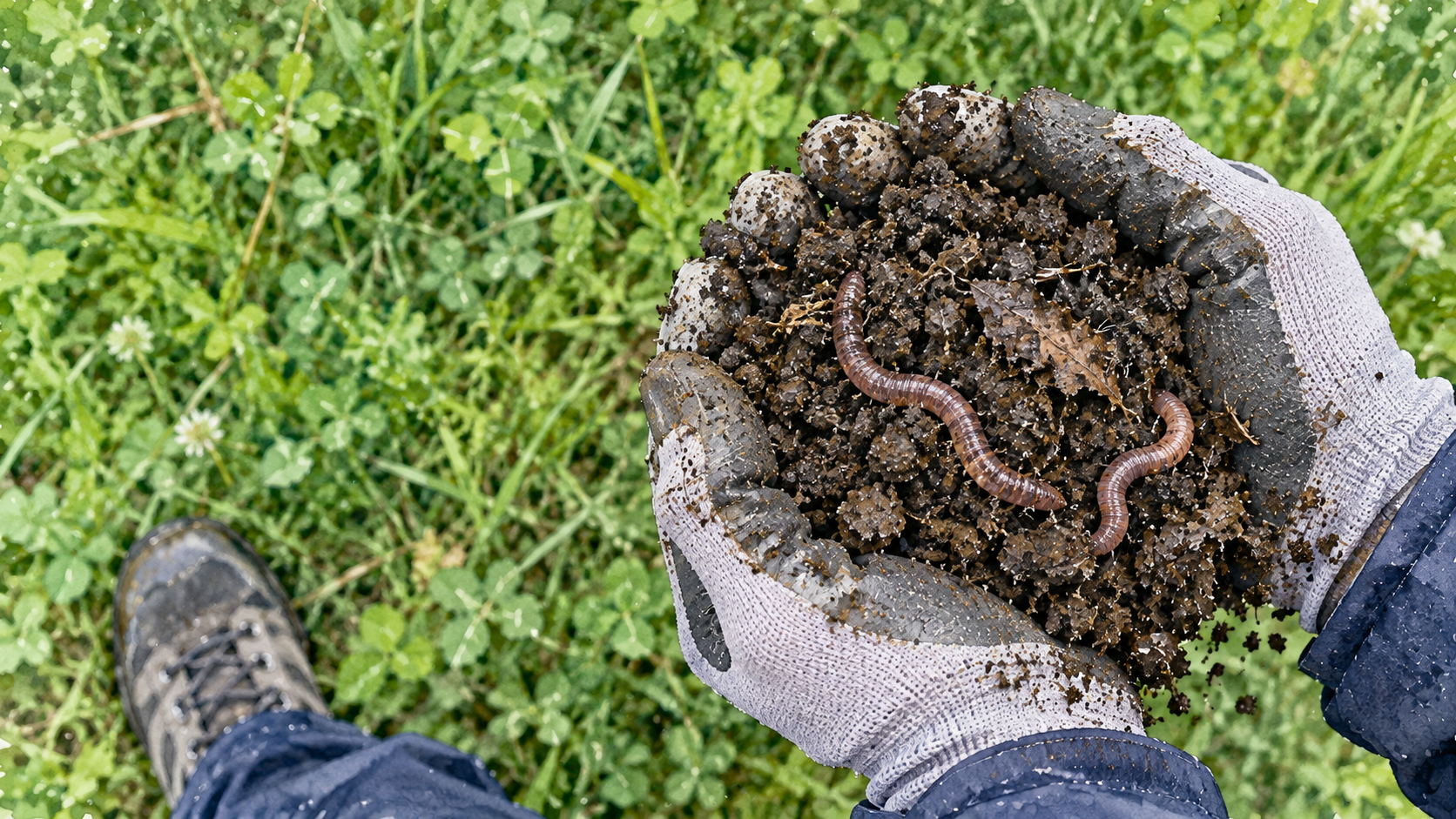
In many cultivated gardens, pastures, and agricultural soils, earthworms improve important soil functions. As they feed and move, they bring organic residues into contact with mineral soil, form aggregates, redistribute nutrients, and leave channels that plant roots can use. Those benefits depend on the earthworm species, soil conditions, and the surrounding ecosystem. Activity that supports a farm field can have damaging consequences in a forest that developed without earthworms.
Their value is best understood through what they actually do to soil, rather than by assuming that every worm automatically improves plant growth. Earthworms work alongside roots, bacteria, fungi, and other soil organisms. They cannot replace organic matter inputs or correct every physical and chemical limitation in a growing site.
Earthworms Help Form Aggregates and Improve Soil Structure
Healthy agricultural soil contains aggregates, which are clusters of mineral particles and organic matter held together by biological and physical processes. Earthworms contribute to their formation when they ingest soil and decomposing residues and deposit the mixture as casts. Mucus, microbial activity, and organic binding materials can help some of these aggregates remain intact when they become wet. Research on soil structure links these processes with better tilth and more stable soil pores.
Aggregate stability matters because a soil that resists breaking down into dispersed particles is less prone to surface sealing and crust formation. Seedlings may establish more easily where the surface remains open, and roots can extend through a more varied structure. However, the effect is not instantaneous or uniform. A long-established pasture with living roots and continuous residue inputs provides different conditions from a frequently tilled bed that is left bare after harvest.
Worms are contributors to this structure, not its sole builders. Roots, fungal networks, soil texture, moisture cycles, and management practices also influence whether aggregates persist. Earthworm activity is most useful when these other processes are working with it, rather than being repeatedly disrupted.
Burrowing Creates Root Pathways Without Solving Every Drainage Problem
Some earthworms form temporary passages within the topsoil, while others maintain more persistent, deeper burrows. Roots can exploit these existing openings, particularly where the surrounding soil is relatively dense. Burrow walls may also contain organic material and casts, creating localized zones where roots encounter different physical and nutritional conditions. A soil-quality earthworm reference describes the relationship between worm-made pores, rooting, and soil structure.
These openings can help air and water move through parts of a soil profile, but their benefit depends on continuity and the condition of the surrounding soil. A tunnel ending above a saturated layer cannot make an inadequate drainage outlet disappear. Frequent cultivation can also break up burrows before they provide much continuing benefit.
The mechanics of different burrow networks, including the distinction between water infiltration and actual field drainage, belong in how earthworms improve soil aeration and drainage. The broader soil benefit is that earthworms can make portions of the rooting environment more accessible without replacing proper management of severe compaction or persistent waterlogging.
They Move Plant Residues Into the Decomposition Process
Earthworms feed on dead plant material, microorganisms, and mixtures of organic matter and soil, depending on the species. Surface-feeding worms shred leaf litter and other residues. Mineral-soil dwellers consume material within the upper soil, while some deep-burrowing species pull fallen leaves toward their tunnel entrances. These feeding patterns change where organic materials are concentrated and how readily microorganisms can reach them.
When residues are fragmented and mixed with mineral particles, bacteria and fungi have new surfaces and locations on which to act. The combined activity releases some nutrients from decomposing material and contributes to the formation and turnover of soil organic matter. The agronomy review of earthworm functions describes this close connection among soil structure, nutrient cycling, carbon transformations, and microbial communities.
Faster breakdown is not automatically the same as more organic carbon retained in soil. Carbon may be released through respiration or become associated with aggregates and minerals. A 2026 synthesis of earthworms and soil carbon reported evidence of both decomposition and stabilization processes, with outcomes influenced by plant-derived carbon inputs. Maintaining crop residues and living cover therefore matters more than treating worms as a substitute for supplying organic material.
The details of decomposing stubble, leaves, and other crop waste are covered separately in earthworms and crop-residue breakdown.
Casts Concentrate and Relocate Nutrients Rather Than Creating Them
Worm casts contain material that has passed through an earthworm’s digestive system. They can differ from nearby soil in aggregation, microbial activity, and the availability of some nutrients. Casts are deposited within soil passages as well as at the surface, so earthworm feeding can redistribute nutrients from one layer or location to another. Root systems growing near active burrows may encounter these nutrient-enriched patches.
The distinction between nutrient cycling and nutrient addition is important. Earthworms do not manufacture nitrogen, phosphorus, or potassium. They transform, consume, and relocate materials that are already in the soil or entered it through organic inputs. How much a particular cast contributes depends on what the worm ate, the parent soil, microbial activity, moisture, and the time since deposition.
This explains why casts cannot be treated as a reliable substitute for a crop’s nutrient requirements. Commercially harvested worm castings and finished vermicompost are separate amendments with their own composition and use considerations. Practical application of finished material belongs in how to use vermicompost in a garden, not in assumptions about the fertilizer value of every wild worm cast.
Earthworm Activity Can Improve Crop Growth, but Results Depend on the System
Earthworms influence root access, residues, and nutrient availability, so it is reasonable to ask whether plants actually grow better in their presence. A meta-analysis of agricultural experiments found an average positive effect of earthworms on crop yield and aboveground plant biomass. The researchers also found that effects varied substantially with crop residues and fertilizer conditions. Benefits were more evident where nitrogen release from organic material could help plants, and diminished when nitrogen was already readily available.
That result comes from combining experimental settings, not from a promise that adding worms to an individual field will increase its harvest. A root crop grown in compacted, residue-poor soil faces different limits from forage growing in a well-covered pasture. Earthworms may contribute to one limiting process while another, such as a disease, unsuitable pH, or a prolonged drought, remains the chief constraint.
Consider the following as a comparison of potential soil functions, not a prediction of yield:
| Managed setting | Earthworm contribution that may matter | What can still limit crop response |
|---|---|---|
| Mulched vegetable bed | Mixing surface residues with soil and supporting aggregation | Irrigation, nutrient imbalance, restrictive underlying layers |
| Perennial pasture | Recycling roots and manure-derived organic matter while maintaining biological pore networks | Grazing damage, severe compaction, waterlogging |
| Conservation-tillage grain field | Processing retained stubble and preserving some burrow activity | Residue quality, climate, nutrient supply, heavy traffic |
| Frequently tilled bare bed | Benefits may be limited if worms, residues, and burrows are repeatedly disturbed | Loss of cover and repeated structural disruption |
There is no scientifically defensible universal yield gain for all these situations. Earthworms are one part of the crop-production system, and the most effective improvement usually addresses whichever constraint currently limits soil function.
Soil Type and Earthworm Species Change the Effects
Earthworms are not a single functional group. Litter-dwelling, mineral-soil-dwelling, and deep-burrowing worms differ in where they feed and deposit material. As a result, the same farm may have surface residue processing in one part of the field and deeper transport of material in another. A fuller guide to the groups and species is available in the different types of earthworms.
Texture and water conditions also influence the scale of their effects. Sandy soil can lose moisture rapidly and may hold fewer stable burrows or less organic matter. Heavy clay may provide abundant fine particles for aggregation but can become oxygen-poor when saturated. Soil pH, cover, temperature, and the frequency of mechanical disturbance further affect whether earthworms can remain active.
Management changes therefore do not produce identical results everywhere. Reducing disturbance may preserve burrows in one soil while producing only modest change where moisture or food availability is limiting. Earthworm-related changes to heavy clay soil are a useful example of why soil texture deserves its own treatment rather than a universal promise.
In Some North American Forests, Their Effects Are Harmful
The agricultural case for earthworms does not apply automatically to natural habitats. Parts of the northern United States and Canada contain forests whose ground-layer plants and soil communities developed with a thick leaf-litter and humus layer and, in some places, few or no native earthworms after glaciation. Introduced earthworms can remove much of that surface organic layer, change nutrient distribution, and alter the conditions experienced by seedlings, fungi, and other organisms.
A forest ecology assessment explains why the loss of that layer can be damaging rather than helpful. The ecological outcome depends on the forest history and species involved; it would be inaccurate to say all earthworms in North America are invasive or that all cultivated soils are harmed by them.
For landowners, the practical distinction is between supporting existing soil processes on cultivated ground and moving living earthworms into a sensitive habitat. Detailed containment, disposal, and movement precautions belong in preventing invasive earthworm spread.
Support the Conditions That Allow These Benefits to Develop
Earthworms need suitable moisture, temperature, and food sources to feed and build soil structures over time. On farmland, keeping organic materials in the system through appropriate crop residues, cover crops, or other well-managed inputs gives decomposers something to process. Avoiding unnecessary tillage helps preserve both animals and the structures they have created. Preventing vehicle traffic on overly wet ground can reduce the compaction that restricts roots and soil life.
These are sensible soil-management practices because they support several biological and physical processes at once, regardless of how quickly worm activity changes. They are not a reason to release purchased worms outdoors. That separate choice is addressed in whether to add earthworms to garden or farm soil.
To decide whether a particular field is functioning well, however, you need more than a list of earthworm benefits. The companion article, are earthworms a sign of healthy soil?, focuses specifically on what worm observations can and cannot reveal about a site’s condition.
Questions About Earthworms and Soil Benefits
Do earthworms make clay soil loose?
They can contribute aggregates and pores where conditions allow activity, but they cannot reliably remove a severe compacted layer or fix a drainage outlet. The soil’s management and water conditions still matter.
Can earthworms replace fertilizer?
No. They cycle and redistribute existing nutrients rather than creating a complete nutrient supply. Fertilizer decisions should be based on crop needs and appropriate soil testing.
Will a farm always produce more crops if it has more earthworms?
No. Research supports potential production benefits under suitable conditions, but greater earthworm numbers alone do not establish that a particular farm’s yield will rise. Residues, nutrient supply, soil limitations, and the crop itself affect the result.
9 thoughts on “Are Earthworms Good for Soil?”