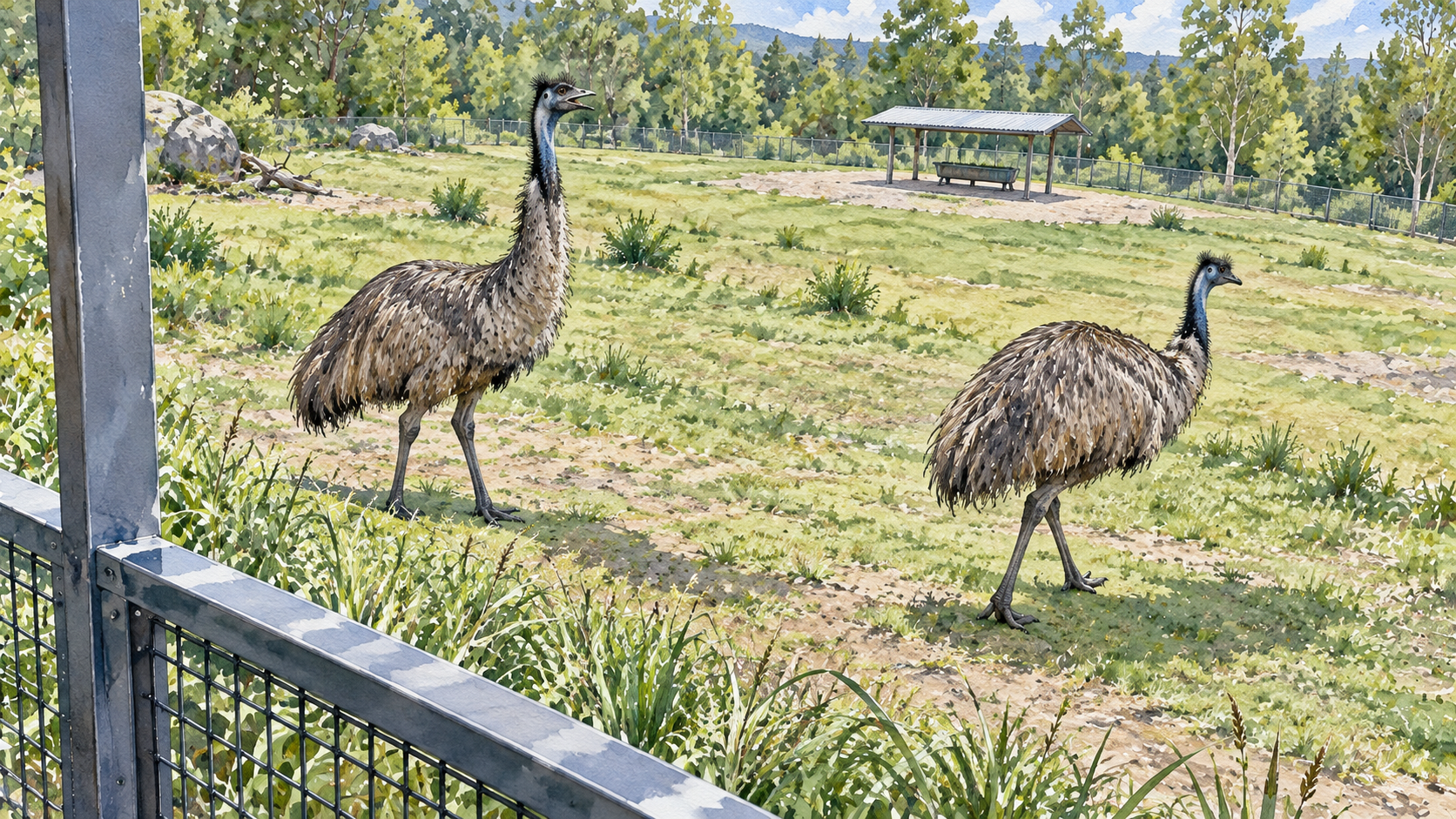
Emus are not constantly aggressive animals. Most encounters involve ordinary walking, foraging, curiosity, or avoidance, but an emu can threaten, chase, peck, or kick another bird when circumstances change. Breeding season, social competition, and the bird’s individual response to disturbance are especially relevant to farm keepers.
Aggression is not a permanent personality label or something that can be predicted from an emu’s size. In a small observational study of eight adult farmed emus, aggressive bouts were recorded in only two females, and none of the birds was aggressive toward familiar caretakers. That result illustrates variation among individuals, not a reliable percentage for every flock.
What Does Aggression Look Like in Emus?
An emu’s threatening behavior can begin before physical contact. In the farm study, researchers distinguished standing on tiptoe and hissing toward another emu from chasing, pushing, and kicking. They also counted a chase when one bird made another retreat, even without a blow landing. These defined behavior categories are more useful for interpreting flock disputes than assuming that every sudden movement means an attack.
A bird may stand taller, hold itself tensely, hiss, or advance toward another bird. If the other emu moves away, the interaction may stop there. More intense encounters can involve repeated pursuit or physical contact. Because emus can deliver powerful kicks at close range, behavior that progresses to kicking deserves serious attention; that defensive ability is also noted in New South Wales wildlife information.
Context matters. An emu investigating an object or approaching a feeder is not necessarily threatening anyone. Nor is every hiss proof of an imminent strike. Look at the direction of the display, whether another animal is withdrawing, whether it happens repeatedly, and whether injuries are appearing. A pattern tells more than one isolated gesture.
Why Does Aggression Increase During Breeding Season?
Reproductive behavior can make an ordinarily tolerant emu much less willing to share its immediate space. During pair formation, females may compete with other birds or establish priority around a partner. Later, a nesting male can become strongly defensive of the nest area. In wild emus, the Australian Museum’s account of breeding behavior describes the female taking the dominant role during pair formation and the male driving other emus away once incubation begins, sometimes including his former mate.
That shift means there is no single answer to whether males or females are the more aggressive sex. The bird’s reproductive stage can matter as much as sex. A male that was tolerant of nearby emus earlier in the year may resist their approach when nesting; a female involved in breeding competition may display aggression without being hostile during ordinary daily activity.
The season itself should not be reduced to one calendar month for every U.S. farm. Wild Australian emus reproduce on a Southern Hemisphere cycle, while captive schedules can differ with location and management. Rather than assuming a particular date guarantees calmer birds, observe changes in interactions over time. The separate discussion of how emus mate covers courtship, and male and female chick-rearing roles covers parental care rather than aggression.
Protectiveness around a nest or chicks is a natural context for defensive behavior, but it is not a reason to approach closely to test how the bird will react. Smithsonian’s emu account describes nesting males driving other birds away and becoming especially defensive when chicks hatch. The degree of aggression still varies by individual.
Do Emus Fight Over Food, Space, or Social Rank?
Conflicts do not require an active nest. In captive groups, one emu may push another away from a feeder or chase it from a preferred area. The 2014 farm observations noted females displacing other emus from feed access and documented differences in how birds reacted to caretakers. A bird that repeatedly loses access to food is facing more than a minor disagreement, even if no obvious wounds are present.
Social history is another factor. Emus that have grown up together may interact differently from adults suddenly placed with unfamiliar birds. The Victorian code for captive emu husbandry notes that social hierarchies begin forming as birds approach and pass 12 months of age, and it cautions against introducing previously unfamiliar birds into established adult groups because of aggression and injury risks. The document is Australian welfare guidance, not a legal stocking rule for U.S. farms.
Crowding can intensify these encounters by limiting opportunities to move away. The same emu welfare code specifically warns about aggression and injuries in densely stocked yearling and adult groups during breeding season. This does not establish a universal number of birds per pen; suitable emu group sizes depend on the animals and the setting.
Are Male or Female Emus More Aggressive?
Neither sex is consistently the more aggressive one in every setting. Female competition can be more conspicuous during pairing, while male nest defense can become prominent later. Individual birds within either sex may be cautious, tolerant, or confrontational.
In the eight-bird study, both individuals observed in aggressive bouts were females, but the sample was too small and observation period too short to declare that female emus are generally more dangerous. A separate study of 11 adult farmed emus found that season affected agonistic, or conflict-related, behavior along with several other activities. It supports seasonal variability, not a rule that all birds of one sex will act alike.
A useful farm record therefore describes the specific interaction rather than labeling a bird simply ‘aggressive’: who chased whom, where it happened, whether feeding or breeding was involved, whether the other animal could retreat, and whether the encounter was repeated. This is a way to recognize patterns, not a substitute for assessing an actual injured or threatened bird.
Why Does One Emu Seem Calm While Another Is Defensive?
Temperament varies among individuals, and behavior can change with circumstances. Some emus tolerate familiar caretakers nearby, others keep their distance, and some react strongly when a person enters an unfamiliar space. Those reactions were all represented in the farm temperament observations, which separated docile, cautious, and panicky birds rather than treating every response as aggression.
An emu that retreats from a handler is showing avoidance, not automatically hostility. At the same time, a bird that regularly approaches people should not be assumed safe to touch or enter an enclosure with during breeding. Familiarity and lack of fear are not guarantees against defensive behavior. This broader distinction between curiosity, tolerance, and perceived friendliness belongs to the companion articles on general emu behavior and friendliness toward familiar people.
Handling pressure can also affect behavior. Ratite handling guidance cautions that chasing and catching emus can cause severe stress, especially in hot conditions. A panicked reaction during such an event should not automatically be interpreted as a bird’s everyday temperament.
When Is an Emu’s Behavior More Than an Ordinary Dispute?
Brief threats or displacement may occur within a group, but repeated intimidation and injuries are not something to dismiss as harmless pecking-order behavior. A practical way to interpret what you see is to distinguish three situations:
- A short warning: One bird hisses or stands tall, another withdraws, and both resume normal activities. Record the context rather than assuming every warning leads to a fight.
- An escalating conflict: The same bird repeatedly chases or excludes another from food, water, or space. The frequency and effect on the other emu make this more concerning.
- An immediate welfare concern: Kicking, visible wounds, inability to escape another bird, or repeated panic demands prompt protection from further harm and appropriate experienced or veterinary help.
This distinction is an editorial synthesis of the observed emu behavior categories and the welfare code’s injury precautions. It is not a validated aggression score or a diagnostic test.
Farmers should not enter a confrontation, try to overpower a defensive emu, or encourage children or visitors to test the bird’s reactions. The separate guide to managing an aggressive emu deals with safe intervention and specialist assistance. For the specific risk of injury to a person, emu attacks on humans is a different question from the species’ normal temperament.
A sudden change in behavior may also accompany discomfort, illness, or environmental disturbance. The captive emu welfare guidance lists lethargy, loss of appetite, lameness, and unusual separation as potential signs of ill health. Those signs warrant veterinary assessment when present; aggression alone cannot establish a medical diagnosis.
Questions About Emu Aggression
Do young emus become aggressive as they mature?
Social interactions can change as emus approach adulthood. The Victorian emu code notes the development of social hierarchies around 12 months and beyond. This is a reason to watch changing relationships, not a claim that every yearling becomes aggressive.
Does hissing always mean an emu is about to kick?
A hiss can be part of a threat display, but it does not predict an unavoidable kick. Watch whether the bird advances, whether another bird retreats, and whether the encounter escalates. Do not approach closely to test the warning.
Can a normally docile emu become territorial?
A familiar, usually tolerant emu can become more defensive when breeding or nesting. Treat changes in access to a nest area or persistent chasing as meaningful rather than assuming past calm behavior guarantees future safety.
One thought on “Are Emus Aggressive?”