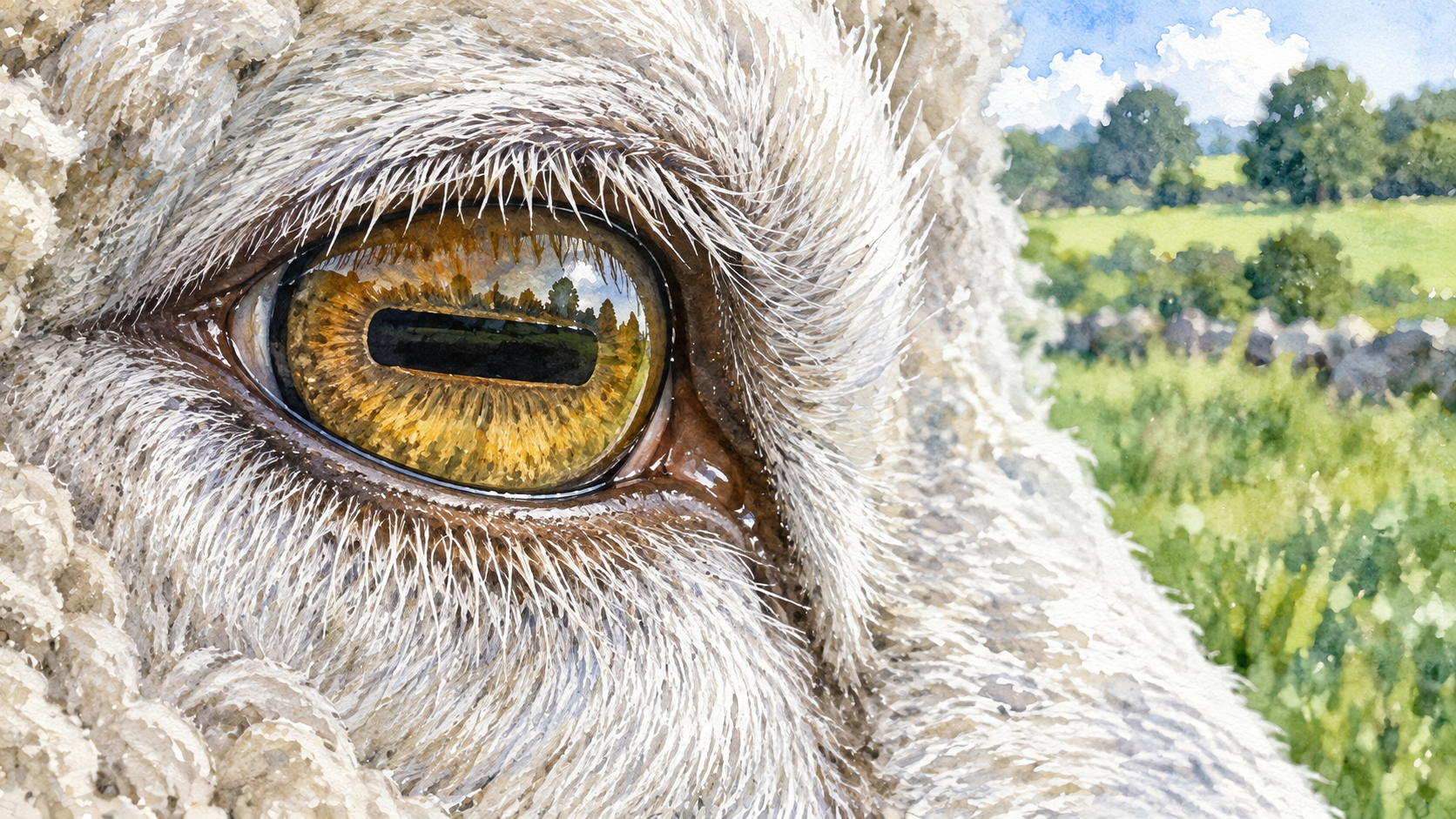
Sheep have horizontally elongated, roughly rectangular pupils that help them watch for threats while keeping their heads down to graze. Together with eyes positioned on the sides of the head, the pupils help maintain a broad view across the ground. Optical research also suggests they make important features of the terrain clearer when sheep need to move quickly.
The dark rectangle is the pupil, an opening controlled by the surrounding iris. It is not a solid black structure or a perfect geometric rectangle. Its horizontal proportions change as the opening dilates and constricts.
A View Built Around the Ground
A grazing sheep faces two competing demands. It must focus on forage beneath its muzzle, yet it also benefits from detecting movement approaching from the front, sides, or rear. Sheep are prey animals, and a wide horizontal field of view makes it possible to monitor much of the surrounding pasture without constantly lifting the head.
Two features work together. Eyes set on the sides of the skull provide a wide field of vision, while the horizontally stretched pupil lets light enter from a broad range of directions along the ground. The pairing of horizontal pupils with side-set eyes is especially common in grazing prey animals, as documented in a comparative analysis of terrestrial pupils. The correlation is strong, although an evolutionary explanation based on optical modeling is not the same as observing every historical step by which the feature arose.
This arrangement does not make sheep all-seeing. They retain a narrow blind region behind them and a relatively small zone where both eyes see the same scene, as the farm-ungulate vision literature describes. How the eyes are placed and how the pupil is oriented are related advantages, not interchangeable ones.
The Shape Helps Sheep See a Useful Horizon
A long horizontal opening admits light from directions that matter for spotting movement across a field. Its relatively narrow vertical dimension can also reduce blur along horizontal features, such as ground edges and paths. Those features may help an animal judge where to place its feet when it turns or runs over uneven ground.
This is a more precise explanation than saying sheep have rectangular pupils simply to “see more.” The eye’s position supplies much of the wide field; the pupil modifies which directions and contours are visually useful within that field. Optical modeling predicts both a useful horizontal panorama and sharper images of horizontal contours ahead and behind.
The horizontal shape can also limit some light arriving from overhead while preserving more light from the horizon. That is a potential optical advantage in open pasture, although it should not be interpreted as proof that sheep cannot be dazzled by bright light or that a rectangle guarantees clear vision in all conditions. This combination of a horizon-oriented view and reduced overhead glare is one of the optical advantages proposed by the researchers.
Why the Pupil Stays Horizontal When a Sheep Grazes
If the rectangular pupil merely followed the angle of a sheep’s head, it would tilt as the animal lowered its muzzle to the grass. Researchers instead observed a compensating movement: the eyeballs rotate within their sockets as the head pitches downward, keeping the long axes of the pupils approximately aligned with the ground.
This compensating eye movement was documented through farm observations and photographs of sheep and other grazers. It is the eye that rotates; the pupil is an opening in the iris, not a piece that spins separately.
That rotation matters because grass is usually close to the ground, whereas a moving predator or obstacle can appear across the wider pasture. Sheep do not need to choose between keeping their mouths down and maintaining a ground-oriented view. This feature also helps explain why a sheep’s eyes may look surprisingly active during ordinary grazing.
What Each Visual Feature Does, and What It Does Not
| Feature | What it contributes | Important limitation |
|---|---|---|
| Eyes set toward the sides of the head | A broad field of view around the sheep | A blind region remains behind the animal, and the forward overlapping field is relatively narrow |
| Horizontally elongated pupils | Favor a useful view and optical detail along the ground | They do not produce perfect focus or reveal every object |
| Eye rotation as the head lowers | Keeps the horizontal pupils approximately aligned with the ground | Alignment is compensatory, not mathematically perfect at every angle |
The distinction matters in a farm setting. For example, sheep may detect a person moving at the edge of their visual field without examining that person’s details as a human would. Their ability to notice motion should not be confused with identical sharpness or depth perception in every direction. Broad peripheral coverage therefore coexists with limited binocular overlap and visual detail, a tradeoff documented in research on farm-ungulate vision.
Sheep also rely on hearing and smell, which are considered alongside vision in how well sheep see, hear, and smell. Neither can be inferred from pupil shape.
Why Pupil Shape Matters When People Work Around Sheep
The same broad view that helps a grazing sheep detect movement can make it sensitive to activity around gates and handling lanes. A worker approaching from a visible side may be detected early, while someone appearing abruptly from a blind area can provoke a startled turn. Sheep may also pause at sharp shadows, changes in surface appearance, or visually confusing entrances.
For low-stress handling, allow animals to see the route ahead, minimize distracting movement around the race, and avoid pushing them blindly into an area they hesitate to enter. These responses to movement, blind spots, and contrasting surfaces are also reflected in practical sheep-handling guidance. Responding calmly to those reactions is part of safe flock herding and low-stress sheep handling, rather than something explained by pupil shape alone.
These practices also help explain why an apparently small movement near the side of a pen may get a flock’s attention. A wide view is useful for predator awareness, but it can also expose sheep to more motion and distraction in a busy farmyard. Pupil shape is only one part of the animal’s response; do not assume every hesitation or sudden turn has a visual cause.
Is a Rectangular Pupil Normal in Every Sheep?
A horizontal, roughly rectangular pupil is a normal feature of domestic sheep, whether their heads are woolly or bare. The visible opening may become broader or change proportions with the available light. Changes in its apparent width under different lighting are not automatically a sign of disease.
Eye discomfort is a different matter. Squinting, excessive tearing, obvious redness, or a cloudy eye warrants prompt veterinary assessment, particularly if the animal cannot navigate normally. These signs can occur with painful eye conditions and cannot be diagnosed from pupil shape alone. Such findings are among the recognized signs of eye inflammation in sheep and goats, although infection is not the only possible cause.
Understanding the normal outline of a sheep’s eye is one part of recognizing its physical characteristics. Understanding how sheep see in darkness requires considering other eye structures, not just the pupil.
2 thoughts on “Why Do Sheep Have Rectangular Pupils?”