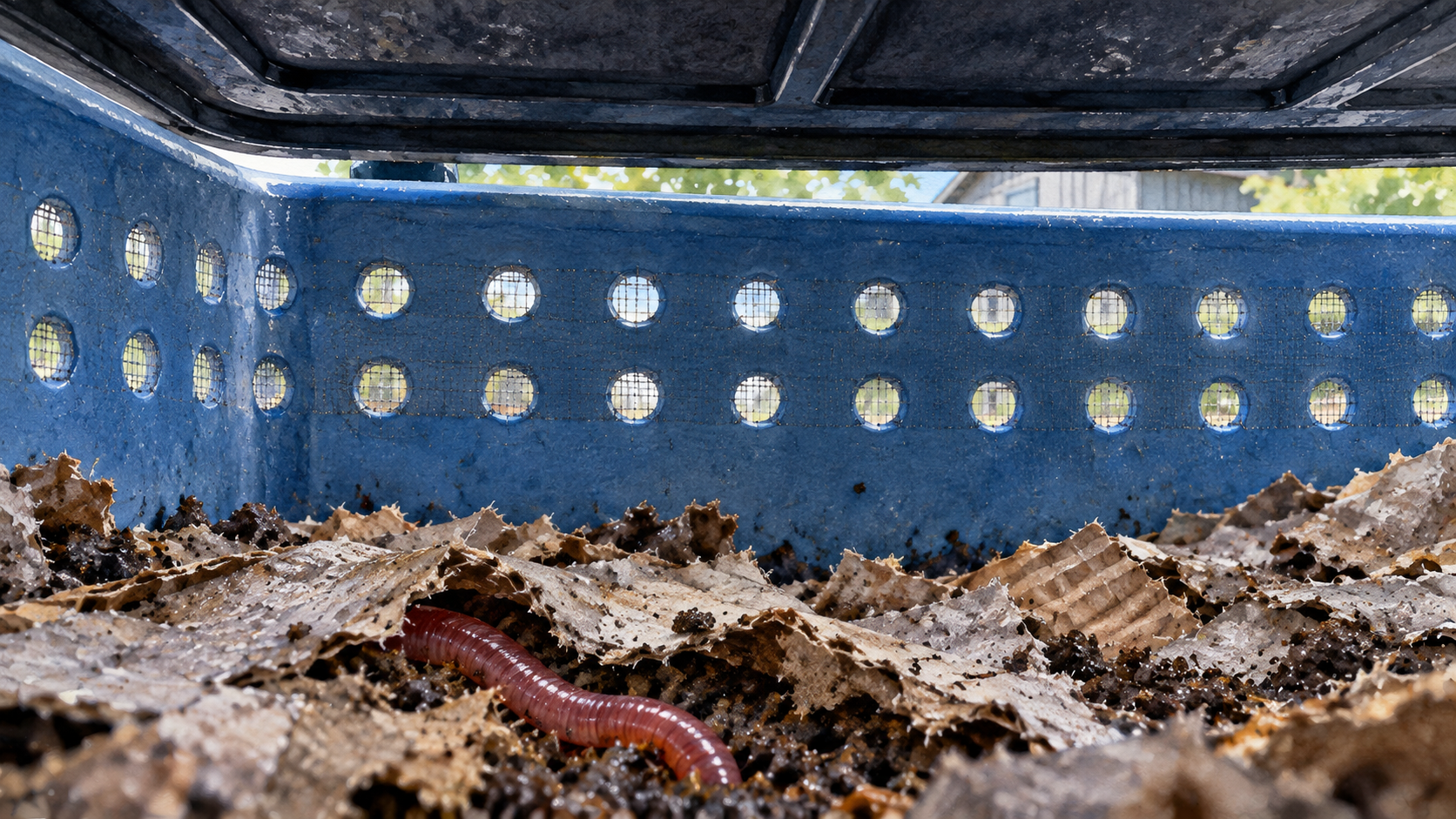
Most enclosed plastic worm bins need air holes or another dependable way for fresh air to enter. Composting worms and the microorganisms breaking down organic scraps depend on oxygen. A tightly sealed storage tote cannot provide reliable air exchange indefinitely, even if it seems to contain plenty of air when the lid is first closed. A loosely covered worm bed, a ventilated commercial system, or a breathable container may provide enough exchange without new holes drilled into its walls.
For a farm or homestead processing kitchen scraps and modest quantities of suitable garden residues, the goal is a continuous route for air to reach the bedding while keeping the contents moist, protected from pests, and sheltered from rain. These principles apply to composting-worm systems generally; most of the small-bin research and designs cited here use red wigglers rather than establishing a separate hole count for every composting species. Air holes alone do not guarantee that oxygen reaches the worms. Material packed into a soggy mass can become oxygen-poor inside an otherwise well-ventilated container.
Aeration depends on more than hole placement. The bed’s moisture level, physical structure, and any standing-water problem also affect whether air reaches the worms.
What Air Holes Actually Do in a Worm Bin
Vermicomposting is an aerobic process. The red wigglers (Eisenia fetida) commonly raised in bins require oxygen, and so do many of the organisms that decompose their food. The Oregon State University guide to composting with worms describes an aerobic environment as a basic requirement and recommends vents alongside loose, fluffed bedding.
Ventilation provides a route for fresh air to replace air inside the container. Air can pass through the openings above the bedding, then move through the spaces between bedding fibers and decomposing materials. The rate of exchange depends on the openings, the lid and wall material, the bedding structure, and the environment around the bin.
A lid dotted with holes cannot compensate for wet scraps compressed into a dense layer. Water occupying bedding pores reduces the air-filled space available for oxygen movement. The University of California, Santa Barbara vermicomposting maintenance guidance specifically identifies excess water and matted material as causes of low-oxygen conditions. Such conditions favor anaerobic decomposition, which can produce unpleasant odors and harm a colony.
Ventilation also changes how quickly moisture evaporates. A system with generous air exposure may dry faster, while a tightly enclosed tote retains more humidity but can trap moisture if badly managed. More holes are therefore not automatically better.
Which Types of Worm Bins Need Ventilation Holes?
The need to drill holes depends on whether the container already exchanges air. A gap beneath a loose-fitting cover, porous sidewalls, or purpose-made vents can provide access that an airtight plastic tote lacks. The NC State guide to worm bins calls for oxygen flow into the container and gives drilled openings as an example. Iowa State’s vermicomposting FAQ also describes loose-fitting lids that allow air exchange.
| Worm system | Are extra drilled air holes usually needed? | What matters most |
|---|---|---|
| Rigid plastic tote with a tight, unvented lid | Yes, unless another reliable air pathway is provided | Openings remain clear and above the working bedding |
| Plastic bin with a breathable cover or a permanently open vent | Not necessarily | The covering truly permits air exchange while excluding pests |
| Commercial stacking-tray system | Follow the manufacturer’s ventilation design | Built-in vents and tray air passages remain unobstructed |
| Open or loosely covered worm bed | Usually not for air entry at the top | Protect the surface from excessive drying, rain and animals |
| Untreated wooden worm box | Depends on gaps, cover and construction | Do not assume wood alone makes a closed box adequately ventilated |
The last column is more informative than the presence of a drill hole. A commercial vent that is blocked by bedding is functionally less useful than an unobstructed opening. Conversely, adding holes to a structure that already exchanges air can create unnecessary drying or provide access to insects.
Should Air Holes Go in the Lid or Sides?
Upper sidewalls are a dependable starting choice for a lidded plastic bin. They keep openings above the bulk of the material and can be shielded from falling rain. In its worm-bin construction guide, NC State recommends ventilation openings near the top of the sidewalls and specifically discourages lid holes because they admit light and can dry the bedding.
Other authoritative guides permit a different arrangement. Oregon State illustrates sidewall vents and optional screened lid vents, with an explicit warning to keep rain out. Utah State’s vermicomposting guide recommends holes in the lid and notes that sidewall holes can provide potential escape routes. These recommendations are alternatives for different designs, not proof that one location is universally correct.
For a small farm bin, choose the location that keeps the vent open during normal use:
- Upper-side vents: Often easier to protect from rain and direct sunlight. Check that the bedding level, an outer collection tray, or nearby storage items do not cover them.
- Lid vents: Can work when covered with suitable breathable screening and protected from rain. Monitor the upper bedding for drying.
- An existing ventilated lid or breathable cover: May eliminate the need for additional openings, provided the cover stays secure and permits enough airflow.
Do not confuse these with holes at the bottom of the container. Bottom openings primarily drain excess liquid; they do not replace a clear route for air to enter above the bedding. The complete choice of bin size, supports and drilling layout belongs in a separate construction plan.
How Many Air Holes Are Enough?
There is no research-backed universal number of holes for every worm bin. The guides that specify counts are describing particular containers and vent sizes, not a formula that scales automatically to every tote.
| Published example | Vent arrangement in that design | How to use the example |
|---|---|---|
| US Environmental Protection Agency indoor bin | One 1-inch screened hole near the top of each opposite side of the upper bin | An example of two larger screened openings in a specified nested-tub system |
| NC State plastic-bin options | Two screened 3-inch end vents, four ½-inch side holes, or many ⅛-inch upper-side holes | Three alternative patterns, not three sets of holes to combine |
| Oregon State two-tote design | Up to ten ¼-inch upper-side holes or four or more fitted 1-inch side vents; optional fitted lid vents | Alternative arrangements for a particular design, not a minimum for every system |
A few larger, well-screened vents and several smaller vents can both provide exchange, but the usable open area also depends on how much mesh covers each opening and whether the lid or bedding blocks it. Hole counts are not a substitute for assessing the whole system.
For a bin that already has vents, first confirm they are unobstructed before adding more. If making new openings, remove the worms and bedding from the work area, wear suitable eye protection, and remove drilling debris and sharp edges before returning the colony. The University of Alaska Fairbanks guidance cautions against repurposing containers previously used for chemicals.
Keep Air Moving Without Inviting Pests or Drying the Bedding
Air vents should not become open doors for fruit flies, other nuisance insects, or escaping worms. The EPA indoor-bin instructions use nonrusting window-type screen over the holes. Oregon State likewise recommends screening ventilation openings against fruit flies. Mesh reduces access but is not a guarantee that a poorly managed bin will remain pest-free.
Screening should remain securely attached, free of accumulated scraps and residue, and porous enough for airflow. An adhesive used to attach it should be fully cured and suitable for the environment before worms are returned. A vent cut into the side of a nested tote must not face a second wall pressed tightly against it.
Placement also matters. Rain entering lid holes may saturate the contents. Direct sun and hot, drying wind can turn a highly ventilated outdoor bin into an unsuitable habitat. Use a protective location and a cover that blocks weather without sealing the air route. Keep the bin secured against livestock, rodents and other animals that might overturn it.
A well-protected vent is one that stays useful during ordinary feeding and cleaning, not merely on the day it was drilled.
Why Loose Bedding Matters as Much as the Holes
A vent exchanges air with the space around the bedding. Oxygen must still reach the working material, where organisms are actively decomposing scraps. Bedding made from shredded cardboard or paper helps maintain spaces between particles if it has not been pressed into a dense wet mat. Oregon State emphasizes fluffed bedding and cautions against blocking vents; UCSB’s maintenance guide makes the same connection between matted material and poor oxygen access.
Watch for these common barriers:
- A thick layer of wet food scraps compacted against the bedding.
- Fine, decomposed material that has become a dense paste rather than a loose mixture.
- Soggy patches or pools of water, which limit air-filled spaces.
- Bedding and equipment pressed directly against vent openings.
A gentle inspection when feeding is preferable to repeatedly turning the whole bed. If the material is matted, carefully lift the affected portion and provide clean, appropriately moistened coarse bedding for structure, without grinding or aggressively stirring the worms. Reduce new additions while the affected area stabilizes. Detailed bedding selection and moisture targets are separate care questions.
Air Holes and Drainage Solve Different Problems
Ventilation openings admit air. Drainage provides a route for excess water to leave. Some bin designs incorporate both; others control liquid without bottom holes through careful moisture management. The two functions should be evaluated independently.
In the EPA two-container example, upper holes provide oxygen while lower holes let excess liquid drain into a separate collection container. The National Center for Appropriate Technology’s vermicomposting overview similarly stresses both ventilation and drainage. Where a nested system is used, the gap between the inner bin and the receiving tray matters because the lower container must not block the openings.
Installing more vents will not remove a puddle under saturated material. Equally, a bin that drains freely can still become oxygen-poor if scraps mat together or the lid seals tightly. Treat standing liquid and severe saturation as a separate problem requiring prompt correction, rather than simply adding new holes.
A Four-Point Airflow Check for an Existing Worm Bin
Rather than treating the number of drilled holes as a pass-or-fail test, follow the path oxygen must take. This four-point assessment synthesizes extension guidance on vents, bedding and drainage; it is an editorial checking method, not a laboratory oxygen test.
- Entry: Is there a reliable path for outside air through an unblocked vent, porous wall, or breathable cover? An airtight lid with no other opening fails this check.
- Access: Do those openings remain above the fill line and free of obstruction from screens, a surrounding collection tray, or objects stored against the bin?
- Internal space: Does the bedding remain loose enough for air to reach decomposing scraps, without large saturated or compacted sections?
- Water exit: Can the system prevent or safely release excess liquid, rather than allowing a standing pool to occupy the lower bedding?
Use observations to decide what to examine next, not to diagnose oxygen by smell alone:
| Observation | Airflow-related possibility | Sensible first check |
|---|---|---|
| Sour or rotten smell with wet, heavy bedding | Oxygen-poor decomposition may be developing | Check pooled moisture, food mats and blocked vents |
| Clear vents but a slimy, compressed food layer | Air exchange at the wall is not reaching the material effectively | Inspect the affected feeding zone and bedding texture |
| Dry material near lid or upper walls | Exposure through vents may be increasing evaporation | Check bedding moisture away from just the surface |
| Insects gathering around a vent | Openings or screens may be allowing access | Inspect mesh condition and exposed food |
A healthy, earthy smell is reassuring but cannot prove oxygen is adequate throughout the bin. Likewise, worms collecting near the lid, escaping, or becoming inactive can reflect several environmental problems, not just low oxygen. Persistent foul odor, widespread worm distress, or deaths require prompt assessment of the entire environment rather than drilling holes at random.
Questions About Keeping Worm Bins Ventilated
Can you leave the lid off a worm bin for better airflow?
Temporarily opening the lid can increase air exposure while you inspect a poorly ventilated bin. UCSB identifies this as an option, but leaving an uncovered system outdoors can expose it to drying, rain, animals and pests. A breathable, protective cover may be more appropriate than permanently removing the lid.
Do worm composting bins need a fan?
A typical small red-wiggler tote usually relies on passive air exchange through its vents and bedding. The extension designs above do not require a powered fan. Forced airflow could increase drying, so a fan should not be used as a substitute for correcting blocked vents or wet bedding.
Can worms crawl out through ventilation holes?
They can sometimes pass through open holes, especially when conditions encourage wandering. A secure screen helps reduce escapes and pest entry. Covering every opening with airtight tape would defeat the purpose; if worms repeatedly leave, investigate their living conditions as well as the vent design.
Do more air holes always make a worm bin healthier?
No. More openings may increase air exchange but also allow greater moisture loss or weather exposure. A bin with modest, unblocked vents and loose, suitably moist bedding can function better than a heavily perforated bin with compacted, saturated material.
3 thoughts on “Do Composting Worms Need Air Holes?”