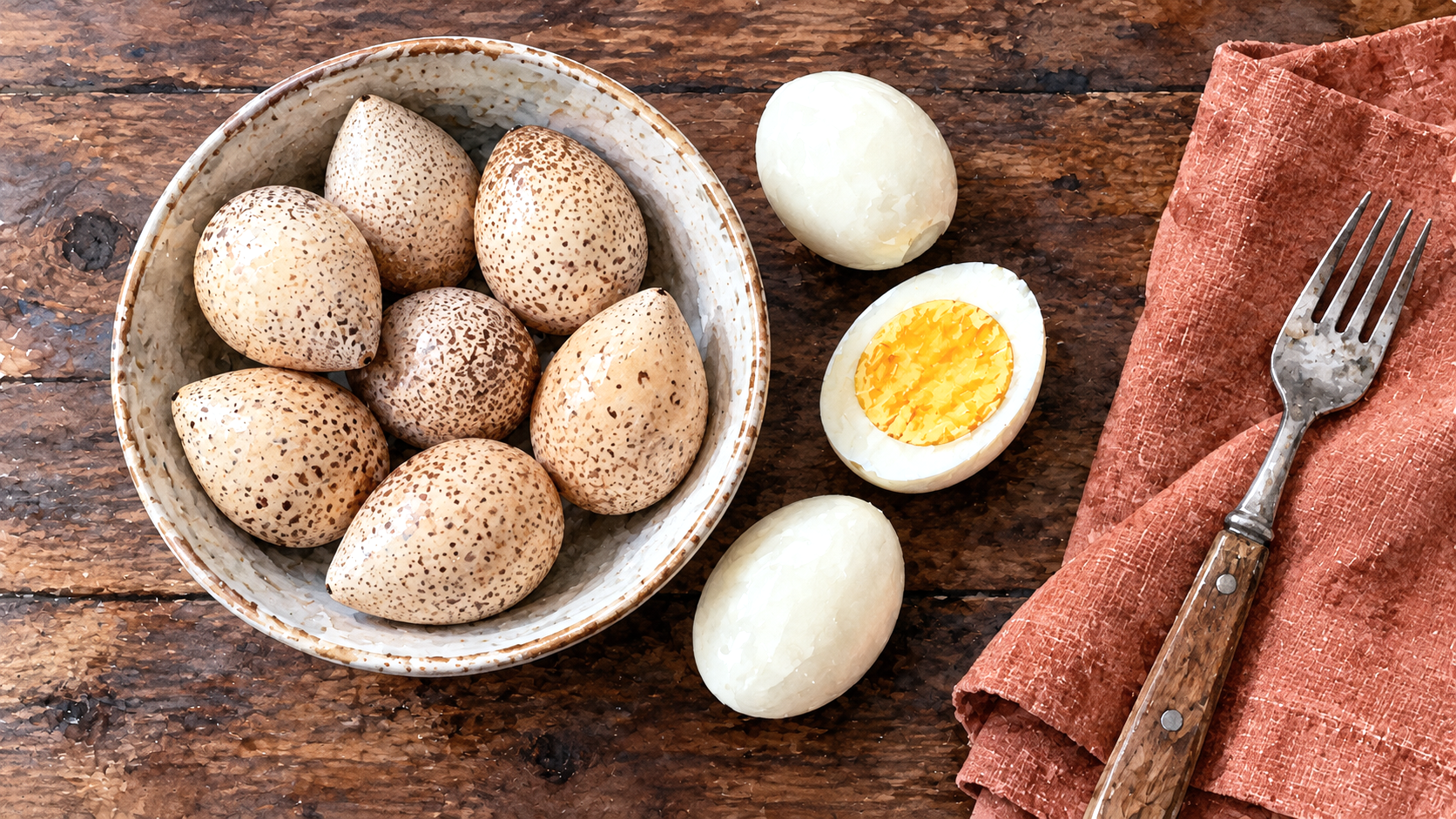
A guinea hen’s eggs may look unfamiliar beside ordinary grocery-store eggs, but they are not just for hatching keets. When they come from properly managed birds and are handled safely, they can be prepared for the table in much the same way as other poultry eggs. Guinea fowl eggs are edible and they provide protein, fat and other nutrients. They can be boiled, fried, scrambled or baked. Their relatively small size and firm shells change how they are prepared, not whether people can eat them. As with other poultry eggs, however, thorough cooking and hygienic handling are important because raw eggs can carry harmful bacteria.
Are Guinea Fowl Eggs Safe for Humans?
Guinea fowl eggs are an established human food. Research examining the protein quality of commonly eaten bird eggs includes guinea fowl alongside chicken, turkey and quail eggs.
Safety depends on how an individual egg was collected, handled and prepared. An intact egg gathered promptly from a known nest and refrigerated appropriately is not equivalent to an egg found after an unknown period outdoors. The FDA’s egg safety recommendations emphasize clean handling, refrigeration and cooking until both yolk and white are firm. Though much of this guidance addresses commercial chicken eggs, the underlying microbiological precautions are relevant to home-produced guinea eggs.
What Do Guinea Fowl Eggs Taste Like?
Their taste is broadly similar to that of other poultry eggs. Some people describe guinea eggs as slightly richer, but differences in feed, freshness, cooking and personal preference affect the experience. No reliable rule establishes that all guinea eggs taste stronger or better than chicken eggs.
Yolk color varies and should not be interpreted as a direct measure of nutritional superiority. The appearance of guinea eggs is more distinctive than their flavor: the shells are often buff or tan and feel unusually solid for their size.
Are Guinea Fowl Eggs Nutritious?
Yes. Their yolks and whites contain dietary protein, fat and other nutrients. Smaller eggs usually provide less total edible food per egg than larger ones, so comparisons need to account for serving size.
A study of amino acids in five bird egg varieties reported a favorable essential-amino-acid profile in the sampled guinea eggs. That supports their value as a protein food, but it does not prove every guinea egg is nutritionally superior to every other egg.
Research on the composition of free-range guinea eggs measured fat, fatty acids and minerals and found some variation associated with the laying hens’ age. The precise nutrient composition therefore depends partly on the birds and the production conditions.
Guinea eggs also contain cholesterol. Chemical research on guinea egg lipids documented both saturated and unsaturated fatty acids, as well as cholesterol. They should be treated as a normal food within an overall diet, not promoted as cholesterol-free or as a special medical treatment.
How Can You Cook Guinea Fowl Eggs?
Guinea eggs can be used in familiar dishes, provided they are cooked adequately. Their shells can require a firmer tap, so cracking each egg into a clean bowl first makes it easier to remove shell fragments before adding the contents to a recipe.
| Preparation | Practical approach |
|---|---|
| Scrambled eggs | Cook until firm rather than runny |
| Fried eggs | Cook yolk and white thoroughly |
| Hard-boiled eggs | Ensure the center has cooked through |
| Omelets | Use enough eggs to create the desired portion |
| Cakes and muffins | Measure the cracked contents when accuracy matters |
| Custards and casseroles | Cook egg mixtures to the recommended safe temperature |
Guinea eggs are generally smaller than large chicken eggs, so a recipe may require more than one guinea egg to replace one chicken egg. The practical differences between guinea and chicken eggs include usable weight as well as shell firmness. In precision baking, weighing the cracked contents is more reliable than counting a fixed number.
The USDA’s safe egg-cooking guidance recommends cooking egg mixtures to 160°F (71°C). When eggs are served alone, cook until the white and yolk are firm. A small egg can still be unsafe when raw or partly cooked.
Can You Eat Guinea Eggs Raw or Runny?
Raw or undercooked guinea eggs can present a foodborne-illness risk. Salmonella is not visible to the naked eye, and a clean shell or normal smell cannot establish that an egg is free of harmful organisms.
The USDA explains how Salmonella can reach shell eggs: contamination can occur during egg formation or through exposure after laying. A strong shell does not prevent every route of contamination.
Avoid using unpasteurized raw guinea eggs in dressings, homemade mayonnaise, uncooked desserts or drinks. For recipes that must contain uncooked egg, use a properly pasteurized egg product. The FDA’s food-service guidance on raw egg recipes recommends pasteurized products for preparations that are not thoroughly cooked.
Young children, pregnant people, older adults and those with weakened immune systems face greater risks from foodborne infections. Fully cooked eggs are the safer choice, particularly for these groups.
Does the Thick Shell Make a Guinea Egg Safer?
No. Guinea eggs tend to have relatively strong shells, but shell strength is not proof of microbiological safety. Cracks, fecal contamination, improper refrigeration and unknown outdoor exposure can all be relevant.
The CDC’s backyard poultry guidance specifically includes guinea fowl and warns that healthy-looking birds can carry germs. Wash hands after collecting eggs or tending poultry, clean raw-egg preparation surfaces and keep poultry equipment out of the kitchen.
Discard cracked or leaking eggs rather than trying to make them safe by extra cooking. The same caution applies to eggs whose age or handling history is unknown.
Are Eggs From Hidden Nests Good to Eat?
A nest found in tall grass may contain eggs laid on several different days. Guinea hens often use concealed ground nests, sometimes shared by several females. A hen seen entering a nest today may not have laid every egg present there.
When finding hidden guinea eggs, do not assume that a thick, intact shell proves freshness. Eggs of unknown age or uncertain exposure to heat, weather or incubation should be discarded rather than eaten. Float tests cannot prove the absence of harmful bacteria.
Eggs collected regularly from known locations can be managed more reliably. Appropriate collection and storage of guinea fowl eggs helps reduce risk, but detailed storage decisions should follow suitable egg-handling guidance rather than guesswork.
Can Someone With a Chicken Egg Allergy Eat Guinea Eggs?
Do not assume guinea eggs are safe for a person allergic to chicken eggs. Proteins in eggs from different bird species can cross-react. Food Allergy Research & Education warns that people with hen-egg allergies may react to other poultry eggs.
People with known or suspected egg allergy should consult an allergist rather than sampling guinea eggs at home. Switching species is not a validated way to avoid an egg allergy.
Can Fertilized Guinea Eggs Be Eaten?
Yes, a freshly laid fertile egg may be suitable for the table if it has been collected promptly, handled appropriately and not incubated. Fertilization alone does not make a newly laid egg inedible.
But eggs kept warm for incubation or discovered after an unknown period outside should not be treated as routinely collected table eggs. The mating behavior of guinea fowl affects whether an egg may be fertilized; it does not establish that the egg is safe to eat.
Hens do not need a male to produce edible eggs. Eggs laid without mating are simply unfertilized.
Questions About Eating Guinea Fowl Eggs
Can you eat guinea eggs every day?
They can be part of an ordinary diet for people who tolerate eggs. Suitable frequency depends on individual dietary needs and any relevant medical advice.
Are guinea eggs healthier than chicken eggs?
Both provide useful nutrients. Claims that one is always healthier are too broad because serving size, the hens’ diets and measured nutrient concentrations vary.
Can you fry guinea eggs?
Yes. Cook the white and yolk until firm.
Are guinea fowl eggs safe for children?
Properly handled and thoroughly cooked eggs can be served to children without egg allergy. Avoid raw and runny preparations.
Can guinea eggs be used in cakes?
Yes. Use the appropriate amount of edible egg for the recipe; weighing cracked eggs is especially useful when substituting for large chicken eggs.
Can you eat free-range guinea eggs?
Yes, when collection, handling and cooking are safe. Free-ranging alone does not guarantee freshness or cleanliness.
Can you eat eggs laid without a male?
Yes. Unfertilized eggs are edible and can be cooked normally.