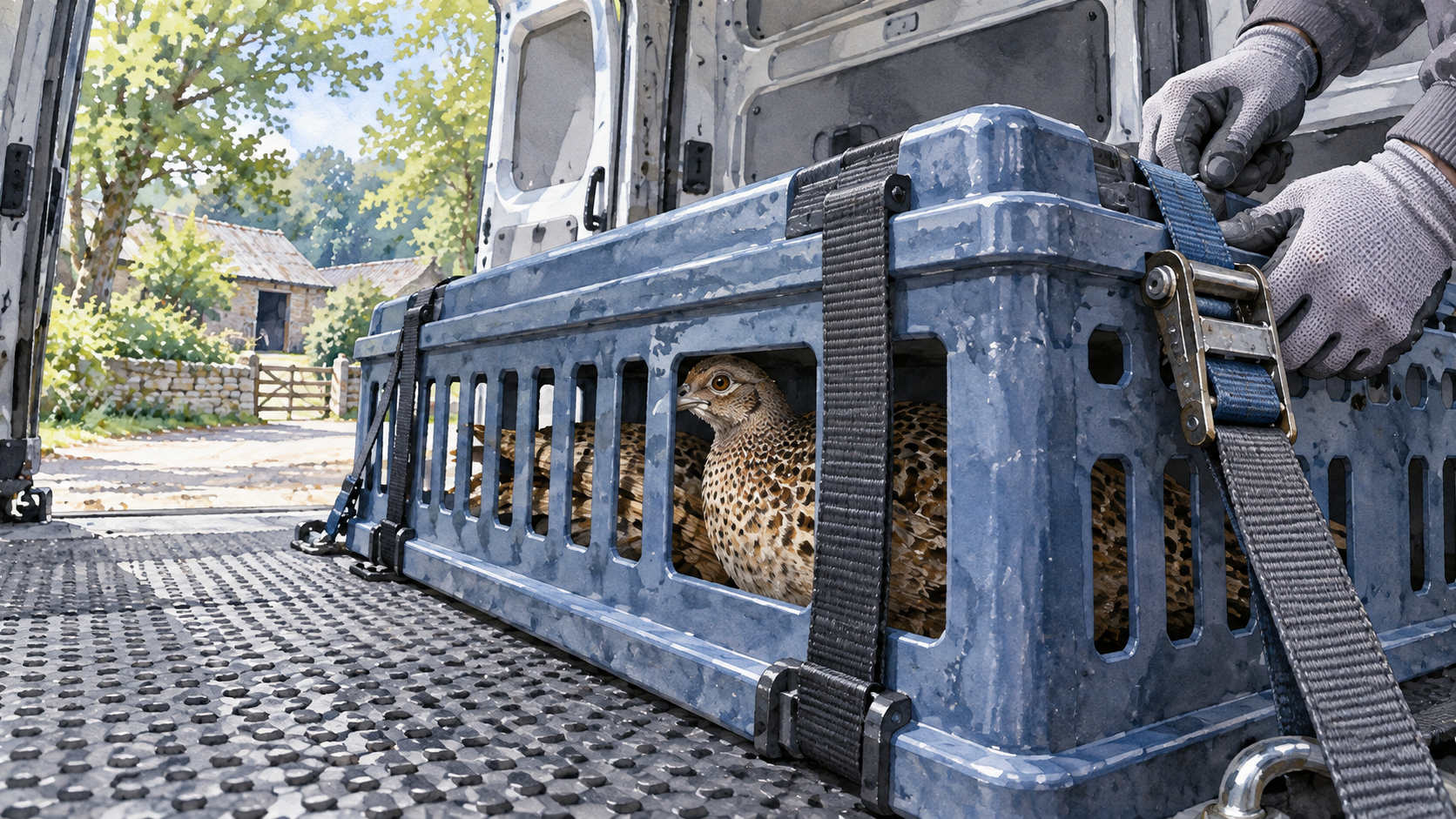
Transport pheasants in secure, well-ventilated crates that let them stand, turn and rest without encouraging frantic flight. Load them shortly before departure, secure the crates against movement, protect the birds from heat and cold, and prepare their destination before the vehicle arrives. An injured, severely stressed or ill pheasant needs veterinary advice before a routine journey; transport should not make an existing problem worse.
Pheasants can flush sharply upward when alarmed and strike the roof of an unsuitable carrier. A carrier sold for chickens is suitable only when its height, openings, floor and capacity also fit the actual pheasants. This guide covers short farm transfers and planned road journeys involving ring-necked pheasants and ornamental species. Chicks, adults, long-tailed birds and commercial shipments may require different arrangements.
Choose a Crate That Protects the Bird From Its Own Flight Response
Pheasants can injure their heads or wings trying to fly inside an excessively tall or open-sided transport enclosure. To reduce that risk, USDA’s pheasant-specific guidance for Animal Welfare Act transport allows suitably restricted crate height and wing room in covered operations. For covered transport, the bird must still be able to stand or semi-crouch comfortably, turn freely and move normally within those limits. This is a controlled travel enclosure, not permission to squeeze a pheasant into a box so small it cannot reposition itself.
A purpose-built gamebird crate is a sensible starting point, but any carrier used must have sound walls, smooth inside surfaces, reliable fasteners and ventilation openings that cannot trap a head, toe, wing or beak. A door should close without forcing feathers into its hinges and allow prompt unloading without releasing other birds. Secure construction, absence of dangerous edges, protection from protruding body parts and prompt emergency removal are all required under the federal standards for covered bird transport enclosures. Their exact regulatory scope depends on the operator and purpose of transport, but those safety checks make sense on any farm.
The floor should be stable rather than slippery, and a modest amount of clean, absorbent, low-dust litter can help manage droppings during the journey. Avoid loose string, deep piles of bedding, sharp wire edges and anything that could entangle toes or obscure ventilation. Damaged doors, cracked panels or missing latches rule a crate out until repaired or replaced. Reusable plastic crates can simplify cleaning and disinfection compared with absorbent materials, an advantage also described in a commercial gamebird producer’s discussion of crate design. The producer’s preference is not evidence that one model suits every age or species.
Check Fit and Group Size Before Loading
A suitable crate has enough floor area for every bird to rest without being piled beneath others, but not so much empty space that an alarmed pheasant can launch into uncontrolled flight. Headroom, tail clearance, floor grip, and reliable ventilation need to be assessed together. The number of birds that fit safely changes with adult size, sex, age, plumage, journey length and weather. A quoted number of pheasants per crate from one commercial supplier should not be copied as a universal stocking limit.
Each bird needs room for a comfortable resting posture, with its head, wings, legs and toes contained safely inside. Those requirements also appear in US federal enclosure standards for covered bird transport. It also warns against mixing birds of very different sizes or different species in a single crate. Although written for Canadian poultry keepers, these are useful welfare principles rather than US legal requirements. Separate aggressive individuals; do not crowd a bird that is already being pecked or chased merely to fit an intended shipment.
Evaluate each proposed load against these questions before closing the door:
- Can each pheasant maintain a normal standing or comfortable resting posture and turn without pressing against another bird?
- Are long tails, wing tips, legs and heads completely protected from the door and ventilation openings?
- Can air reach every bird even after the crates are placed in the vehicle or stacked as designed?
- Is the door locked, the floor stable, and the crate easy to lift without tipping?
A failure on any of these points calls for a different carrier, fewer birds, or a changed transport plan. Juveniles and ornamental species with unusual feathering need their own fit check, not assumptions drawn from adult ring-necked pheasants.
Schedule the Journey Around the Weather and the Birds
Heat, poor airflow and unnecessary time spent crated can turn an otherwise routine move into an emergency. Arrange the route and receiving enclosure before catching any birds. In hot weather, choose cooler travel hours when possible and minimize stationary waiting, as outlined in 2025 Canadian food-inspection guidance on transport heat stress. Do not load pheasants the night before a trip or leave crated birds waiting in an unventilated vehicle. Pheasants should not be left crated in direct sunlight while people finish unrelated farm chores.
Cold weather introduces different problems. Wet birds, exposure to driving wind and excessive chilling can be dangerous, especially for juveniles or birds with poor feather cover. Keep crates out of precipitation and protect them from drafts without sealing their ventilation openings. A tarp, blanket or solid vehicle cover that blocks airflow can be more hazardous than the weather it was meant to exclude. US federal bird-transport climate rules for covered operations require action against overheating, excessive cooling and other harmful conditions, while leaving the necessary approach dependent on the journey and birds.
Do not invent a single safe vehicle temperature for every pheasant. Forecast heat, humidity, wind, travel duration, road delays, age, and crate loading density all affect risk. If there is no dependable way to maintain ventilation and appropriate conditions throughout the route, reschedule the journey or obtain specialist transport help.
Prepare the Vehicle Before the First Bird Is Caught
Transport the crates in a protected cargo area where air can circulate and the driver can safely check their condition at stops. An open truck bed may expose birds to wind, rain and sun; an unventilated trailer, vehicle trunk or closed compartment can trap heat or exhaust. The correct arrangement is the one that gives each crate secure placement, weather protection, fresh air and appropriate monitoring. Do not assume that a parked, enclosed vehicle remains safe just because it was comfortable while moving.
Use suitable tie-downs or fixed restraints so crates cannot slide, overturn, collide or fall during braking. Keep them level, upright and clear of loose tools, fuel containers, chemical products and sharp equipment. Do not stack units unless they are designed and secured for stacking, with sufficient space for air to enter all vents. Secure, clean and well-ventilated containers, along with careful loading, are required in England’s gamebird welfare code. That document applies in England and does not establish US travel-time limits.
Clean and dry reusable crates before the trip, especially if they have been used by another flock. Remove droppings and debris before using a disinfectant according to its label, and allow surfaces to become safe and dry before loading birds. Contaminated crates, boots and vehicles can introduce pathogens between farms; USDA poultry biosecurity instructions specifically require cleaning away organic material before disinfecting. Keep arrival equipment and the receiving pen ready, so unloading does not depend on borrowing dirty gear from other poultry housing.
Keep Catching and Loading Brief, Quiet and Organized
Have one person coordinate the loading area and another check crate doors and labels if the number of birds makes assistance necessary. A prepared route from pen to vehicle reduces delays and repeated disturbance. Work calmly in a secured space where a loose pheasant cannot escape to a road or open field. Avoid loud machinery, dogs and needless spectators close to the catch area.
Capture technique itself requires training and belongs in a separate pheasant-handling procedure. During this transport stage, the essential rules are to avoid prolonged pursuit, never lift or carry birds carelessly by vulnerable body parts, and place each bird on its feet inside the crate. If a pheasant becomes dangerously distressed or appears injured, stop the process and obtain experienced help. Transport staff must be competent to minimize stress and injury under the gamebird-specific welfare standard, a sound principle for small-farm movements as well.
Check the final load immediately before leaving: every door closed and secured, no bird trapped against an opening, all crate vents clear, the receiving site expecting arrival, and the cargo area protected without restricting airflow. Count the crates and birds using a written list. Load as close to departure as practical rather than keeping pheasants confined while the vehicle is prepared.
Monitor the Trip and Know When to Stop
Drive smoothly, avoid unnecessary detours, and make checks at safe places without opening crates beside an unsecured roadway. Monitor for unusual struggling, open-mouth breathing, collapse, lack of responsiveness or birds piling on top of one another. These signs may indicate distress from crowding, temperature, injury or another cause; observation alone cannot diagnose the problem. Persistent or severe breathing difficulty, collapse, serious bleeding, or multiple distressed birds require immediate veterinary direction and urgent correction of unsafe conditions.
For transport that is actually regulated under the US Animal Welfare Act, 9 CFR § 3.165 requires visual checks at least every four hours during ground transportation, and the standard prohibits transporting ill, injured or distressed birds in commerce except for veterinary care. This is a legal minimum for covered transport, not advice to wait four hours before checking stressed pheasants. Shorter intervals or immediate intervention may be warranted whenever the birds or weather require it.
Food and water arrangements depend on age, journey duration, temperature and applicable transport rules. Do not impose an arbitrary fast on birds to keep crates clean. For birds and transporters covered by the Animal Welfare Regulations, 9 CFR § 3.164 sets feeding and watering requirements, including offering weaned birds food and potable water within four hours before transport unless an allowed exception applies, and providing water during covered transport at prescribed intervals. The same figures are not a universal permission to withhold water from chicks, stressed birds or unregulated flocks. Plan the shorter journey possible; for extended trips, arrange accessible hydration and feeding under a veterinarian- or carrier-approved plan rather than repeatedly opening insecure crates.
If the vehicle breaks down or the destination is delayed, keep ventilation and weather protection functioning while contacting the receiving farm or veterinarian. Never leave birds in an unventilated parked vehicle or try to cool them by covering crate vents. A severe heat or respiratory emergency may require immediate professional assistance and a safer transport arrangement; move the birds only in a way that does not create an additional escape or injury risk.
Unloading and the First Arrival Check
Prepare the destination pen before the truck arrives: close all external gates, provide appropriate shelter, fresh water and the correct gamebird feed, and keep unrelated animals out. Place crates on stable ground or another safe surface within the secured receiving area. Only open a door when the bird’s intended enclosure is closed off from the surrounding property. Do not release pheasants into an open yard simply to get them out of the crate quickly.
After unloading, check that each pheasant is alert, breathing normally, able to stand and walk, and free of obvious bleeding or damaged limbs. Confirm the head, eyes, beak, feet and feathers were not caught or injured during travel. Birds that remain collapsed, show significant respiratory effort, cannot stand, or have serious injuries need urgent veterinary assessment. Young chicks are vulnerable to chilling and dehydration, so prompt counting, inspection, water and appropriately heated brooder accommodation are particularly important on arrival, as explained in a US pheasant hatchery’s arrival instructions. This chick-specific advice does not replace a brooding plan or apply identical heat needs to adult birds.
Record the arrival time, the number and condition of birds, any problems during travel, and changes needing follow-up. Offer water and their appropriate ration without making them compete at a single feeder. Quiet observation after arrival helps detect injuries that were not obvious during unloading. Newly acquired pheasants should enter their prepared isolation area under the farm’s separate quarantine procedure; do not introduce them directly to resident birds simply because they survived the journey.
Check Movement Rules Before Transporting Between Farms or States
Transporting pheasants can require documentation in addition to a safe crate. The requirements depend on the origin and destination states, species, whether birds are sold or exhibited, and whether the move is interstate or international. Health certificates, identification, disease testing, gamebird possession permits and active outbreak movement orders may all be relevant. Do not assume that having purchased a pheasant gives unrestricted permission to move it through every state.
Interstate poultry movements can require official identification and a health certificate, subject to specific exceptions; Ohio’s published poultry-movement guidance gives a state example and warns that the destination state may impose additional requirements. These are Ohio’s published rules and examples, not a substitute for checking the actual receiving state. Before departure, contact the destination state’s animal-health authority and wildlife or gamebird agency as appropriate; consult an accredited veterinarian for required documents or testing.
The Animal Welfare Act transport rules also have a limited scope. USDA explains that farm-type poultry used, sold or transported solely for agricultural purposes may be exempt, while covered nonagricultural activities and regulated businesses have additional welfare obligations. Even when a particular move is exempt from those federal provisions, suitable containment, ventilation, humane handling and compliance with applicable state animal-welfare and movement laws remain essential. Air shipping and international movement require carrier-specific and border documentation beyond this farm-road guide.
A Go-or-Delay Check for the Departure Day
The following decision table is an editorial synthesis of pheasant-specific USDA advice, poultry transport standards and gamebird welfare guidance. It is intended to prevent preventable mistakes before a farm journey, not to certify that a load meets every state law or carrier condition.
| Check | Proceed only when | Delay or obtain help when |
|---|---|---|
| Bird condition | Each pheasant appears fit, alert and able to stand normally | Breathing distress, collapse, serious injury, or unexplained sickness is present |
| Crate fit | Birds can stand or comfortably rest, turn, and remain fully contained without crowding | Any bird is trapped, piled on another, able to protrude, or at risk of a panic flight collision |
| Air and weather | All vents remain clear and the vehicle protects birds from harmful heat, cold and wet conditions | Airflow depends on a closed compartment, a blocked vent, or an unreliable parked vehicle |
| Travel and receiving site | Crates are secured, the route is planned, and a safe enclosed destination is ready | Delays, a broken crate door, or an unprepared receiving pen will prolong confinement |
| Movement permissions | Applicable state, interstate, carrier and animal-health requirements are confirmed | Required records, testing, permits or movement clearance are uncertain |
When these conditions are met, the transport task is not finished until the pheasants have been safely unloaded, checked, watered and settled in appropriate accommodation. The most useful final indicator is that all birds arrived safely and any transport-related problem has been documented and addressed, not merely that the vehicle reached its destination on schedule.