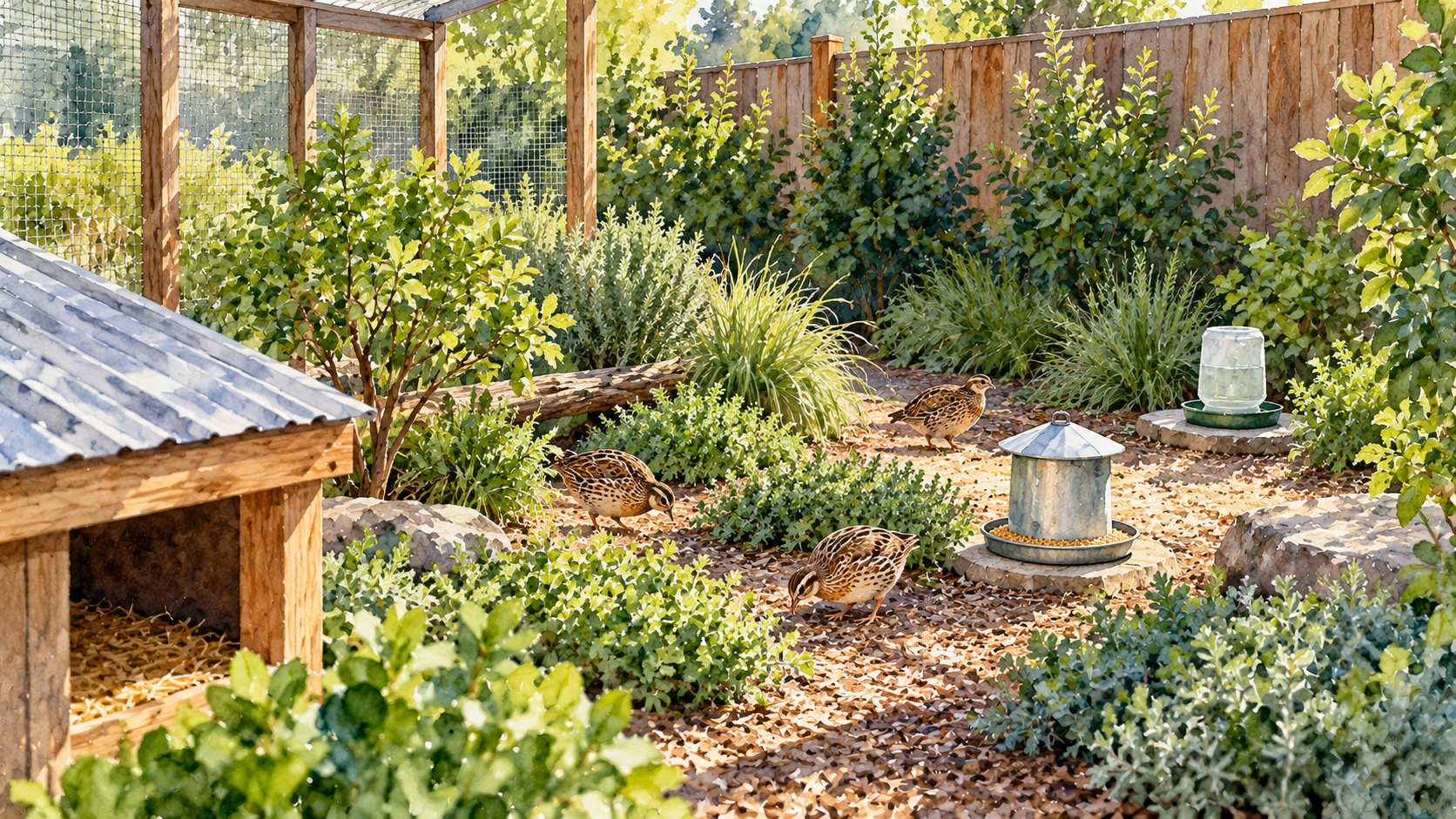
The best way to reduce quail noise is to prevent unnecessary stress, maintain suitable flock groupings, provide secure housing, and avoid disturbances that trigger repeated calling. These changes can reduce alarm calls, separation calls, and vocalizations associated with social conflict. They cannot eliminate the normal whistles, crows, and contact calls that quail use to communicate.
Noise management begins with recognizing the difference between ordinary vocal behavior and avoidable calling. A male advertising during the breeding season may continue calling in an otherwise excellent enclosure, whereas a group repeatedly startled by passing animals may become quieter once its surroundings are more secure. The goal should be a calm, well-managed flock, not silence at the expense of the birds’ welfare.
Can You Actually Make Quail Quieter?
Quail can become less disruptive when their calling is associated with preventable problems, but the amount of improvement depends on the species and the individual birds. Reducing crowding, correcting aggressive group arrangements, and limiting sudden disturbances may lower the frequency of avoidable vocalizations. None of these changes guarantees that an adult male will stop advertising or that a separated bird will never call.
Some species are naturally more conspicuous than others. Northern bobwhites produce recognizable whistles, Japanese quail males crow, and California quail use repeated contact calls. Those vocalizations serve biological functions that appropriate husbandry should accommodate. The usual noise expectations for different quail species help distinguish a reasonable management goal from an expectation that no sounds will ever be heard.
It is also important to judge improvement over several days rather than immediately after changing the enclosure. Moving birds, rearranging groups, or introducing unfamiliar equipment may temporarily increase activity and calling, even when the eventual arrangement is more suitable.
Does Keeping Fewer Male Quail Reduce Crowing?
Reducing the number of mature males may reduce the number of birds producing prominent advertisement calls, particularly in species where males are responsible for much of the conspicuous crowing. However, one vocal male can still call repeatedly, and removing every male does not make a flock completely silent.
The arrangement matters as much as the count. Several mature males housed together may compete, while males in neighbouring enclosures can sometimes stimulate one another through visual or auditory contact. Conversely, some established groups coexist without frequent conflict.
The 2023 European Food Safety Authority assessment of quail welfare identifies male-to-female ratios as an important consideration when grouping mature quail. Reducing male numbers may be appropriate where aggression is occurring, but flock changes should preserve suitable companionship, avoid unnecessary isolation, and respect the normal social structure of the species.
Can an All-Female Quail Flock Be Quieter?
An all-female group can be a comparatively quiet arrangement for certain domestic quail, especially Japanese quail, because it eliminates the characteristic crowing of mature males. This may be suitable for keepers interested in eggs without breeding.
Females nevertheless communicate through contact, alarm, and other calls. In some quail species, female vocalizations can also be conspicuous. A female-only group should therefore be considered a way of changing the expected sound profile, not a guarantee that neighbours will hear nothing.
Group stability remains essential. Established birds can develop conflict after new individuals are introduced, and housing females together does not automatically prevent competition for food or space. The process of introducing quail into an existing flock requires attention to compatibility whether males are present or not.
How Does Overcrowding Affect Quail Noise?
Overcrowding can increase social tension by making it difficult for birds to avoid confrontations, access resources, or establish comfortable distances from one another. The resulting chasing, pecking, and disturbance may produce more agitation and alarm-related calling.
A 2022 scientific review of quail stocking density and welfare found that housing conditions and stocking density influence aggression, welfare, and performance. Larger spaces and enriched aviaries were associated with reduced aggressive behaviour, although the effects varied among studied systems.
Adequate space must be judged according to the birds’ size, group composition, and housing arrangement. A long, narrow enclosure with only one feeding point may still create competition even when its total floor area appears adequate. The space requirements for captive quail therefore matter when attempting to reduce avoidable disturbances.
Can Better Enclosure Design Make Quail Quieter?
Thoughtful enclosure design can reduce the events that cause unnecessary calling. Quail generally benefit from opportunities to move away from other birds, use shelter, and avoid feeling continuously exposed. A bare enclosure with little visual cover may leave nervous individuals repeatedly reacting to nearby movement.
The European Food Safety Authority’s quail welfare recommendations support greater usable space, suitable litter, enrichment, and cover. These features address important welfare needs and may reduce stressful encounters. However, the available evidence is stronger for improvements in behavior and welfare than for a precise reduction in calling frequency.
Choose enclosure features that suit the birds rather than adding obstacles indiscriminately. Cover must not block access to essential resources, create trapping hazards, or compromise ventilation. A secure and appropriately arranged quail coop provides a better foundation for calm behaviour than improvised soundproofing.
Will Hiding Places and Visual Barriers Reduce Calling?
Visual barriers can help quail avoid direct confrontation and may reduce fear when birds have somewhere to retreat. Low shelters, suitable vegetation, or other secure cover can give subordinate individuals opportunities to move away from aggressive companions.
However, visual barriers can have different effects depending on why a bird is calling. In a controlled study of male Japanese quail, visual access to a female suppressed male crowing under the experimental conditions. This finding does not mean every male should be housed where he can see females, nor does it justify introducing birds solely to reduce noise. It demonstrates that social context can change vocal behaviour in ways that are not always intuitive.
Use barriers primarily to improve safety, comfort, and social compatibility. Blocking sightlines may help with direct aggression but can also increase contact calling if companions that normally remain together are unexpectedly separated.
Can Keeping Quail in Stable Groups Reduce Noise?
Stable social groups can reduce the repeated disturbances associated with introductions, separation, and territorial conflict. Quail generally benefit from appropriate companionship, although the best arrangement varies by species, sex, and breeding purpose.
The European guidance on accommodation for captive quail recommends group housing and cautions that mixing established groups can increase aggressive pecking. These observations support avoiding unnecessary reshuffling as a welfare measure, not a promise that group stability will silence normal calls.
If a bird is repeatedly calling after separation, check whether it can safely maintain contact with familiar companions. The social needs of quail kept without other quail should be considered before isolating a vocal individual. Separation can sometimes be necessary for injury or severe aggression, but it should not be used casually as a noise-control measure.
Does Providing More Feeding Space Help?
Competition around feeding and drinking points can contribute to agitation. Birds may chase one another from a narrow trough, repeatedly interrupt feeding, or become unsettled when one individual controls access.
Providing enough accessible feeding and drinking positions helps address the underlying competition. When several birds can eat or drink without direct confrontation, there is less opportunity for repeated displacement. The configuration of quail feeders and waterers can therefore influence the social environment even though the equipment itself does not directly control vocalization.
Observe the birds during ordinary activity, not just when food is added. A full feeder is not necessarily accessible to every bird, and a group that appears calm when the keeper is present may still have recurring conflicts at other times.
Can Reducing Sudden Disturbances Make Quail Quieter?
Yes, reducing unnecessary startle events is one of the more practical ways to limit avoidable alarm calling. Quail may react sharply to unexpected movement, barking dogs, slamming gates, unfamiliar visitors, or repeated activity immediately beside their enclosure.
The European recommendations for quail housing and handling emphasize calm approaches because quail can show rapid startle responses capable of causing head injuries. Approaching predictably and avoiding sudden movements benefits the birds independently of any improvement in noise.
Do not try to eliminate every ordinary farm sound. Instead, prevent repeated disturbances that create fear or panic. The objective is for birds to become familiar with normal daily activity while still having a secure environment and appropriate opportunities to retreat.
Does Protecting Quail From Predators Reduce Alarm Calls?
Predator activity around an enclosure may cause abrupt vocalizations, frantic running, or attempts to escape. Dogs, cats, raccoons, and other animals can disturb captive quail even when they cannot immediately reach them.
A properly protected enclosure helps prevent these encounters. Secure barriers, sound doors, and the removal of access gaps are more important than simply trying to conceal the birds from passing animals. The protection of quail from predators involves preventing physical entry as well as reducing opportunities for persistent harassment.
Do not assume every alarm call indicates a predator. Ordinary movement or unfamiliar sounds can produce similar reactions. The useful management step is to look for recurring external disturbances and correct security problems rather than treating the vocalization itself as the problem.
Can Lighting Changes Help Reduce Avoidable Calling?
A consistent day–night lighting arrangement can help birds maintain predictable periods of activity and rest. Sudden changes, constantly illuminated enclosures, and unexpected bright lights may disturb normal behaviour, particularly in buildings with artificial lighting.
The 2026 UK advisory standards for quail and other research birds address appropriate lighting and environmental management for captive birds. Lighting requirements vary with species and production goals, so one fixed lighting schedule should not be imposed on every flock solely to reduce sound.
A dark period should not be removed or extended excessively as a punishment for calling. Lighting is a welfare and reproductive-management issue, not a substitute for correcting crowding, disturbance, or unsuitable group composition.
Can Sound Barriers Reduce the Noise Neighbours Hear?
Physical surroundings influence how sounds travel from an enclosure to neighbouring properties. Solid structures may interrupt direct sound paths, while distance and orientation can change how noticeable repeated calls are at nearby windows or outdoor seating areas.
These measures affect sound transmission rather than the birds’ motivation to call. A sheltered enclosure positioned away from a shared boundary may be less intrusive than an otherwise identical enclosure immediately beside a neighbour’s bedroom. The benefit depends on building materials, openings, local terrain, and the frequency of the calls.
Do not seal an enclosure, obstruct essential airflow, or cover it with heavy materials merely to contain noise. The European Food Safety Authority’s assessment of quail housing emphasizes environmental conditions and the birds’ ability to perform normal behaviours. Ventilation, temperature control, light, and physical safety take priority over acoustic isolation.
Can Enrichment Reduce Stress-Related Quail Noise?
Suitable enrichment gives quail opportunities to peck, scratch, investigate their surroundings, and dust-bathe. These behaviours can make the environment more engaging and may reduce frustration or harmful social interactions.
The EFSA recommendations for quail enrichment include dry friable litter, fine dust-bathing material, suitable cover, and manipulable materials that encourage exploration. The evidence supports welfare benefits, although it does not establish that a specific enrichment item will reduce vocalizations by a predictable percentage.
Enrichment should match the birds’ size and behaviour and remain clean and safe. Objects that introduce sharp edges, crowd the enclosure, or prevent escape from aggressive individuals may create more problems than they solve.
Why Does Isolating or Punishing a Noisy Quail Usually Make Things Worse?
Quail vocalizations are normal communication, not deliberate misbehaviour. Spraying birds with water, startling them, withholding necessities, or repeatedly handling them to stop calls can cause fear and injury without addressing the reason they are vocalizing.
Isolation can also create new problems because quail are social animals. Research on separation crowing in male Japanese quail found that males called when separated from females with which they had paired, and their calling changed with background noise. Deliberately creating separation or exposing birds to loud sound is therefore not a sound welfare-based solution.
Never attempt surgical, physical, or chemical suppression of vocalizations for convenience. If a particular bird remains unusually vocal despite appropriate care, reassess species expectations and social conditions instead of trying to punish a natural behaviour.
How Can You Tell Whether Your Noise-Reduction Changes Are Working?
Begin with a clear description of the problem rather than the general impression that the flock is noisy. Note approximately when excessive calling happens, how long it lasts, whether particular birds are involved, and whether the calls follow ordinary activity or disturbances.
After adjusting one identifiable cause, observe the same conditions over several days. Fewer alarm episodes, less chasing, calmer movement, and more settled flock behaviour provide useful signs that the environment has improved. A normal breeding call may continue even when these other measures are successful.
The social behavior and welfare evidence for captive quail supports evaluating housing changes through behavior and condition, not sound alone. An effective noise-management approach should leave birds healthy, socially compatible, and able to perform normal activities.
What If the Quail Are Still Noisy?
Some calling will continue despite appropriate management. Persistent vocalizations may reflect the natural behaviour of the particular species, the presence of mature breeding males, or individual variation. A quiet enclosure should not be the only measure of successful husbandry.
If neighbours remain concerned, assess the physical distance between the enclosure and nearby living areas, the timing and repetition of calls, and whether the property is suited to the birds being kept. Local animal-keeping and nuisance-noise rules may apply independently of whether the quail are healthy or properly housed.
The most responsible long-term decision may involve changing the planned flock composition or deciding that a naturally vocal species is unsuitable for a particular property. Such choices should be made without abandoning birds, forcing incompatible groupings, or compromising their care.
Common Questions About Reducing Quail Noise
Can you stop male quail from crowing? Normal crowing cannot reliably or humanely be eliminated through training or punishment. Appropriate social grouping and reduced disturbance may limit some unnecessary calling.
Will keeping only female quail reduce noise? In some species, particularly domestic Japanese quail, female-only groups may be quieter because mature males produce the characteristic crow. Females still communicate and can make audible calls.
Does a larger quail enclosure reduce noise? Additional usable space can reduce crowding and social conflict, potentially lowering agitation-related calling. It does not prevent natural contact or breeding vocalizations.
Will covering a quail cage make the birds quiet? Covering an enclosure is not a reliable noise-control method and can compromise ventilation, light, and temperature. Appropriate shelter and secure visual cover are preferable to obstructing the entire cage.