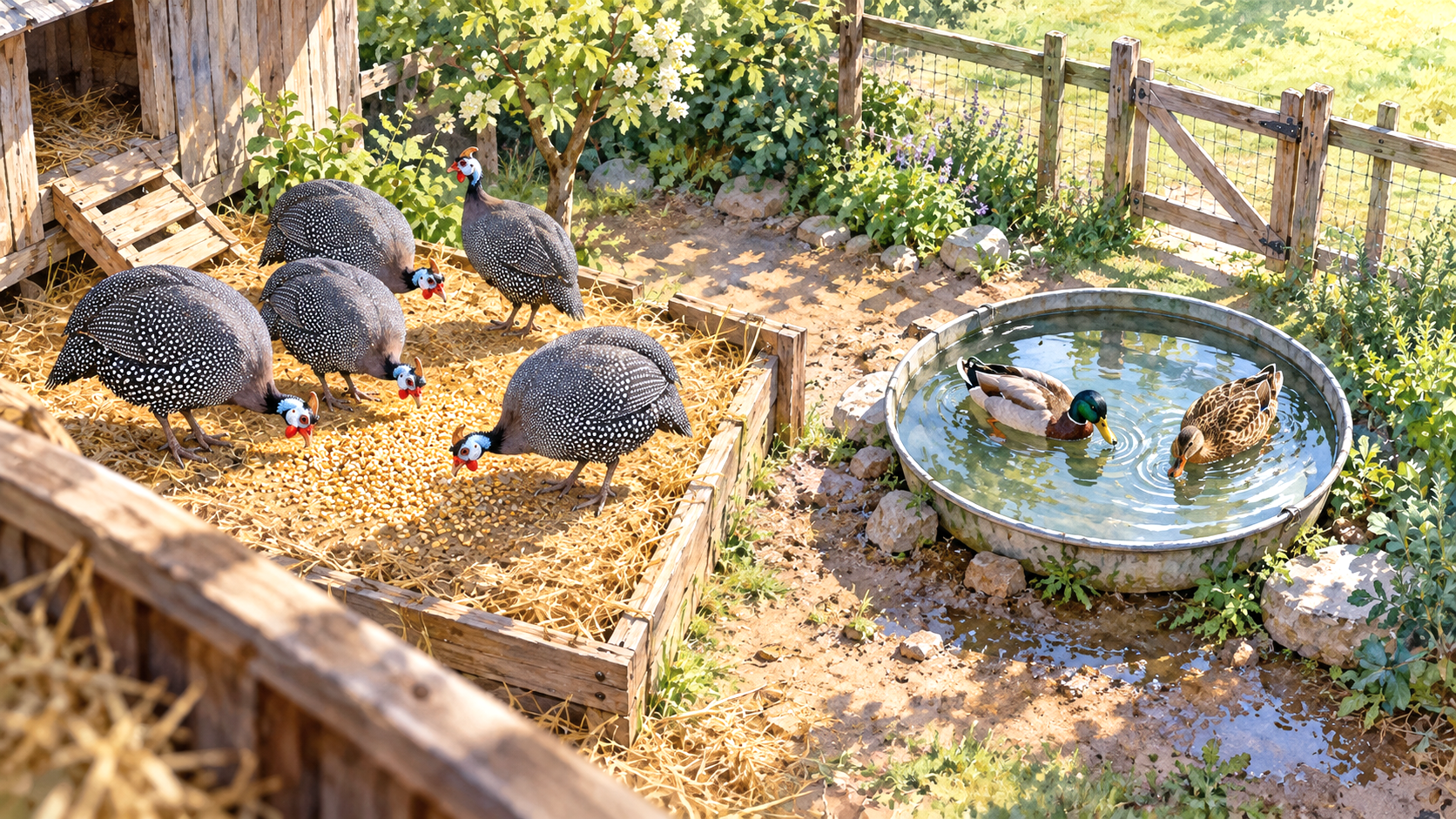
Guinea fowl and ducks can share a farmyard without paying much attention to each other. The guinea fowl may spend the afternoon exploring dry ground and searching through vegetation, while the ducks remain near a waterer or investigate muddy patches. Problems often arise when both groups must use the same shelter, feeding area or confined outdoor space.
Guinea fowl can live with ducks, but separate sleeping areas and appropriately managed water facilities are generally the safer arrangement. Some mixed flocks coexist peacefully, although individual behavior, available space, feeding arrangements and sanitation determine whether the combination works. The greatest husbandry challenge is accommodating ducks’ wetter living conditions without compromising the dry environment guinea fowl need.
Why Guinea Fowl and Ducks Can Share a Farmyard
These birds have different ways of moving through their surroundings. Guinea fowl are active terrestrial foragers that often travel together while searching for insects, seeds and vegetation. Ducks spend more time probing moist ground, investigating water and using their bills to search for food. Their activities can overlap without necessarily creating direct competition.
Neither species is inherently aggressive toward every bird of another species. A well-established group of ducks may largely ignore guinea fowl passing through its feeding area, while the guinea fowl may show little interest in the ducks. Nevertheless, there is limited controlled research comparing the behavior of domestic guinea fowl and ducks housed together. Reports of successful mixed flocks are primarily husbandry observations rather than evidence that the combination is consistently safe.
Allowing the birds to occupy different parts of a spacious yard can reduce unwanted contact. The situation is more complicated when guinea fowl are confined to an outdoor run, where feeding, resting and movement must occur within the same restricted area. Ducks may tolerate activities that cause guinea fowl to become unsettled, and one group’s preferred location can interfere with the other’s access to resources.
Compatibility should be judged by how the birds behave over time, not simply by whether they can stand beside each other without fighting.
Ducks Need Water Access That Guinea Fowl Do Not
Ducks require drinking equipment that allows them to immerse their bills adequately, helping them maintain normal feeding and cleaning behaviors. Guinea fowl do not need the same arrangement, and a shared drinking station designed only for terrestrial poultry may be inadequate for ducks.
Duck waterers must accommodate the size and movement of their bills. Ducks also splash, spill and carry water away from drinking areas, creating muddy ground and wet bedding. Equipment that works well for guinea fowl may therefore become difficult to maintain when ducks use it regularly.
A practical mixed yard provides accessible drinking facilities for both species, with the ducks’ water station positioned over a draining surface or outside the dry sleeping area. A separate, clean waterer for guinea fowl can reduce competition and prevent them from depending on a constantly soiled duck station.
Swimming water is not essential for domestic ducks, although appropriate access to water for normal bill and head maintenance remains important. Duck housing guidance distinguishes drinking-water requirements from swimming facilities. If a pool or pond is provided, its location, water quality and access must be managed without turning the guinea fowl’s living area into a persistently wet enclosure.
Deep containers also need to be secured against accidental entry by smaller birds. A water feature suitable for adult ducks is not necessarily safe for guinea keets.
Why Shared Housing Often Becomes Too Wet
Dry bedding is particularly important for guinea fowl. Persistent dampness contributes to poor litter conditions, increases ammonia problems and can create an unhealthy resting environment. Ducks, meanwhile, produce wetter manure and frequently spill water, making a common sleeping area harder to maintain.
In sheltered accommodation, duck droppings contain substantial moisture, so bedding may need frequent replacement and waterers must be positioned to minimize spillage. A litter-management schedule suitable for guinea fowl alone may not be sufficient once ducks share the space.
The most practical solution is often to provide separate sleeping compartments. Guinea fowl can use a dry area with appropriate perches, while ducks have a protected floor-level resting section with bedding suited to their habits. Separation also prevents ducks from settling directly below elevated guinea fowl roosts, where droppings could contaminate their resting space.
If a common building is unavoidable, its housing layout should support independent resting areas, adequate ventilation and easy access for cleaning. Regular bedding replacement and moisture control become especially important when waterfowl occupy adjoining spaces.
Any persistent smell of ammonia, wet litter beneath waterers or repeated respiratory irritation indicates that the arrangement needs improvement. Masking odor or adding bedding without correcting the source of moisture is not an adequate long-term solution.
Perching Guinea Fowl and Ground-Resting Ducks
Guinea fowl commonly seek elevated perches when settling for the night. Most domestic ducks, by contrast, sleep on the floor rather than using the raised roosting bars preferred by guinea fowl.
This creates different housing requirements within the same structure. Guinea fowl need secure, accessible resting positions, while ducks require sufficient unobstructed floor space to lie down and move normally. A coop arranged almost entirely around high perches will not necessarily provide suitable accommodation for ducks.
Guinea fowl roosts should be positioned so birds can reach them without colliding with the ducks below. Avoid locating duck bedding, feeders or waterers underneath perches. Overcrowding near the entrance may cause birds to rush, jostle or trample smaller individuals when entering or leaving.
A divided building or adjoining shelters can preserve the convenience of keeping both species near each other while accommodating their different resting habits. Each section still needs protection from weather, predators and poor ventilation.
Feeding Ducks and Guinea Fowl in the Same Yard
Adult ducks and adult guinea fowl may consume some of the same formulated poultry feeds, but their nutritional requirements should not be treated as identical. Species, age, reproductive condition and production purpose affect the nutrients required.
Ducks have particular nutritional requirements for vitamins, minerals and energy. Niacin is an especially important consideration for growing ducks, and an ordinary poultry feed should not automatically be assumed adequate for ducklings. Guinea keets also require carefully selected starter feeds because their early growth requirements differ from those of mature birds.
For adults, a suitable commercially formulated feed may sometimes serve as part of a shared feeding plan if its complete nutrient profile meets the needs of both groups. However, selecting feed for adult guinea fowl should not depend solely on whether the ducks will eat it. Medicated feeds must be checked for species-specific labeling and veterinary suitability before use.
Mixed-age flocks are more complicated. Growing guinea keets have different feeding requirements from adult ducks, while ducklings need an appropriate waterfowl or otherwise professionally evaluated starter ration. Separate feeding areas or housing may be necessary to ensure that young birds receive the correct diet.
Ducks also eat differently, using their broad bills to scoop or shovel feed. Feeder designs that accommodate duck bills may reduce waste, but multiple feeding stations are still advisable when guinea fowl can dominate a particular location. Observe actual consumption rather than assuming adequate food is available simply because a feeder remains full.
Are Guinea Fowl Aggressive Toward Ducks?
Some guinea fowl and ducks coexist with little interaction, but conflict remains possible. Guinea fowl may pursue ducks during periods of excitement or competition, while an assertive duck may peck or displace another bird around food and resting areas.
Individual behavior is more informative than general claims that either species is always peaceful. Warning signs include persistent chasing, repeated pecking, blocked feeder access, injured birds and ducks avoiding areas they previously used.
A gradual introduction is preferable to placing unfamiliar adults into one enclosure. Initially keeping the groups separated by a secure partition allows them to see and hear one another without direct contact. Later meetings can occur under supervision in a spacious, neutral area with more than one escape route.
The same general principles used when introducing guinea fowl into an existing flock apply to managing unfamiliar birds, although guinea-duck interactions must be assessed on their own terms. An introduction that initially appears successful does not guarantee continued compatibility during breeding activity or changes in housing.
Repeated aggression should lead to separation before an injury occurs. Neither species should be forced to endure ongoing harassment while a keeper waits for the birds to resolve the conflict themselves.
Disease Risks When Waterfowl and Guinea Fowl Mix
Keeping ducks and guinea fowl together creates opportunities for pathogens to spread through shared water, droppings, litter, equipment and direct contact. Wet feeding areas may also become sources of contamination if they are not cleaned and drained properly.
Avian influenza deserves particular attention because ducks and guinea fowl are both susceptible to avian influenza viruses. Some infected waterfowl may show few signs, while other poultry can develop severe disease. A duck that appears healthy therefore cannot be assumed incapable of introducing infection into a mixed flock.
The USDA recommends separating different types of poultry and their equipment wherever practical to limit disease transmission. This makes adjoining but separate housing preferable to unrestricted shared facilities from a biosecurity perspective.
Open ponds can introduce another exposure route when wild ducks or other waterbirds visit the same water used by domestic poultry. Wild waterfowl can carry and spread avian influenza, so discouraging contact with wild birds and protecting feed and drinking stations are important precautions.
Newly purchased ducks and guinea fowl should be kept apart from established poultry until appropriate health monitoring and quarantine have been completed. Following quarantine procedures for incoming guinea fowl helps reduce the likelihood of introducing disease, but combining species afterward does not remove ongoing biosecurity concerns.
Sudden deaths, severe breathing difficulty, neurologic signs or unusual illness involving several birds warrant prompt veterinary attention and compliance with applicable state animal-health reporting requirements.
When Keeping Them Together Is Not Worth the Risk
Separate housing is the better choice when ducks repeatedly soak guinea fowl bedding, the birds compete for food, either group is being injured or the keeper cannot maintain appropriate sanitation. A small mixed enclosure may be convenient for the owner while providing neither species with suitable living conditions.
The arrangement is also less suitable when the flock includes very young birds with different nutrition, heating and water-safety needs. Ducklings and guinea keets should not be placed together merely because they are similar in age.
A successful farm setup does not require both species to sleep, eat and socialize in the same space. They may occupy neighboring yards or use a shared outdoor area at different times while maintaining independent housing and resources. This can provide the practical benefits of keeping both species without requiring one to live under conditions designed for the other.
Questions About Guinea Fowl and Ducks
Can guinea fowl and ducks sleep in the same coop?
They may tolerate a shared building, but separate sleeping sections are preferable. Guinea fowl need suitable perches and dry bedding, whereas ducks require clean floor-level resting space and generate more moisture.
Do ducks and guinea fowl become friends?
Individual birds may become accustomed to one another and sometimes associate closely. However, there is insufficient research to claim that domestic guinea fowl and ducks reliably form lasting interspecies bonds.
Can guinea fowl eat duck feed?
Some formulations may be suitable for certain adult guinea fowl, but duck feed is not universally appropriate. Check the full nutritional specification against the birds’ age and reproductive needs rather than relying on the feed’s name.
Can ducks and guinea fowl share a pond area?
They may use the same outdoor landscape, but pond access should be managed separately from guinea fowl resting and feeding areas. Wet ground, contaminated water and accidental immersion of smaller birds are important hazards.
Should guinea keets and ducklings be raised together?
Separate brooders are generally preferable because they have different water-management and nutritional requirements. Duckling splashing can create wet conditions that are especially hazardous for young guinea keets.
Can one guinea fowl live with ducks instead of other guinea fowl?
Ducks do not reliably substitute for companionship with other guinea fowl. Guinea fowl are social birds with their own flock relationships, and keeping a single bird with ducks alone may not meet its social needs.