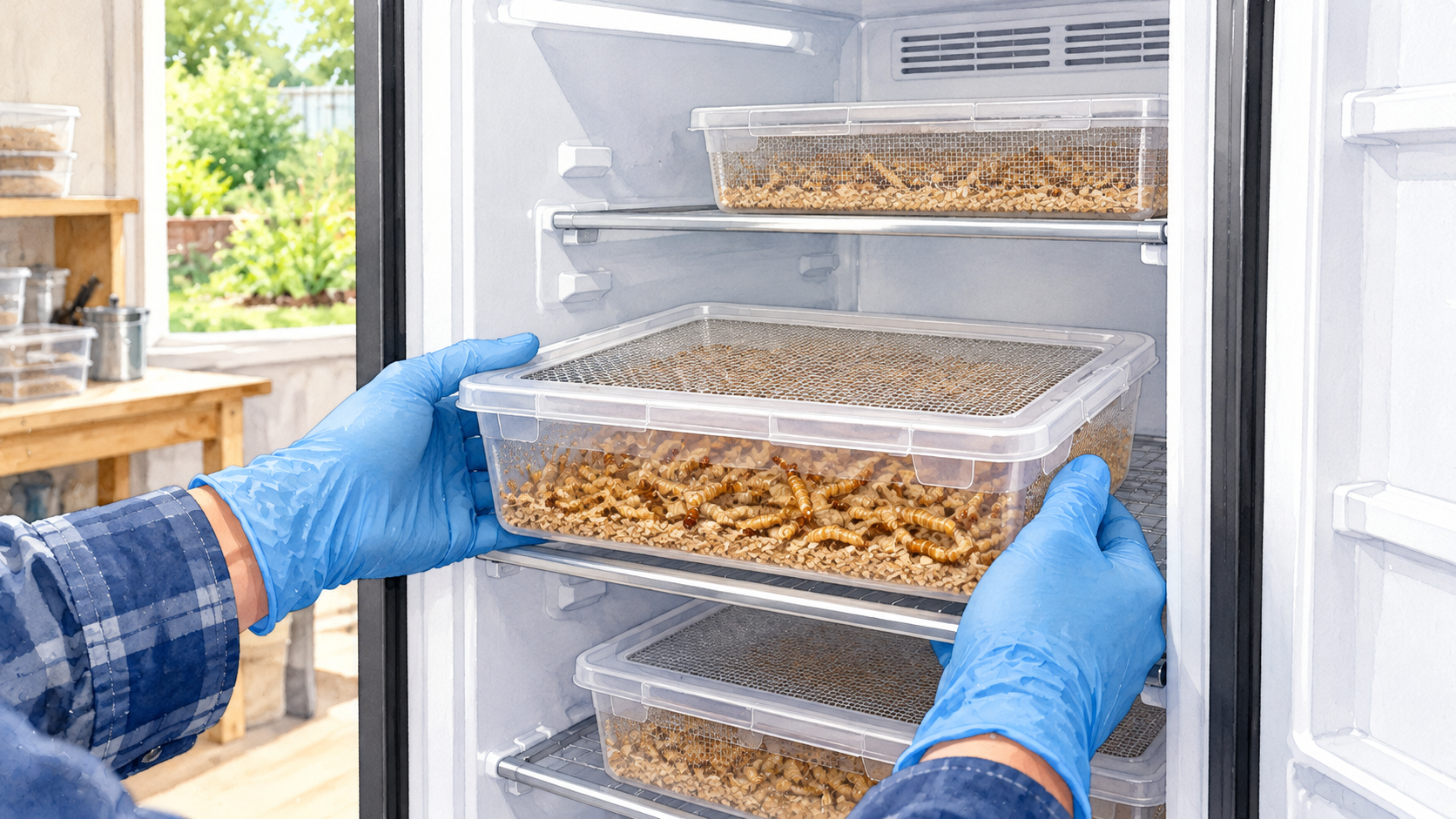
You can refrigerate live mealworms to slow their growth and delay pupation. Cooler temperatures reduce the activity and metabolism of yellow mealworm (Tenebrio molitor) larvae, allowing them to remain in the larval stage longer than they would under normal growing conditions. However, refrigeration does not stop aging indefinitely, and excessive cold or poor storage conditions can kill them. For feeder insects that will be used gradually, controlled chilling can be practical. For breeding stock intended to resume development, temperature stability, storage duration, and recovery after refrigeration deserve particular attention.
What Happens When You Refrigerate Mealworms?
Mealworms are cold-blooded insects whose body temperature and metabolism are strongly influenced by their surroundings. As temperatures fall, they move less, eat less, and develop more slowly.
A 2021 study of prolonged cold storage demonstrated that mealworm larvae could remain alive for extended periods at 10°C (50°F), with development substantially slowed.
This reduced activity is commonly described as dormancy, although refrigerated mealworms should not be assumed to have entered a permanent or completely inactive physiological state.
Chilling can delay the transition from larvae to pupae. It does not reverse development that has already occurred, and some larvae may pupate after they return to warmer conditions.
The life cycle of darkling beetles helps explain why delaying larval development is useful when insects are being held for later use.
What Temperature Is Suitable for Refrigerating Mealworms?
There is no single temperature guaranteed to preserve every mealworm batch equally well. Practical feeder-insect instructions commonly recommend temperatures in the approximate range of 45–50°F (7–10°C), while some suppliers use cooler refrigeration.
For example, Dubia.com’s mealworm storage guidance recommends 45–50°F to reduce activity. Wormera’s care guidance instead identifies 3–7°C (37–45°F) as its preferred range.
These are supplier recommendations, not identical scientifically validated standards.
The controlled cold-storage experiment used 10 ± 1°C (approximately 50°F). Its results cannot automatically be extended to a typical household refrigerator operating near 4°C (39°F).
For a colony that must remain healthy and capable of later development, a dedicated, temperature-monitored cooler with a stable setting around the upper end of these ranges may provide more control than an ordinary refrigerator. Avoid locations where temperatures approach freezing.
How Long Can Mealworms Stay Refrigerated?
Refrigerated mealworms can remain alive for weeks, but survival depends on temperature, initial health, ventilation, moisture, and whether they receive periodic opportunities to feed.
The 2021 long-term storage study examined larvae held at approximately 10°C for 30–120 days. After 120 days, researchers reported a relatively modest 15.81% loss and observed that surviving insects could continue development, although further work was needed to establish their reproductive performance.
Those findings are encouraging, but they do not guarantee four months of survival in a household refrigerator.
The BugGuide mealworm rearing instructions describe several weeks of refrigerated storage with periodic feeding and checks.
A practical approach is to use stored larvae before they deteriorate rather than relying on the longest duration reported under laboratory conditions.
What Container Should You Use for Refrigeration?
Use a clean container with smooth interior walls, adequate ventilation, and sufficient space to avoid crowding. The container should prevent escape without restricting airflow.
A shallow layer of dry edible bedding, such as suitable wheat bran or oats, can provide a familiar holding material. Avoid wet substrate or tightly packed insects.
The feeder-insect storage guidance recommends ventilated containers with grain-based bedding and periodic inspection.
Do not place mealworms in completely sealed jars or containers where condensation can accumulate. Keep the insects separated from household foods, and use equipment dedicated to insect storage whenever possible.
The construction of suitable mealworm containers involves similar principles of ventilation and containment, although refrigerated holding containers can be smaller than active growing bins.
Should You Feed Mealworms While They Are Refrigerated?
Mealworms eat very little while chilled, but they still require appropriate care if storage continues for an extended period.
Fresh vegetables left inside a cold container may release moisture, deteriorate, and encourage condensation or mold. For this reason, some insect suppliers advise removing fresh food during refrigeration and periodically bringing larvae into a suitable warmer environment to feed.
Wormera’s refrigerated mealworm instructions recommend weekly feeding opportunities for storage lasting longer than three weeks, followed by removal of uneaten vegetables before the insects return to the refrigerator.
Predator Foods’ mealworm care recommendations describe a similar routine.
These are practical supplier protocols rather than a universally established feeding schedule. Monitor the insects’ condition and avoid leaving moisture-rich food in a container where it can spoil.
The water requirements of mealworms remain relevant when chilled larvae are warmed for feeding.
Can Refrigeration Harm Mealworms?
Yes. Excessive cold, prolonged storage, repeated temperature changes, and poor ventilation may reduce survival or compromise later development.
The cold-storage research at 10°C assessed not only survival but also pupation and the emergence of adult beetles. This matters because a larva can survive chilling without necessarily being as productive afterward.
Household refrigerators also have warmer and colder areas. Containers placed against a cold back wall or close to a cooling outlet may experience temperatures lower than the refrigerator’s displayed setting.
Inspect mealworms periodically for unusual discoloration, dead insects, condensation, or mold. The causes of mealworm deaths may be multifactorial, so not every loss during refrigeration should automatically be attributed to cold exposure alone.
How Do You Return Refrigerated Mealworms to Normal Temperatures?
When the larvae are needed again, remove their container from refrigeration and allow them to warm gradually in a suitable, stable room environment.
Avoid placing cold mealworms directly on heating pads, next to strong heat sources, or in direct sunlight. Give the insects time to become active, then provide appropriate dry feed and a fresh moisture source.
The refrigeration instructions published by Predator Foods recommend allowing the larvae to return to activity and feed before use.
Healthy survivors should gradually begin moving and eating again. Some may remain sluggish initially, and a few may fail to recover after prolonged or excessively cold storage.
Remove deteriorating or dead insects. If the larvae are intended to rejoin a growing colony, observe them before mixing them with other batches.
Their subsequent development depends on the temperature conditions needed for mealworm growth.
Should You Refrigerate Mealworms Intended for Breeding?
Refrigeration can delay development, but keeping breeding stock cold for long periods creates additional uncertainty about subsequent reproductive performance.
The long-term cold-storage study showed that many larvae could survive and develop into adults after chilling at 10°C. However, the researchers noted that the fertility of the resulting adults required further investigation.
For a dependable breeding colony, keep the main reproductive groups under appropriate active-rearing conditions. If larvae must be held back temporarily, maintain a separate, clearly labeled refrigerated group and assess its recovery before relying on it to produce future generations.
The process of breeding mealworms depends on healthy developmental transitions rather than merely keeping larvae alive.
Is Refrigeration the Same as Freezing Mealworms?
No. Refrigeration aims to keep larvae alive while slowing their development. Freezing exposes insects to substantially lower temperatures and raises different questions about survival and tissue damage.
An ordinary refrigerator may also contain localized cold spots, which is why a temperature reading from one shelf cannot always establish the conditions experienced by every container.
Do not move larvae into a freezer as a substitute for controlled chilling. Refrigeration also should not be confused with processing methods used to dispatch insects for feed.
The purpose of refrigerated storage is temporary preservation of living larvae, not processing them into a shelf-stable product.
Questions About Refrigerating Mealworms
Will mealworms still move when refrigerated?
They may move very little because their metabolism is slowed. Lack of movement in the cold does not necessarily mean they are dead.
Can mealworms pupate after refrigeration?
Yes. Larvae that survive chilling can resume development and may pupate after warming.
Can mealworms be kept in a household refrigerator?
Yes, provided temperatures are appropriate and stable, containers are ventilated, and the insects are checked regularly. Some household refrigerators are colder than ideal for reliable long-term survival.
Should refrigerated mealworms be warmed before feeding them to farm animals?
Allowing them to warm and become active also provides an opportunity to inspect their condition and offer suitable food and moisture before use.
One thought on “Can You Refrigerate Mealworms?”